MSM supplement (methylsulfonylmethane): benefits, side effects and dosage

The short answer
MSM (methylsulfonylmethane) is a small sulfur compound found in trace amounts in food and sold as a joint supplement. Three small placebo-controlled trials, in 49 to 88 people over 12 weeks, show a modest improvement in knee pain or function at 2 to 6 g a day. A meta-analysis rates the effect as statistically real but of uncertain clinical importance. It is well tolerated up to about 4 g a day, but there is no data for pregnancy, breastfeeding or long-term use.
This article is for information and does not replace medical advice. If joint pain persists, if you are pregnant or take medication, talk to your doctor or pharmacist.
What is MSM supplement?
Methylsulfonylmethane, or dimethyl sulfone, is a simple molecule: one sulfur atom bound to two methyl groups and two oxygen atoms. Sulfur makes up about a third of its weight, hence the name “organic sulfur”. It is a derivative of DMSO, a solvent studied in medicine since the 1950s.
Small amounts occur naturally in fruit, vegetables, grains, coffee, tea and cow’s milk (Butawan et al., 2017). Most dietary sulfur comes from protein foods such as eggs and salmon, and from cabbage-family vegetables like broccoli. Supplement MSM is made industrially, as a bitter, highly water-soluble white powder. Products sold for horses are veterinary products, not meant for humans.
MSM benefits for joints: what the studies show
Three small placebo-controlled trials
| Study | Participants and dose | Result at 12 weeks |
|---|---|---|
| Kim et al., 2006 (US) | 50 adults aged 40-76 with knee osteoarthritis; 6 g a day (3 g twice) | Pain and function improved; no effect on stiffness |
| Debbi et al., 2011 (Israel) | 49 adults aged 45-90 with X-ray confirmed knee osteoarthritis; 3.375 g a day | Function and total score improved; WOMAC pain not significant; gains described as small |
| Toguchi et al., 2023 (Japan) | 88 healthy adults with mild knee pain; 2 g a day | Knee quality-of-life score improved (narrowly: p = 0.046) |
These trials point the same way, but they are small and short. The 2006 authors state their pilot cannot confirm benefit or long-term safety; the 2011 authors call the improvements small, with clinical significance yet to be shown.
The meta-analysis view
A British Journal of Sports Medicine meta-analysis (Liu et al., 2018) compared 20 supplements across 69 osteoarthritis trials. MSM was among six supplements with statistically significant but clinically unclear pain relief, alongside glucosamine and chondroitin. No supplement had a clinically important long-term effect.
For comparison, see our glucosamine and chondroitin guide and our best joint supplement comparison.
Other claimed MSM benefits: hair, skin, cancer
- Hair and nails: brands cite small studies published outside major indexed journals; we found no solid trial in PubMed. See also our biotin guide.
- Inflammation and exercise recovery: the Butawan review reports effects on inflammation and oxidative stress markers, mostly in animals and small trials. One of its three authors works for the maker of OptiMSM.
- Cancer: reported effects come from cells in a lab dish. No human study shows MSM prevents or treats cancer.
- Weight loss: we found no serious study.
MSM side effects and safety
According to Butawan et al., MSM is well tolerated by most people up to 4 g a day, with few, mild side effects. One MSM brand (OptiMSM) received FDA GRAS (“generally recognized as safe”) status in 2007, for intakes under about 4.8 g a day. The trials above reported no major adverse events, but lasted 12 weeks at most.
| Situation | What to know |
|---|---|
| Usual dose (up to 4 g a day) | Well tolerated in studies |
| Use over several years | No human data |
| Pregnancy, breastfeeding | No studies: avoid unless your doctor agrees |
| Children | Not studied: adults only |
| Medications (blood thinners, etc.) | Interactions not studied: tell your doctor or pharmacist |
| Alcohol | Effects reported on forums, but no studies to date |
How much MSM per day, and when
- Studied doses: 2 to 6 g a day, often split into 2 or 3 doses. Start low to check how your stomach handles it.
- When: with meals, morning and evening. No study shows a better time of day.
- How long: trials lasted 12 weeks; reassess after 3 months and stop if you notice no difference.
- Powder or capsules: powder is cheaper but bitter; capsules avoid the taste but mean several a day.
- The basics: exercise, weight and an anti-inflammatory diet rich in omega-3.
Another option people use for joints: devil’s claw.
Dynveo: pure OptiMSM
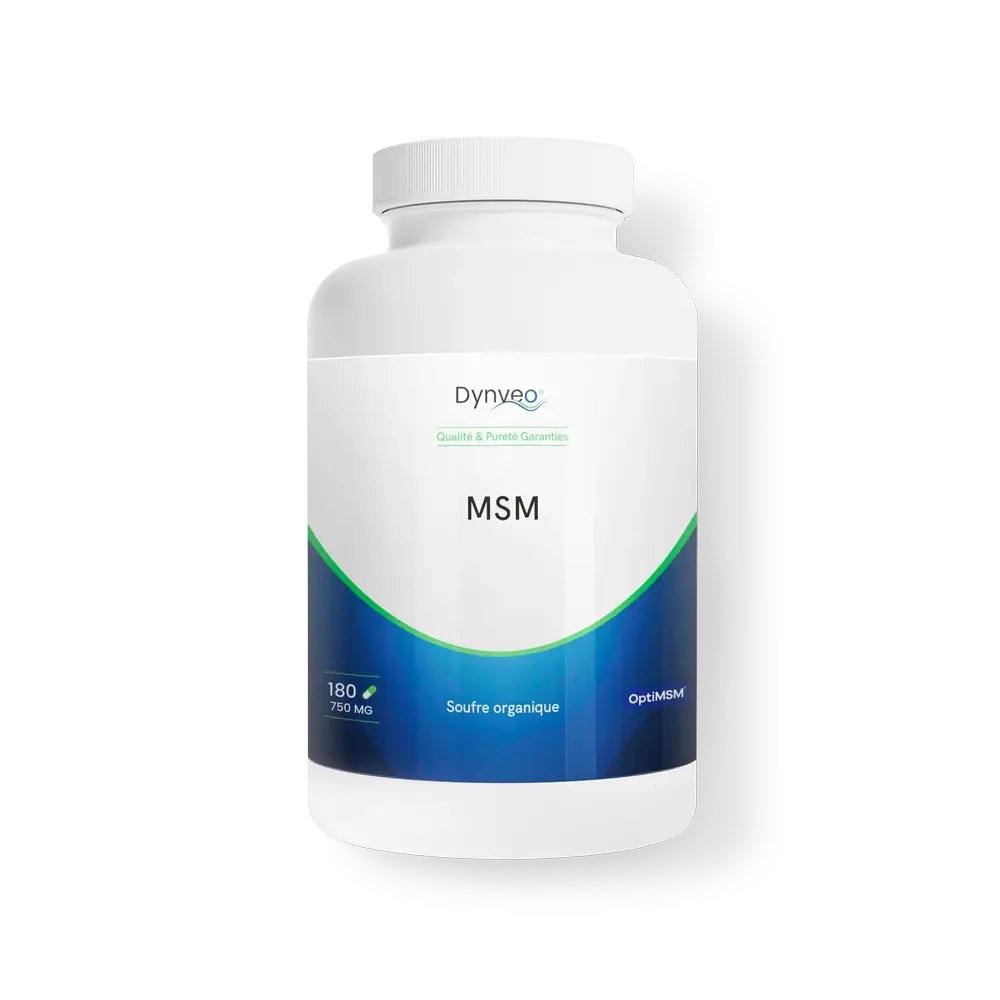
For MSM on its own, Dynveo’s MSM pur uses OptiMSM, the MSM brand that holds US GRAS status. Its product page lists:
- over 99% pure MSM, purified by distillation, no additives; vegan, non-GMO;
- 750 mg per plant capsule (pullulan); directions: 4 capsules a day (2 morning, 2 evening, with meals), i.e. 3 g;
- 180 capsules, a 45-day supply at 4 a day; €25.90 (price checked on 22/11/2026), about €0.58 a day;
- also sold as powder (250 g, €13.90), about 83 days at 3 g a day, roughly €0.17 a day;
- batch analysis certificates published on the page (microbiology, content, heavy metals).
How does the dose compare? 3 g a day sits within the trial range: slightly under the 3.375 g of the 2011 trial, above the 2 g of the Japanese trial, and half the 6 g of the 2006 trial. It is also under the 4 g a day the Butawan review describes as well tolerated, and the suggested 3-month course matches trial length. The studies did not test this product, and their effects are modest.
If pregnant or breastfeeding, ask your doctor or midwife first, as there are no studies. The brand reserves the product for adults.
Partner link: we earn a commission if you order through this link, at no extra cost to you.
Frequently asked questions
What are the benefits of MSM?
The best-documented one is a small improvement in knee pain and function in osteoarthritis, in three short trials. Evidence for hair, skin or cancer is lacking in humans.
Does MSM work for joint pain?
A little, perhaps: gains are statistically significant but small, and their importance for patients is uncertain. It does not rebuild cartilage.
What are the side effects of MSM?
Rare and mild at usual doses. Data are lacking for long-term use, pregnancy, breastfeeding and drug interactions.
Can you take MSM with glucosamine and chondroitin?
Many formulas combine them, but no large study shows the combination beats each one alone. Glucosamine’s own precautions still apply.
Sources
- Kim L.S. et al. Efficacy of methylsulfonylmethane (MSM) in osteoarthritis pain of the knee: a pilot clinical trial. Osteoarthritis Cartilage, 2006; 14(3): 286-94. PubMed 16309928
- Debbi E.M. et al. Efficacy of methylsulfonylmethane supplementation on osteoarthritis of the knee: a randomized controlled study. BMC Complement Altern Med, 2011; 11: 50. PubMed 21708034
- Toguchi A. et al. Methylsulfonylmethane Improves Knee Quality of Life in Participants with Mild Knee Pain: A Randomized, Double-Blind, Placebo-Controlled Trial. Nutrients, 2023; 15(13): 2995. PubMed 37447322
- Liu X. et al. Dietary supplements for treating osteoarthritis: a systematic review and meta-analysis. Br J Sports Med, 2018; 52(3): 167-175. PubMed 29018060
- Butawan M., Benjamin R.L., Bloomer R.J. Methylsulfonylmethane: Applications and Safety of a Novel Dietary Supplement. Nutrients, 2017; 9(3): 290. PubMed 28300758