Group · Herbs & spices
Celery seeds
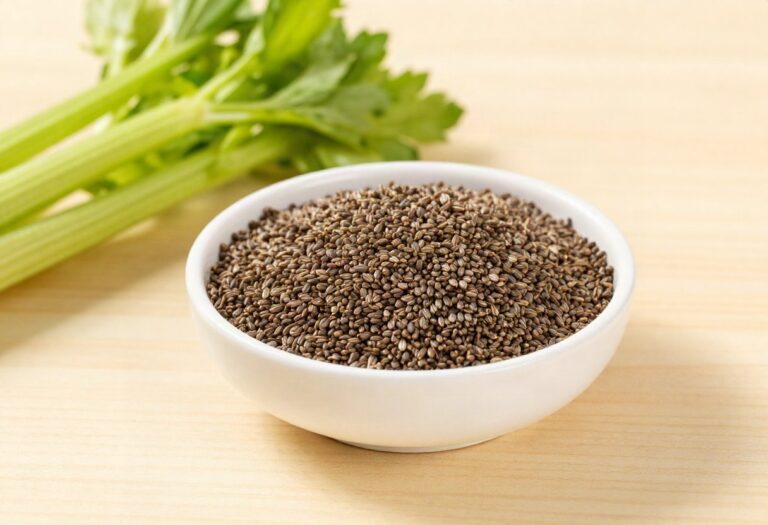
Small but powerful, celery seeds are a spice from the celery plant (often wild celery, or smallage). Light brown in colour, these tiny seeds give off an intense aroma that is herbaceous, slightly bitter and characteristic of celery. They come whole or ground, and are used to make the well-known celery salt. Nutritionally, they concentrate protein (around 18.07 g per 100 g), fibre (nearly 11.8 g), good-quality fats and many minerals. Used in very small amounts, they lift dishes without adding to the overall calorie intake and naturally find a place in tasty, balanced cooking.
Macronutrient breakdown
Nutrition table per 100 g
| Calories | 392 kcal |
| Kilojoules | 1641 kJ |
| Protein | 18,1 g |
| Carbohydrate | 41,4 g |
| Fat | 25,3 g |
| Fibre | 11,8 g |
Micronutrients per 100 g
All measured nutrients, ranked by share of the daily reference intake.
- Manganese7,57 mg378 %
- Iron44,9 mg321 %
- Calcium1767 mg221 %
- Copper1,37 mg137 %
- Magnesium440 mg117 %
- Phosphorus547 mg78 %
- Potassium1400 mg70 %
- Zinc6,93 mg69 %
See the other 8 nutrients
- Vitamin B60,89 mg64 %
- Vitamin B10,34 mg31 %
- Selenium12,1 µg22 %
- Vitamin C17,1 mg21 %
- Vitamin B20,29 mg21 %
- Vitamin B33,06 mg19 %
- Vitamin E1,07 mg9 %
- Vitamin A3 µg0 %
USDA FoodData Central (SR Legacy)
Tips
Like all spices, celery seeds are used by the pinch: their high calorie density (392 kcal per 100 g) has no impact at the scale of a recipe, as you rarely use more than 1 to 2 g. You can add them whole to stocks, marinades, court-bouillons for fish, pickles and vinegar preserves. Lightly dry-roasted and then crushed in a mortar, they release more aroma in soups, stews and homemade breads.
- Pairings: they go with tomatoes, carrots, potatoes, eggs and white meats.
- Homemade: blended with coarse salt, they make a celery salt that is perfect for seasoning vegetable juices and vinaigrettes.
- Storage: keep them in an airtight jar, away from light and moisture, to preserve their essential oils.
Nutritionally, celery seeds provide useful fibre, plant protein and minerals such as calcium, iron, magnesium and manganese. Their aromatic compounds contribute to the profile of foods rich in antioxidants. Used as a natural flavour enhancer, they often let you cut back on added salt, a plus for anyone watching their blood pressure, in the spirit of the DASH diet.
Within the herbs and spices family, they offer an original alternative to fennel seeds or cumin in your blends. To build a complete seasoning, you can combine them with freshly ground black pepper.
For active people: celery seeds are not meant to supply energy before exercise, as the quantity is too small. They do, however, let you lift dishes rich in complex carbohydrate and protein (chicken, lentils, brown rice) without resorting to fatty or very salty sauces. Well-seasoned, tasty cooking helps you enjoy balanced recovery meals better and limit sugar cravings.
Points to note: in the kitchen, there is no reason to fear the calories of celery seeds given the minimal amounts. Stay careful with ready-made products (shop-bought celery salt, flavoured blends), which can be very salty. Otherwise, rely on moderation and variety to enjoy their distinctive flavour within a well-managed diet.