Group · Sweet foods
Molasses
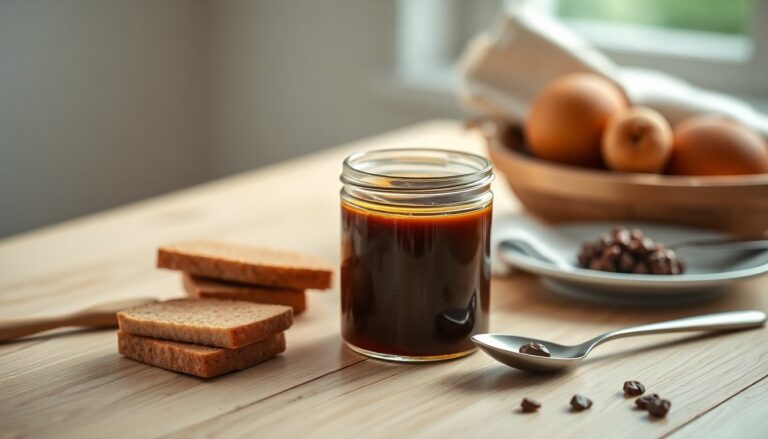
Molasses is a thick, dark brown syrup, a by-product of refining cane or beet sugar. With a strong, slightly bitter, caramelised taste, it comes in several varieties: light molasses, dark molasses and the famous blackstrap molasses, which is the most concentrated. Very rich in carbohydrate (around 74.7 g per 100 g) and providing nearly 300 kcal per 100 g, it is still a sweetener, but it keeps some of the minerals of the original juice. It is traditionally used in baking, in gingerbread (pain d’épices), marinades and some sauces. Its distinctive flavour makes it a popular ingredient for flavouring and colouring many preparations.
Macronutrient breakdown
Nutrition table per 100 g
| Calories | 300 kcal |
| Kilojoules | 1270 kJ |
| Carbohydrate | 74,7 g |
| Fat | 0,1 g |
Micronutrients per 100 g
All measured nutrients, ranked by share of the daily reference intake.
- Manganese1,53 mg77 %
- Potassium1460 mg73 %
- Magnesium242 mg65 %
- Copper0,49 mg49 %
- Vitamin B60,67 mg48 %
- Iron4,72 mg34 %
- Calcium205 mg26 %
- Vitamin B50,8 mg13 %
See the other 5 nutrients
- Vitamin B30,93 mg6 %
- Phosphorus31 mg4 %
- Vitamin B10,04 mg4 %
- Zinc0,29 mg3 %
- Vitamin B20 mg0 %
Anses Ciqual 2025. Source: Anses, 2025, Ciqual food composition table
Tips
Molasses is used above all as a flavoursome sweetener. One teaspoon is often enough to flavour a yoghurt, porridge, marinade or vinaigrette. In baking, it gives softness and an amber colour to cakes, biscuits and gingerbread. You can also add it to a homemade barbecue sauce, where its bitterness balances the sweetness of other ingredients.
Varieties and uses. Light molasses, from the first boiling, is the sweetest and mildest. Blackstrap molasses, from the third boiling, is more bitter and more concentrated in minerals such as iron, calcium, magnesium and potassium. It is the one most sought after for its nutrition profile, even though it is still a sugary product to be eaten in moderation.
Nutrition facts. With around 290 kcal and nearly 74.7 g of carbohydrate per 100 g, molasses is dense in sugars and has a high glycaemic index. It provides no notable protein or fat, and virtually no fibre. Its mineral content does set it apart from ordinary table sugar, which is lower in micronutrients. Even so, these contributions do not justify eating too much.
Tips for active people. Its concentration of fast carbohydrate can give a small energy boost before a session, for example diluted in a drink or added to a snack. For recovery, pair it with a source of protein (fromage blanc, oat flakes) to replenish your stores. For balanced ideas, take a look at protein snacks, which combine carbohydrate and protein more fully.
Weight control. Even though it is natural and mineral-rich, molasses is still a concentrated sugar. If you are watching your waistline, limit the amounts and use it as a flavour enhancer rather than your main sweetener. One tablespoon already adds a notable dose of sugars. To compare its calories with other sugary products, see the food calorie table or explore other options in the sugary foods family. A liquid alternative such as maple syrup has a different profile.
Storage. Keep molasses in an airtight container, away from light and heat. Well sealed, it keeps for a long time without crystallising, unlike honey.