Group · Meat
Raw bacon
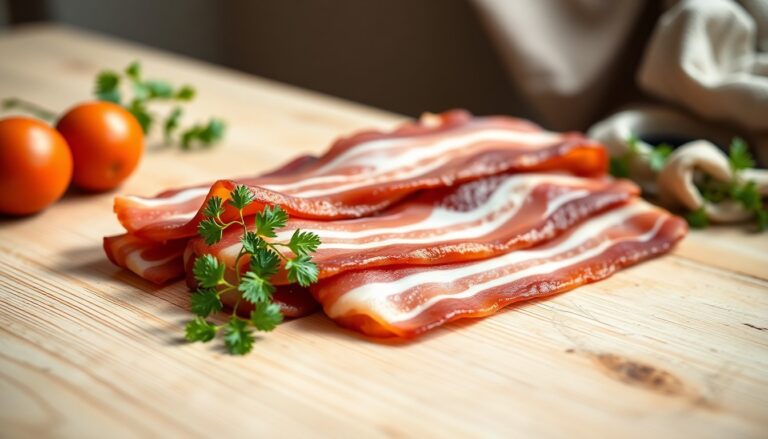
Raw bacon is a cured meat from pork belly or back, pork that has been salted and sometimes smoked, but not yet cooked. It is recognised by its thin slices streaked with fat and lean, ready to be fried. Very common in British and American cooking at breakfast, it also turns up in sandwiches, quiches and stews. Nutritionally, raw bacon provides around 118 kcal per 100 g, with 23.1 g of protein and 2.6 g of fat, for almost no carbohydrate. It is therefore a food rich in protein but also in fats and salt, to be included in moderation in a balanced diet.
Macronutrient breakdown
Nutrition table per 100 g
| Calories | 118 kcal |
| Kilojoules | 500 kJ |
| Protein | 23,1 g |
| Carbohydrate | 0,7 g |
| Fat | 2,6 g |
Micronutrients per 100 g
All measured nutrients, ranked by share of the daily reference intake.
- Vitamin B10,6 mg55 %
- Vitamin B36,53 mg41 %
- Phosphorus190 mg27 %
- Vitamin B949,1 µg25 %
- Vitamin B60,34 mg24 %
- Potassium470 mg24 %
- Vitamin B50,93 mg16 %
- Vitamin B120,38 µg15 %
See the other 12 nutrients
- Zinc1,4 mg14 %
- Vitamin C6,55 mg8 %
- Magnesium23 mg6 %
- Vitamin B20,08 mg6 %
- Vitamin E0,45 mg4 %
- Copper0,03 mg3 %
- Iron0,4 mg3 %
- Omega-6 LA0,28 g3 %
- Total omega-30,04 g2 %
- Vitamin A10,5 µg1 %
- Omega-3 ALA0,02 g1 %
- Calcium3,8 mg0 %
Anses Ciqual 2025. Source: Anses, 2025, Ciqual food composition table
Tips
Raw bacon is almost always cooked before eating: in a very hot frying pan, under the grill or in the oven. Cooking melts away some of the fat and concentrates the flavours. Remember to drain it on kitchen paper to limit excess fat. A reasonable portion is around 2 to 3 slices (30 to 40 g), enough to flavour a dish without weighing down the calorie total.
As for nutrition facts, raw bacon provides good protein (23.1 g per 100 g), iron, zinc and B vitamins. But it is also loaded with fat (2.6 g) and above all with salt, linked to the curing process. Its glycaemic index is negligible since it contains almost no carbohydrate. For weight control, its calorie density calls for moderation: it is better to use it as a flavour enhancer than as a main dish.
- Smart pairings: a few eggs, green vegetables or a salad to balance things out.
- Storage: in the fridge, well wrapped, and eaten quickly once opened.
- When: ideal at brunch or as a tasty touch in a one-pot dish.
If you like cured meats of this kind, you can compare with grilled bacon or ham, often leaner once cooked. Turkey bacon is a lighter alternative in fat for anyone watching their figure. You will find other options in the meat family.
For active people: raw bacon provides protein useful for muscle recovery, but its fat and salt make it a supplementary food rather than a basic protein source. When bulking, it can go with a meal rich in complex carbohydrates. Avoid it before exercise, as the fat slows digestion. To meet your protein needs more practically, solutions such as protein powder can top up your diet around training.
In short, raw bacon remains an occasional pleasure: tasty, rich in protein, but to be measured out for its salt and calories. Choose a cooking method that removes the excess fat, serve it with vegetables, and keep it for meals where its smoky flavour really makes a difference.