Oranges and diabetes: eat the fruit, skip the juice, the numbers

The short answer
Yes, the orange is one of the easiest fruits to fit into a diet with diabetes. Its glycaemic index measured in people with type 2 diabetes averages 45 (five studies), a low GI, and it contains little carbohydrate: 8 g per 100 g, half as much as a banana. A medium 131 g orange provides 10.5 g of carbohydrate, a glycaemic load of about 5, and 78% of the day’s vitamin C. Orange juice, on the other hand, even freshly squeezed at home, loses the fibre and is drunk quickly: the whole fruit is the better choice.
This guide gives general benchmarks. If you are treated with insulin or with a medicine that can cause hypoglycaemia (a « hypo »), your carbohydrate amount per meal should be set with your doctor or dietitian.
What an orange contains
| For | Calories | Carbohydrate | of which sugars | Fibre | Vitamin C |
|---|---|---|---|---|---|
| 100 g of orange | 42 kcal | 8.0 g | 7.6 g | 2.7 g | 48 mg |
| A small orange, 96 g | 40 kcal | 7.7 g | 7.3 g | 2.6 g | 46 mg |
| A medium orange, 131 g | 55 kcal | 10.5 g | 10.0 g | 3.5 g | 62 mg |
| A large orange, 184 g | 77 kcal | 14.8 g | 14.0 g | 5.0 g | 87 mg |
The Fédération Française des Diabétiques (the French diabetes federation) defines a portion of fruit as 15 to 20 g of carbohydrate. One large orange, or two small ones, make up a portion: it is one of the fruits whose portion is the most generous in volume. The orange also provides 2.7 g of fibre per 100 g, almost as much as a banana, for half the carbohydrate.
Glycaemic index and glycaemic load of the orange
The international glycaemic index tables (Atkinson, Foster-Powell and Brand-Miller, 2008) list five measurements in people with diabetes, for a 120 g portion:
| Study | People | Glycaemic index | Glycaemic load (120 g) |
|---|---|---|---|
| Denmark, 8 people | type 2 diabetes | 31 | 3 |
| Israel, 8 people | gestational diabetes | 47 | 6 |
| Italy, 8 people | type 2 diabetes | 48 | 5 |
| United States, 10 people | type 2 diabetes | 48 | 5 |
| Canada | type 2 diabetes | 51 | 6 |
| Average of the 5 studies | 45 | 5 |
In people without diabetes, two studies measured 33 (South Africa) and 40 (Canada). The sugars in an orange are split between sucrose, fructose and glucose, and its fibre, notably the pectin in the membranes, slows their passage into the blood. To understand the concept, see our guide to the glycaemic index.
Work out the glycaemic load of your portion
| Portion | Carbohydrate | Glycaemic load |
|---|---|---|
| A small orange, 96 g | 7.7 g | 3 |
| A medium orange, 131 g | 10.5 g | 5 |
| A large orange, 184 g | 14.8 g | 7 |
| Two medium oranges, 262 g | 21.0 g | 9 |
Even two medium oranges eaten in one go stay below the threshold of a moderate glycaemic load. That is what makes the orange a fruit of choice for an afternoon snack or a dessert.
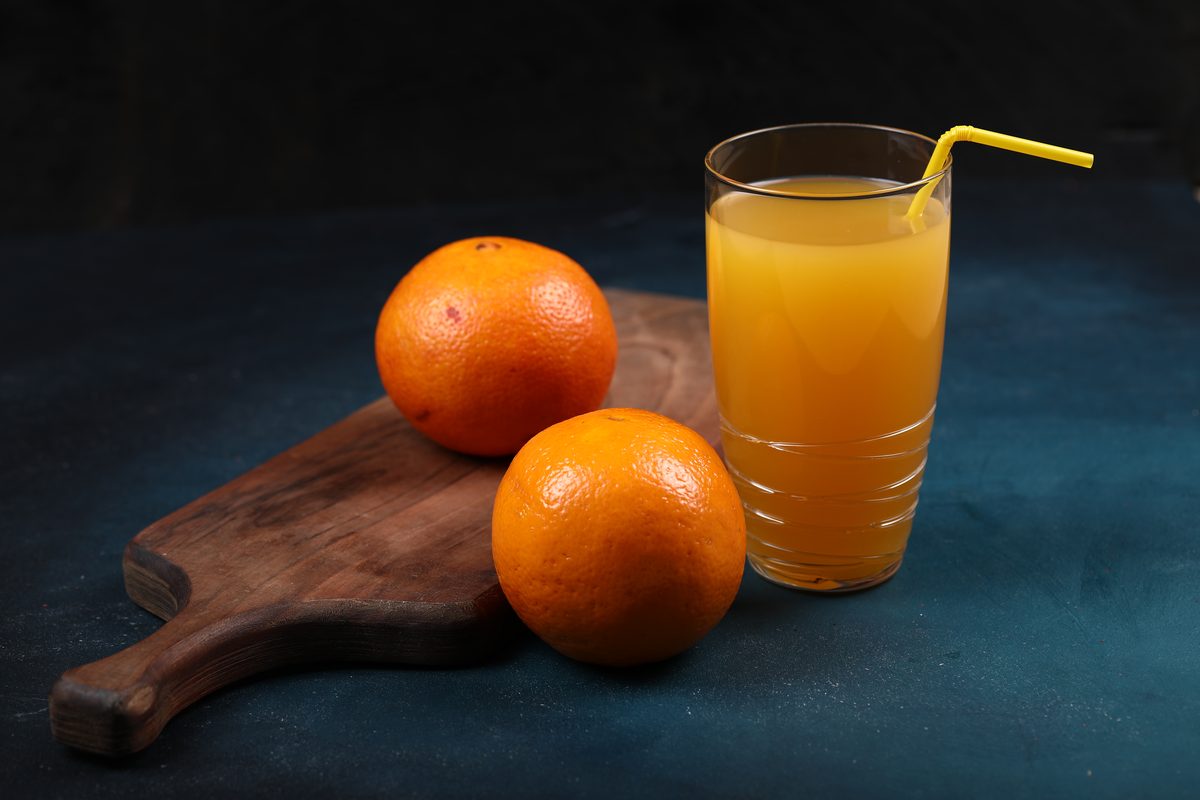
Whole orange or orange juice
| For | Carbohydrate | Fibre | Glycaemic index | Glycaemic load |
|---|---|---|---|---|
| A medium orange, 131 g | 10.5 g | 3.5 g | 45 | 5 |
| A glass of freshly squeezed orange juice, 25 cl | about 23 g | 0.5 g | not measured | – |
| A glass of pure juice, 25 cl | about 24 g | 0.7 g | 50 (people without diabetes, 4 studies) | 12 |
| A glass of juice from concentrate, 25 cl | about 24 g | 0.6 g | 57 (type 2 diabetes, 1 study) | 15 |
A glass of juice contains the carbohydrate of more than two medium oranges, without their fibre, and it is drunk in a minute. The GI rises, and the load doubles or triples. The Fédération Française des Diabétiques recommends avoiding fruit juice. In the cohort study by Muraki et al. (BMJ, 2013), fruit juice was associated with an 8% higher risk of type 2 diabetes for every three glasses a week.
« Freshly squeezed at home » orange juice does not escape the rule: its carbohydrate is the same as that of shop-bought juice, 9.2 g per 100 g according to Ciqual. The only exception: in the case of hypoglycaemia, a small 15 cl fruit juice is one of the fast-acting options recommended by the Fédération Française des Diabétiques to bring blood sugar back up.
Whole orange versus juice: what the trials measured
The difference between the fruit and the juice has been measured directly, with the same amount of sugars.
- A trial in 45 adults (Guzman et al., Journal of Nutrition, 2021) compared whole orange, orange juice and a juice enriched with 5 g of orange pulp fibre, with the same amount of sugars. After the whole orange, the two-hour blood glucose response was 29% lower than after the juice: area under the curve of 689 against 974. Adding fibre to the juice lowered the blood glucose peak to the level of the fruit, but not the total response. The participants did not have diabetes.
- A meta-analysis of 17 cohorts (Imamura et al., BMJ, 2015), covering more than 38,000 cases of diabetes, linked each daily glass of fruit juice to a 7% higher risk of type 2 diabetes once weight was taken into account. The authors consider the result fragile, with possible biases, but conclude that fruit juice is probably not a healthy alternative to sugary drinks.
In other words, added fibre does not turn a juice into a fruit. The structure of the whole fruit, which you have to chew, matters as much as its fibre.
All citrus juices, for a 25 cl glass
No citrus juice escapes the rule. Here is what Ciqual measures for one glass:
| A 25 cl glass of | Carbohydrate | Fibre | Vitamin C |
|---|---|---|---|
| Grapefruit juice, pure juice | 22 g | 0.4 g | 56 mg |
| Freshly squeezed orange juice at home | 23 g | 0.5 g | 125 mg |
| Orange nectar | 23 g | 0.5 g | 58 mg |
| Orange juice, pure juice | 24 g | 0.7 g | 93 mg |
| Blood orange juice, pure juice | 26 g | 1.7 g | 100 mg |
| Clementine juice, pure juice | 26 g | 0.4 g | 44 mg |
| For comparison: a medium orange, 131 g | 10.5 g | 3.5 g | 62 mg |
Every glass provides between 22 and 26 g of carbohydrate, more than two medium oranges. The home-squeezed juice is the richest in vitamin C, but a single whole orange already provides 62 mg, 78% of the reference value, with five to seven times more fibre than a glass of juice. For vitamin C, juice is therefore never necessary.
How much a day and when
The Fédération Française des Diabétiques advises spreading fruit through the day, for example one in the morning, one as a lunchtime dessert and one as an afternoon snack. One to two oranges a day easily find their place, and the orange can serve as the replacement fruit when the rest of the day includes a sweeter fruit, such as grapes or banana.
Should you limit fruit? A Danish randomised trial (Christensen et al., 2013) in 63 people newly diagnosed with type 2 diabetes found no difference in HbA1c after 12 weeks between the group that ate at least two pieces of fruit a day and the one that ate at most two.
Ideas for when to eat it
- At breakfast, in segments, instead of juice.
- As a dessert, after a meal that contains protein and vegetables: the vitamin C in the orange also helps you absorb the iron in pulses and cereals. See foods high in iron.
- As an afternoon snack, with a few almonds or a plain yoghurt.
Other citrus fruits
| 100 g of | Calories | Carbohydrate | Fibre | Vitamin C | Glycaemic index |
|---|---|---|---|---|---|
| Orange | 42 kcal | 8.0 g | 2.7 g | 48 mg | 45 (5 studies) |
| Clementine or mandarin | 46 kcal | 9.2 g | 1.7 g | 49 mg | not measured |
| Grapefruit (listed as pomelo in Ciqual) | 34 kcal | 5.9 g | 1.1 g | 36 mg | 25 (1 study) |
- The clementine is a little sweeter than the orange and lower in fibre. One 74 g clementine provides 6.8 g of carbohydrate: two to three clementines make a portion of fruit.
- The grapefruit (called pomelo in the French tables) has the lowest GI measured in people with diabetes among citrus fruits, 25. One caution, however: grapefruit and its juice interact with some medicines, including some statins often prescribed to people with diabetes. Ask your pharmacist before eating it regularly.
Yellow or pink grapefruit, and the lemon
Ciqual distinguishes two grapefruits. The pink grapefruit contains 6.2 g of carbohydrate and 1.6 g of fibre per 100 g; the yellow grapefruit, 7.3 g of carbohydrate and 1.1 g of fibre. Both are less sweet than the orange. Half a grapefruit at breakfast, with no sugar sprinkled on it, is one of the lightest fruits in carbohydrate in winter, subject to the interaction with some medicines already mentioned.
The lemon barely counts: homemade lemon juice contains 2.5 g of carbohydrate per 100 g, which is about 0.25 g for a 10 ml tablespoon. To dress a salad, flavour a fish or flavour water, it is free, unlike orange juice.
Fennel and orange salad: the numbers
Our fennel and orange salad uses two oranges for four people, with fennel, olives and olive oil. Calculated from Ciqual, one serving provides 11 g of carbohydrate and 6.6 g of fibre, for 149 kcal. That is the equivalent of half a portion of fruit, with nearly twice as much fibre as an orange on its own thanks to the fennel. As a starter, it lets you keep a fruit for dessert or the afternoon snack.
Orange or another fruit
| 100 g of | Carbohydrate | Glycaemic index | Glycaemic load |
|---|---|---|---|
| Banana | 19.7 g | 48 (9 studies) | 9.5 |
| Grapes | 16.3 g | 43 to 49 (2 studies) | 7 to 8 |
| Pear | 12.3 g | 38 (4 studies) | 4.7 |
| Apple | 11.9 g | 36 (5 studies) | 4.3 |
| Kiwi | 11 g | 47 (1 study) | 5.2 |
| Orange | 8.0 g | 45 (5 studies) | 3.6 |
Weight for weight, the orange has the lowest glycaemic load of these common fruits. Its GI is a little higher than that of the apple, but it contains much less carbohydrate. See also our guides to apples and diabetes, bananas and diabetes and grapes and diabetes.
On the prevention side, the Muraki study found no association between orange consumption and the risk of type 2 diabetes, in either direction, whereas grapefruit was associated with a slightly lower risk, of 5%. What really matters is eating the fruit rather than drinking its juice.
Special cases
Gestational diabetes
The Israeli study in the Atkinson tables measured a GI of 47 for the orange in women with gestational diabetes, which is low. The whole orange is therefore a good snack fruit during pregnancy, within the spread of meals and snacks set by the care team. See our guide to eating during pregnancy.
Prediabetes
Replacing the morning glass of orange juice with a whole orange is one of the simplest and most effective swaps. See type 2 diabetes: diet and prevention.
Acid reflux
Citrus fruits are among the foods that can make reflux worse in some people. If that is you, eat the orange at the end of a meal rather than on an empty stomach. See acid reflux: what to eat.
3 ideas for eating it
- Fennel and orange salad: the orange as a starter, with a crunchy, very low-sugar vegetable.
- Orange segments and a plain yoghurt, sprinkled with cinnamon, as an afternoon snack.
- Orange segments on a lentil or chickpea salad: the vitamin C helps you absorb the iron in pulses.
More ideas in our low glycaemic index recipes.
Frequently asked questions
Can someone with diabetes eat oranges?
Yes. The average GI of the orange in people with diabetes is 45, and a medium 131 g orange provides only 10.5 g of carbohydrate, for a glycaemic load of about 5.
How many oranges a day with diabetes?
One to two, spread through the day with the other fruit. One large orange or two small ones make a portion of fruit of 15 to 20 g of carbohydrate.
Is orange juice not recommended with diabetes?
Not for everyday drinking: a 25 cl glass provides about 24 g of carbohydrate without the fibre, more than two medium oranges. It is, however, useful for correcting hypoglycaemia, in a small amount.
Orange or clementine with diabetes?
The orange is a little less sweet, 8 g of carbohydrate per 100 g against 9.2 g, and higher in fibre. Two to three clementines equal a portion of fruit.
Does grapefruit lower blood sugar?
No, no food lowers blood sugar. Its GI is low, 25, but it interacts with some medicines: ask your pharmacist for advice.
Should you eat the orange in the morning or the evening?
The timing matters little thanks to its low GI. The most useful thing is to eat it whole, in segments, rather than as juice.
Is freshly squeezed orange juice better than pure juice?
Not for blood sugar: 9.2 g of carbohydrate per 100 g for squeezed juice, 9.6 g for pure juice according to Ciqual, and very little fibre in both. It is only richer in vitamin C.
How much orange juice to correct hypoglycaemia?
A 15 cl carton of pure orange juice provides about 14 g of carbohydrate, close to the 15 g advised by the Fédération Française des Diabétiques. Check your blood sugar 15 minutes later and top up if it is still low.
Is adding fibre to orange juice enough?
No. In one trial, 5 g of orange fibre added to the juice lowered the blood glucose peak, but the total glycaemic response remained higher than with the whole orange.
The foods and diabetes series
Glycaemic index, glycaemic load and the right portion, food by food: apples and diabetes, pears and diabetes, bananas and diabetes, grapes and diabetes, dates and diabetes, melon and diabetes, strawberries and diabetes, pineapple and diabetes, cheese and diabetes, mango and diabetes, honey and diabetes, dark chocolate and diabetes, lentils and diabetes, potatoes and diabetes, avocado and diabetes, porridge oats and diabetes, bread and diabetes, kiwi and diabetes, sweet potatoes and diabetes, rice and diabetes.
Going further
Apples and diabetes, bananas and diabetes, grapes and diabetes, foods high in vitamin C, nutrition facts for the orange.
Our sources
- Atkinson FS, Foster-Powell K, Brand-Miller JC. International Tables of Glycemic Index and Glycemic Load Values: 2008. Diabetes Care, 2008.
- Muraki I et al. Fruit consumption and risk of type 2 diabetes: results from three prospective longitudinal cohort studies. BMJ, 2013.
- Christensen AS et al. Effect of fruit restriction on glycemic control in patients with type 2 diabetes, a randomized trial. Nutrition Journal, 2013.
- Fédération Française des Diabétiques: fruit portion, spreading through the day, fruit juice, fast-acting carbohydrate for hypoglycaemia.
- Ciqual 2025 table (Anses): orange, clementine, grapefruit (pomelo), fresh orange juice, pure juice and juice from concentrate; USDA FoodData Central, SR Legacy: fruit weights.
- Regulation (EU) No 1169/2011, Annex XIII: vitamin C reference value.
- Guzman G, Xiao D, Liska D et al. Addition of Orange Pomace Attenuates the Acute Glycemic Response to Orange Juice in Healthy Adults. Journal of Nutrition, 2021. PMID 33704466.
- Imamura F, O’Connor L, Ye Z et al. Consumption of sugar sweetened beverages, artificially sweetened beverages, and fruit juice and incidence of type 2 diabetes: systematic review, meta-analysis, and estimation of population attributable fraction. BMJ, 2015. PMID 26199070.
- Ciqual 2025 table (Anses): blood orange juice, grapefruit juice, orange nectar, yellow and pink grapefruit, homemade lemon juice. Site recipe: fennel and orange salad, values calculated from Ciqual.