Royal jelly: benefits, side effects, who should avoid it and storage
The short answer
Royal jelly is the secretion young worker bees produce to feed larvae and, for her whole life, the queen. It contains water, proteins, sugars and unusual fats. Its benefits in people are poorly proven: a recent meta-analysis found improved menopause symptoms, based on few trials; for fatigue or “vitality” there is no solid trial. The main side effect to know about is allergy: asthma attacks (bronchospasm), anaphylaxis and at least one death have been reported after taking it, mostly in people with asthma or allergies. Avoid it if you are allergic to bee products and talk to your doctor first if you have asthma.
This article is for information and does not replace medical advice. Lasting tiredness deserves a check-up: royal jelly should not delay finding the cause.
What is royal jelly?
Nurse bees secrete it from glands in their heads. All larvae get some at first; only the future queen eats it all her life, which is where its “superfood” reputation comes from. It is a pale cream with a sour, slightly sharp taste. It contains bee-specific proteins (the “major royal jelly proteins”, or MRJPs, which are also its main allergens), sugars and a fatty acid found nowhere else, 10-HDA. At around a gram a day, its contribution of vitamins or protein to your diet is small.
| Form | What it is | Storage |
|---|---|---|
| Fresh (jar) | Unprocessed, as harvested | In the fridge, 2 to 6 °C (36 to 43 °F) |
| Freeze-dried (capsules, tablets) | Dried at low temperature, more concentrated | Room temperature, dry |
| Vials | Diluted, often with honey or other ingredients | As labelled |
Royal jelly vs honey: honey is made from flower nectar and is mostly sugar; royal jelly is secreted by the bees and richer in protein. Honey raises sugar questions (see honey and diabetes); royal jelly raises allergy questions.
Royal jelly benefits: what the research shows
Menopause: the strongest signal, from few trials
A meta-analysis (Ferraz et al., Menopause, 2026) included 6 studies and 471 postmenopausal women. Compared with placebo, royal jelly improved menopause symptoms with a moderate effect (standardised mean difference 0.73), but that pooled result rests on 2 trials and 312 women. Products and doses varied, and some studies used vaginal rather than oral royal jelly. A lead worth following, not a certainty. See also our menopause diet guide and best menopause supplement comparison.
Fatigue and energy: no convincing trial
In a Japanese randomised trial (Morita et al., Nutrition Journal, 2012), 61 healthy volunteers aged 42 to 83 took 3 g of royal jelly a day for 6 months. Researchers saw a small rise in red blood cells, better glucose tolerance and a better “mental health” score on a quality-of-life questionnaire. Fatigue was not the outcome measured, the effects were modest and the trial was small. If you have been tired for weeks, a blood test (iron, vitamin D, thyroid) is a better first step: see our best supplement for fatigue comparison.
Immunity, cholesterol, blood sugar
Other meta-analyses look at inflammation, cholesterol or blood sugar, with small, mixed trials. Nothing yet supports using royal jelly to treat or prevent disease. For immunity, food comes first: how to boost your immune system with food.
Royal jelly side effects and who should avoid it
Asthma, bronchospasm and anaphylaxis: serious cases reported
In the 1990s, Australian doctors described asthma attacks and anaphylaxis after royal jelly (Leung et al., 1995) and a fatal asthma case attributed to it (Bullock et al., 1994). In Japan, a 26-year-old woman with asthma, allergic rhinitis, atopic eczema and a food allergy had anaphylaxis after a royal jelly drink (Katayama et al., 2008).
In a Hong Kong survey (Leung et al., 1997), 31% of 1,472 people had taken royal jelly, and 9 described reactions: hives, eczema, rhinitis and acute asthma. About 7% of those given a skin test reacted to royal jelly, including patients from an asthma clinic, and nearly all were allergic to other things too.
| Situation | Advice |
|---|---|
| Allergy to bee products (propolis, pollen, honey) | Avoid |
| Asthma | Avoid without medical advice: serious cases were described in people with asthma |
| Atopic eczema, hay fever, food allergies | Ask your doctor first; tiny, supervised first dose |
| Pregnancy, breastfeeding | No safety data: ask your doctor or midwife |
| Children | No reason to give it without medical advice |
| Medication | Ask your doctor or pharmacist |
Warning signs: itching, hives, swollen lips or face, coughing, wheezing, chest tightness, feeling faint. Trouble breathing is an emergency; never take royal jelly again after such a reaction. In pregnancy, there are no safety studies: ask your doctor. For honey, see can you eat honey when pregnant and our pregnancy diet guide.
How to take royal jelly
- Dose: there is no validated dose. Fresh jars are typically designed for about 0.5 g a day (see the product below); Morita’s trial used 3 g a day for 6 months in volunteers without safety concerns.
- Timing: traditionally in the morning on an empty stomach, under the tongue; a little honey softens the sour taste.
- First dose: a tiny amount, then watch for any reaction.
- Every day? In courses of a few weeks; nothing shows a benefit from year-round use.
- Storage: fresh royal jelly belongs in the fridge at 2 to 6 °C, tightly closed, served with a clean dry spoon.
Nutrition•pro: organic French royal jelly, GRF certified
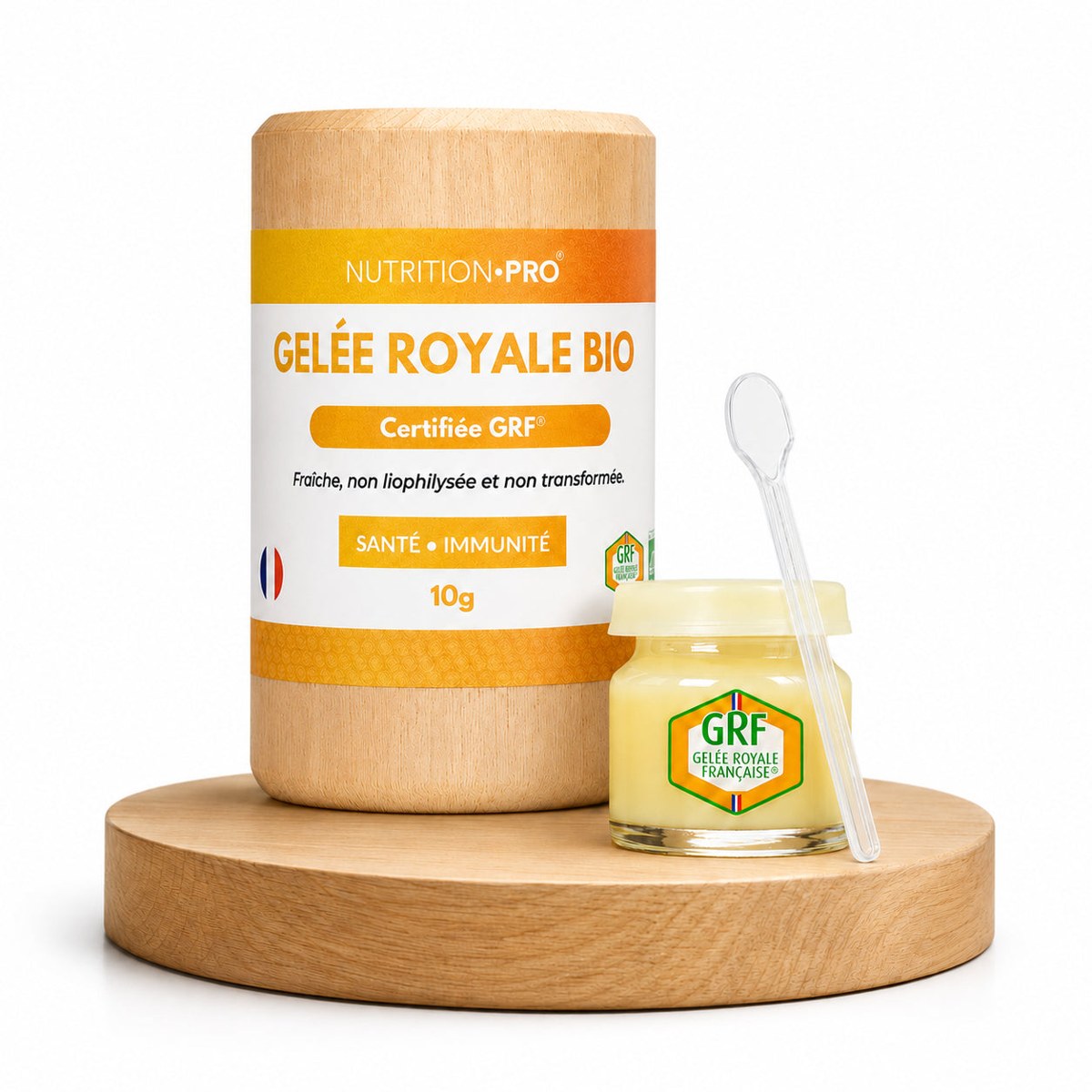
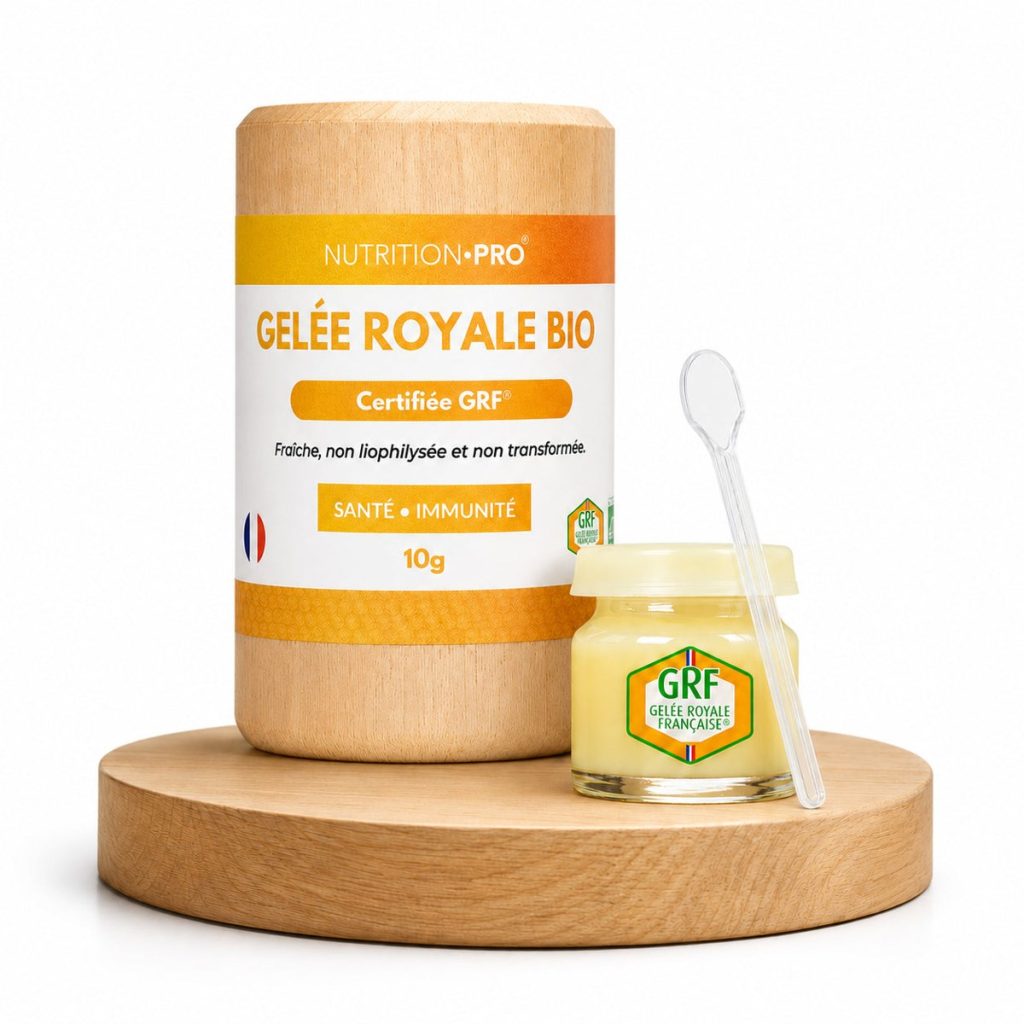
Nutrition•pro, a French brand based in Paris, offers a royal jelly that ticks the quality boxes in this category. According to the product page, it comes from 100% French production, is certified organic and GRF certified (Gelée Royale Française, a French label for controlled origin and traceable harvesting). It is sold fresh, not freeze-dried and unprocessed, with a measuring spoon included.
- ingredients: organic, GRF-certified royal jelly, nothing else;
- directions: one measuring spoon in the morning on an empty stomach, under the tongue, alone, with honey or in fruit juice;
- 10 g jar, presented by the brand as a 20-day course, about 0.5 g a day;
- keep refrigerated at 2 to 6 °C;
- €39.99 per jar (price checked on 22/11/2026), about €2.00 a day.
How does the dose compare? About 0.5 g a day is six times less than the 3 g used by Morita. The menopause studies used other products and doses, so their results do not transfer automatically. Choosing a fresh, French, traceable jelly is mainly about quality and origin, which GRF certification lets you check. The brand advises against it for people allergic to bee products and recommends medical advice in pregnancy and breastfeeding. If you have asthma, talk to your doctor first.
Promo code: SEOCONSULTINGSL for 10% off your order, €35.99 per jar, about €1.80 a day (as of 22/11/2026).
See Nutrition•pro organic royal jelly →
Partner link: we earn a commission if you order through this link, at no extra cost to you.
Frequently asked questions
What are the benefits of royal jelly?
The best-studied is relief of menopause symptoms, from a small number of trials. For fatigue, immunity or energy, human evidence is lacking.
What are the side effects of royal jelly?
Mostly allergic: hives, eczema, rhinitis, and in rare cases severe asthma attacks or anaphylaxis, including one reported death. People with asthma or allergies are most at risk.
Can I take royal jelly every day?
During a course of a few weeks, yes, if you are not allergic. There is no evidence for year-round use.
Is royal jelly the same as honey?
No. Honey comes from flower nectar and is mainly sugar; royal jelly is secreted by bees to feed larvae and the queen, is richer in protein and is far more allergenic.
How do you store fresh royal jelly?
In the fridge at 2 to 6 °C, tightly closed, using a clean dry spoon. Freeze-dried capsules keep at room temperature.
Sources
- Ferraz S.D. et al. Royal jelly for management of postmenopausal symptoms: a systematic review and meta-analysis. Menopause, 2026; 33(4): 501-509. PubMed 41401249
- Morita H. et al. Effect of royal jelly ingestion for six months on healthy volunteers. Nutr J, 2012; 11: 77. PubMed 22995464
- Leung R. et al. Royal jelly consumption and hypersensitivity in the community. Clin Exp Allergy, 1997; 27(3): 333-6. PubMed 9088660
- Leung R. et al. Royal jelly-induced asthma and anaphylaxis: clinical characteristics and immunologic correlations. J Allergy Clin Immunol, 1995; 96(6): 1004-7. PubMed 8543734
- Bullock R.J. et al. Fatal royal jelly-induced asthma. Med J Aust, 1994; 160(1): 44. PubMed 8271989
- Katayama M. et al. Case of anaphylaxis caused by ingestion of royal jelly. J Dermatol, 2008; 35(4): 222-4. PubMed 18419679