Group · Vegetables
Chicory (endive)
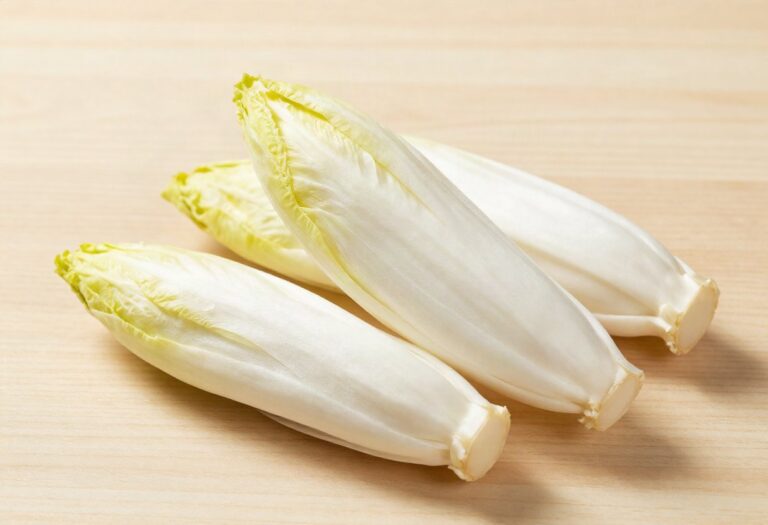
Chicory (known as endive in some countries and as chicon in the north of France and Belgium) is a winter vegetable with an elongated shape and pearly white leaves edged with pale yellow. Grown away from the light (a technique called forcing), it develops this pale colour and its characteristic bitterness. You find it raw and crunchy, or cooked, melting and milder. With only 16.6 kcal per 100 g, it is one of the lightest vegetables and fits easily into a balanced diet. Rich in water and fibre, low in fat and carbohydrate, chicory brings freshness and volume to the plate without weighing down the calorie total. A discreet but valuable asset for varying flavours.
Macronutrient breakdown
Nutrition table per 100 g
| Calories | 17 kcal |
| Kilojoules | 70 kJ |
| Protein | 1,2 g |
| Carbohydrate | 2,9 g |
| Fat | 0,2 g |
| Fibre | 1,1 g |
Micronutrients per 100 g
All measured nutrients, ranked by share of the daily reference intake.
- Potassium150 mg8 %
- Vitamin B10,07 mg6 %
- Copper0,04 mg4 %
- Manganese0,08 mg4 %
- Phosphorus23 mg3 %
- Vitamin C2,12 mg3 %
- Calcium20 mg3 %
- Vitamin B50,15 mg3 %
- Vitamin B9dietary folate equivalents25,6 µg
See the other 7 nutrients
- Magnesium8,3 mg2 %
- Vitamin B60,03 mg2 %
- Vitamin B30,21 mg1 %
- Zinc0,13 mg1 %
- Total omega-30,03 g1 %
- Iron0,12 mg1 %
- Vitamin A0,21 µg0 %
Anses Ciqual 2025. Source: Anses, 2025, Ciqual food composition table
Tips
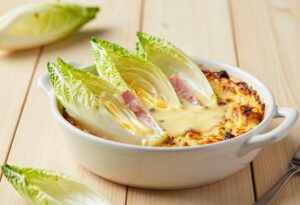
Chicory lends itself to a thousand preparations. Raw, its separated leaves make pretty little boats to fill, or can be sliced into a salad with walnuts, an apple and a splash of lemon juice to temper the bitterness. Cooked, it can be gently braised, baked au gratin or wrapped in a slice of ham. Slow cooking considerably softens its taste. To limit the bitterness, remove the small hard cone at the base and avoid washing it too much, as the water makes it spongy.
Nutritionally, chicory is interesting for its fibre content (1.1 g per 100 g), useful for digestive comfort and fullness. It also provides water, potassium, folate (vitamin B9) and a little vitamin C. Its low glycaemic index and low energy density make it an ally of balanced meals. It is typically the kind of vegetable found in a balanced diet approach, where you aim to fill the plate with low-calorie vegetables.
As for seasonality, chicory is best enjoyed from autumn to early spring, when it is freshest and most affordable. Choose it very white, firm and tightly packed, and keep it away from the light in the fridge salad drawer to stop it turning green and becoming more bitter.
To vary the pleasure, combine it with other crunchy vegetables such as raw fennel or celery in a salad. You can also explore the whole vegetable family to put together colourful, complete plates.
For active people, chicory is not a source of energy for exercise, but it has its place in recovery meals or when cutting: it increases the volume of the plate and the feeling of fullness without adding many calories. Combine it with a source of protein (egg, fish, poultry) and a starchy food with a moderate glycaemic index for a balanced, filling meal.
Weight control: raw chicory is practically neutral in calories. Beware, though, of preparations that change everything, such as gratins very rich in cream and cheese or sweet sauces meant to mask the bitterness. To stay light, favour gentle cooking and controlled seasoning. You can compare its nutrition facts with those of other foods using the calorie table.