Group · Condiments & sauces
Homemade vinaigrette
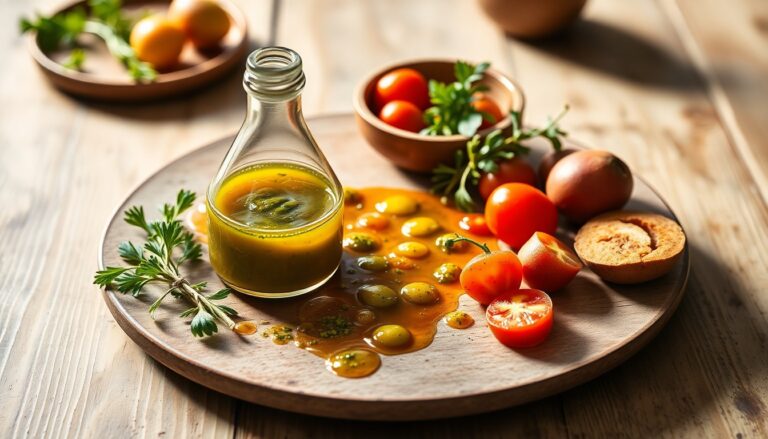
Homemade vinaigrette is the dressing of choice for salads and raw vegetables. Made with oil, vinegar, mustard, salt and herbs, it comes in a thousand variations depending on your inspiration: olive oil and balsamic, rapeseed oil and lemon, or versions flavoured with fresh herbs. It adds taste and brings the flavours of a dish together without resorting to ready-made products. Nutritionally, homemade vinaigrette is a condiment high in fat: at around 471 kcal per 100 g, it should be eaten in moderation. Its main strength lies in the quality of the oils used, which are sources of healthy fatty acids, making it a good fit for a well-portioned balanced diet.
Macronutrient breakdown
Nutrition table per 100 g
| Calories | 471 kcal |
| Kilojoules | 1940 kJ |
| Protein | 0,7 g |
| Carbohydrate | 3,1 g |
| Fat | 50,5 g |
| Fibre | 0,6 g |
Micronutrients per 100 g
All measured nutrients, ranked by share of the daily reference intake.
- Vitamin K198,8 µg132 %
- Vitamin E12,9 mg108 %
- Vitamin B10,12 mg11 %
- Potassium110 mg6 %
- Phosphorus33 mg5 %
- Iron0,64 mg5 %
- Vitamin B60,05 mg4 %
- Vitamin B96,58 µg3 %
See the other 11 nutrients
- Vitamin B30,4 mg3 %
- Vitamin A13 µg2 %
- Vitamin B120,04 µg1 %
- Copper0,01 mg1 %
- Calcium7,63 mg1 %
- Vitamin B50,05 mg1 %
- Vitamin B20,01 mg1 %
- Iodine1 µg1 %
- Manganese0,01 mg0 %
- Zinc0,02 mg0 %
- Magnesium0,11 mg0 %
Anses Ciqual 2025. Source: Anses, 2025, Ciqual food composition table
Tips
The great strength of homemade vinaigrette is that you control every ingredient. You choose the oil (olive, rapeseed, walnut), the type of vinegar and the amount of salt, unlike ready-made versions, which are often too salty or sweet. The classic ratio is three parts oil to one part vinegar, but you can lighten it by increasing the proportion of vinegar or adding a little water, mustard or plain yoghurt to emulsify.
How much should you use? A sensible portion is one tablespoon (about 15 g), or nearly 95 kcal. Given the high energy density and the fat content (50.5 g per 100 g), it is mainly the amount of oil that tips the balance. To keep your weight in check, measure with a spoon rather than by eye, and mix well before serving so that every leaf is coated with little fat.
In terms of nutrition facts, homemade vinaigrette contains little protein and few carbohydrates, but vegetable oils provide valuable unsaturated fatty acids. The fats and oils family deserves careful choosing: opt for a good-quality, cold-pressed oil. You can liven up your dressing with yellow mustard or brown mustard, and add garlic, shallots, fresh herbs or a touch of honey.
If you cannot decide between making your own dressing or buying one, compare it with shop-bought vinaigrette and explore the rest of the condiments and sauces family to vary your dressings.
Practical tips:
- Make it in a closed jar and shake vigorously to get a good emulsion.
- Keep it for a few days in the fridge, and take it out to come up to room temperature before serving.
- Dress your salad at the last moment to keep the crunch of the vegetables.
- Lighten it with lemon juice, stock or yoghurt to cut the calories.
For active people: a vinaigrette made with rapeseed or walnut oil is a good complement to a plate of raw vegetables after training, providing healthy fats that help recovery. Keep a light hand, though, if you are watching your calorie intake. To plan your meals, have a look at our guidelines on fitness nutrition.