Group · Seafood
Fish roe
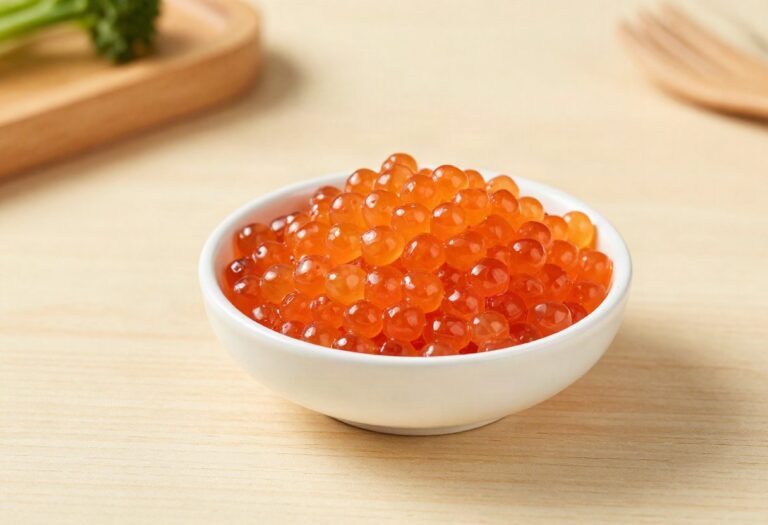
Fish roe, also called roe or tarama depending on how it is prepared, covers a wide variety of products from the milt and ovaries of fish: salmon roe, lumpfish roe, trout roe, herring roe or the famous sturgeon eggs that give us caviar. Delicate, salty and iodine-rich, they are eaten raw, as shiny beads, or added to refined recipes. Nutritionally, they are remarkable: with around 77.8 kcal per 100 g, they pack nearly 10.4 g of protein, few carbohydrates (1.01 g) and 3.48 g of fat rich in omega-3 fatty acids. It is a dense, festive food that has its place in a varied, balanced diet, eaten in moderation.
Macronutrient breakdown
Nutrition table per 100 g
| Calories | 78 kcal |
| Kilojoules | 326 kJ |
| Protein | 10,4 g |
| Carbohydrate | 1,1 g |
| Fat | 3,5 g |
| Fibre | 0,4 g |
Micronutrients per 100 g
All measured nutrients, ranked by share of the daily reference intake.
- DHA0,84 g336 %
- EPA0,64 g256 %
- Vitamin B125,45 µg218 %
- Total omega-31,51 g60 %
- Vitamin D2,65 µg53 %
- Iodine60 µg40 %
- Vitamin E1,89 mg16 %
- Selenium8 µg15 %
See the other 14 nutrients
- Vitamin B925 µg13 %
- Phosphorus83 mg12 %
- Zinc0,8 mg8 %
- Vitamin B60,08 mg6 %
- Vitamin B20,07 mg5 %
- Vitamin B50,28 mg5 %
- Potassium68,4 mg3 %
- Iron0,4 mg3 %
- Vitamin A13 µg2 %
- Calcium11,6 mg1 %
- Omega-3 ALA0,03 g1 %
- Magnesium3 mg1 %
- Vitamin K10,6 µg1 %
- Omega-6 LA0,04 g0 %
Anses Ciqual 2025. Source: Anses, 2025, Ciqual food composition table
Tips
Fish roe is enjoyed above all for its delicacy. A small amount is enough to flavour a dish: allow a sensible portion of 15 to 30 g to top blinis, a slice of wholemeal bread, a steamed potato, scrambled eggs or an avocado. Its iodine-rich flavour goes wonderfully with a squeeze of lemon, crème fraîche, chives or dill. Always keep it in the fridge, in its original tightly closed container, and eat it quickly once opened, as these are fragile, sensitive products.
As for nutrition facts, their great strength is their richness in high-quality protein (nearly 10.4 g per 100 g), along with beneficial fats, notably omega-3, as well as vitamin B12, vitamin D, phosphorus and selenium. Carbohydrates are almost absent and the glycaemic index is negligible, which makes it a food compatible with a low-sugar approach. Depending on the variety, the salt content can be high: watch this intake if you pay attention to your blood pressure, and keep your consumption occasional.
- Common varieties: lumpfish roe (often coloured), salmon, trout and herring roe, and of course caviar from sturgeon, the most prestigious.
- Clever pairings: rye bread, soft cheese, crunchy vegetables to balance the meal.
- Storage: chilled, away from air, ideally eaten within a few days.
For active people, fish roe is a concentrated, tasty source of protein, useful for varying your intake at a recovery meal. Its protein density makes it an option to include on a plate rich in vegetables and wholegrain starchy foods after exercise. To go further on protein needs, you can see our guide to fitness nutrition. If you are looking for other protein-rich seafood, take a look at oysters or prawns.
For weight control, remember that the calories in fish roe stay moderate per portion, but using it in fatty spreads (such as taramasalata) or with lots of cream can quickly add to the calorie bill. Favour simple preparations and small amounts. Discover the whole seafood family to diversify your menus, or compare intakes using the food calorie table.