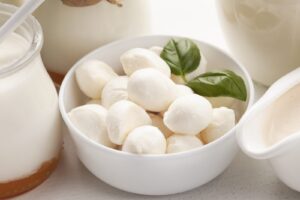
Group · Dairy
Semi-skimmed milk ricotta
Semi-skimmed milk ricotta is an Italian-style fresh cheese made from whey that has been cooked a second time, hence its name, which literally means « recooked ». Its grainy, mild and slightly milky texture makes it a versatile ingredient in the kitchen, in sweet and savoury dishes alike. Compared with the whole milk version, this semi-skimmed ricotta has a lighter profile while still being rich in protein. With 138 kcal per 100 g, around 7.96 g of protein, 4.09 g of carbohydrate and 10.7 g of fat, it fits easily into a balanced diet and provides calcium. Its mildness and softness make it popular with food lovers and athletes alike.
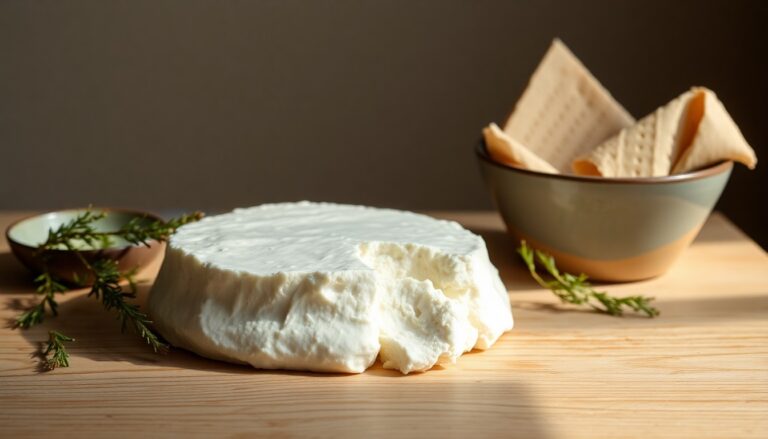
Macronutrient breakdown
Nutrition table per 100 g
| Calories | 138 kcal |
| Kilojoules | 577 kJ |
| Protein | 8 g |
| Carbohydrate | 4,1 g |
| Fat | 10,7 g |
Micronutrients per 100 g
All measured nutrients, ranked by share of the daily reference intake.
- Calcium314 mg39 %
- Phosphorus158 mg23 %
- Vitamin A120 µg15 %
- Vitamin B20,2 mg14 %
- Vitamin B120,34 µg14 %
- Iodine18 µg12 %
- Zinc1,16 mg12 %
- Omega-3 ALA0,16 g8 %
See the other 14 nutrients
- Vitamin B912 µg6 %
- Potassium105 mg5 %
- Vitamin D0,2 µg4 %
- Vitamin B50,21 mg4 %
- Vitamin B60,04 mg3 %
- Magnesium11 mg3 %
- Iron0,38 mg3 %
- Copper0,02 mg2 %
- Omega-6 LA0,15 g2 %
- Vitamin K11,1 µg1 %
- Vitamin B10,01 mg1 %
- Vitamin E0,11 mg1 %
- Vitamin B30,1 mg1 %
- Manganese0,01 mg0 %
Anses Ciqual 2025. Source: Anses, 2025, Ciqual food composition table
Tips
Semi-skimmed milk ricotta lends itself to many uses. You can use it plain, sweetened with a drizzle of honey at breakfast, or savoury with fresh herbs, pepper and a splash of olive oil. It works wonders in lasagne, cannelloni, savoury tarts and lighter cheesecakes, or simply spread on a slice of wholemeal bread. Its creamy texture also lets you lighten sauces without always reaching for cream.
- Recommended portion: 30 to 60 g as an accompaniment, up to 100 g as the base of a high-protein dish.
- Storage: in the fridge, tightly closed, and eaten soon after opening, as it is a delicate fresh cheese.
- Pairings: spinach, sun-dried tomatoes, citrus zest, red fruits, cocoa, or even nuts and seeds.
In terms of nutrition facts, this ricotta is appealing for its protein density (around 7.96 g per 100 g) while remaining moderate in calories. It provides calcium, phosphorus and B vitamins. Its glycaemic index is low, as its carbohydrates come mainly from lactose. To vary your sources, you can compare it with whole milk ricotta, which is higher in fat, or with the very light 0% fat fromage blanc. Also discover the full range of dairy products to diversify your intake.
For active people, semi-skimmed ricotta is a useful ally. Its milk proteins, rich in casein, are digested slowly and suit an evening snack or a recovery bite. Mixed with fruit or used in a protein snack, it helps maintain muscle mass. You can add it to an omelette, to protein pancakes or to a bowl of oat flakes after exercise. To go further in organising your sports nutrition, see our advice on nutrition for fitness.
Weight control: as part of a weight-loss programme, choose the semi-skimmed version rather than the whole milk one and watch your portions, as there is still some fat. Avoid drowning it in sugar in desserts. Its protein content helps you feel full, which makes it a good choice for a filling snack. To see how its calories compare with other foods, the calorie table will help you balance your meals day to day.