High ferritin: what diet can (and cannot) do
The short answer
High ferritin is not treated through diet. Most often, it does not reflect a major iron overload but another cause: metabolic syndrome, alcohol, inflammation or liver damage. It is this cause that you need to identify with your doctor. When it really is an iron overload, as in haemochromatosis, treatment relies on venesection (blood removal), and diet plays only a supporting role: no iron supplements, no vitamin C tablets, no alcohol.
At what level is ferritin considered high?
| Serum ferritin | Interpretation |
|---|---|
| Over 300 µg/L in men, over 200 µg/L in women | Hyperferritinaemia |
| Up to 500 µg/L | Moderate hyperferritinaemia |
| From 500 to 1,000 µg/L | Marked hyperferritinaemia |
| Over 1,000 µg/L | Major hyperferritinaemia |
Ferritin is the protein that stores iron, but it is also an inflammation protein. This is why a high figure does not, on its own, tell you that your body contains too much iron. The doctor usually completes it with the transferrin saturation coefficient (TSC): normal, below 45%, it points rather to a cause without overload; very high, it prompts a search for haemochromatosis.

The most common causes
- Metabolic syndrome (abdominal excess weight, blood sugar, blood pressure, lipids): this is the most common cause in everyday practice. Ferritin usually stays below 1,000 µg/L and the TSC is normal.
- Alcohol: it increases ferritin production, which varies with consumption.
- Inflammation, acute or chronic: ferritin is often below 500 µg/L, with a raised CRP.
- Liver damage (hepatitis, cytolysis): damaged cells release their ferritin into the blood.
- Haemochromatosis, a genetic disease that makes you absorb too much iron: the TSC is then very high, from 60 to 100%.
Source: SNFGE, 2019. These causes often overlap, and only a medical work-up can tell them apart.
Why your plate counts for so little: the iron numbers
To understand why no diet replaces venesection, you need to look at the orders of magnitude. According to Anses, the body of an adult man contains about 4 g of iron, 70% of it in haem form (in haemoglobin and myoglobin). Daily losses are small, 1 to 2 mg a day in adults, because the iron in red blood cells is constantly recycled. The body has no active way of getting rid of an excess: it can only regulate what it absorbs.
Yet this absorption depends on the form of the iron. Anses holds that with adequate stores (ferritin above 40 µg/L), haem iron is absorbed at about 25%, against 5 to 10% for non-haem iron, depending on the quality of the meal. Haem iron is found only in animal flesh (meat, offal, fish, seafood), where it makes up 15 to 80% of the iron present. Non-haem iron is everywhere, including in plants.
| Food (cooked, per 100 g) | Iron | Main form |
|---|---|---|
| Black pudding, grilled or pan-fried | 22.8 mg | Contains haem iron (blood) |
| Cooked pork liver | 17.9 mg | Contains haem iron |
| Fortified breakfast cereals (average) | 8.66 mg | Non-haem, added |
| Mussels cooked in water | 3.99 mg | Contains haem iron |
| Cooked lentils | 2.45 mg | Non-haem |
| Grilled beef steak | 2.21 mg | Contains haem iron |
| Grilled chicken breast fillet | 0.39 mg | Contains haem iron |
This table is not a list of forbidden foods. It mainly shows two things. First, very iron-rich foods are few and rarely eaten every day (black pudding, offal). Second, fortified products supply added iron that you can spot on the label: it is one of the few easy sources to cut without changing how you eat.
In haemochromatosis, the problem is precisely that regulation no longer puts the brakes on. In a trial of 20 patients with haemochromatosis and 20 patients with dysmetabolic iron overload (the overload linked to metabolic syndrome), an iron-rich test meal (43 mg) was absorbed 3.5 times more by the haemochromatosis patients (Lobbes, Clinical Nutrition, 2020). This is why the same plate does not pose the same problem depending on the cause of your high ferritin.
What diet can do
If the cause is metabolic or alcohol
This is where diet matters most, not because it removes iron, but because it acts on the cause: cutting down or stopping alcohol, reducing your waist measurement if you are overweight, limiting sugary and ultra-processed products. Our guides to losing belly fat and type 2 diabetes go through these levers.
If it is haemochromatosis
The French National Authority for Health (Haute Autorité de santé, HAS) recommends avoiding medicines containing iron, as well as those containing vitamin C, because it promotes iron absorption in the gut. The patient association France Fer Hémochromatose states that there is no particular diet to follow: a balanced diet is enough, and only venesection genuinely lowers ferritin. It does, however, advise drinking tea with meals, which curbs iron uptake, and not banning coffee.
| Do | Avoid |
|---|---|
| A balanced, varied diet | Iron supplements, unless medically advised |
| Tea or coffee during the meal | Vitamin C tablets |
| Keep to the venesection schedule set by your doctor | Alcohol |
Fruit and vegetables rich in vitamin C are not the issue: the HAS warning concerns medicines. You also do not have to cut out meat; the usual guidelines still apply, see our guide how much red meat per week.
What the studies on diet really say
The dietary advice given to patients rests on few trials. A systematic review published in the American Journal of Clinical Nutrition (Moretti, 2013) found no prospective randomised trial on the subject. It retained nine studies that measured iron absorption from test meals, three small longitudinal studies and eight cross-sectional studies. According to the three longitudinal studies, limiting the iron absorbed from food could reduce the volume of blood to be removed by 0.5 to 1.5 litres a year, depending on the person and the type of change. The authors conclude that the effect may exist, but that data on clinical benefit remain limited.
To give you an order of magnitude: the HAS limits each venesection to 7 ml per kilo, without exceeding 550 ml. Half a litre to a litre and a half a year therefore represents, by our calculation, the equivalent of one to three venesections a year. It is a real boost for some, not a treatment.
Tea with meals: the reference study
France Fer Hémochromatose’s advice on tea relies on a trial published in Gut (Kaltwasser, 1998). In 18 patients, drinking tannin-rich black tea during the meal, instead of water, significantly reduced the iron absorption of a test meal. Over a year, the group that drank tea at every meal built up about a third less stored iron than the control group. The authors conclude that tea taken with meals reduces the frequency of venesections needed.
Polyphenol capsules: no measured effect
It would be tempting to replace tea with a supplement. A randomised double-blind trial tested 100 mg of procyanidins (polyphenols) taken during an iron-rich meal, in 20 haemochromatosis patients and 20 dysmetabolic patients. Result: no significant drop in iron absorption, in either group (Lobbes, 2020). The benefit seen with tea therefore does not automatically carry over to a capsule.
Antacid medicines: a medical matter
Some medicines that reduce stomach acidity, proton pump inhibitors (PPIs), also curb iron absorption. A meta-analysis of three studies (68 patients) found that patients on PPIs for at least a year needed about 3 fewer venesections a year, with no significant drop in ferritin (Dirweesh, 2021). These are medicines with their own side effects: this is not a route to follow on your own, only a question to put to your doctor.
A diet proposal, to be taken as such
A Danish narrative review (Milman, 2021) proposes rules for limiting absorption: avoid iron-fortified foods and supplements, eat plenty of fruit and vegetables, prefer poultry and fish to red meat, avoid offal and blood-based foods, drink tea, coffee or milk with meals and fruit juice outside them, and abstain from alcohol. The author states that this advice is close to the official Danish recommendations of 2021. It is not a French consensus: in France, France Fer Hémochromatose points out that no particular diet is necessary and the HAS does not ask for meat to be cut out.
Alcohol, the factor that changes the outlook
Of all the advice, that on alcohol is the best supported. In a study published in Gastroenterology (Fletcher, 2002), liver biopsies from 224 C282Y homozygous patients were analysed. 7% of those who drank less than 60 g of alcohol a day had severe fibrosis or cirrhosis, against 61% of those who drank 60 g or more. Above this threshold, the risk of cirrhosis was about 9 times higher.
To get your bearings: a standard drink contains 10 g of pure alcohol, according to the French national health insurance (Assurance maladie). 60 g is therefore 6 drinks a day. But this threshold is not a « safe » limit: it is the one used in the study. The guidelines from Santé publique France (the French public health agency) for all adults are at most 10 drinks a week, no more than 2 a day, and alcohol-free days. In the case of haemochromatosis or liver damage, the HAS asks that advice on alcohol abuse be given, and it is with your doctor that you decide what is reasonable for you.
If your ferritin is high because of alcohol without iron overload, the SNFGE describes a ferritin that « fluctuates with » consumption: it is a marker that reacts. To estimate what you really drink, our alcohol calorie calculator helps you add it up over a week.
Treatment of haemochromatosis
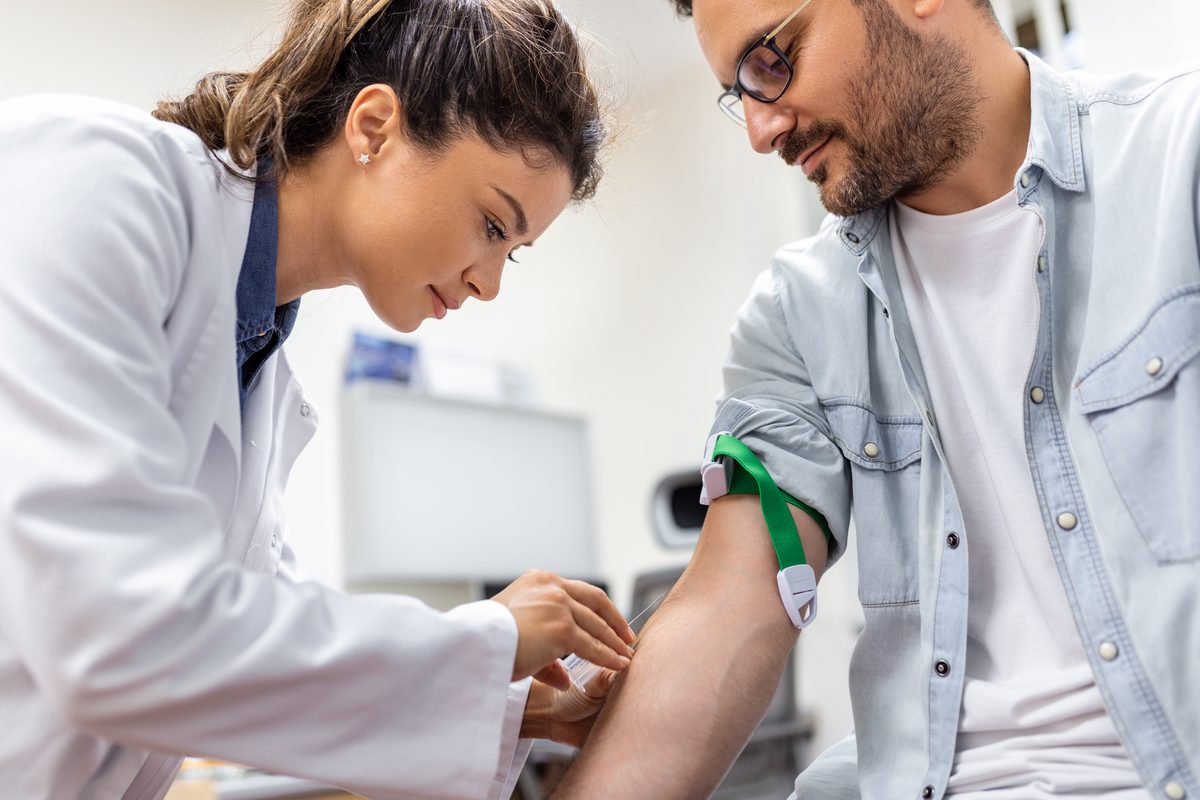
Venesection is the reference treatment. According to the HAS, it starts as soon as ferritin exceeds 300 µg/L in men and 200 µg/L in women, and continues until it falls back to 50 µg/L or less, before a maintenance phase. No food can replace this treatment.
Ferritin is not the only liver work-up marker to watch: see also how to lower gamma GT.
The stages of haemochromatosis and the follow-up set out by the HAS
The HAS classifies haemochromatosis linked to the HFE gene into stages, according to the transferrin saturation coefficient (TSC), ferritin and symptoms. The stage decides whether treatment is given and how monitoring is done.
| Stage | Situation | Treatment and follow-up |
|---|---|---|
| Stage 0 | No symptoms, TSC below 45%, normal ferritin | No treatment; check every 3 years |
| Stage 1 | No symptoms, TSC above 45%, normal ferritin | No treatment; check every year |
| Stage 2 | No symptoms, TSC above 45%, high ferritin | Venesection |
| Stages 3 and 4 | Symptoms, TSC above 45%, high ferritin | Venesection and management of complications |
In practice, the induction phase relies on venesections at most once a week, until ferritin reaches 50 µg/L or less. A maintenance phase follows, with one venesection every 2, 3 or 4 months depending on the patient. The HAS provides for a haemoglobin check in the 8 days before the venesection and a suspension if it falls below 11 g/dl. It also recommends hepatitis B vaccination and a work-up for close family, because the disease is genetic: it is up to the patient to inform their brothers, sisters, parents and adult children.
Venesection donation: your venesection can be put to use
The French blood service (Établissement français du sang, EFS) offers venesection donation (don-saignée) to people with genetic haemochromatosis with iron overload, who need venesections and who meet the usual blood donation criteria (except for the intervals between two donations). You need a prescription from your doctor. Since 1 September 2025, the EFS has removed the requirement to have five therapeutic venesections before a first venesection donation, which is therefore possible from the start of treatment, at donation centres as well as at mobile collections. The blood collected is then used for patients.
Day to day: simple adjustments
Drawing together what the HAS, France Fer Hémochromatose and the studies cited above say, here is what is easy to do without falling into a restrictive diet:
- Read the labels of breakfast cereals, drinks and multivitamin supplements: added iron or vitamin C is indicated there. The HAS advises against medicines that contain them.
- Drink tea during the meal if you enjoy it; coffee does not need to be cut out.
- Keep fruit and vegetables: the warning about vitamin C is aimed at tablets, not food.
- Cut alcohol clearly, it is the strongest lever for your liver.
- Keep your follow-up booklet: the HAS recommends a shared tool with the dates, venesection volumes and ferritin results.
If your ferritin is linked to metabolic syndrome, the levers are those of waist measurement and blood sugar. Our guide to liver health sorts out what really helps from « detox » products.
Frequently asked questions
Which foods should you avoid with high ferritin?
No food is forbidden in itself. What you should avoid are alcohol, iron supplements and vitamin C tablets. The rest depends on the cause, to be identified with your doctor.
Can you lower your ferritin by eating less iron?
No. In haemochromatosis, only venesection lowers ferritin, according to France Fer Hémochromatose. In other cases, it comes back down by treating the cause: alcohol, excess weight or inflammation.
Does tea really help?
Drunk during the meal, it curbs iron uptake, and the association France Fer Hémochromatose advises it. It is a boost, not a treatment.
Is a ferritin of 400 serious?
It is a moderate hyperferritinaemia. It means looking for the cause, often metabolic or alcohol-related. Only a full work-up can settle it.
Should you stop eating red meat?
No, neither the HAS nor the patient association asks for this. The usual consumption guidelines apply.
Can I give blood with haemochromatosis?
Yes, under conditions. The EFS offers venesection donation to patients with iron overload who need venesections and meet the donation criteria, on prescription. Since 1 September 2025, it is possible from the start of treatment.
Do polyphenol or green tea capsules replace tea?
Nothing shows that they do. A randomised trial with 100 mg of procyanidins at a meal did not reduce iron absorption in haemochromatosis or dysmetabolic patients (Lobbes, 2020).
How much alcohol with haemochromatosis?
One study found a risk of cirrhosis about 9 times higher above 60 g a day, or 6 standard drinks. This is not a risk-free threshold: the general guideline is at most 10 drinks a week, and your doctor may advise less.
Can eating less iron space out venesections?
A little, perhaps. According to a systematic review, limiting the iron absorbed could avoid 0.5 to 1.5 litres of venesection a year, but no randomised trial has confirmed it (Moretti, 2013).
To go further on iron: our guides to iron-rich foods and iron and anaemia, which deal with the opposite situation.
Our sources
- SNFGE, P. Brissot, Conduite à tenir devant une hyperferritinémie, February 2019.
- Haute Autorité de santé, Prise en charge de l’hémochromatose liée au gène HFE, July 2005.
- France Fer Hémochromatose, Le traitement de référence.
- Anses, Avis relatif à l’actualisation des références nutritionnelles en vitamines et minéraux (iron chapter), referral 2018-SA-0238, 2021.
- Anses, Table de composition nutritionnelle des aliments Ciqual, 2025.
- Kaltwasser J. P. et al., Clinical trial on the effect of regular tea drinking on iron accumulation in genetic haemochromatosis, Gut, 1998, PMID 9824354.
- Moretti D. et al., Relevance of dietary iron intake and bioavailability in the management of HFE hemochromatosis: a systematic review, American Journal of Clinical Nutrition, 2013, PMID 23803887.
- Lobbes H. et al., Effect of procyanidin on dietary iron absorption in hereditary hemochromatosis and in dysmetabolic iron overload syndrome: a crossover double-blind randomized controlled trial, Clinical Nutrition, 2020, PMID 30792142.
- Dirweesh A. et al., Proton pump inhibitors reduce phlebotomy burden in patients with HFE-related hemochromatosis: a systematic review and meta-analysis, European Journal of Gastroenterology & Hepatology, 2021, PMID 32769410.
- Milman N. T., Managing genetic hemochromatosis: an overview of dietary measures, which may reduce intestinal iron absorption in persons with iron overload, Gastroenterology Research, 2021, PMID 34007348.
- Fletcher L. M. et al., Excess alcohol greatly increases the prevalence of cirrhosis in hereditary hemochromatosis, Gastroenterology, 2002, PMID 11832443.
- Établissement français du sang, Le don-saignée, soigner et être soigné, accessed in 2026.
- Santé publique France, Recommandations relatives à l’alimentation, à l’activité physique et à la sédentarité pour les adultes, 2019; Assurance maladie (ameli.fr), Alcool : définition et repères de consommation.
This guide is for information and does not replace your doctor’s advice.