How much red meat per week? 500 g, pork included
The short answer
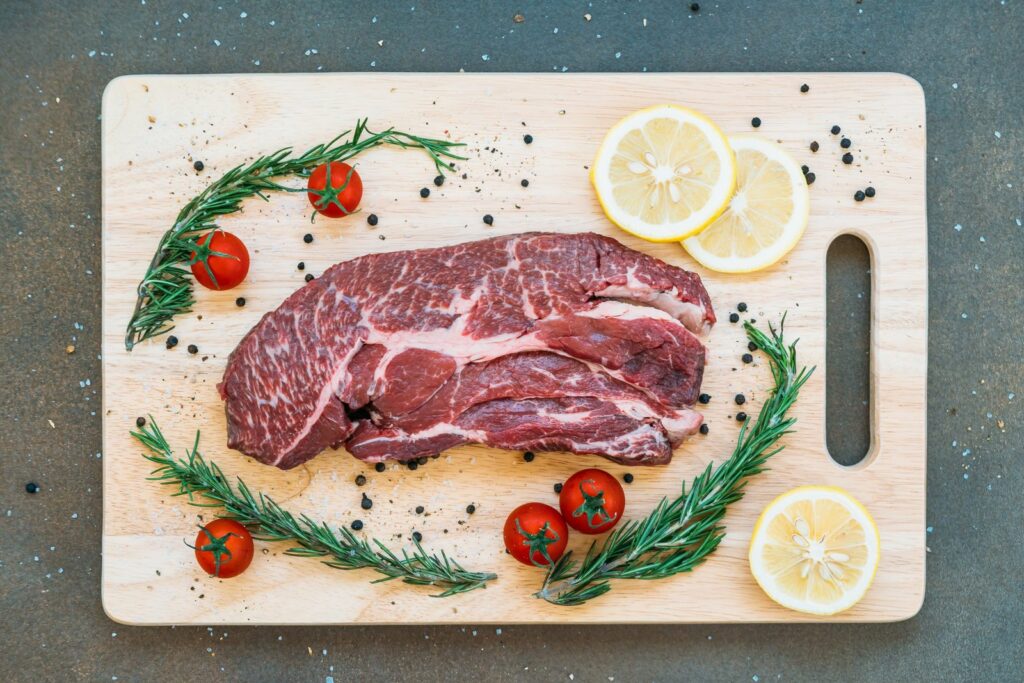
500 g a week at most, or about 3 or 4 steaks: that is the recommended limit in France for all meat other than poultry, meaning beef, veal, pork, lamb, mutton and offal. Processed meat has its own, stricter limit: 150 g a week, about 3 slices of ham. Poultry, which is the better choice, has no numerical limit.
The official guidelines
| Category | Weekly limit | In practice |
|---|---|---|
| Meat other than poultry: beef, veal, pork, lamb, mutton, offal | 500 g | 3 or 4 steaks |
| Processed meat, ham included | 150 g | about 3 slices of ham |
| Poultry | no numerical limit | the better choice |
Watch the wording: the 500 g limit does not only cover « red meat » in the everyday sense. Pork and veal are included. Only poultry (chicken, turkey, duck) is excluded.
Why limit it
In October 2015, the International Agency for Research on Cancer, the WHO’s specialist cancer agency, classed processed meat (charcuterie, ham, sausages) as carcinogenic to humans, and red meat as probably carcinogenic, mainly for colorectal cancer. That is why the limit is lower for processed meat.
Processed meat is also very salty: 2.1 g of salt per 100 g of cooked ham, 4.75 g for dry sausage (saucisson sec), which also provides 418 kcal. And not all steaks are equal: cooked minced beef contains 14.9 g of fat per 100 g, of which 5.6 g is saturated, against less than 2 g for a grilled steak.
What a steak provides
| Per 100 g | Grilled steak | Turkey escalope | Cooked lentils |
|---|---|---|---|
| Calories | 128 kcal | 124 kcal | 125 kcal |
| Protein | 27.6 g | 28.5 g | 10.1 g |
| Iron | 2.2 mg | 0.5 mg | 2.5 mg |
| Zinc | 5.4 mg | 1.2 mg | 1.3 mg |
| Vitamin B12 | 2.7 µg | 0.6 µg | not measured |
Red meat has real advantages: a 100 g steak covers 58% of a woman’s reference intake for zinc and 68% of the one for vitamin B12 (4 µg). Its iron, known as haem iron, is better absorbed than the iron in plant foods. That is why the recommendation says to limit, not to cut out. If you eat little of it, the rankings of foods rich in iron, foods rich in zinc and foods rich in vitamin B12 show how to make up for it.
A typical week under the limit
Two 120 g steaks and a 150 g roast pork on Sunday: 390 g of meat other than poultry. Two poultry meals, two fish meals (one of them oily fish) and one or two meals based on pulses complete the week. As for processed meat, two slices of ham already make up two thirds of the 150 g limit.
Where the 500 g figure comes from
The limit was not chosen at random. It comes from the Anses opinion of December 2016 on updating the PNNS guidelines, which reviewed the major studies linking consumption of food groups to chronic diseases.
For meat other than poultry, Anses finds a convincing link with colorectal cancer, and a probable link with cardiovascular disease and type 2 diabetes. According to meta-analyses, each extra 100 g a day of meat other than poultry increases the risk of these diseases by 10 to 20%. For processed meats, including charcuterie, each extra 50 g a day increases it by up to 50%.
To set a ceiling, the experts looked at the colorectal cancer studies one by one. Most showed a significant rise in risk from 70 to 80 g a day of meat other than poultry. Hence the limit of 500 g a week, or 71 g a day, in line with that of the World Cancer Research Fund. For processed meat, risk increases appeared from 25 g a day, with no data below that: this is why the limit is much lower.
A point on vocabulary that Anses itself makes: English-language studies talk about « red meat », which includes pork and veal. In French, « viande rouge » tends to mean beef, lamb and horse meat. To avoid confusion, the guidelines use the phrase « meat other than poultry ».
What recent studies measure
Colorectal cancer
The IARC classes processed meat as carcinogenic to humans (group 1), on evidence judged convincing of a causal link, and meat other than poultry as probably carcinogenic (group 2A), on limited evidence in humans backed by mechanistic data. The increase in colorectal cancer risk is estimated at 18% for each 50 g of processed meat a day, Anses points out. The French National Cancer Institute also describes the link between meat other than poultry and colorectal cancer as convincing.
Type 2 diabetes
The largest analysis to date, published in 2024, pooled individual data from nearly 2 million adults followed in 31 cohorts across 20 countries, with 107,271 new cases of diabetes over a median follow-up of 10 years. Diabetes risk rose by 10% for each 100 g of unprocessed red meat a day, and by 15% for each 50 g of processed meat. Replacing processed meat with unprocessed meat or poultry was associated with less diabetes. For poultry, a weaker link appeared, 8% per 100 g, but it did not hold up under every analysis method.
These are observational studies: they show associations, which researchers adjust for weight, smoking or physical activity, but which do not on their own prove cause and effect. It is the convergence of many studies, and of mechanistic data, that led to the current limits.
Why processed meat is more strictly limited: nitrites
Part of the explanation lies in the nitrite additives (nitrites and nitrates) used to make processed meat. In July 2022, Anses published an opinion on these additives. Its main conclusions:
- The data confirm an association between colorectal cancer risk and exposure to nitrates and nitrites, whether they come from drinking water or from processed meat.
- More than half of adults’ and children’s exposure to nitrites comes from processed meat products.
- Nearly 99% of the population does not exceed the acceptable daily intakes, but Anses asks for the addition of these additives to be reduced as far as reasonably possible.
- In its simulations, applying the 150 g a week limit for processed meat to cooked ham and sausages was enough to eliminate any exceedance of the acceptable intake in children.
Finally, Anses points out that processes that replace added nitrites with naturally occurring nitrates do not really reduce exposure: bacteria convert them into nitrites. Processed meat marketed as having no added nitrite is still processed meat, and counts towards the 150 g.
Not all cuts are equal
The 500 g limit is the same for all cuts, but their composition varies a great deal:
| Per 100 g, cooked | Calories | Fat | of which saturated | Iron | Zinc |
|---|---|---|---|---|---|
| Beef, roast beef | 126 kcal | 3.2 g | 0.6 g | 3.1 mg | 5.4 mg |
| Beef, grilled rump steak | 138 kcal | 2.1 g | 0.8 g | 2.6 mg | 4.8 mg |
| Beef, minced steak 5% fat | 155 kcal | 5.9 g | 2.9 g | 2.8 mg | 6.4 mg |
| Beef, minced steak 20% fat | 265 kcal | 19.2 g | 8.1 g | 2.5 mg | 4.3 mg |
| Beef, ribeye, lean part | 198 kcal | 10.7 g | 4.8 g | 2.6 mg | 6.3 mg |
| Veal, escalope | 147 kcal | 2.5 g | 0.8 g | 1 mg | 3.2 mg |
| Pork, roast | 163 kcal | 4.3 g | 1.3 g | 0.6 mg | 1.7 mg |
| Lamb, roast leg | 169 kcal | 6.9 g | 2.6 g | 1.4 mg | 4 mg |
| Lamb, grilled chop | 240 kcal | 15.2 g | 6.7 g | not measured | 3.5 mg |
Two lessons. First, minced steak with 20% fat contains more than three times as much fat as the 5% one and almost three times as much saturated fat: for the same weight, the fat percentage you choose matters as much as the number of steaks. Second, iron is mainly beef’s strength: roast pork and veal escalope provide two to five times less. If you eat meat other than poultry for its iron, lean cuts of beef are the most worthwhile.
Which processed meat to choose?
Santé publique France advises choosing cooked white ham and poultry ham among processed meats. The Ciqual table shows why:
| Per 100 g | Calories | Fat | Salt |
|---|---|---|---|
| Sliced turkey ham | 99 kcal | 1.7 g | 1.9 g |
| Premium cooked ham | 113 kcal | 2.8 g | 1.9 g |
| Cooked ham, reduced salt | 121 kcal | 3.8 g | 1.5 g |
| Cured ham | 239 kcal | 13.2 g | 5.7 g |
| Strasbourg sausage | 291 kcal | 25.9 g | 2 g |
| Pork rillettes | 391 kcal | 36 g | 0.9 g |
| Dry sausage (saucisson sec) | 418 kcal | 33.1 g | 4.8 g |
White ham and poultry ham are the leanest. Cured ham and dry sausage are two and a half to three times saltier: 50 g of cured ham provides 2.8 g of salt, more than half of the WHO’s limit of 5 g a day. Beware of one trap: poultry ham is still processed meat. Santé publique France explicitly includes it in the 150 g weekly limit, along with sausages, lardons, bacon, tinned meats and dry-cured and cured hams.
Cooking matters too
In the same 2016 opinion, Anses recommends limiting meat cooked at high temperature, on a barbecue or by frying for example, and varying cooking methods: boiled, roasted, slow-cooked. Cuts for braising or stewing, such as chuck or beef bourguignon, suit these gentle methods well. To go further, see our guide to gentle cooking.
Do you need meat for your protein?
This is often the worry when you cut down on meat. The figures put it in perspective. In its 2007 report on protein, Afssa, now Anses, set a recommended intake of 0.83 g of protein per kilo of body weight per day for healthy adults, or about 58 g for 70 kg. It stresses that this value remains well below the amounts consumed in Western countries.
A 100 g grilled steak provides 27.6 g of protein according to Ciqual, nearly half of that 58 g. But turkey escalope provides just as much, 28.5 g, and two eggs, a yoghurt, a piece of cheese, bread and pulses easily fill out the day. Staying under 500 g of meat other than poultry a week therefore does not endanger your protein intake. The real point to watch, when you eat very little red meat, is rather iron and vitamin B12, as the table above shows. For a full overview of sources, see our ranking of the highest-protein foods.
Less meat, without losing the enjoyment
Staying under 500 g does not mean giving up meat dishes. Two simple strategies, with recipes from the site:
- Use meat as a garnish rather than the main item: beef pho or beef bo bun pair a few slices of meat with plenty of vegetables and starchy foods.
- Replace part of the meat with pulses, which Santé publique France advises at least twice a week: lentil bolognese, mujaddara or Ethiopian misir wot.
- Keep slow-cooked dishes for the weekend, like beef and carrots: a 120 g portion of meat is only a quarter of the weekly limit.
Frequently asked questions
How much red meat per week?
500 g at most for all meat other than poultry, pork and veal included, or 3 or 4 steaks.
How much processed meat per week?
150 g at most, or about 3 slices of ham. White ham counts as processed meat.
Is pork a red meat?
For the French recommendation, it makes no difference: pork falls within the 500 g a week limit, like beef and lamb. Only poultry is excluded.
What about poultry?
It has no numerical limit and is the better choice: turkey escalope provides as much protein as steak, 28.5 g per 100 g.
Can you do without red meat?
Yes, provided you find the iron, zinc and vitamin B12 elsewhere. For B12, a diet with no animal products at all requires a supplement.
How much protein do you need per day?
Anses sets 0.83 g per kilo of body weight for healthy adults, or about 58 g for 70 kg. A 100 g steak provides 27.6 g, a turkey escalope 28.5 g.
Do horse meat and game count?
Yes. In its 2019 recommendations, Santé publique France includes beef, pork, veal, mutton, goat, horse, wild boar and venison in the 500 g. Only poultry is excluded.
Why 500 g and not less?
Because most studies on colorectal cancer show a significant rise in risk from 70 to 80 g a day. 500 g a week, or 71 g a day, stays below that, according to Anses (2016).
Does turkey ham count as processed meat?
Yes. Santé publique France classes poultry ham as processed meat, to be limited to 150 g a week, even though it is among the processed meats to favour.
Is « nitrite-free » processed meat risk-free?
No. According to Anses, processes that replace nitrites with natural nitrates do not really reduce exposure, and the 150 g a week limit still applies.
Does minced steak count towards the 500 g?
Yes, it is beef. Choose the 5% fat version: 5.9 g of fat per 100 g cooked, against 19.2 g for the 20% one.
Other quantity guidelines
how many seeds per day, how many almonds per day, how much coffee per day, how much sugar per day, how much fish per week, how much cheese per day, how many walnuts per day, how many eggs per day, how many bananas per day, how much water to drink per day, how much dark chocolate per day, how much rice per person, how much pasta per person.
Our sources
- Manger Bouger (Santé publique France), recommendations on meat and charcuterie.
- Centre international de recherche sur le cancer (CIRC), evaluation of red meat and processed meat, October 2015.
- Table Ciqual 2025 (Anses) ; Anses, références nutritionnelles en vitamines et minéraux, 2021.
- Anses, Actualisation des repères du PNNS : révision des repères de consommations alimentaires, avis et rapport, décembre 2016.
- Anses, Évaluation des risques liés à la consommation de nitrates et nitrites, avis révisé et rapport d’expertise collective, juillet 2022 (saisine 2020-SA-0106).
- Santé publique France, Recommandations relatives à l’alimentation, à l’activité physique et à la sédentarité pour les adultes, 2019.
- Afssa, Apport en protéines : consommation, qualité, besoins et recommandations, rapport, 2007.
- Bouvard V et al. Carcinogenicity of consumption of red and processed meat. Lancet Oncology, 2015. PMID 26514947.
- Li C et al. Meat consumption and incident type 2 diabetes: an individual-participant federated meta-analysis of 1,97 million adults with 100 000 incident cases from 31 cohorts in 20 countries. Lancet Diabetes and Endocrinology, 2024. PMID 39174161.
- WHO, recommendation on sodium intake: less than 5 g of salt per day for adults.