How many almonds a day? A handful, and what it provides
The short answer
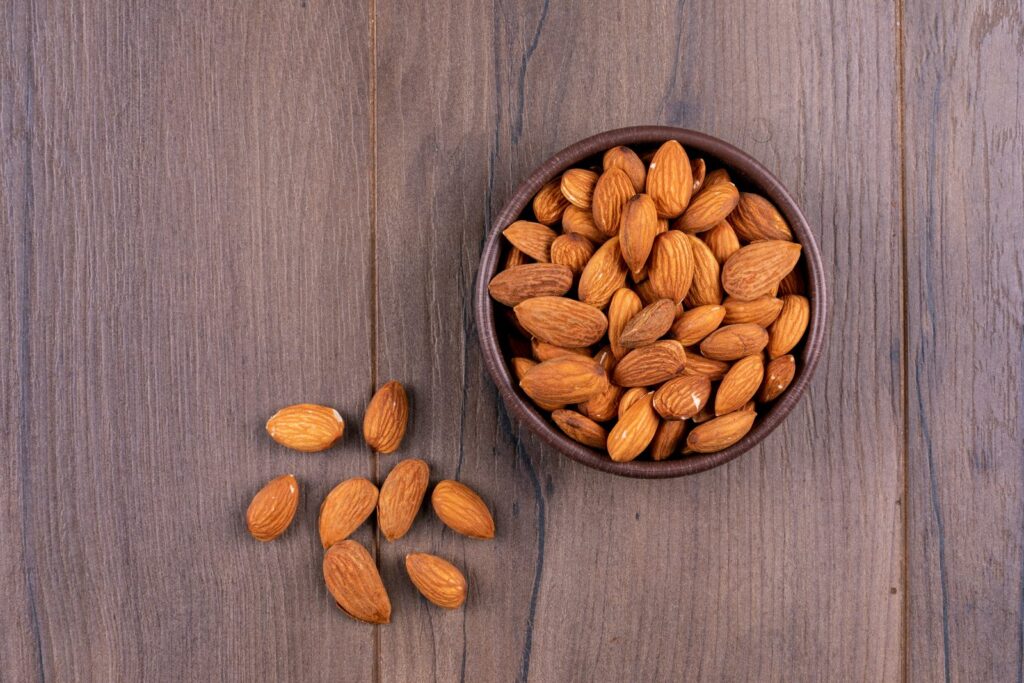
The official recommendation is a small handful of unsalted nuts a day, or about 20 to 25 almonds. An almond weighs about 1.2 g: 23 almonds make 28 g and 170 kcal, with 3.5 g of fibre and 75 mg of magnesium, a quarter of a woman’s reference intake. Beyond that, it is not the almonds themselves that are a problem, it is the calories: one almond is worth more than 7 kcal.
What your almonds provide
| Amount | Weight | Calories | Protein | Fibre | Magnesium | Calcium |
|---|---|---|---|---|---|---|
| 1 almond | 1.2 g | 7.4 kcal | 0.2 g | 0.2 g | 3 mg | 3 mg |
| 10 almonds | 12 g | 74 kcal | 2.3 g | 1.5 g | 32 mg | 31 mg |
| 23 almonds, a small handful | 28 g | 170 kcal | 5.2 g | 3.5 g | 75 mg | 72 mg |
| 40 almonds | 48 g | 295 kcal | 9 g | 6 g | 130 mg | 125 mg |
Why a handful
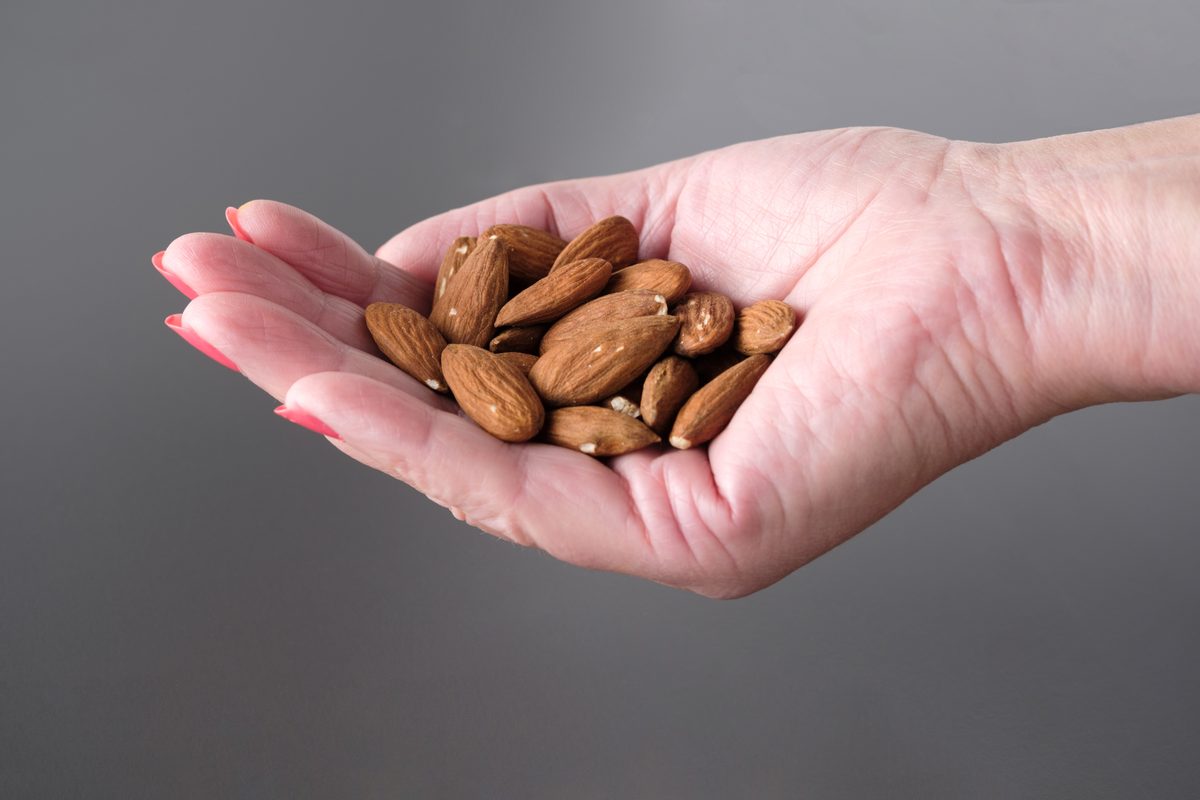
The French national nutrition and health programme recommends eating a small handful of unsalted nuts a day: almonds, walnuts, hazelnuts, pistachios. They provide good-quality fats: of the 51.3 g of fat per 100 g of almonds, 34.4 g is monounsaturated fatty acids, as in olive oil, and only 4.1 g is saturated.
Almonds also provide, per 100 g, 12.5 g of fibre, 260 mg of calcium and 270 mg of magnesium. A handful covers about 25% of a woman’s reference intake for magnesium and 8% of the one for calcium. To compare with other sources, see our rankings of foods rich in magnesium and foods rich in calcium.
When it is too much
Allergy aside, the main risk is calories: 40 almonds come to 295 kcal, and when nibbled in front of a screen they add up fast. Three simple tips:
- Count them once to picture your handful of 20 to 25, then serve yourself in a bowl rather than from the bag.
- Choose them plain: salted roasted almonds contain 380 mg of sodium per 100 g, and 647 kcal instead of 615.
- Swap, don’t add: a handful of almonds is a better swap for a biscuit at snack time, not something to add to it.
Almonds are a tree nut, an allergen that must be declared in Europe: if you have a known allergy, there is no safe dose.
What about almond butter?
Made from ground almonds, it has a similar composition. 15 g of almond butter is worth about 12 almonds, or 90 to 95 kcal, and it is easy to spread in large quantities. The products are compared in our comparison of almond butters. For other seeds, see our guide how many seeds per day.

Plain, blanched, roasted: what changes
On the shelf, almonds come in several forms. For the same 28 g handful, here is what sets them apart:
| 28 g of almonds | Calories | Protein | Fibre | Sodium | Calcium |
|---|---|---|---|---|---|
| With skin, unsalted | 172 kcal | 5.3 g | 3.5 g | less than 1.5 mg | 73 mg |
| Blanched, unsalted | 177 kcal | 6 g | 2.8 g | 5 mg | 66 mg |
| Roasted, salted | 181 kcal | 5.6 g | 2.4 g | 106 mg | 75 mg |
| Roasted, salted, smoked flavour | 176 kcal | 5.2 g | 2.3 g | 134 mg | not measured |
Two differences really matter. The first is the skin: it holds some of the fibre, and blanched almonds lose a fifth of it. The second is salt: a handful of salted roasted almonds provides 106 mg of sodium, and the smoked version 134 mg, against almost nothing for plain almonds. This is why Santé publique France specifies « no added salt » in its recommendation on nuts. Calories hardly move: from 172 to 181 kcal depending on the form.
The little-known strength: vitamin E
People often talk about the magnesium in almonds, much less about their vitamin E, which is in fact their real strength. The Ciqual table does not list it for almonds, but the American USDA database gives 25.6 mg of vitamin E (alpha-tocopherol) per 100 g of almonds.
A 28 g handful therefore provides about 7.2 mg, or 60% of the European labelling reference value, set at 12 mg. By comparison, the same amount of walnuts provides only 0.2 mg according to the same database. European Regulation No 432/2012 also authorises the claim « vitamin E contributes to the protection of cells from oxidative stress » for foods that are a source of it.
It is a good argument for alternating nuts: walnuts for omega-3, as explained in our guide how many walnuts per day, almonds for vitamin E, fibre and calcium.
The real calories in a handful
The calories shown on a bag of almonds are calculated with the conversion factors set by European Regulation No 1169/2011: 9 kcal per gram of fat, 4 kcal per gram of protein or carbohydrate, 2 kcal per gram of fibre. A USDA study published in 2012 checked this calculation in humans.
Eighteen adults followed a controlled diet for 18 days containing 0, 42 or 84 g of almonds a day, and the researchers measured the energy actually excreted. Result: the almonds provided only 4.6 kcal per gram, or 129 kcal for a 28 g portion, instead of the 168 to 170 kcal predicted by the standard calculation. The standard factors therefore overestimated their calories by 32%.
Two caveats before drawing a conclusion. It is a single study, in 18 people, and with whole almonds: it says nothing about almond butters or almond powders. And 129 kcal is still 129 kcal: the handful remains the right guide.
What the health studies say
Cholesterol
This is the best-documented effect. A meta-analysis published in 2025 brought together 36 publications and 2,485 adults without cardiovascular disease, in trials lasting at least 4 weeks. Almonds lowered LDL cholesterol by 0.13 mmol/L, or about 5 mg/dL, total cholesterol by 0.16 mmol/L and apolipoprotein B by 4.6 mg/dL, with no effect on HDL. An older meta-analysis, from 2021, found similar figures: 5.7 mg/dL less LDL and 6.7 mg/dL less triglycerides, with an effect on triglycerides that increased with the dose.
In people with type 2 diabetes, results are less clear-cut: a meta-analysis of five trials found no overall effect on cholesterol, with a drop in LDL only in the trials that exceeded 50 g of almonds a day.
Weight
A meta-analysis of 37 trials, published in 2024, found no weight gain with almonds, quite the opposite: 0.45 kg less, 0.66 cm less around the waist and a slightly lower feeling of hunger than in the control groups. The authors rate the certainty of these results as moderate for weight and very low for appetite. In most of these trials, the almonds replaced other foods.
These effects are modest. They point the same way as the official guidelines, but a handful of almonds replaces neither cholesterol treatment nor dietary follow-up.
Almonds and blood sugar
A 28 g handful of almonds with skin contains 2.7 g of carbohydrate, of which 1.2 g is sugars, according to Ciqual. On their own, they hardly raise blood sugar at all. The interesting question lies elsewhere: what happens when you eat them with a starchy food?
A small Canadian study published in 2007 tested adding 30, 60 or 90 g of almonds to a white bread meal providing 50 g of carbohydrate, in nine healthy volunteers. The glycaemic index of the meal fell with the dose: 105.8 with 30 g of almonds, 63 with 60 g and 45.2 with 90 g, with white bread alone as the reference at 100. In other words, a 30 g handful changed little, and it took two to three handfuls for a clear effect, or 350 to 550 kcal of almonds.
The practical lesson is modest: pairing almonds with a carbohydrate-rich meal can blunt the rise in blood sugar a little, but the daily handful is not a treatment. If you have diabetes, portion guidelines for starchy foods remain the basis, as detailed in our guide type 2 diabetes: diet and prevention, and your doctor or dietitian remain the people to talk to about adjusting your diet.
Bitter almonds, the real exception
All almonds contain compounds that release cyanide when chewed, called cyanogenic glycosides. In sweet almonds, the kind you buy for snacking, the content is low, around 25 mg of cyanide per kilo. In bitter almonds, it ranges from 500 to more than 1,000 mg per kilo, according to data cited by EFSA.
In its 2019 opinion, EFSA sets an acute reference dose of 20 µg of cyanide per kilo of body weight, not to be exceeded in one sitting. With a bitter almond at 1,477 mg per kilo, this dose is reached with 0.1 to 1.4 g of almond depending on body weight: less than half a small almond for a young child, one large almond for an adult. EFSA points out that poisonings, some fatal, have been caused by bitter almonds.
In practice:
- Almonds sold for snacking are sweet almonds: no special precautions.
- If an almond tastes distinctly bitter, don’t eat it, and don’t leave it within a child’s reach.
- Marzipan is made from sweet almonds; the European Union also sets a maximum content of 50 mg of cyanide per kilo for it.
Drink, marzipan, sugared almonds: what is left of the almond?
| Per 100 g | Calories | Protein | Sugars | Calcium |
|---|---|---|---|---|
| Almond with skin | 615 kcal | 18.8 g | 4.2 g | 260 mg |
| Plain almond drink, unfortified | 36 kcal | 1.1 g | traces | 12 mg |
| Sweetened almond drink, calcium-fortified | 44 kcal | 0.7 g | 3.4 g | 54 mg |
| Semi-skimmed milk | 48 kcal | 3.5 g | 121 mg | |
| Marzipan | 432 kcal | 5.8 g | 60.1 g | 91 mg |
| Sugared almond (dragée) | 465 kcal | 5.3 g | 68.3 g | 84 mg |
Almond drink contains very little almond: 1.1 g of protein per 100 g, three times less than milk, and 12 mg of calcium when unfortified, ten times less. Even fortified, it does not reach half the calcium of milk in the Ciqual table. That is not a problem if you like it, but it counts neither as a handful of almonds nor as a dairy product. For calcium, see our ranking of foods rich in calcium.
Marzipan and sugared almonds are, first and foremost, sugar: 60 to 68 g per 100 g. They belong with sugary products, not with nuts.
Who should adjust their handful?
- If you have a nut allergy: almonds are among the allergens in Annex II of European Regulation No 1169/2011, which must be highlighted in the ingredients list. Santé publique France specifies that the daily handful is not meant for people with allergies. Also watch for products where almonds hide: pastries, biscuits, marzipan, praline.
- If you watch your salt: stick to plain almonds, which provide almost no sodium, rather than salted roasted or smoked ones, with up to 134 mg per handful.
- If you watch your calories: weigh out 28 g once, or about 23 almonds, to keep the guide in mind.
Your handful in meals
A few recipes from the site where almonds find a place without adding to your snacking:
- As a main dish: baked trout with almonds, which pairs almonds with an oily fish.
- With vegetables: pan-fried green beans with garlic and almonds or green bean, almond and feta salad.
- At breakfast: banana and almond porridge.
In these recipes, count the almonds in the dish towards your handful for the day.
Frequently asked questions
How many almonds a day to lose weight?
A small handful, 20 to 25 almonds, or 150 to 185 kcal, in place of a sweeter snack. Adding them without removing anything makes you gain weight like any other food.
How many calories are in an almond?
About 7.4 kcal for a 1.2 g almond, or 170 kcal for 23 almonds according to Ciqual.
How many almonds are in 30 g?
About 25 almonds, for 185 kcal, 5.6 g of protein and 3.8 g of fibre.
Is eating too many almonds dangerous?
Allergy aside, the risk is mainly calories: 40 almonds make 295 kcal. Roasted and salted versions add salt.
Almonds with or without skin?
With the skin: 12.5 g of fibre per 100 g, against 9.9 g for blanched almonds according to Ciqual.
Are bitter almonds dangerous?
Yes. According to EFSA, 0.1 to 1.4 g of bitter almond is enough to reach the acute reference dose for cyanide, which is less than half an almond for a young child. The sweet almonds sold in shops contain very little.
Do almonds lower cholesterol?
A little: about 5 mg/dL less LDL in a 2025 meta-analysis of 2,485 adults. It is a complement, not a treatment.
Does almond milk replace milk?
Not nutritionally: 1.1 g of protein and 12 mg of calcium per 100 g when unfortified, against 3.5 g and 121 mg for semi-skimmed milk, according to Ciqual.
Do almonds provide vitamin E?
Yes, plenty: about 7.2 mg for a 28 g handful according to the USDA, 60% of the reference value of 12 mg.
Other quantity guidelines
how many seeds per day, how much coffee per day, how much sugar per day, how much red meat per week, how much fish per week, how much cheese per day, how many walnuts per day, how many eggs per day, how many bananas per day, how much water to drink per day, how much dark chocolate per day, how much rice per person, how much pasta per person.
Our sources
- Table Ciqual 2025 (Anses): almond with skin no added salt, blanched almond, roasted salted almond.
- USDA FoodData Central, SR Legacy, « Nuts, almonds »: weight of one almond.
- Manger Bouger (Santé publique France), recommendation on unsalted nuts.
- USDA FoodData Central, SR Legacy, « Nuts, almonds » and « Nuts, walnuts, english »: vitamin E.
- Regulation (EU) No 1169/2011, Annexes XIII (reference values) and XIV (energy conversion factors); Regulation (EU) No 432/2012 (health claims).
- Santé publique France, Recommandations relatives à l’alimentation, à l’activité physique et à la sédentarité pour les adultes, 2019.
- EFSA CONTAM Panel. Evaluation of the health risks related to the presence of cyanogenic glycosides in foods other than raw apricot kernels. EFSA Journal, 2019. PMID 32626287.
- Novotny JA, Gebauer SK, Baer DJ. Discrepancy between the Atwater factor predicted and empirically measured energy values of almonds in human diets. American Journal of Clinical Nutrition, 2012. PMID 22760558.
- Musa-Veloso K et al. Blood Lipid Levels in Response to Almond Consumption: A Systematic Review and Meta-Analysis of Randomized Controlled Trials. Nutrients, 2025. PMID 40944180.
- Asbaghi O et al. The effect of almond intake on lipid profile: a systematic review and meta-analysis of randomized controlled trials. Food and Function, 2021. PMID 33586744.
- Wang P, Sheng Y, Samadi M. Effects of almond consumption on lipid profile in patients with type 2 diabetes: a systematic review and meta-analysis of randomised controlled trials. Archives of Physiology and Biochemistry, 2024. PMID 34624199.
- Josse AR et al. Almonds and postprandial glycemia, a dose-response study. Metabolism, 2007. PMID 17292730.
- Chahibakhsh N et al. Almond supplementation on appetite measures, body weight, and body composition in adults: a systematic review and dose-response meta-analysis of 37 randomized controlled trials. Obesity Reviews, 2024. PMID 38351580.