How much rice per person? 90 g raw, 200 g cooked
The short answer
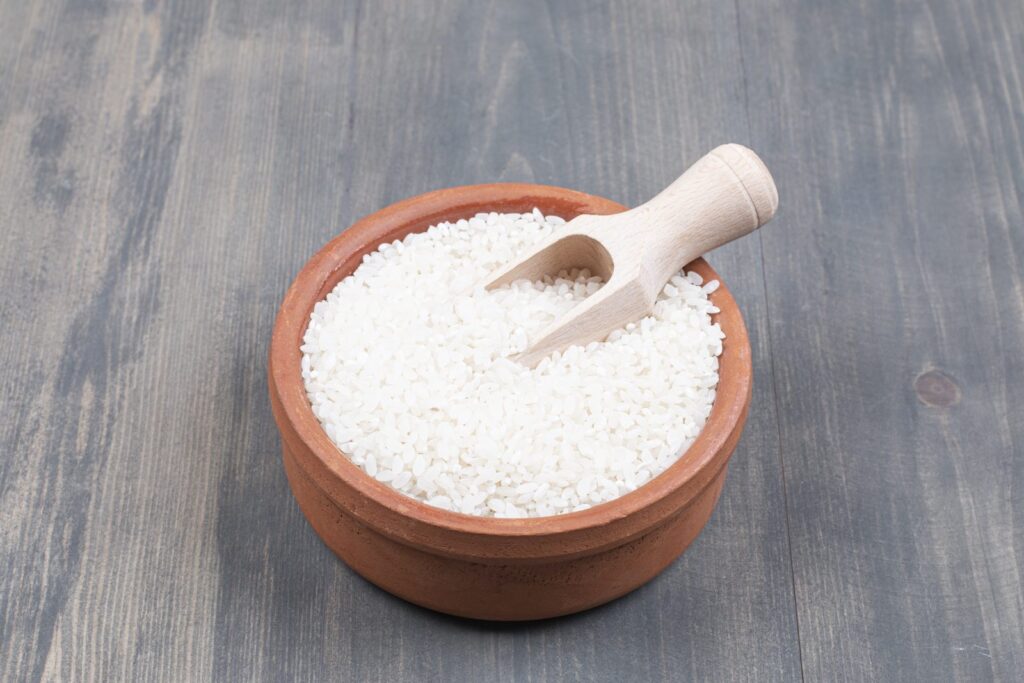
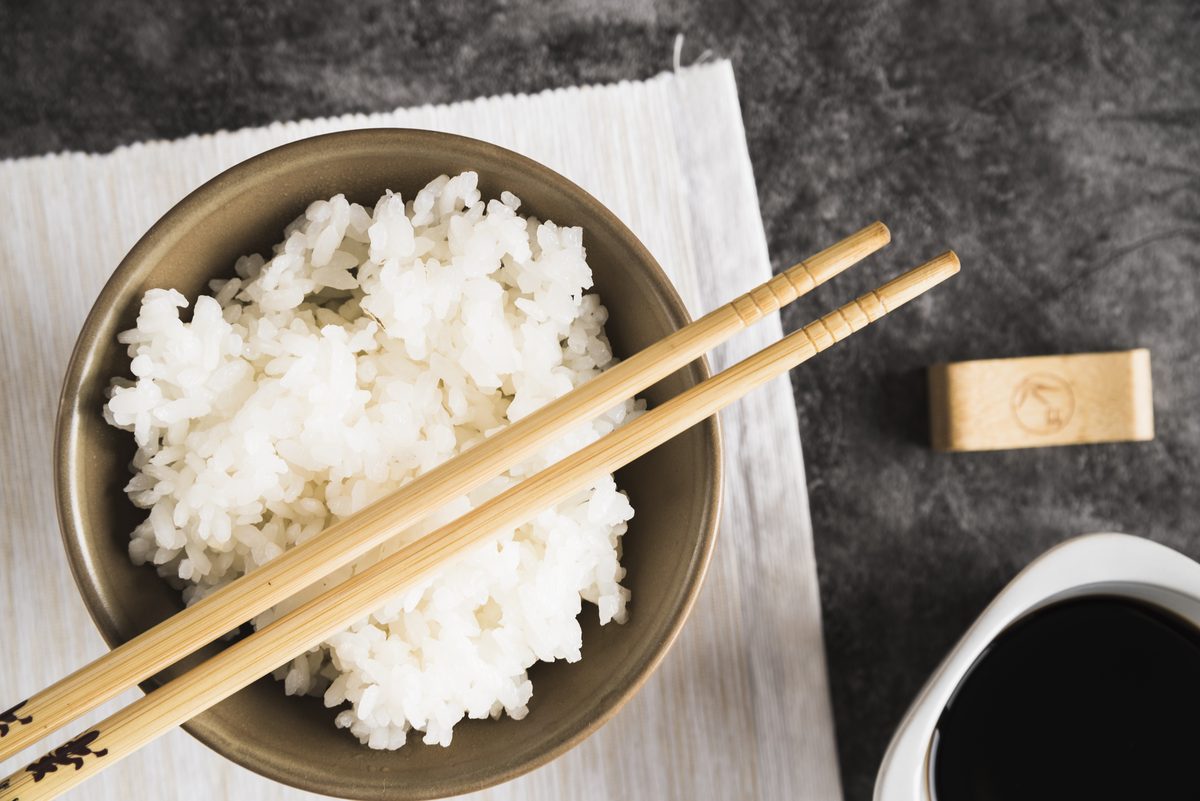
Allow 90 g of raw rice per adult, which is about 200 g once cooked. That is the bottom of the official range for French collective catering (GEMRCN, the nutrition guidelines for school and collective catering), which provides 200 to 250 g of cooked rice for a teenager or an adult as a side dish. For a child in nursery school, 120 g cooked is enough, about 55 g raw; in primary school, 170 g cooked, or 75 g raw. A 200 g portion of cooked white rice provides 310 kcal and 66 g of carbohydrate.
Where this figure comes from
The PNNS (the French national nutrition and health programme) recommends starchy foods every day, wholegrain where possible, without giving a weight per meal. The only official reference in grams is the GEMRCN portion table, the nutritional framework for school and collective catering. It sets the quantities of rice, pasta and potatoes cooked, ready to eat, within 10%:
| Diner | Cooked rice (GEMRCN) | Raw white rice equivalent |
|---|---|---|
| Child in nursery school | 120 g | about 55 g |
| Child in primary school | 170 g | about 75 g |
| Teenager, adult | 200 to 250 g | about 90 to 110 g |
| Rice salad as a starter, adult | 100 to 150 g | about 45 to 65 g |
The GEMRCN specifies that these weights are « necessary but also sufficient »: they cover the needs of a main meal without having to be increased as a matter of course. If the rice goes with an already hearty dish, a chilli or a curry with pulses for example, the lower end of the range is enough.
How much does rice weigh once cooked?
Rice absorbs water as it cooks and gains weight. Comparing the dry matter of the « raw » and « cooked » lines in the Ciqual table gives the conversion factor for each type of rice:
| Type of rice | Water, raw | Water, cooked | 100 g raw gives | For 200 g cooked, weigh |
|---|---|---|---|---|
| White rice | 12.6% | 61.4% | about 225 g cooked | 90 g raw |
| Parboiled white rice | 9.9% | 63.5% | about 245 g cooked | 80 g raw |
| Brown rice | 12.6% | 54% | about 190 g cooked | 105 g raw |
These factors are averages: the result varies with cooking, longer or shorter, in plenty of water or by absorption. Remember the order of magnitude: white rice a little more than doubles, brown rice a little less. Because brown rice absorbs less water, 200 g of cooked brown rice contains more grain than 200 g of cooked white rice.
Without scales: equivalents
Nobody weighs their rice every evening. Based on USDA weights, a US cup of 237 mL holds 185 g of raw long-grain rice, which is about 0.78 g per millilitre. From this we can work out:
| Measure | Raw long-grain rice |
|---|---|
| 1 tablespoon (15 mL) | about 12 g |
| 1 full 20 cL glass | about 155 g |
| 90 g, one adult portion | a little more than half a glass, or 7 to 8 tablespoons |
For a meal for several people, simply multiply the portion:
| Number of adults | Raw white rice | Approximate cooked weight |
|---|---|---|
| 1 | 90 g | 200 g |
| 2 | 180 g | 410 g |
| 4 | 360 g | 815 g |
| 6 | 540 g | 1.2 kg |
What a portion gives you
To compare rice types for an equal portion on the plate, here is 200 g of each cooked rice, based on the Ciqual table:
| 200 g cooked | Calories | Carbohydrate | Protein | Fibre | Magnesium | Manganese |
|---|---|---|---|---|---|---|
| White rice | 310 kcal | 66 g | 6.3 g | 2.8 g | 18 mg | 0.56 mg |
| Brown rice | 374 kcal | 75 g | 7.7 g | 4.2 g | 116 mg | 2.6 mg |
| Parboiled white rice | 292 kcal | 63 g | 5.9 g | 2.2 g | 20 mg | less than 0.2 mg |
| Basmati rice | 296 kcal | 66 g | 6.1 g | less than 1 g | 11 mg | 0.64 mg |
| Thai rice | 286 kcal | 63 g | 4.8 g | less than 1 g | 8 mg | 0.58 mg |
Rice is first and foremost a source of energy in the form of starch. Brown rice stands out clearly: its portion covers 130% of the reference value for manganese (2 mg), 31% of that for magnesium (375 mg) and 39% of that for phosphorus (700 mg), with 276 mg. The bran and germ, removed when white rice is polished, concentrate these minerals and the fibre. To go further, see our guides to dietary fibre and foods rich in magnesium.
On protein, rice stays modest: 5 to 8 g per portion. Combined with pulses, lentils or kidney beans, it makes a dish complete in amino acids, as our guide to plant proteins explains.
When is it too much?
There is no toxic threshold for rice itself. Two limits really matter: the balance of the plate and arsenic.
The balance of the plate
Doubling the portion, 400 g of cooked white rice, gives 620 kcal and 133 g of carbohydrate for the side dish alone. The rice then takes the place of vegetables and protein. The practical balanced-plate rule, detailed in our guide to eating a balanced diet, reserves about a quarter of the plate for starchy foods.
Inorganic arsenic
Rice often grows in flooded paddy fields and absorbs more arsenic from the soil than other cereals. EFSA, in its updated opinion published in 2024, confirms that inorganic arsenic is a genotoxic carcinogen and that rice and its products are among the main dietary sources, along with other cereals and drinking water. The European Union sets maximum levels (EU Regulation 2023/465):
| Product | Maximum inorganic arsenic |
|---|---|
| White rice (milled, non-parboiled) | 0.15 mg/kg |
| Parboiled rice and brown rice (husked) | 0.25 mg/kg |
| Rice flour | 0.25 mg/kg |
| Rice cakes, wafers, crackers and puffed rice cereals | 0.30 mg/kg |
| Rice intended for food for infants and young children | 0.10 mg/kg |
| Rice-based drinks | 0.03 mg/kg |
The higher ceiling for brown rice makes sense: arsenic concentrates in the husk of the grain. For an adult who eats rice a few times a week in normal portions, this is not a reason to stop. Three habits reduce exposure:
- Cook in plenty of water and discard the cooking water: with 6 volumes of water to 1 volume of rice, the drop in inorganic arsenic is in the order of 35 to 45% depending on the rice.
- Parboil, then finish by absorption: in a University of Sheffield study (Menon et al., 2021), boiling the rice for 5 minutes, discarding the water, then finishing the cooking in fresh water removed 54% of the inorganic arsenic from brown rice and 73% from white rice, while preserving more of the minerals.
- Vary your starchy foods: pasta, potatoes, quinoa, semolina, pulses. This applies especially to young children and to people who eat rice, rice cakes and rice flour every day, for example on a gluten-free diet.
Cooked rice left waiting
Rice can contain spores of Bacillus cereus, a bacterium that survives cooking. If cooked rice stays for several hours at room temperature, it can multiply and produce a toxin that reheating does not destroy. According to Anses, prevention relies on rapid cooling and storage in the fridge: do not leave a pan of rice to cool on the worktop until the next day.
Depending on your profile
Child
The GEMRCN provides 120 g of cooked rice in nursery school and 170 g in primary school, about 55 g and 75 g of raw white rice. To limit arsenic, alternate rice with other starchy foods and, for toddlers, favour infant products subject to the 0.10 mg/kg ceiling. Rice drinks do not replace milk for a child. See our guide to children’s nutrition.
Teenager
Teenagers are entitled to the same portion as adults, 200 to 250 g cooked, and often the top of the range if they play sport or are in a growth spurt. See the guide to teenage nutrition.
Athlete
Carbohydrate needs depend on training. The joint position of the American College of Sports Medicine and the North American dietetic associations (2016) recommends 3 to 5 g of carbohydrate per kilo per day for light activity, 5 to 7 g for about an hour a day, and 6 to 10 g for endurance of one to three hours a day. For a 70 kg athlete at 6 g per kilo, that is 420 g of carbohydrate a day: a 200 g portion of cooked white rice provides 66 g. A portion and a half per meal then becomes logical. See what to eat before and after exercise.
Diabetes
Rice is not off limits, but the quantity matters: 200 g of cooked white rice provides 66 g of carbohydrate. Three levers help: stick to the portion, prefer brown rice, richer in fibre, or parboiled rice and basmati, whose glycaemic index is generally more moderate than sticky or jasmine rice, and always pair it with vegetables and a protein. The details are in our guides to the glycaemic index and type 2 diabetes.
Do you have diabetes? Which rice to choose and how much: see rice and diabetes.
Weight loss
No need to cut out rice: 150 g of cooked white rice, about 65 g raw, gives 233 kcal. Complete the plate with vegetables for volume and a protein for fullness. Brown rice is a little more filling thanks to its fibre.
Older adults
For older people who eat little, the risk is rather a lack of energy and protein. A portion of rice paired with meat, fish, eggs or pulses helps prevent malnutrition.
Gluten-free and sensitive gut
Rice is naturally gluten-free, which makes it a staple starchy food in coeliac disease: see our gluten-free guide. It is also low in FODMAPs, useful with irritable bowel syndrome. In both cases people often eat a lot of it: this is where varying your grains, quinoa, buckwheat, millet, matters most for arsenic.
How to fit it in
Three recipes on the site to put rice at the centre of a balanced meal:
- Pea risotto: the peas add fibre and plant protein.
- Vegetable paella: a plate where the vegetables take up as much room as the rice.
- Chilli con carne: with the kidney beans, 150 g of cooked rice is enough per person.
To prepare several meals at once, our batch cooking guide reminds you how to cool and store cooked starchy foods.
Frequently asked questions
How much raw rice per person?
90 g of raw white rice per adult, which is about 200 g cooked. Collective catering provides 200 to 250 g cooked, or 90 to 110 g raw.
How much rice for 4 people?
360 g of raw white rice, which gives about 815 g of cooked rice.
How much does 100 g of rice weigh once cooked?
About 225 g for white rice, 245 g for parboiled rice and 190 g for brown rice, according to the Ciqual table.
How many calories in a portion of rice?
310 kcal for 200 g of cooked white rice, 374 kcal for 200 g of cooked brown rice, which contains more grain for the same weight.
Can you eat rice every day?
Yes in a normal portion, but it is better to alternate with other starchy foods to limit exposure to inorganic arsenic, especially in children. Cooking in plenty of water also reduces arsenic.
White rice or brown rice?
Brown rice provides more fibre, magnesium and above all manganese. It also contains a little more arsenic, concentrated in the husk: cooking in plenty of water is all the more useful.
Other quantity guidelines
how many seeds a day, how many almonds a day, how much coffee a day, how much sugar a day, how much red meat a week, how much fish a week, how much cheese a day, how many walnuts a day, how many eggs a day, how many bananas a day, how much water to drink a day, how much dark chocolate a day, how much pasta per person.
Our sources
- GEMRCN, nutrition recommendation: portion weights of foods for schoolchildren, teenagers and adults.
- Table Ciqual 2025 (Anses): white rice, parboiled white rice and brown rice, raw and cooked; basmati rice and Thai rice, cooked.
- USDA FoodData Central, SR Legacy, « Rice, white, long-grain, regular, raw »: weight of a cup.
- Regulation (EU) No 1169/2011, Annex XIII: labelling reference values.
- Regulation (EU) 2023/465: maximum levels of inorganic arsenic; EFSA, Update of the risk assessment of inorganic arsenic in food, EFSA Journal, 2024.
- Menon M et al. Improved rice cooking approach to maximise arsenic removal while preserving nutrient elements. Science of the Total Environment, 2021.
- Anses, data sheet on biological hazards transmissible by food: Bacillus cereus.
- Thomas DT, Erdman KA, Burke LM. Nutrition and Athletic Performance, joint position of ACSM, the Academy of Nutrition and Dietetics and Dietitians of Canada, 2016.
- PNNS, consumption guidelines (Santé publique France, Manger Bouger).


