Liposomal vitamin C: benefits, liposomal vs regular vitamin C, dosage and side effects

The short answer
Liposomal vitamin C is ordinary vitamin C (ascorbic acid) packed inside tiny phospholipid bubbles called liposomes, designed to get more of it across the gut wall. A 2025 review found 10 studies: 9 showed higher blood levels than standard vitamin C, with peaks 1.2 to 5.4 times higher. But the studies are small (11 and 27 people in two of the trials), mostly single-dose, often run by manufacturers, and almost none measured a health outcome. In healthy people, a few hundred milligrams of regular vitamin C already saturate the blood. Liposomal vitamin C costs over 20 times more per gram than plain powder, and from 1 g a day, vitamin C in any form is linked to a slightly higher kidney stone risk in men.
This article is for information and does not replace medical advice.
What is liposomal vitamin C?
A liposome is a tiny sphere with a shell of phospholipids, the same fats that make up cell membranes; supplements mostly use phosphatidylcholine from sunflower or soy lecithin. Water-soluble vitamin C sits inside. Regular vitamin C is absorbed by gut transporters that saturate as the dose rises; liposomes may use another route. You’ll find it as capsules, liquids or sachets. “Liposomal” on a label says nothing about liposome size, stability or how much vitamin C is actually encapsulated.
Liposomal vs regular vitamin C
How regular vitamin C behaves
In Levine’s landmark 1996 study, 7 volunteers were hospitalized for 4 to 6 months and given 30 to 2,500 mg a day. Findings:
- a 200 mg dose is fully absorbed;
- blood is fully saturated at 1,000 mg a day, white blood cells at 100 mg;
- from 500 mg in a single dose, absorption drops and the excess is excreted;
- at 1,000 mg a day, urinary oxalate and uric acid rise.
The authors saw no clear value above 400 mg a day in healthy people. Food covers needs easily: think red peppers, guava or broccoli (see our list of foods high in vitamin C).
What liposomal vitamin C studies show
| Study | Design | Result | Worth knowing |
|---|---|---|---|
| Davis et al., 2016 | 11 adults, 4 g single dose: placebo, oral, liposomal, IV | Higher blood levels than regular oral, lower than IV; protection against oxidative stress similar to regular oral | One co-author affiliated with private companies |
| Gopi and Balakrishnan, 2021 | Single fasting dose, open-label crossover | Bioavailability 1.77 times higher | Authors employed by supplement-industry companies |
| Purpura et al., 2024 | 27 adults, 500 mg single dose, double-blind, placebo-controlled | Peak blood level +27%, 24-hour exposure +21%; in white blood cells, peak +20% and exposure +8% | Branded formula (LipoVantage®), single dose |
| Carr, 2025 (review) | 10 studies, 0.15 to 10 g | 9 of 10 favorable: peak 1.2 to 5.4-fold, exposure 1.3 to 7.2-fold higher | None measured urinary excretion; only 2 looked at a biological effect |
So liposomal vitamin C probably raises blood levels somewhat more, especially at high doses where gut transporters saturate. But the gap varies widely by formula, studies are short and small, and no study shows extra health benefits (fewer colds, less fatigue) over the same dose of regular vitamin C.
Liposomal vitamin C benefits: real but limited
The benefits are those of vitamin C itself: immune function, reduced fatigue, collagen formation and better absorption of plant iron, mainly in people who fall short. The liposomal form may help if regular high-dose vitamin C upsets your stomach (not rigorously measured), or if a doctor recommends high doses without IV. If you eat fruits and vegetables, a supplement of any form adds little.
Side effects: kidney stones and other cautions
Part of vitamin C is converted to oxalate, the main component of most kidney stones. In large US cohorts (Ferraro et al., 2016, nearly 200,000 people followed for about 11 years):
- in men, supplemental vitamin C of 1,000 mg or more a day was linked to a 19% higher stone risk, and total intake of 1,000 mg or more to a 43% higher risk;
- in women, no link;
- no link with vitamin C from food.
A meta-analysis (Jiang et al., 2019) agrees. Nothing suggests liposomes avoid this. If you’ve had a kidney stone or have kidney disease, avoid 1 g a day or more and talk to your doctor. Also be careful with iron overload (hemochromatosis), G6PD deficiency, cancer treatment, pregnancy, and soy allergy (check the lecithin source). High doses can cause diarrhea and cramps.
How much liposomal vitamin C per day?
- Needs: France’s health agency (Anses) sets 110 mg a day for adults; 200 mg a day already sits past the steep part of the saturation curve (Levine, 1996).
- Typical products: 500 to 1,000 mg a day, the dose that fully saturates blood with regular vitamin C.
- Above 1 g a day: no proven benefit in healthy people, plus stone risk in men.
- Splitting: two 500 mg doses of regular vitamin C are better absorbed than one 1 g dose; not studied with liposomes.
- Price: in our best vitamin C supplement comparison, pure powder costs about €0.04 per gram versus about €1 for liposomal capsules. For a whole-food option, see acerola cherry.
Novoma: 1,000 mg liposomal Quali®-C vitamin C, made in France
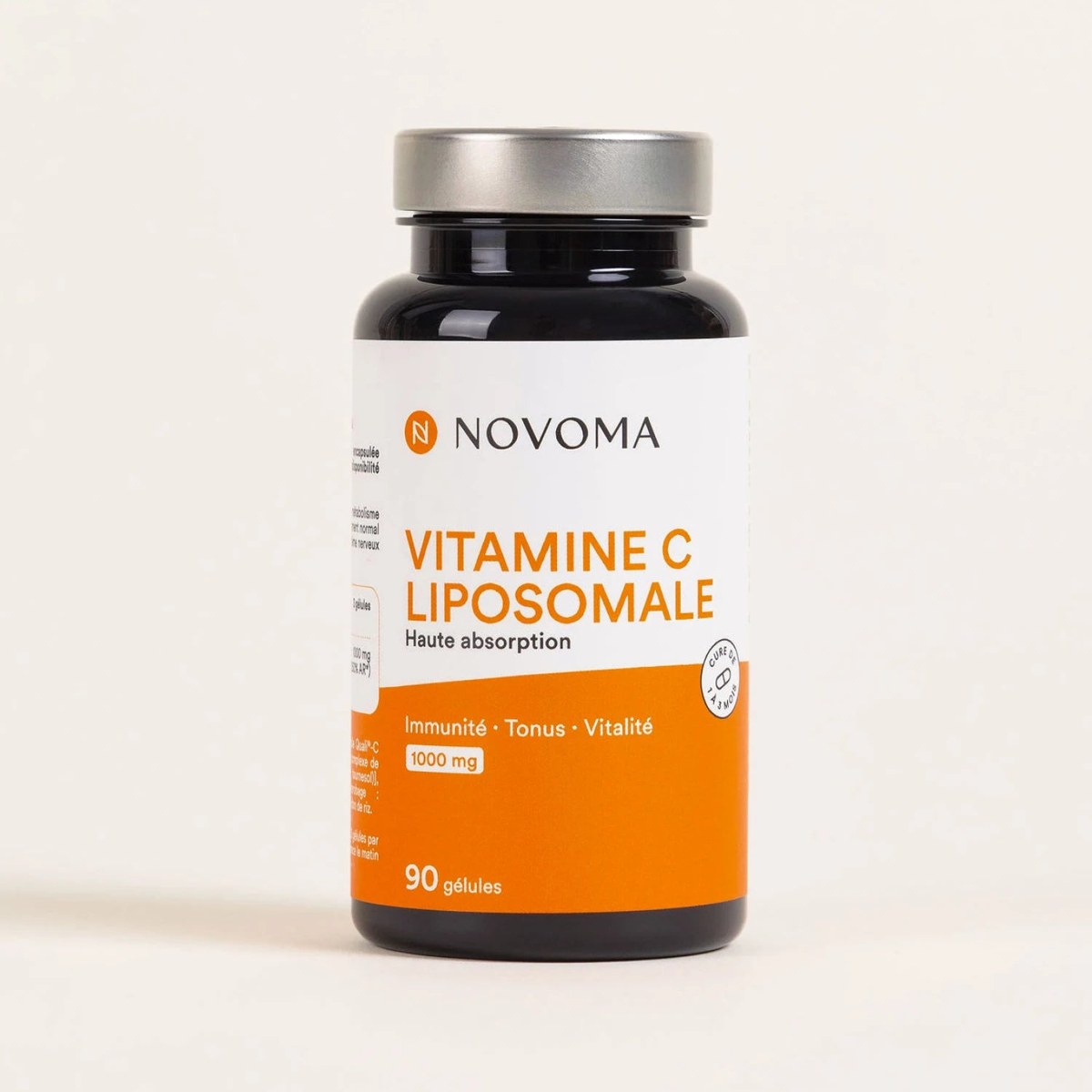
If you prefer the liposomal form, Novoma‘s product page is notably transparent. It lists:
- 1,000 mg of vitamin C per 3 capsules, from Quali®-C ascorbic acid made in Scotland;
- sunflower phosphatidylcholine liposomes (no soy), plant capsule and rice starch: a short ingredient list;
- capsules made in France, with encapsulation done in the US; a downloadable certificate of analysis;
- 3 capsules a day with a glass of water, ideally in the morning; 90 capsules, a 30-day supply; suggested 2-month course;
- a clear caution we appreciate: the brand advises against it for people with kidney stones;
- €27.90 per bottle (price checked on 22/11/2026), about €0.93 a day.
How does the dose compare? 1,000 mg a day is the dose that saturates blood with regular vitamin C and falls within the range of liposomal bioavailability studies (0.5 to 4 g single doses). Those studies did not test this formula. If you’re a man with a history of stones, or already eat plenty of produce, 1 or 2 capsules may be enough; ask your doctor or pharmacist.
See Novoma Liposomal Vitamin C →
Partner link: we earn a commission if you order through this link, at no extra cost to you.
Frequently asked questions
What is liposomal vitamin C?
Regular vitamin C wrapped in phospholipid bubbles (liposomes) to improve absorption. The molecule is the same ascorbic acid.
Is liposomal vitamin C better than regular vitamin C?
It raises blood levels somewhat more, by 20% to several-fold depending on the study, but no trial shows better health outcomes at the same dose.
What are the benefits of liposomal vitamin C?
The same as vitamin C: immune function, collagen formation, iron absorption, reduced fatigue, mainly if you are low. Possibly better stomach tolerance at high doses.
Is 1,000 mg of liposomal vitamin C too much?
Not dangerous for most people, but about ten times daily needs. Blood is already saturated at that dose, and men prone to kidney stones should go lower.
Who should avoid liposomal vitamin C?
People with kidney stones or kidney disease, iron overload or G6PD deficiency, and anyone on cancer treatment without medical advice.
Sources
- Carr A.C. Do Liposomal Vitamin C Formulations Have Improved Bioavailability? A Scoping Review. Basic Clin Pharmacol Toxicol, 2025; 137(1): e70067. PubMed 40506693
- Davis J.L. et al. Liposomal-encapsulated Ascorbic Acid: Influence on Vitamin C Bioavailability and Capacity to Protect Against Ischemia-Reperfusion Injury. Nutr Metab Insights, 2016; 9: 25-30. PubMed 27375360
- Gopi S., Balakrishnan P. Evaluation and clinical comparison studies on liposomal and non-liposomal ascorbic acid. J Liposome Res, 2021; 31(4): 356-364. PubMed 32901526
- Purpura M. et al. Liposomal delivery enhances absorption of vitamin C into plasma and leukocytes: a randomized trial. Eur J Nutr, 2024; 63(8): 3037-3046. PubMed 39237620
- Levine M. et al. Vitamin C pharmacokinetics in healthy volunteers: evidence for a recommended dietary allowance. Proc Natl Acad Sci U S A, 1996; 93(8): 3704-9. PubMed 8623000
- Ferraro P.M. et al. Total, Dietary, and Supplemental Vitamin C Intake and Risk of Incident Kidney Stones. Am J Kidney Dis, 2016; 67(3): 400-7. PubMed 26463139
- Jiang K. et al. Ascorbic Acid Supplements and Kidney Stones Incidence Among Men and Women: a meta-analysis. Urol J, 2019; 16(2): 115-120. PubMed 30178451