Moringa benefits, side effects and how to take moringa powder
The short answer
Moringa (Moringa oleifera) is a tropical tree whose leaves are eaten fresh or dried into a green powder. The leaf is genuinely nutritious: 9.4 g of protein, 185 mg of calcium and 4 mg of iron per 100 g of fresh leaves. But as a supplement you take 1 to 3 g a day, and at that dose the nutrient contribution is small. As for health benefits, human trials show at best a small drop in blood sugar and blood pressure, and the most rigorous meta-analysis rates the evidence as “very low” certainty. Side effects: the leaf is well tolerated in studies, but the root and bark must be avoided in pregnancy, and moringa calls for caution with diabetes medication or blood thinners.
This article is for information and does not replace medical advice. If you are pregnant, take medication (diabetes, blood thinners, blood pressure) or have had a blood clot, talk to your doctor before using moringa.
Want to try it without picking the wrong product? Here is our pick, from Nutrition•pro: a French brand that designs and makes its products in France, it says.
What is moringa?
Moringa is a fast-growing tree native to the Indian subcontinent and grown across the tropics, especially in Africa and Asia, where it is nicknamed the “tree of life” or “drumstick tree”. The leaves are cooked like a vegetable or dried into powder, the young pods are eaten, and the seeds give moringa oil, used mainly in skincare. Root and bark belong to traditional medicine, not to the kitchen.
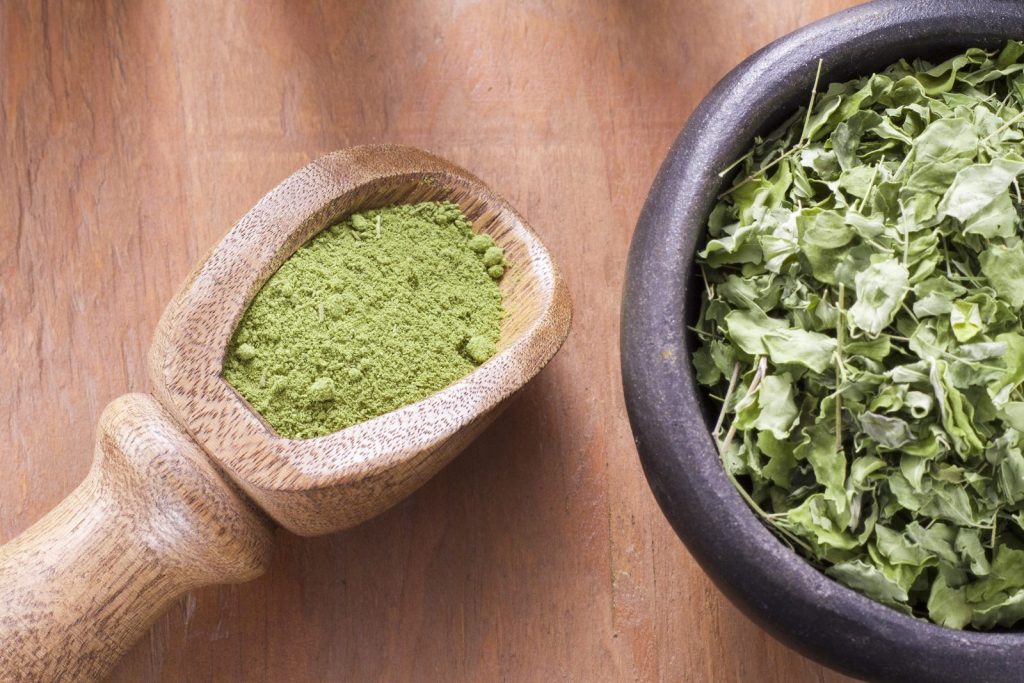
Moringa powder, capsules and most moringa supplements contain dried leaf powder. That is what this guide covers. Moringa tea is simply an infusion of the dried leaves.
Moringa nutrition: impressive per 100 g, modest per dose
Reference values for fresh leaves, from our moringa food page:
| Per 100 g | Fresh moringa leaves |
|---|---|
| Energy | 64 kcal |
| Protein | 9.4 g |
| Calcium | 185 mg |
| Iron | 4 mg |
| Vitamin C | 51.7 mg |
| Vitamin A | 378 µg |
| Vitamin B6 | 1.2 mg |
That protein level is unusual for a leaf, though kale provides more vitamin C. The catch: nobody eats 100 g of moringa powder. Using the label of the Nutrition•pro powder (280 kcal and 27 g of protein per 100 g), here is what real doses provide:
| Dose | Powder | Protein | Energy |
|---|---|---|---|
| 3 capsules | 0.9 g | 0.24 g | 2.5 kcal |
| About 1 teaspoon | 2.5 g | 0.7 g | 7 kcal |
| For comparison: 1 egg | – | about 6 g | – |
Moringa is a good food, and a real tool against malnutrition when leaves are eaten by the handful. A few grams of powder is a small green extra, not a multivitamin. That is the problem with the superfood label, which we unpack in what is a superfood, really?
Moringa benefits: what the research shows
Blood sugar: possible effect, weak evidence
In a double-blind Spanish trial (Gómez-Martínez et al., Nutrients, 2021), 65 adults with prediabetes took 2.4 g of leaf powder a day (6 capsules) or a placebo for 12 weeks. Fasting glucose and HbA1c drifted down with moringa and up with placebo, with no change in liver or kidney markers.
- A meta-analysis of 9 randomized trials (Crișan et al., 2025, 649 participants) found no significant effect on most cardiometabolic markers. A small drop in diastolic pressure did not hold up in sensitivity analyses, and certainty was very low for every outcome.
- A meta-analysis restricted to people with metabolic disease (Mokgalaboni et al., 2026, 20 studies) found HbA1c 0.62 points lower on average, results the authors call preliminary.
Moringa is no substitute for treatment or diet. Start with our type 2 diabetes diet guide and our best blood sugar supplements comparison.
Blood pressure and weight
A meta-analysis of 8 trials (Samarin et al., 2026) found lower blood pressure (about -6 mmHg systolic, -7 mmHg diastolic), mostly with 5 to 10 g a day for over 4 weeks, but no effect on body weight or BMI. The stricter Crișan analysis did not robustly confirm the blood pressure effect. Moringa will not make you lose weight.
Moringa benefits for women: breastfeeding
In the Philippines, moringa (malunggay) is a traditional galactagogue. The NIH LactMed database cites a meta-analysis of 14 studies (865 women) showing higher prolactin and milk volume, and a review of 8 randomized trials (Ammar et al., 2025) agrees, over short courses of 3 to 10 days. No serious short-term side effects were reported in mothers or babies, but long-term data are thin. See also what to eat while breastfeeding.
Moringa benefits for men, energy and immunity
Claims about testosterone, libido, energy or immunity rest mainly on the leaf’s composition and on animal or lab studies. A 2022 review (Liu et al.) concludes that clinical data are too scarce to support medical use. We found only animal studies on sexual function.
Moringa side effects, interactions and pregnancy
Leaf powder is well tolerated
Human studies of leaf powder have not reported notable adverse effects (Stohs and Hartman, 2015), and animal toxicity appears only at doses far above human use. It is fibre-rich, so start with a small amount.
Pregnancy: no root, no bark
In rats, a moringa root extract showed hormonal and anti-fertility effects (Shukla et al., 1988), and a review of herbs to avoid in pregnancy (Bernstein et al., 2021) lists Moringa oleifera on that basis. Trials giving leaf powder to pregnant women have not flagged problems, but they are few. Our position: no root, bark or concentrated extract in pregnancy, and medical advice before any leaf supplement. See our pregnancy diet guide.
Diabetes medication
If moringa lowers blood sugar slightly, the effect may add to metformin, sulfonylureas or insulin. This has not been measured directly; it is a sensible precaution. Tell your doctor and monitor your glucose when you start.
Blood thinners and clots
LactMed notes that moringa may promote blood clotting and advises caution in anyone at high risk of clots. Two published cases point the same way: a pulmonary embolism in a 63-year-old woman after 5 months of leaf extract (Ebhohon and Miller, 2022), and a stroke in a man on warfarin whose INR crashed after he added moringa powder to his shakes, then recovered once he stopped (Kobayashi et al., 2026). Two cases do not prove causation, but on warfarin or with a history of clots, avoid moringa unless your doctor agrees.
Other medicines
In the lab, leaf extracts inhibit CYP3A4, a liver enzyme that clears many drugs (Monera et al., 2008). Clinical relevance is unproven; mention moringa to your pharmacist if you take long-term medication.
How to take moringa powder or capsules
- Dose: 1 to 3 g of leaf powder a day as a food. Blood sugar trials used 2.4 g; blood pressure trials often 5 to 10 g.
- Timing: with a meal, for digestive comfort.
- Form: powder goes into smoothies, soups (added at the end) or sauces; its taste is grassy, like green tea or spinach. Capsules avoid the taste.
- Duration: trials ran from a few days to 12 weeks; review after that.
- Quality: leaf powder (not root), organic, with batch quality control.
Nutrition•pro organic moringa: capsules and powder
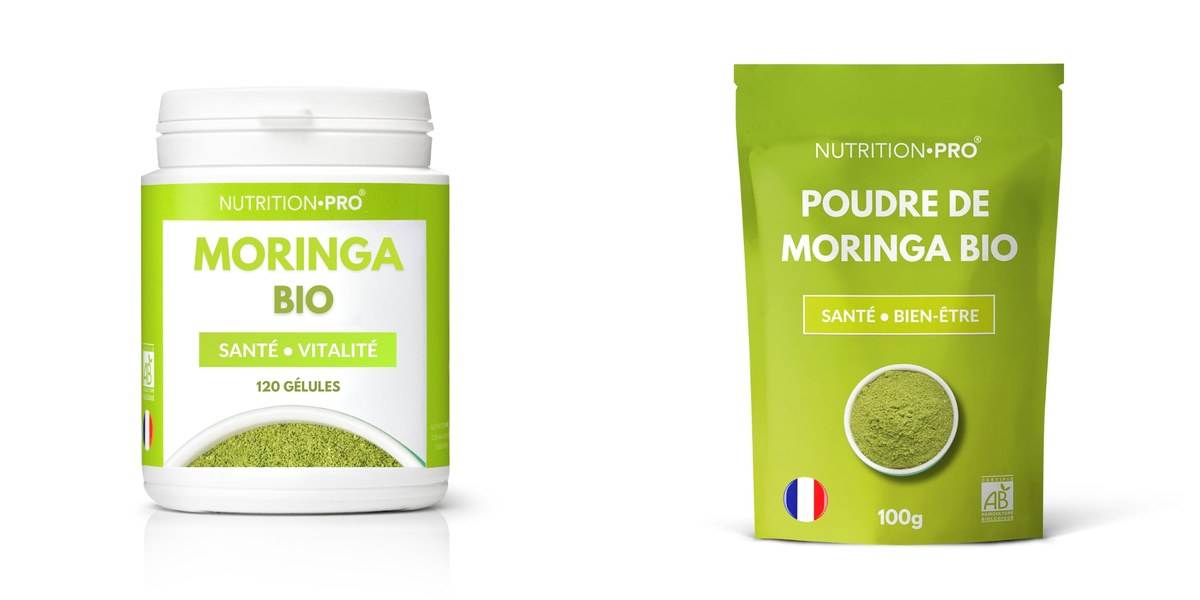
Nutrition•pro is a French brand based in Paris. Its moringa comes in two forms with the same strength: a single ingredient, organic moringa leaf powder, with no additives or preservatives. The product page states tropical cultivation without chemical fertilisers, low-temperature drying and laboratory analysis of every batch, screening for more than 400 unwanted substances. That matters for a plant powder.
| Organic moringa (capsules) | Organic moringa powder | |
|---|---|---|
| Ingredients | 100% organic moringa leaf powder; plant capsule (HPMC) | 100% organic moringa leaf powder |
| Suggested use | 3 capsules a day (900 mg) | 1 to 2 teaspoons a day |
| Pack | 120 capsules, 40 days | 100 g (40 days per the brand) or 500 g |
| Price (checked 22 Nov 2026) | €19.99, about €0.50 a day | €19.99 per 100 g; €44.99 per 500 g |
| With the code | €17.99, about €0.45 a day | €17.99 per 100 g; €40.49 per 500 g |
Our take. The capsules are convenient and tasteless at 900 mg a day, a maintenance dose below the 2.4 g of the blood sugar trial. The powder makes it easier to reach studied doses and costs less per gram, especially in the 500 g pouch (under half the price per kilo). Either way, keep the limits of the research in mind.
Promo code: SEOCONSULTINGSL for 10% off your order (prices checked 22 Nov 2026).
See Nutrition•pro moringa capsules →
See Nutrition•pro moringa powder →
Partner link: we earn a commission if you order through this link, at no extra cost to you.
Weighing it against spirulina? Read our spirulina benefits guide. For blood sugar, berberine is better studied.
FAQ
What is moringa good for?
As a food, it is rich in protein, calcium, iron and vitamins. In human trials it may slightly lower blood sugar and blood pressure and support milk supply, with weak evidence. It does not cause weight loss.
What are the side effects of moringa?
A strong taste, modest nutrition at usual doses, and key cautions: pregnancy (no root or bark), diabetes medication, blood thinners or a history of clots.
Can I take moringa every day?
Yes, at food-level doses (1 to 3 g of leaf powder) for a healthy adult. Trials lasted up to 12 weeks without notable side effects.
Is moringa tea as good as the powder?
Tea extracts only part of the leaf’s compounds and none of its protein or fibre. Human trials used leaf powder, not tea.
Do moringa and berberine patches work?
We found no published human trial of these patches. Moringa research uses swallowed powder; berberine research uses oral capsules.
Sources
- Crișan D. et al. Effects of Moringa oleifera Lam. Supplementation on Cardiometabolic Outcomes. Nutrients, 2025; 17(22): 3501. PubMed 41305552
- Mokgalaboni K. et al. Moringa oleifera on hyperglycemia and hypertension in metabolic diseases. Metabol Open, 2026; 29: 100451. PubMed 41816507
- Samarin M.M. et al. The Effect of Moringa oleifera on Body Weight and Blood Pressure. Food Sci Nutr, 2026; 14(5): e71899. PubMed 42254443
- Gómez-Martínez S. et al. Moringa oleifera Leaf Supplementation as a Glycemic Control Strategy in Subjects with Prediabetes. Nutrients, 2021; 14(1): 57. PubMed 35010932
- Stohs S.J., Hartman M.J. Review of the Safety and Efficacy of Moringa oleifera. Phytother Res, 2015; 29(6): 796-804. PubMed 25808883
- Drugs and Lactation Database (LactMed). Moringa. NICHD, updated 2026. PubMed 30000959
- Ammar M. et al. Moringa oleifera Supplementation as a Natural Galactagogue. Foods, 2025; 14(14): 2487. PubMed 40724308
- Liu R. et al. Moringa oleifera: a systematic review of its botany, traditional uses, phytochemistry, pharmacology and toxicity. J Pharm Pharmacol, 2022; 74(3): 296-320. PubMed 34718669
- Bernstein N. et al. Is it safe to consume traditional medicinal plants during pregnancy? Phytother Res, 2021; 35(4): 1908-1924. PubMed 33164294
- Shukla S. et al. Antifertility profile of the aqueous extract of Moringa oleifera roots. J Ethnopharmacol, 1988; 22(1): 51-62. PubMed 3352285
- Monera T.G. et al. Moringa oleifera leaf extracts inhibit 6beta-hydroxylation of testosterone by CYP3A4. J Infect Dev Ctries, 2008; 2(5): 379-383. PubMed 19745507
- Ebhohon E., Miller D. Moringa Oleifera leaf extract induced pulmonary embolism: a case report. Int J Emerg Med, 2022; 15(1): 16. PubMed 35413819
- Kobayashi Y. et al. Acute ischemic stroke associated with Moringa oleifera and protein powder consumption in a patient on warfarin. Surg Neurol Int, 2026; 17: 570. PubMed 42974563