Group · Dairy
Brie
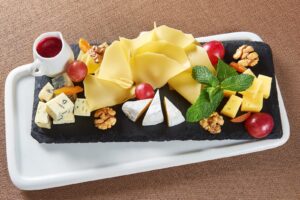
Brie is a soft, bloomy-rind cheese, recognisable by its thin, downy white layer and its creamy, melting paste. Originally from the Brie region of Île-de-France, it comes in several renowned varieties such as Brie de Meaux or Brie de Melun, but also in more industrial versions sold in portions. Made from cow’s milk, it has a smooth texture and a mild taste that intensifies with maturing. In terms of nutrition facts, brie provides around 345 kcal per 100 g, with 17.3 g of protein and 30.4 g of fat. Rich in calcium and good-quality protein, it has its place, in moderation, in a balanced, indulgent diet.

Macronutrient breakdown
Nutrition table per 100 g
| Calories | 345 kcal |
| Kilojoules | 1430 kJ |
| Protein | 17,3 g |
| Carbohydrate | 0,7 g |
| Fat | 30,4 g |
| Fibre | 0,1 g |
Micronutrients per 100 g
All measured nutrients, ranked by share of the daily reference intake.
- Calcium420 mg53 %
- Phosphorus274 mg39 %
- Vitamin B969,6 µg35 %
- Vitamin B20,45 mg32 %
- Vitamin B120,76 µg30 %
- Vitamin A242 µg30 %
- Zinc2,35 mg24 %
- Vitamin B60,22 mg16 %
See the other 16 nutrients
- Iodine18,9 µg13 %
- Vitamin B50,58 mg10 %
- Omega-3 ALA0,18 g9 %
- Selenium4,54 µg8 %
- Total omega-30,2 g8 %
- Vitamin D0,39 µg8 %
- Potassium142 mg7 %
- EPA0,02 g7 %
- Vitamin B10,06 mg5 %
- Magnesium18,4 mg5 %
- Copper0,04 mg4 %
- Omega-6 LA0,41 g4 %
- Vitamin E0,47 mg4 %
- Vitamin K12,3 µg3 %
- Iron0,42 mg3 %
- Vitamin B30,39 mg2 %
Anses Ciqual 2025. Source: Anses, 2025, Ciqual food composition table
Tips
Brie is best enjoyed at room temperature, taken out of the fridge 30 minutes before eating to bring out all its creaminess. A reasonable portion is around 30 g, or one thin slice, which provides a useful amount of calcium and protein without weighing down the calorie count of your meal. Keep it wrapped in its original paper, in the vegetable drawer, and use it quickly once cut to preserve its melting texture.
In the kitchen, brie is versatile: on a cheeseboard, as a topping on country bread, melted in a quiche, grilled over vegetables or slipped into a reinvented croque-monsieur. It pairs wonderfully with fresh fruit (pear, grapes, fig), walnuts and a little honey for a sweet and salty contrast. For variety, you can alternate it with other soft cheeses such as Camembert or discover more distinctive cheeses such as Munster.
Nutritionally, brie is almost free of carbohydrates (0.68 g per 100 g) and contains no fibre. Its protein (17.3 g) is complete and of good quality, while its fat (27.68 g, of which a significant share is saturated fatty acids) explains its calorie density. It also provides calcium, phosphorus, vitamin B12 and vitamin A. Its glycaemic index is negligible, which makes it compatible with an approach to managing blood sugar.
- Active people: brie can round out a protein-rich snack, for example with wholemeal bread after exercise. For recovery, pair it instead with a source of carbohydrates. If you are looking for other ideas, see our protein snack recipes.
- Weight control: its calorie density calls for moderation. Favour a thin slice over a generous chunk, and limit the bread and butter that go with it.
To place brie among the other dairy products and compare its nutrients, take a look at the food calorie table. Included in moderation in a varied diet, brie remains a tasty cheese treat that brings flavour and character to your meals.
Pregnant? This soft, bloomy-rind cheese is not recommended during pregnancy, even when pasteurised, unless cooked until piping hot. See our guide to Camembert and Brie during pregnancy.