Group · Dairy
Dry goat’s cheese
Dry goat’s cheese is the matured, dehydrated version of goat’s cheese, obtained after several weeks of drying. Over time the paste tightens, loses its water and concentrates its aromas: the result is a firm, sometimes crumbly cheese with a strong, distinctive flavour. It comes as small crottins, logs or discs, more or less matured depending on the region. Rich in protein (29.9 g per 100 g) and calcium, it also provides a large share of fat and 440 kcal per 100 g. Its calorie density makes it a tasty food to include in moderation in a balanced diet, with sensible portions.

Macronutrient breakdown
Nutrition table per 100 g
| Calories | 440 kcal |
| Kilojoules | 1830 kJ |
| Protein | 29,9 g |
| Carbohydrate | 2,2 g |
| Fat | 35,6 g |
Micronutrients per 100 g
All measured nutrients, ranked by share of the daily reference intake.
- Calcium895 mg112 %
- Phosphorus729 mg104 %
- Vitamin B21,19 mg85 %
- Vitamin A486 µg61 %
- Iodine70 µg47 %
- Vitamin B953 µg27 %
- Zinc1,59 mg16 %
- Vitamin B32,4 mg15 %
See the other 11 nutrients
- Magnesium54 mg14 %
- Vitamin D0,7 µg14 %
- Iron1,88 mg13 %
- Vitamin B10,14 mg13 %
- Copper0,07 mg7 %
- Vitamin B50,41 mg7 %
- Vitamin B60,08 mg6 %
- Vitamin B120,12 µg5 %
- Vitamin K13 µg4 %
- Vitamin E0,31 mg3 %
- Potassium48 mg2 %
Anses Ciqual 2025. Source: Anses, 2025, Ciqual food composition table
Tips
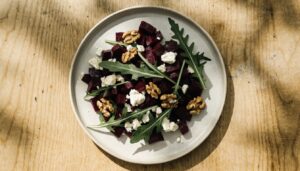
Dry goat’s cheese is best enjoyed in small amounts given how intense its flavour is. A portion of 20 to 30 g is more than enough to flavour a plate or finish a meal. Its firm texture can be grated, crumbled or shaved to liven up salads, gratins, pasta or toast. To soften its strength, pair it with honey, walnuts, dried fruit or a pan of seasonal vegetables.
Nutrition facts and key points:
- Calories: 440 kcal per 100 g, a high calorie density to watch when slimming.
- Protein: 29.9 g, a remarkable amount that contributes to fullness and maintaining muscle mass.
- Fat: 35.6 g, mostly saturated, hence the value of moderation.
- Carbohydrates: only 2.17 g, which makes it a cheese with a very low glycaemic index.
- A source of calcium, phosphorus and B vitamins.
Eating and storage tips: keep it in the fridge in packaging that lets it breathe, or leave it at room temperature for a few hours before eating to bring out its aromas. The drier it gets, the stronger its taste becomes. You can include it at lunchtime on a hearty salad, or at the end of a meal with a little wholemeal bread rather than as an evening snack. For variety, discover fresher alternatives such as fresh goat’s cheese or semi-dry goat’s cheese, which are less concentrated in calories.
For active people: its richness in protein makes it a useful ally for recovery and muscle maintenance. A few shavings over a quinoa or lentil salad round off a post-workout meal nicely. Beware of the fat content, though: when you are cutting, favour small portions and pair it with lighter sources such as 0% fromage blanc. For targeted snacks, you can also take inspiration from these protein snack ideas.
Weight control: the benefits of dry goat’s cheese depend on getting the amount right. Its concentration of fat calls for vigilance if you are watching your waistline. Weigh your portions, serve it with raw vegetables and limit how often you eat it. To compare its nutrition facts with other options, explore the dairy products family and its many variations.