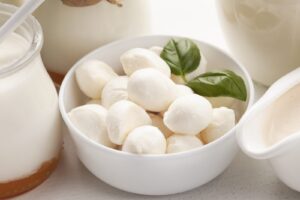
Group · Dairy
Whole milk ricotta
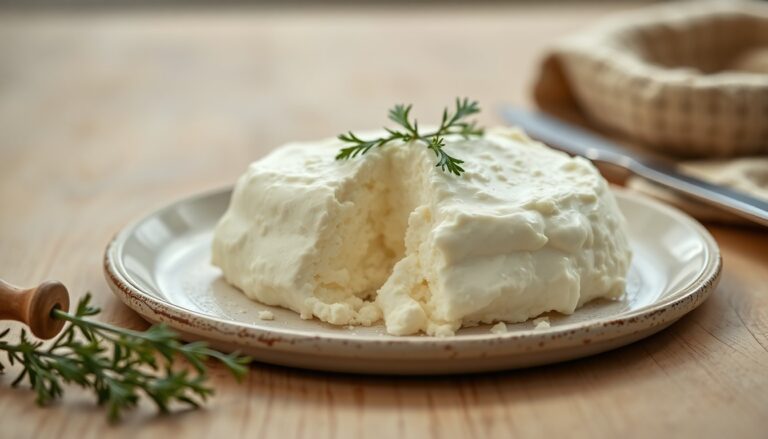
Whole milk ricotta is an Italian soft fresh cheese made by cooking whey a second time (hence its name, meaning « recooked »). Creamy, slightly grainy and mild and milky in flavour, it stands apart from matured cheeses thanks to its freshness and light texture. Versatile, it works in both savoury and sweet recipes. In terms of nutrition facts, it provides 174 kcal per 100 g, with 7.96 g of protein, 4.09 g of carbohydrate and 10.7 g of fat. Its protein content and smoothness make it a popular ingredient in a balanced diet, as long as you watch your portions of the whole milk version, which is naturally higher in fat than semi-skimmed ricotta.
Macronutrient breakdown
Nutrition table per 100 g
| Calories | 174 kcal |
| Kilojoules | 728 kJ |
| Protein | 8 g |
| Carbohydrate | 4,1 g |
| Fat | 10,7 g |
Micronutrients per 100 g
All measured nutrients, ranked by share of the daily reference intake.
- Calcium314 mg39 %
- Phosphorus158 mg23 %
- Vitamin A120 µg15 %
- Vitamin B20,2 mg14 %
- Vitamin B120,34 µg14 %
- Iodine18 µg12 %
- Zinc1,16 mg12 %
- Omega-3 ALA0,16 g8 %
See the other 14 nutrients
- Vitamin B912 µg6 %
- Potassium105 mg5 %
- Vitamin D0,2 µg4 %
- Vitamin B50,21 mg4 %
- Vitamin B60,04 mg3 %
- Magnesium11 mg3 %
- Iron0,38 mg3 %
- Copper0,02 mg2 %
- Omega-6 LA0,15 g2 %
- Vitamin K11,1 µg1 %
- Vitamin B10,01 mg1 %
- Vitamin E0,11 mg1 %
- Vitamin B30,1 mg1 %
- Manganese0,01 mg0 %
Anses Ciqual 2025. Source: Anses, 2025, Ciqual food composition table
Tips
To get the most from whole milk ricotta, make the most of its versatility in the kitchen. A portion of 30 to 50 g is enough to add softness to your dishes without adding too many calories. It can be eaten plain, lightly salted and peppered, on a slice of wholemeal bread, mixed with fresh herbs, or added to hot dishes.
- Savoury: as a filling for ravioli, lasagne, cannelloni and quiches, or as the base of a stuffing with spinach and Parmesan.
- Sweet: folded into a cheesecake or a dessert cream, or simply drizzled with honey and topped with fresh fruit.
- Quick fix: as a partial replacement for cream or butter for a lighter texture.
Keep it in the fridge, tightly closed, and eat it soon after opening, as it is a fresh product that spoils quickly. Avoid freezing it, as this spoils its grainy texture.
Nutritionally, ricotta stands out for its useful protein content (around 7.96 g per 100 g), calcium and phosphorus, nutrients that support bones and muscles. Its carbohydrate content is low, which gives it a moderate glycaemic index. If you are watching your fat intake, bear in mind that the whole milk version is higher in fat: for a lighter alternative, go for semi-skimmed milk ricotta or 0% fat fromage blanc, which is lower in calories still.
For active people: ricotta is an excellent snack ally. Its protein content makes it a useful option after exercise, to be combined with fruit or oat flakes to replenish carbohydrate stores. In the evening, its richness in casein, a slow-digesting protein, makes it a suitable bedtime snack to support muscle recovery. You will find more tasty ideas in our protein snack recipes, and more general guidance in our guide to nutrition for fitness.
Weight control: with its medium calorie density, whole milk ricotta is still reasonable compared with many matured cheeses, but its mildness can tempt you into large portions. Keep an eye on quantities, especially in sweet desserts. To compare its calories with those of other dairy products, see the other pages in the dairy products family or our food calorie table. Eaten in moderation, ricotta fits perfectly into a varied and tasty diet.