L-carnitine: benefits, weight loss, side effects and dosage

The short answer
L-carnitine is a compound your body makes and that you mostly get from red meat. It carries fats into the mitochondria, where they are burned for energy, hence its “fat burner” image. Meta-analyses find real but modest weight loss: about 1 to 1.3 kg more than placebo over a few months, mainly in people with overweight. As L-carnitine L-tartrate, small trials show better recovery after resistance training. It is well tolerated up to 2 g a day, but one question remains open: gut bacteria turn it into TMAO, a molecule linked to cardiovascular risk.
This article is for information and does not replace medical advice. If you have heart, kidney or thyroid disease, ask your doctor before taking it.
What is L-carnitine?
Carnitine is often called an amino acid, but it is really an amino acid derivative: your liver and kidneys make it from lysine and methionine. The “L” is the active form, the only one used in supplements. Its main job is to move long-chain fatty acids into the mitochondria, the “power plants” of your cells, especially in muscle and heart.
It is found mainly in animal foods, with red meat at the top (see our beef steak page). Vegetarians eat very little, but their body makes enough: true deficiency is rare and linked to genetic conditions or dialysis. A well-planned vegetarian diet does not require a supplement (see how to become vegetarian).
Supplements come in several forms: L-carnitine base (often liquid), L-carnitine L-tartrate (LCLT, the form used in recovery studies) and acetyl-L-carnitine (studied mostly for the brain and nerves). They do not share the same evidence: this guide focuses on L-carnitine and its tartrate form.
Does L-carnitine work for weight loss?
That is the most common question. Several meta-analyses have pooled randomised trials, and they agree:
| Meta-analysis | Trials | Weight vs control | Other findings |
|---|---|---|---|
| Pooyandjoo, Obesity Reviews, 2016 | 9 trials, 911 people | -1.33 kg | The effect shrinks over time |
| Talenezhad, Clin Nutr ESPEN, 2020 | 37 trials, 2,292 people | -1.21 kg | Fat mass -2.08 kg; no effect on waist or body fat %; maximum effect around 2 g a day |
| Askarpour, Pharmacol Res, 2020 | 43 trials | -1.13 kg | Effect only in people with overweight or obesity |
| Hamedi-Kalajahi, 2025 (review of 8 meta-analyses) | 16,352 participants | -1.11 kg | Waist -1.34 cm; doses from 150 to 4,000 mg a day, 8 to 30 weeks |
How to read these numbers: the effect is statistically real, but it amounts to just over a kilo across several months. Trials vary a lot (doses, durations, people with overweight, diabetes or liver disease), and the loss looks clearer when carnitine comes on top of a diet and exercise. It does not melt belly fat on its own: a calorie deficit still does the work, as explained in how to lose belly fat and how to calculate a calorie deficit.
L-carnitine L-tartrate benefits for recovery: small but encouraging trials
The tartrate form was studied by Jeff Volek and William Kraemer’s team (University of Connecticut), with favourable results on recovery markers:
- In 10 trained men (Volek et al., 2002): 2 g of L-carnitine a day as tartrate for 3 weeks before a squat session. Markers of muscle damage (myoglobin, creatine kinase) and oxidative stress rose less, and MRI showed an area of damaged muscle 41 to 45% the size seen with placebo.
- In 18 middle-aged adults (mean age 45 for men, 52 for women) (Ho et al., 2010): the same 2 g a day, the same markers improved and less soreness. However, no effect on strength or power.
The limits: these are small crossover trials, run by the same team and partly funded by the ingredient maker. They show better biological recovery, not better performance. L-carnitine does not build muscle: for that, see nutrition for muscle gain, and for fuelling workouts, what to eat before and after exercise. For a supplement with strong evidence on strength, creatine remains the benchmark (see our best creatine comparison).
L-carnitine side effects and the TMAO question
Well tolerated up to 2 g a day
A 2006 risk assessment (Hathcock and Shao) concluded that the evidence of safety is strong up to 2,000 mg of L-carnitine a day for long-term use. Higher doses have been used without problems, but the data are not enough to be confident about long-term safety. Reported side effects are mostly digestive (nausea, cramps, diarrhoea).
TMAO: the honest question
Part of the carnitine you swallow is not absorbed and reaches the colon. Some bacteria turn it into TMA, which the liver converts into TMAO (trimethylamine N-oxide). In observational studies, TMAO is linked to higher cardiovascular risk.
- In mice, long-term carnitine increased TMAO production and atherosclerosis (Koeth et al., Nature Medicine, 2013).
- In 2,595 cardiac patients, high blood carnitine was linked to more cardiac events only when TMAO was also high (same study).
- In humans, meat eaters produced over 20 times more labelled TMAO than vegetarians after a carnitine dose, and 2 months or more of supplementation made gut bacteria better at this conversion (Koeth et al., Journal of Clinical Investigation, 2019).
What we can say without overstating it: no trial has shown that carnitine supplements cause heart attacks. But the pathway is documented in humans, and it is stronger in heavy meat eaters. To be safe, if you have heart disease or a high cardiovascular risk, do not take carnitine long term without medical advice, and prefer defined courses to permanent use.
Thyroid, kidneys, pregnancy: precautions
- Thyroid: carnitine blunts the action of thyroid hormones in cells. One trial even used 2 or 4 g a day to ease symptoms of excess thyroid hormone (Benvenga et al., 2001). If you take levothyroxine for an underactive thyroid, talk to your doctor first.
- Kidney disease: carnitine is cleared by the kidneys; in dialysis, it is a matter for prescription.
- Pregnancy and breastfeeding: not enough data on supplements, so avoid without medical advice.
- Long-term medication (blood thinners, heart drugs): ask your pharmacist.
How to take L-carnitine (studied doses)
- Weight loss: trials range from 150 to 4,000 mg a day; Talenezhad’s dose-response analysis places the maximum effect around 2 g a day, over 8 to 30 weeks.
- Recovery: 2 g of L-carnitine a day as tartrate, for 3 weeks before testing, in the Volek and Ho trials.
- Timing: no specific time has proven better. Taking it with a meal is easy to remember and may limit mild digestive upset.
- Duration: effects build over weeks. Given the TMAO question, a defined course (2 to 3 months) is better than open-ended use.
Reading labels: 1,500 mg of L-carnitine L-tartrate provides about 1,000 mg of carnitine. Studies usually report carnitine, not tartrate.
Nutrition•pro: L-carnitine as L-tartrate
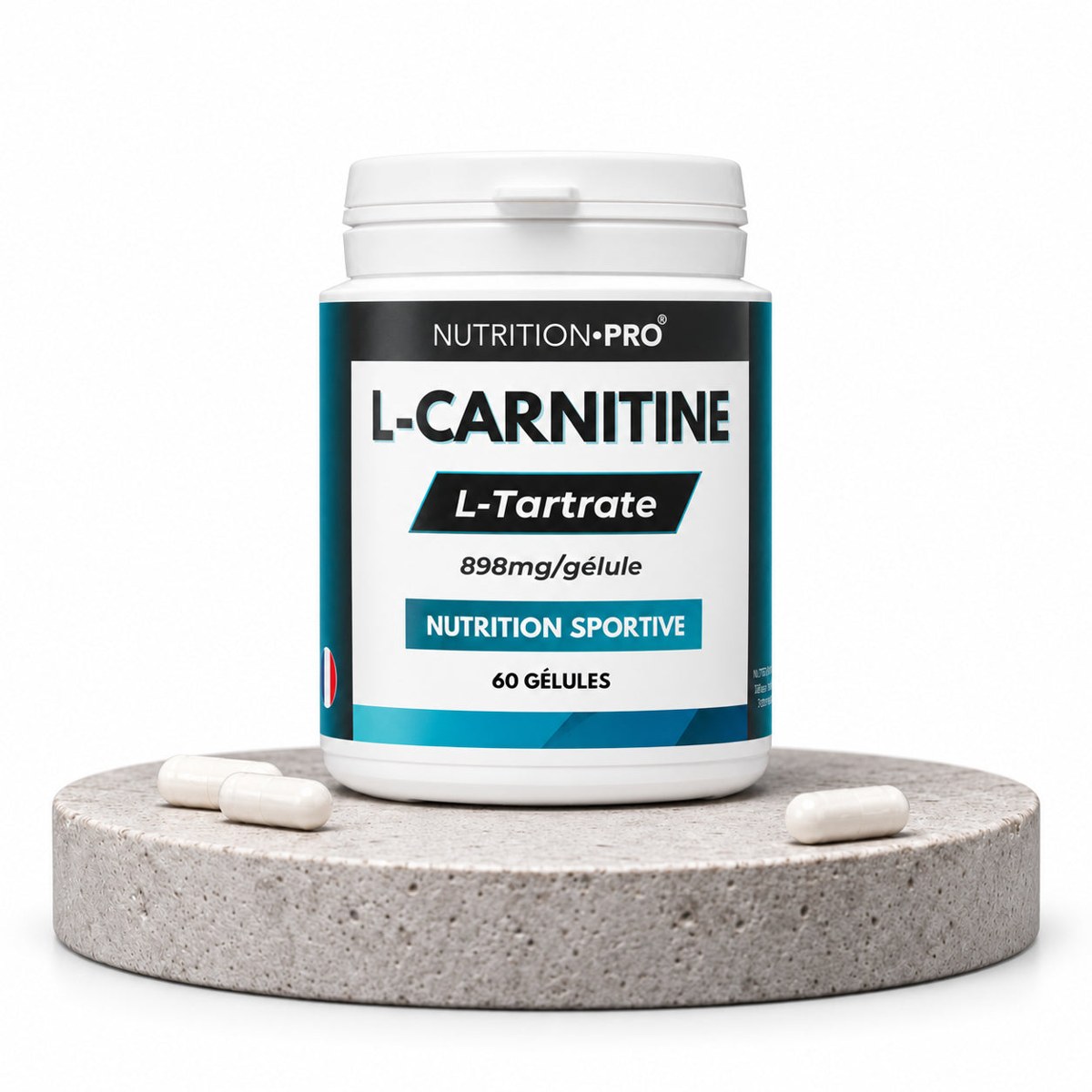
Nutrition•pro is a French brand that says it designs and makes its formulas in France. Its L-Carnitine uses the form most studied for recovery:
- L-carnitine L-tartrate, the form used in the Volek and Ho trials;
- 2 capsules a day = 1,500 mg of L-carnitine tartrate, including 1,000 mg of carnitine, with the carnitine content clearly stated on the label;
- short formula: HPMC capsule (plant-based shell) and an anti-caking agent (magnesium stearate), no colourings;
- 60 capsules, a 30-day course;
- €29.99 per jar (price checked on 22/11/2026), about €1 a day.
Product dose versus study doses: 1 g of carnitine a day sits within the range of the weight loss trials (150 to 4,000 mg) and well below the 2 g considered safe long term. It is, however, half the 2 g used in the recovery trials, so their results do not carry over one to one. Stick to the label dose; if you are considering more, talk to a health professional.
Promo code: SEOCONSULTINGSL for 10% off your order, €26.99 per jar, about €0.90 a day (as of 22/11/2026).
See Nutrition•pro L-Carnitine →
Partner link: we earn a commission if you order through this link, at no extra cost to you.
Our pick: Carnipure L-Carnitine Dynveo (Dynveo) See the product → Partner link
Frequently asked questions
What does L-carnitine do?
It carries fatty acids into the mitochondria to be burned for energy. As a supplement, the best-documented effects are modest weight loss and, as tartrate, better recovery markers and less soreness after resistance training. No proven effect on strength.
Does L-carnitine really help you lose weight?
A little. Meta-analyses find 1.1 to 1.3 kg more loss than placebo, with a clearer effect in people with overweight who also follow a diet. It is not a fat burner that works on its own.
Can I take L-carnitine every day?
Yes, up to 2 g a day safety is considered strong. But since long-term use boosts TMAO production by gut bacteria, courses of a few months with breaks are wiser, especially if you eat a lot of red meat.
What are the side effects of L-carnitine?
Mostly digestive (nausea, cramps, diarrhoea). Watch-outs are TMAO for people at cardiovascular risk, its effect on thyroid hormones, and kidney disease.
When should I take L-carnitine?
No timing has proven best: with a meal is simple and often better tolerated. For recovery, regular intake over several weeks matters more than the time of day.
Sources
- Pooyandjoo M. et al. The effect of (L-)carnitine on weight loss in adults: a systematic review and meta-analysis of randomized controlled trials. Obes Rev, 2016; 17(10): 970-6. PubMed 27335245
- Talenezhad N. et al. Effects of l-carnitine supplementation on weight loss and body composition: A systematic review and meta-analysis of 37 randomized controlled clinical trials with dose-response analysis. Clin Nutr ESPEN, 2020; 37: 9-23. PubMed 32359762
- Askarpour M. et al. Beneficial effects of l-carnitine supplementation for weight management in overweight and obese adults. Pharmacol Res, 2020; 151: 104554. PubMed 31743774
- Hamedi-Kalajahi F. et al. The Effect of the L-Carnitine Supplementation on Obesity Indices: An Umbrella Meta-Analysis. Int J Vitam Nutr Res, 2025; 95(2): 40033. PubMed 40298161
- Volek J.S. et al. L-Carnitine L-tartrate supplementation favorably affects markers of recovery from exercise stress. Am J Physiol Endocrinol Metab, 2002; 282(2): E474-82. PubMed 11788381
- Ho J.Y. et al. l-Carnitine l-tartrate supplementation favorably affects biochemical markers of recovery from physical exertion in middle-aged men and women. Metabolism, 2010; 59(8): 1190-9. PubMed 20045157
- Koeth R.A. et al. Intestinal microbiota metabolism of L-carnitine, a nutrient in red meat, promotes atherosclerosis. Nat Med, 2013; 19(5): 576-85. PubMed 23563705
- Koeth R.A. et al. l-Carnitine in omnivorous diets induces an atherogenic gut microbial pathway in humans. J Clin Invest, 2019; 129(1): 373-387. PubMed 30530985
- Hathcock J.N., Shao A. Risk assessment for carnitine. Regul Toxicol Pharmacol, 2006; 46(1): 23-8. PubMed 16901595
- Benvenga S. et al. Usefulness of L-carnitine, a naturally occurring peripheral antagonist of thyroid hormone action, in iatrogenic hyperthyroidism. J Clin Endocrinol Metab, 2001; 86(8): 3579-94. PubMed 11502782