Group · Bread
Sourdough bread
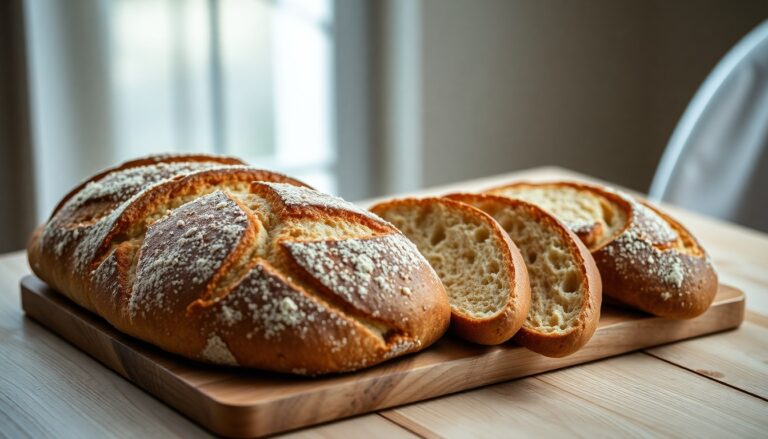
Sourdough bread is a traditional bread made through natural fermentation, with no added baker’s yeast. The sourdough starter, a living mixture of flour and water populated by lactic acid bacteria and wild yeasts, gives it its open crumb, thick crust and characteristic mild tang. It comes in many forms: a large loaf, a round loaf, a tourte or a country loaf, made with wheat flour or spelt. With around 261 kcal per 100 g, it provides complex carbohydrates, plant protein and some fibre. Its long fermentation is often appreciated for digestibility and keeping quality. It is a quality bread that easily finds a place in a balanced, varied diet.
Macronutrient breakdown
Nutrition table per 100 g
| Calories | 261 kcal |
| Kilojoules | 1110 kJ |
| Protein | 8,2 g |
| Carbohydrate | 53,1 g |
| Fat | 1,3 g |
| Fibre | 2,1 g |
Micronutrients per 100 g
All measured nutrients, ranked by share of the daily reference intake.
- Manganese0,57 mg29 %
- Phosphorus87,3 mg12 %
- Copper0,11 mg11 %
- Iron1,3 mg9 %
- Vitamin B31,15 mg7 %
- Vitamin B50,4 mg7 %
- Vitamin B10,07 mg6 %
- Potassium124 mg6 %
- Vitamin B9dietary folate equivalents13,8 µg
See the other 8 nutrients
- Zinc0,53 mg5 %
- Magnesium18,7 mg5 %
- Vitamin B60,06 mg4 %
- Omega-6 LA0,39 g4 %
- Calcium18,7 mg2 %
- Vitamin B20,02 mg1 %
- Vitamin K11 µg1 %
- Omega-3 ALA0,02 g1 %
Anses Ciqual 2025. Source: Anses, 2025, Ciqual food composition table
Tips
To get the best from sourdough bread, a portion of 40 to 60 g (one or two good slices) is usually enough to go with a meal. Its slightly tangy flavour goes as well with sweet toppings as with savoury ones: spread with fresh cheese, topped with avocado and egg, or simply with a drizzle of olive oil. At breakfast, it offers slow-release carbohydrates that help you get through the morning without cravings.
- Nutrition facts (per 100 g): 261 kcal, 8.13 g of protein, 53.1 g of carbohydrate, 1.3 g of fat and 2.1 g of fibre.
- Glycaemic index: lactic fermentation tends to lower the GI compared with a bread made with ordinary yeast, an advantage for steady energy.
- Storage: thanks to its acidity, it keeps for several days in a clean cloth or a bread bin, and freezes very well in slices.
In terms of nutrients, sourdough bread provides B vitamins and a little iron, magnesium and zinc, all present in the flour. The long fermentation makes these minerals more available and often improves digestibility, which many people find pleasant. Note, however, that it contains gluten, so it is not suitable if you have coeliac disease. If you are sensitive to it, this information to understand gluten intolerance may help.
For active people, sourdough bread is an excellent source of complex carbohydrates before training: a slice topped with almond butter or banana 1 to 2 hours before exercise provides lasting fuel. After the session, pair it with a source of protein (egg, lean ham, fromage blanc) to support recovery. You will find more snack ideas in our protein snack recipes, and some guidelines in this article on fitness nutrition.
Weight control: like any bread, it is still fairly high in calories and dense in carbohydrates. To keep your figure, it is better to eat it in reasonable amounts and choose low-fat toppings. You can vary things by exploring the fibre richness of wholemeal bread or the other breads in the bread family. To compare intakes, the calorie table is a handy everyday reference.
If you have diabetes: the glycaemic index of breads ranges from 53 to 95 depending on the flour and grains. See the comparison in our guide which bread for people with diabetes.