Which bread for people with diabetes? The GI of 11 breads compared
The short answer
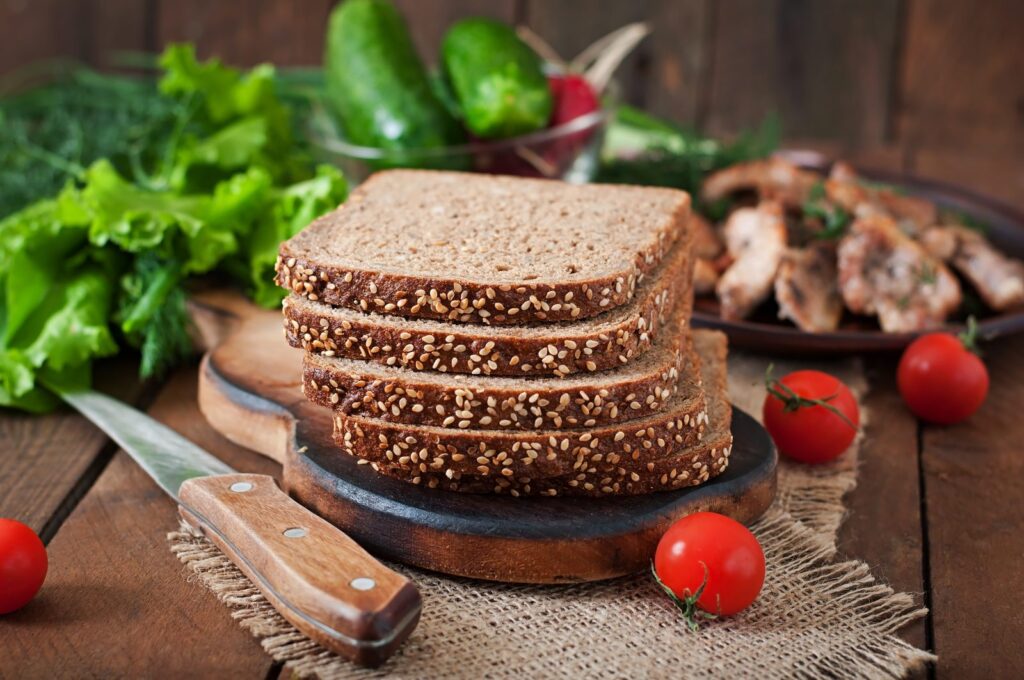
The best bread for people with diabetes is wholemeal or rye bread, ideally with visible whole grains, in a 40 to 60 g portion per meal. But beware of a common misconception: wholemeal bread made with wholemeal flour has almost the same glycaemic index as white bread, 69 versus 73 on average in people with diabetes. What really lowers the GI is whole or cracked grains and rye: 53 for rye kernel bread, 48 for a bread made with 75% cracked wheat. The sure advantage of wholemeal bread lies elsewhere: less carbohydrate per slice, 16.5 g against 23.3 g, and nearly three times as much fibre.
This guide gives general guidance. If you are treated with insulin or with a medicine that can cause hypos (low blood sugar), your carbohydrate amount per meal should be set with your doctor or dietitian.
Glycaemic index of bread: measurements in people with diabetes
The international glycaemic index tables (Atkinson, Foster-Powell and Brand-Miller, 2008) contain many measurements of bread in people with diabetes:
| Bread | Glycaemic index | Number of studies |
|---|---|---|
| White baguette, France | 69 to 95 | 3 |
| Gluten-free bread | 69 to 80 | 4 |
| White sandwich bread | 73 on average | 4 |
| White bread enriched with fibre | 67 and 69 | 2 |
| Wholemeal bread, wholemeal flour | 69 on average | 11 |
| Wholemeal rye bread, flour | 58 on average | 4 |
| Rye sourdough bread | 57 | 1 |
| White pitta bread | 57 | 1 |
| Rye kernel bread (pumpernickel) | 53 on average | 7 |
| Bread with 75% cracked wheat grains | 48 | 1 |
| Bread with 75% barley grains | 27 | 1 |
Why does wholemeal flour make so little difference? Because once milled, even wholemeal flour offers starch a large surface for digestive enzymes to attack. What really slows digestion is the structure of the grain: whole or cracked grains, whose husk protects the starch, and rye, whose viscous fibres thicken the contents of the stomach. The French baguette, with its very airy crumb, is on the contrary one of the breads with the highest GI. For the concept of GI, see our guide to the glycaemic index.
What a slice of bread contains
| 40 g of | Calories | Carbohydrate | Fibre | Salt |
|---|---|---|---|---|
| White bread, baguette or round loaf | 115 kcal | 23.3 g | 1.1 g | 0.50 g |
| French traditional bread (pain de tradition) | 112 kcal | 22.7 g | 1.5 g | 0.51 g |
| Brown bread (pain bis) | 106 kcal | 21.6 g | 1.7 g | 0.47 g |
| Sourdough bread | 104 kcal | 21.2 g | 0.8 g | 0.50 g |
| Rye and wheat bread | 104 kcal | 20.6 g | 1.8 g | 0.45 g |
| White sandwich loaf | 112 kcal | 20.2 g | 1.1 g | 0.43 g |
| Country loaf | 101 kcal | 20.0 g | 1.7 g | 0.47 g |
| Multigrain and seeded bread | 108 kcal | 18.8 g | 2.1 g | 0.45 g |
| Wholemeal sandwich loaf | 103 kcal | 16.7 g | 2.9 g | 0.43 g |
| Wholemeal bread, T150 flour | 94 kcal | 16.5 g | 2.9 g | 0.47 g |
| Wholemeal rye bread | 85 kcal | 15.8 g | 3.3 g | 0.50 g |
Wholemeal and rye bread provide about 30% less carbohydrate than white bread, weight for weight, because they contain more fibre and water. This is a real advantage, independent of the glycaemic index. They also provide two to three times more fibre. See our guide to dietary fibre.
Work out the glycaemic load of your slice
| 40 g of | Carbohydrate | Glycaemic index | Glycaemic load |
|---|---|---|---|
| White baguette | 23.3 g | 69 to 95 | 16 to 22 |
| White bread | 23.3 g | 73 | 17 |
| Wholemeal bread, flour | 16.5 g | 69 | 11 |
| Wholemeal rye bread | 15.8 g | 58 | 9 |
By combining a slightly lower GI with less carbohydrate, a slice of wholemeal rye bread has a glycaemic load that is almost half that of a slice of baguette.
Equivalents: 20 g of carbohydrate in bread
Breads do not all have the same carbohydrate density. For the same amount of carbohydrate, about 20 g, here is the weight of bread to allow for:
| Bread | Weight for 20 g of carbohydrate |
|---|---|
| Classic rusk (biscotte) | 27 g |
| Unleavened bread | 27 g |
| White bread, baguette or round loaf | 34 g |
| French traditional bread (pain de tradition) | 35 g |
| Wheat tortilla | 38 g |
| Country loaf | 40 g |
| Pitta bread | 41 g |
| Multigrain and seeded bread | 43 g |
| Wholemeal sandwich loaf | 48 g |
| Wholemeal bread, T150 flour | 49 g |
| Wholemeal rye bread | 51 g |
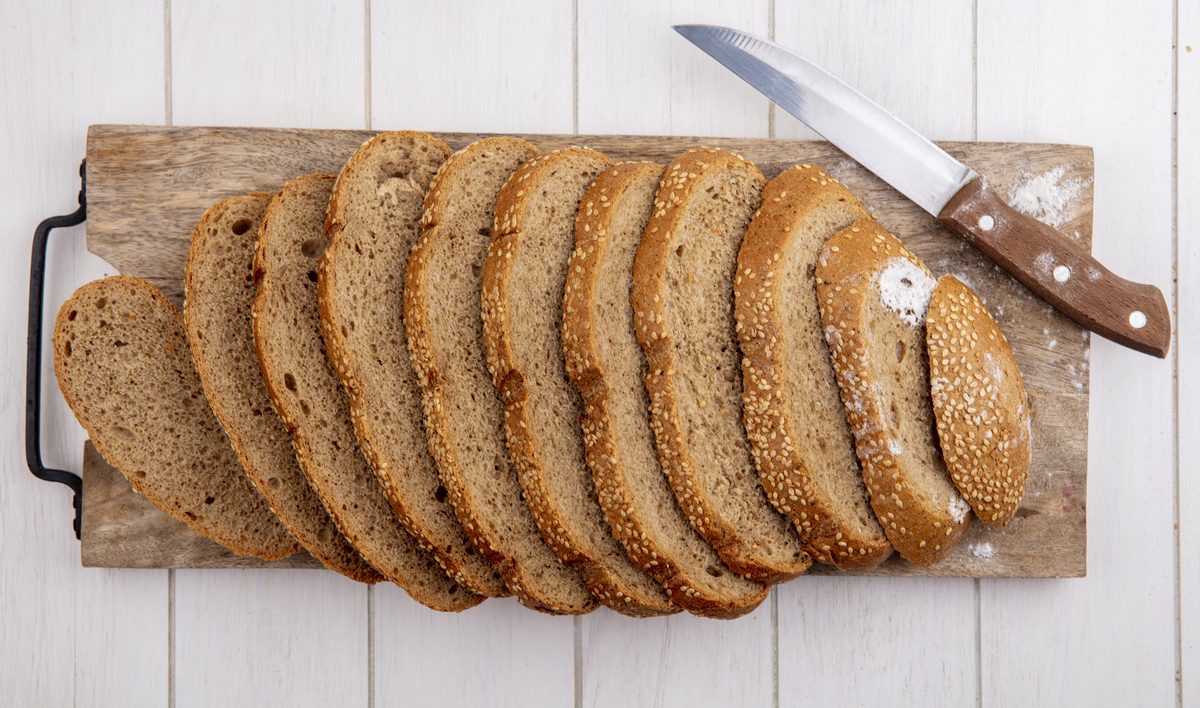
For the same carbohydrate, you can have 45 to 50% more bread with a wholemeal or rye bread than with a baguette: 49 to 51 g instead of 34 g. Conversely, dry breads, rusks and unleavened bread, concentrate carbohydrate: 27 g is enough to provide 20 g. This is a good guide for anyone counting carbohydrate, particularly on insulin, in agreement with your care team.
How much bread per meal
The GEMRCN, the French reference for catering in canteens and care homes, provides for 50 to 100 g of bread per adult per main meal. For a person with diabetes, the rule is simple: bread is a starchy food.
- 40 to 60 g per meal, that is one to one and a half slices, if the meal already contains another starchy food, such as rice, pasta or potatoes.
- Up to 80 to 100 g if bread is the only starchy food in the meal, for example at breakfast or with a mixed salad.
- A quarter of a baguette, about 60 g, provides 35 g of carbohydrate: it is quickly reached when you eat bread while waiting for the main course.
For breakfast, see also our guide to oats and diabetes.
What studies say about wholemeal bread
GI is only part of the story. Population studies and trials bring other evidence:
- The risk of diabetes. A meta-analysis of sixteen cohorts (Aune et al., European Journal of Epidemiology, 2013) found that three servings of whole grains a day were associated with a 32% lower risk of type 2 diabetes. Refined grains were not associated with the risk. Wholemeal bread was among the whole-grain products associated with a lower risk, but based on a small number of studies. The authors advise at least two servings of whole grains a day.
- Insulin. In a Finnish trial in 20 healthy adults (Leinonen et al., 1999), whole-grain rye bread caused a lower insulin response than wheat bread, while blood sugar rose just as much. The pancreas therefore needed less insulin for the same blood sugar.
- A refused claim. In 2014, the European Food Safety Authority (EFSA) examined a claim for a high-fibre rye sourdough bread, said to reduce the rise in blood sugar after a meal. It did not approve it: the studies compared it with glucose, and almost any solid food does better than glucose. Be wary of packaging that promises a bread that « lowers blood sugar ».
What really lowers the GI of a bread: viscous fibres
The international tables show a very clear effect when soluble, viscous fibres are added to white bread, in people with type 2 diabetes:
| Bread tested | Participants | Glycaemic index |
|---|---|---|
| White bread, average of 4 studies | people with diabetes | 73 |
| White bread with 3 g of guar fibre | 9 people with type 2 diabetes | 53 |
| White bread with 15 g of guar fibre | 9 people with type 2 diabetes | 37 |
| White bread with 15 g of psyllium | 12 people with type 2 diabetes | 41 |
| Barley flour bread, 100% | 6 people with type 2 diabetes | 67 |
| Bread with 75% whole barley grains | 5 people with type 2 diabetes | 27 |
Two lessons. Viscous fibres, guar or psyllium, almost halve the GI, which confirms the role of the fibres in rye and barley. And the same cereal, barley, gives a GI of 67 as flour and 27 as whole grains: it is the structure of the grain that counts, as with wheat. Psyllium supplements should not be taken casually if you are on medication: talk to your doctor.
Rusks, toast, gluten-free bread: the traps
| 100 g of | Carbohydrate | Fibre |
|---|---|---|
| White bread | 58.3 g | 2.7 g |
| Toasted white bread | 64.0 g | 3.7 g |
| Classic rusk (biscotte) | 73.2 g | 4.3 g |
| Wholewheat rusk | 66.0 g | 11.0 g |
| Gluten-free bread, pre-packed | 37.1 g | 9.9 g |
- Rusks and toast are not lighter: they have lost their water, so they concentrate carbohydrate. Toasted white bread was measured at 73 in people with diabetes, like white bread: toasting does not lower the GI.
- Gluten-free bread has a GI of 69 to 80 in people with diabetes. It offers no benefit for blood sugar in the absence of coeliac disease.
- Sandwich loaves and brioche-style breads often contain added sugar: 6.1 g of sugars per 100 g in white sandwich loaf, 10.5 g in brioche-style sandwich loaf, against 2.3 g in white bread.
Viennoiseries, wraps, burger buns: the other breads
| 100 g of | Carbohydrate | of which sugars | Fat | GI in people with diabetes |
|---|---|---|---|---|
| Croissant | 46.2 g | 7.5 g | 22.1 g | 67 (13 people with type 1 and 2 diabetes) |
| Pain au chocolat | 45.4 g | 12.8 g | 22.5 g | not measured |
| Brioche | 52.1 g | 13.9 g | 13.0 g | not measured |
| Burger bun | 47.2 g | 6.5 g | 4.9 g | 61 (12 people with type 1 and 2 diabetes) |
| Wheat tortilla, for wraps | 53 g | 2.1 g | 7.5 g | not measured |
- The croissant does not have a higher GI than white bread, 67, because its fat slows digestion. But it provides 22 g of fat per 100 g: it is an occasional pastry, not a bread.
- Brioche and pain au chocolat add 13 to 14 g of sugars per 100 g, nearly six times as much as white bread.
- Tortillas for wraps are almost as dense in carbohydrate as white bread, 53 g against 58.3 g per 100 g: a wrap is not lighter than a sandwich.
- Burger buns contain added sugar, 6.5 g per 100 g, nearly three times as much as white bread.
How to choose your bread well
- Visible grains: whole-grain bread, rye bread with kernels, cracked wheat bread.
- Rye: wholemeal rye bread or pumpernickel.
- A dense crumb, rather than an airy one like a baguette.
- T110 to T150 flour at the very least: brown or wholemeal bread.
- The ingredients list for packaged breads: no added sugar, wholemeal flour as the first ingredient.
And with what?
What goes with bread matters as much as the bread itself. A slice with an egg, cheese, avocado or sardines raises blood sugar less than a slice with jam or honey. See avocado and diabetes, cheese and diabetes and honey and diabetes.
Open sandwiches from the site
- Sardine and avocado tartine: protein and good fats on bread.
- Ricotta and cherry tomato tartine and goat’s cheese and grilled courgette tartine: vegetables and a dairy product, for a light lunch.
- Panzanella: a Tuscan salad where stale bread is mixed with lots of tomatoes and raw vegetables.
For these recipes, choose a wholemeal or rye bread, in one 40 to 50 g slice per person.
Special cases
Coeliac disease
It is more common in type 1 diabetes. Gluten-free bread is then essential; choose one enriched with fibre or seeds, and count it as a high-GI starchy food. See gluten-free.
High blood pressure
Bread is one of the main sources of salt in France: about 0.5 g per 40 g slice. Bread without added salt exists, 0.01 g per 100 g according to Ciqual.
Gestational diabetes
At breakfast, when blood sugar often rises the most during pregnancy, prefer a slice of wholemeal or rye bread with a dairy product or an egg. See eating during pregnancy.
Frequently asked questions
Which bread should you choose with diabetes?
A wholemeal or rye bread, ideally with visible whole grains. Rye kernel bread has an average GI of 53 in people with diabetes, against 73 for white bread.
Does wholemeal bread have a low GI?
Not really: bread made with wholemeal flour has an average GI of 69 across eleven studies in people with diabetes, close to white bread. But it provides 30% less carbohydrate and three times as much fibre.
How much bread a day with diabetes?
40 to 60 g per meal if there is another starchy food, up to 80 to 100 g if it is the only one. A 40 g slice of wholemeal bread provides 16.5 g of carbohydrate.
Is a baguette not recommended?
It is one of the breads with the highest GI, 69 to 95 according to French studies. Not forbidden, but in small quantities, with the meal.
Is sourdough bread better for blood sugar?
Rye sourdough bread was measured at 57 in people with diabetes. The wheat sourdough tested in France had a high GI, 80, in people without diabetes: it is mainly rye that makes the difference.
Are rusks lighter than bread?
No: 73.2 g of carbohydrate per 100 g, against 58.3 g for white bread. They have simply lost their water.
How much bread for 20 g of carbohydrate?
34 g of white bread, 49 g of wholemeal T150 bread or 51 g of wholemeal rye bread, according to Ciqual.
Can someone with diabetes eat a croissant?
Now and then. Its GI measured in people with diabetes is 67, close to white bread, but it provides 22 g of fat per 100 g. Keep it for an occasion, not for daily breakfast.
Wrap or bread for a sandwich?
Wheat tortilla contains 53 g of carbohydrate per 100 g, almost as much as white bread. A wholemeal or rye bread remains the best choice for fibre.
Does wholemeal bread protect against diabetes?
Population studies associate three servings of whole grains a day with a 32% lower risk of type 2 diabetes. These are associations, but they all point the same way.
The foods and diabetes series
Glycaemic index, glycaemic load and the right portion, food by food: apples and diabetes, pears and diabetes, oranges and diabetes, bananas and diabetes, grapes and diabetes, dates and diabetes, melon and diabetes, strawberries and diabetes, pineapple and diabetes, cheese and diabetes, mango and diabetes, honey and diabetes, dark chocolate and diabetes, lentils and diabetes, potatoes and diabetes, avocado and diabetes, oats and diabetes, kiwi and diabetes, sweet potatoes and diabetes, rice and diabetes.
Further reading
Oats and diabetes, potatoes and diabetes, lentils and diabetes, glycaemic index, type 2 diabetes: diet and prevention.
Our sources
- Atkinson FS, Foster-Powell K, Brand-Miller JC. International Tables of Glycemic Index and Glycemic Load Values: 2008. Diabetes Care, 2008.
- GEMRCN: portion sizes, bread per meal.
- Table Ciqual 2025 (Anses): breads, rusks, toast, gluten-free bread, sandwich loaf.
- Aune D, Norat T, Romundstad P, Vatten LJ. Whole grain and refined grain consumption and the risk of type 2 diabetes: a systematic review and dose-response meta-analysis of cohort studies. European Journal of Epidemiology, 2013. PMID 24158434.
- Leinonen K, Liukkonen K, Poutanen K, Uusitupa M, Mykkänen H. Rye bread decreases postprandial insulin response but does not alter glucose response in healthy Finnish subjects. European Journal of Clinical Nutrition, 1999. PMID 10334650.
- EFSA, NDA panel. Scientific Opinion on the substantiation of a health claim related to high fibre sourdough rye bread and reduction of post-prandial glycaemic responses. EFSA Journal, 2014.
- Table Ciqual 2025 (Anses): rusk (biscotte), unleavened bread, wheat tortilla, pitta bread, croissant, pain au chocolat, brioche, burger bun.