Thyme tea: dangers, contraindications and the right dose
The short answer
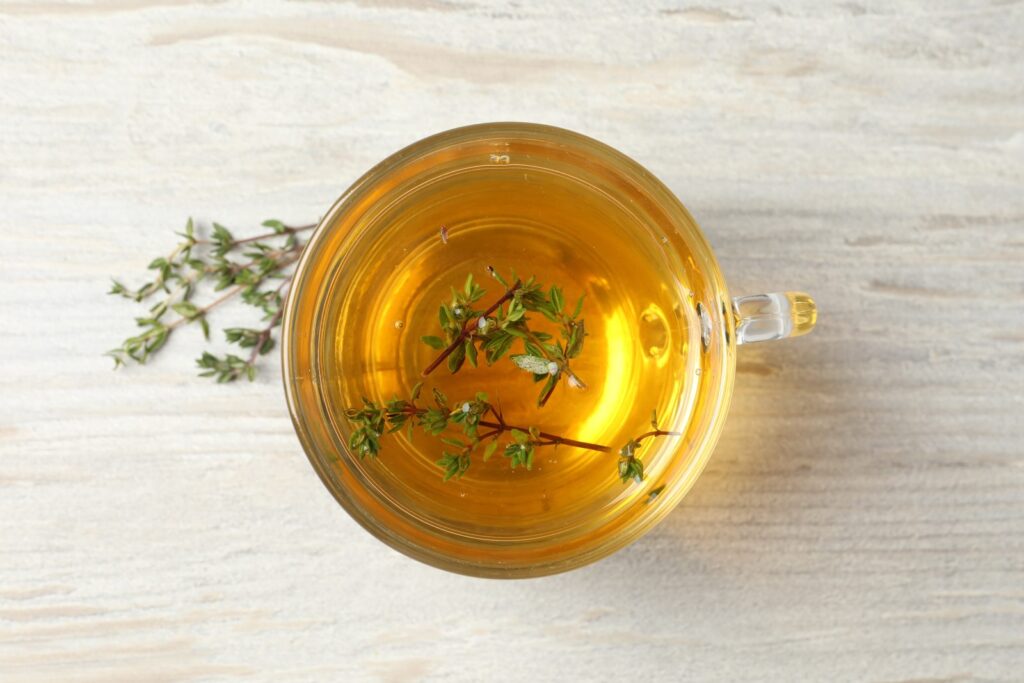
No, thyme tea is not dangerous for a healthy adult at the usual doses. The European Medicines Agency (EMA) recognises its traditional use for the productive cough of a cold, at 1 to 2 g of thyme in 150 mL of boiling water, 3 to 4 times a day. It reports no drug interactions and no overdose, only possible digestive upset. Two precautions: thyme tea is not recommended during pregnancy and breastfeeding, because of a lack of data, and it is contraindicated if you are allergic to thyme or to plants of the same family, such as mint, sage or rosemary. If your cough lasts more than a week, see a doctor.
This article is for information only and does not replace medical advice. If you have a chronic condition or are on treatment, talk to your doctor or pharmacist.
What the European Medicines Agency says
| Point | What the monograph says |
|---|---|
| Traditional use | productive cough (a « chesty » cough) associated with a cold |
| Dose as tea, adolescents and adults | 1 to 2 g of thyme in 150 mL of boiling water, 3 to 4 times a day |
| Duration | see a doctor if symptoms last more than a week |
| Contraindication | allergy to thyme or to other plants of the Lamiaceae family |
| Warning signs | shortness of breath, fever or purulent sputum: see a doctor |
| Children | the tea is only intended for adolescents and adults; only certain extracts are intended from 4 years |
| Pregnancy and breastfeeding | safety not established: use not recommended; no adverse effects reported during pregnancy |
| Interactions | none reported |
| Adverse effects | stomach upset possible, frequency unknown |
| Overdose | no cases reported |
Thyme tea is therefore one of the best-tolerated herbal teas. Its « dangers » mainly concern a few specific situations, and above all another product: essential oil.
The real dangers: for whom?
Pregnancy and breastfeeding
The EMA does not recommend thyme tea during pregnancy and breastfeeding, because there are not enough safety data. It states that no adverse effects have been reported in this context: it is a precautionary principle. Thyme used in cooking, in small amounts, is not concerned. See our guide to eating during pregnancy.
Children
The monograph only provides for the tea in adolescents and adults. If your child has a cough, ask your doctor or pharmacist for advice, especially under 4 years old.
Allergy to Lamiaceae
Thyme belongs to the Lamiaceae family, along with mint, sage, rosemary, basil, lavender and oregano. If you have a known allergy to any of these plants, thyme tea is contraindicated.
Sensitive stomach
The EMA mentions possible stomach upset. If the tea gives you heartburn or nausea, stop drinking it.
A cough that lingers
The real risk would be treating yourself for too long with a herbal tea: a cough that lasts more than a week, or comes with shortness of breath, fever or purulent sputum, should prompt you to see a doctor.
Other forms of thyme: extracts, syrups, drops
The tea is only one of the preparations provided for by the European Medicines Agency. The monograph lists about a dozen, with different ages, which explains why a thyme syrup can be indicated for a child while the tea is not.
| Preparation | From age | Adult dose |
|---|---|---|
| Tea, 1 to 2 g of thyme in 150 ml of boiling water | 12 years | 3 to 4 times a day |
| Liquid extract (ratio 1:2 to 2.5) | 4 years | 1 to 4 g per dose, up to 14 g a day |
| Fresh plant juice, aqueous extract | 4 years | 10 ml, 3 to 4 times a day |
| Tinctures, in 70% alcohol | 12 years | from 40 drops to 6 ml, 3 times a day depending on the tincture |
| Dry extracts, in tablets or capsules | 12 years | 75 to 200 mg per dose depending on the extract |
For children aged 4 to 12, only two preparations are provided for: the liquid extract, at 0.5 to 0.9 ml 3 to 5 times a day, and fresh plant juice, 7 to 10 ml 2 to 3 times a day. Under 4 years, the monograph recommends no form at all, because medical advice is needed. All the other preparations, tea included, are not recommended under 12 years, because of insufficient data.
Watch out for the alcohol in tinctures. Tinctures are made with 70% alcohol, and several extracts contain it too. The EMA requires this alcohol content to appear on the label. During pregnancy, where the rule is zero alcohol, and in children, this is one more reason to avoid them.
In every case, read the leaflet of the product you buy: doses depend on the exact extract, and a shop-bought « thyme » syrup may also contain other plants.
Thyme tea and essential oil: two different products
Thyme essential oil is a concentrate of aromatic molecules, notably thymol, which is nothing like an infusion of a few grams of leaves. It is covered by a separate EMA monograph, with other precautions. Never add it to a herbal tea and do not swallow it without a pharmacist’s advice, especially during pregnancy and in children. Everything said here concerns thyme leaf tea.
Thyme essential oil: what the EMA says
Thyme essential oil has its own European monograph, revised in 2020. It is far more tightly regulated than the tea:
| Use | Who for | Intended dose |
|---|---|---|
| By mouth, for the cough of a cold | adults only | 0.2 to 0.25 ml per dose, 3 to 5 times a day, maximum 1.25 ml a day |
| On the skin, rubbed on the chest and back | adults only | preparations of 10% at most, up to 3 times a day |
| In the bath | from 3 years, reduced doses according to age | 7 to 25 mg per litre of water for adults, bath at 35 to 38 °C for 10 to 20 minutes |
The precautions are far more numerous than for the tea:
- Babies: thyme essential oil must not be applied to the face, particularly around the nose, of babies and children under 2 years, because of the risk of laryngospasm, a spasm of the larynx that blocks breathing.
- Children and adolescents: oral use and application to the skin are not recommended under 18 years.
- Pregnancy and breastfeeding: use not recommended, because of a lack of data.
- Hot baths: contraindicated in cases of extensive wounds, acute skin disease, high fever, severe infection, severe circulatory disorders or heart failure; take care if you have high blood pressure.
- Adverse effects: allergic reactions and skin irritation have been observed.
Finally, the monograph points out that genotoxicity tests give contradictory results for two constituents of the oil, thymol and carvacrol, and that no reproductive toxicity test has been carried out. This is not proof of danger, but one more reason to reserve the essential oil for adults, at the intended doses, and never to swallow it neat or add it to a herbal tea.
What studies show on cough
The use of thyme tea is recognised as « traditional »: the EMA accepts it on the basis of long-standing use, without sufficient clinical trials. There are, however, trials on thyme extracts combined with other plants, in adults with acute bronchitis and a productive cough.
| Trial | Product tested | Reduction in coughing fits, days 7 to 9 |
|---|---|---|
| Kemmerich et al., 2006 | liquid extract of thyme and ivy | 68.7%, versus 47.6% with placebo |
| Kemmerich, 2007 | dry extracts of thyme and primrose root | 67.1%, versus 51.3% with placebo |
In both trials, half of the coughing fits had gone about 2 days earlier than with placebo, and adverse effects were no more frequent than with placebo. Two limitations: these are combinations of plants as standardised extracts, not thyme alone as a herbal tea; and the cough also eased markedly with placebo, as is often the case in acute bronchitis, which clears up on its own.
The honest conclusion: thyme has some evidence against a productive cough, especially as extracts, but a homemade herbal tea remains a comfort remedy. The EMA only provides for thyme for a productive cough, the chesty kind, not for a dry cough.
Thyme tea with honey: a good idea?
Adding honey to thyme tea is a classic remedy for coughs, and honey itself has evidence behind it. A 2018 Cochrane review, covering 6 trials and 899 children, concludes that honey probably reduces how often children cough better than no treatment or a placebo, with a moderate level of evidence.
- Never give honey before 1 year: Anses advises against it for infants, because of the risk of infant botulism.
- Between 1 and 12 years: honey can be given, but thyme tea is not provided for by the EMA at this age. A spoonful of honey on its own, or in a hot drink without thyme, is therefore the simplest option.
- From 12 years and in adults: thyme tea and honey can be combined, bearing in mind that honey is a sugar.
To find out everything about honey, see our honey page and our guide to honey during pregnancy.
The traffic light by profile
| Profile | Thyme tea |
|---|---|
| Healthy adult, 1 to 4 cups a day during a cold | 🟢 possible |
| Long-term medication | 🟢 no interaction reported; mention it to your pharmacist |
| Sensitive stomach | 🟠 stop if it causes upset |
| Child | 🟠 medical advice, the tea is only intended from adolescence |
| Pregnancy, breastfeeding | 🔴 not recommended by the EMA |
| Allergy to thyme or Lamiaceae | 🔴 contraindicated |
How many cups a day?
The traditional dose is 1 to 2 g of dried thyme per 150 mL cup of boiling water, 3 to 4 times a day. Weigh your dose once so you can judge it by eye. No cases of overdose have been reported, but there is no point in exceeding these amounts, or in drinking it continuously for months.
Can you drink it in the evening?
Yes: thyme contains no caffeine. A hot cup in the evening, when you have a cold, is even a comforting thing to do. For sleep in general, see our guide to foods for sleep.
What thyme contains, and what ends up in the cup
| Per | Iron | Calcium | Vitamin K |
|---|---|---|---|
| 100 g of dried thyme | 124 mg | 1,890 mg | 1,710 µg |
| 2 g of dried thyme, one serving of tea | 2.5 mg | 38 mg | 34 µg |
| 100 mL of brewed herbal tea, all plants | 0.08 mg | 2 mg | 0 µg |
On paper, dried thyme is extraordinarily rich in iron and calcium. But you only eat a few grams, and an infusion extracts only a tiny fraction of these minerals: according to Ciqual, a brewed herbal tea contains on average 0.08 mg of iron per 100 mL. Thyme tea is therefore neither a source of iron nor a source of calcium. For these nutrients, see our guides to foods high in iron and foods high in calcium. Its vitamin K does not pass into the water either, which is reassuring for people taking anticoagulants.
Real benefits and claims
- Productive cough of a cold: this is the traditional use recognised by the EMA, based on long-standing use.
- « Natural antibiotic »: thyme contains antimicrobial molecules tested in the laboratory, but a herbal tea does not replace treatment for a bacterial infection. A sore throat, an ear infection or a bronchitis that is getting worse should be treated with a doctor.
- « Detox », « immunity »: none of these claims is recognised for thyme.
- Hydration: its most concrete benefit. When you have a cold, drinking hot drinks often helps you stay hydrated. See how much water to drink a day.
For other herbal teas, see also our guide to nettle tea: dangers and contraindications.
Frequently asked questions
Is thyme tea dangerous?
Not for a healthy adult at traditional doses. The EMA reports no interaction and no overdose. It is not recommended during pregnancy and breastfeeding, and is contraindicated if you are allergic to Lamiaceae.
How many thyme teas a day?
3 to 4 cups, made with 1 to 2 g of thyme in 150 mL of boiling water, according to the EMA.
Can you drink thyme tea when pregnant?
The EMA does not recommend it during pregnancy or breastfeeding, because of a lack of data. Thyme in cooking is not concerned.
Does thyme tea raise blood pressure?
The EMA monograph mentions no effect on blood pressure. That reputation belongs to liquorice, not thyme.
Can you give thyme tea to a child?
The monograph only provides for the tea from adolescence. For a child, ask your doctor or pharmacist for advice.
Is thyme tea rich in iron?
No: an infusion contains on average 0.08 mg of iron per 100 mL according to Ciqual.
Is thyme essential oil dangerous?
It is reserved for adults, by mouth or on the skin, at the doses provided for by the EMA. It must never be applied to the face of a child under 2 years, because of the risk of laryngospasm, and is not recommended during pregnancy.
Can you give a thyme syrup to a child?
Certain liquid extracts are provided for from 4 years by the EMA, at a reduced dose. Under 4 years, medical advice is needed. Follow the product leaflet.
Does thyme tea work for a dry cough?
The use recognised by the EMA concerns the productive cough associated with a cold, not a dry cough.
Can you put honey in thyme tea?
Yes for adults and adolescents. Honey itself has evidence against cough, but it is forbidden before 1 year because of infant botulism.
Do thyme tinctures contain alcohol?
Yes, they are made with 70% alcohol. Avoid them during pregnancy and in children.
Our sources
- EMA, Committee on Herbal Medicinal Products (HMPC), Community herbal monograph on Thymus vulgaris L. and Thymus zygis L., herba (EMA/HMPC/342332/2013).
- Ciqual 2025 table (Anses): dried thyme, brewed herbal tea.
- EMA, HMPC. European Union herbal monograph on Thymus vulgaris L., Thymus zygis L., aetheroleum, revision 1 (EMA/HMPC/59032/2017), 8 July 2020.
- Kemmerich B, Eberhardt R, Stammer H. Efficacy and tolerability of a fluid extract combination of thyme herb and ivy leaves and matched placebo in adults suffering from acute bronchitis with productive cough. Arzneimittelforschung, 2006 (PMID 17063641).
- Kemmerich B. Evaluation of efficacy and tolerability of a fixed combination of dry extracts of thyme herb and primrose root in adults suffering from acute bronchitis with productive cough. Arzneimittelforschung, 2007 (PMID 17966760).
- Oduwole O et al. Honey for acute cough in children. Cochrane Database Syst Rev, 2018 (PMID 29633783).
- Anses: no honey before one year, risk of infant botulism.