How many walnuts a day? 7 walnuts, and almost all your plant omega-3
The short answer
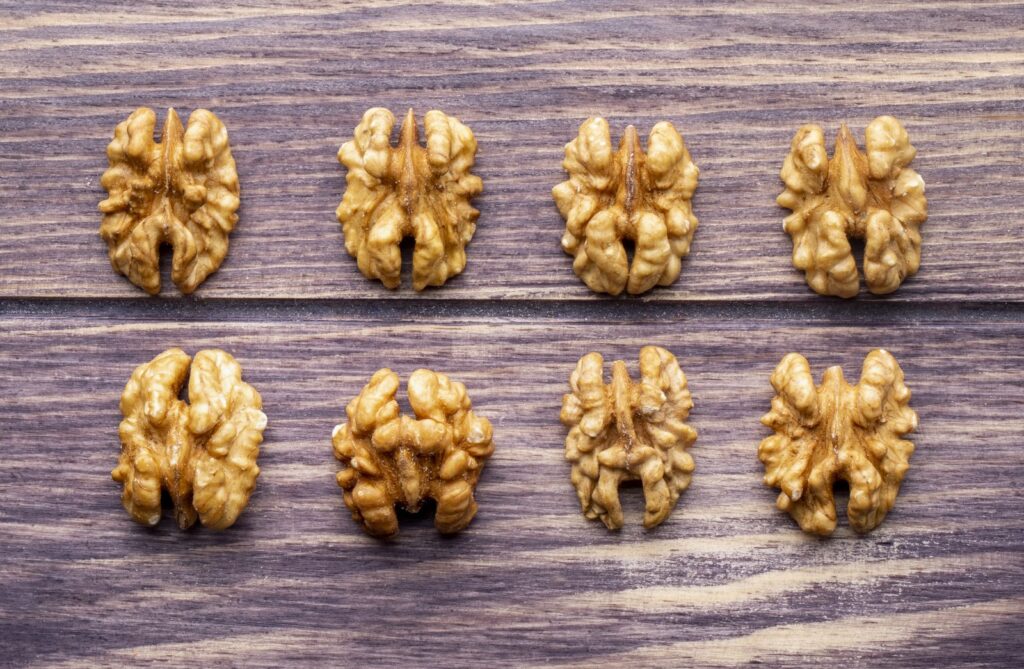
The official recommendation is a small handful of unsalted nuts a day. For walnuts, that is about 7 walnuts, or 28 g of kernels and 199 kcal. It is the most interesting nut for omega-3: these 7 walnuts provide 2.1 g of ALA, almost the whole 2.2 g daily reference, whereas almonds and hazelnuts contain almost none.
What your walnuts provide
| Amount | Kernels | Calories | Omega-3 (ALA) | Fibre | Magnesium |
|---|---|---|---|---|---|
| 1 walnut | 4 g | 28 kcal | 0.3 g | 0.3 g | 6 mg |
| 4 walnuts | 16 g | 113 kcal | 1.2 g | 1.1 g | 22 mg |
| 7 walnuts, a small handful | 28 g | 199 kcal | 2.1 g | 1.9 g | 39 mg |
| 14 walnuts | 56 g | 397 kcal | 4.2 g | 3.8 g | 78 mg |

Why walnuts stand out
| 28 g of | Calories | Omega-3 (ALA) |
|---|---|---|
| Walnuts | 199 kcal | 2.1 g |
| Pecans | 204 kcal | 0.26 g |
| Unsalted pistachios | 177 kcal | 0.07 g |
| Unsalted cashews | 173 kcal | 0.02 g |
| Hazelnuts | 177 kcal | 0.01 g |
| Almonds | 172 kcal | less than 0.003 g |
Walnuts contain 7.5 g of ALA per 100 g, thirty times more than pistachios and hundreds of times more than almonds. Manger Bouger (the French public health guidance) cites them for their omega-3 as well. Be aware that this plant omega-3 does not replace the omega-3 from fish, because very little of it is converted to DHA, as our guide to foods high in omega-3 explains.
When it is too much
Walnuts are among the most calorific nuts: 709 kcal per 100 g. 14 walnuts, a double handful, already come to 397 kcal. Apart from allergy, that is the only real limit. Three habits to adopt:
- Count them once: 7 walnuts, or 14 half-kernels.
- Replace rather than add: on a salad instead of croutons, as an afternoon snack instead of a biscuit.
- Choose them plain, with no salt or sugary coating.
Walnuts are tree nuts, which are allergens that must be declared in Europe. For other nuts, see our guides on how many almonds a day and foods high in selenium, which covers the case of the Brazil nut.
The fat profile of your 7 walnuts
Walnuts are fatty, but not in just any way. Of the 67.3 g of fat in 100 g of kernels, 43.6 g are polyunsaturated fatty acids, two thirds. Saturated fat accounts for only 6.45 g. This is a very different profile from that of the almond or the hazelnut, which are mostly rich in monounsaturated fat, as in olive oil.
| Fatty acids | Per 100 g of kernels | Per 7 walnuts (28 g) |
|---|---|---|
| Total fat | 67.3 g | 18.8 g |
| Saturated | 6.45 g | 1.8 g |
| Monounsaturated | 14.1 g | 3.9 g |
| Polyunsaturated | 43.6 g | 12.2 g |
| of which linoleic acid (omega-6) | 36.1 g | 10.1 g |
| of which alpha-linolenic acid (omega-3) | 7.5 g | 2.1 g |
Why look at omega-6 alongside omega-3? Because the two families use the same enzymes in the body. In its 2011 report on fatty acids, Anses explains that an imbalance between the two hampers the production and use of long-chain omega-3, and notes that a ratio of linoleic acid to alpha-linolenic acid below 5 is generally accepted. The walnut stands at 4.8 (36.1 g against 7.5 g): it meets this ratio on its own. Sunflower oil, by contrast, contains 56.3 g of linoleic acid for 0.05 g of omega-3.
In other words, 7 walnuts do not just provide omega-3: they do so without worsening the excess of omega-6 common in Western diets.
The other nutrients in a handful
Omega-3 gets most of the attention, but a small handful of walnuts also provides a few minerals in notable amounts. To compare them, here are the European labelling reference values, the ones you see as percentages on packaging:
| For 7 walnuts (28 g) | Amount | Share of the reference value |
|---|---|---|
| Manganese | 0.81 mg | 41% of 2 mg |
| Copper | 0.31 mg | 31% of 1 mg |
| Folate (vitamin B9) | 34 µg | 17% of 200 µg |
| Phosphorus | 101 mg | 14% of 700 mg |
| Protein | 3.7 g | |
| Carbohydrate | 1.9 g, of which 0.8 g sugars |
Manganese and copper are the walnut’s two quiet strengths: 7 walnuts cover about 40% and 30% of the reference values. The protein, 3.7 g, remains modest: the walnut is not a protein food in the way a yoghurt or an egg is. And with 1.9 g of carbohydrate in the handful, it barely raises blood glucose, which makes it an easy snack to fit in when you are watching your carbohydrate.
Alternating with other nuts
The Santé publique France recommendation talks about a small handful of nuts, not just walnuts. Each has its own strengths, and varying them lets you add them all up over the week:
| 28 g of | Manganese | Copper | Potassium | Vitamin B1 | Monounsaturated fat |
|---|---|---|---|---|---|
| Walnuts | 0.81 mg | 0.31 mg | 120 mg | 0.08 mg | 3.9 g |
| Hazelnuts | 0.92 mg | 0.48 mg | 241 mg | 0.10 mg | 12.4 g |
| Almonds with skin | 0.53 mg | 0.27 mg | 224 mg | 0.04 mg | 9.6 g |
| Roasted unsalted pistachios | 0.35 mg | 0.36 mg | 283 mg | 0.20 mg | 6.6 g |
The walnut remains unbeatable for omega-3. The hazelnut provides more manganese and copper, and plenty of monounsaturated fat. The pistachio stands out for potassium and vitamin B1, two and a half times more than the walnut. A good rule: walnuts most of the time for the omega-3, and other plain nuts a few days a week. With no added salt in every case: that is the precision Santé publique France gives.
Walnuts or walnut oil?
Walnut oil is even more concentrated in omega-3 than the nut: 11.9 g of ALA per 100 g, against 7.5 g for the kernels. The two do not play the same role, however.
| Portion | Calories | Omega-3 (ALA) | Fibre | Omega-6 / omega-3 ratio |
|---|---|---|---|---|
| 7 walnuts (28 g) | 199 kcal | 2.1 g | 1.9 g | 4.8 |
| 10 g of walnut oil | 90 kcal | 1.2 g | 0 g | 4.8 |
| 10 g of rapeseed oil | 90 kcal | 0.8 g | 0 g | 2.4 |
| 10 g of sunflower oil | 90 kcal | 0.005 g | 0 g | over 1,000 |
In its 2016 opinion on updating the PNNS guidelines, Anses concludes that consumption of oils rich in ALA, such as walnut or rapeseed oil, should be daily and considerably increased, and that of oils low in ALA reduced. The 2019 Santé publique France guidelines put it simply: favour rapeseed, walnut and olive oils.
In practice, the two complement each other. Walnut oil replaces another oil in the dressing, so it adds no calories to your day. Whole walnuts also provide fibre, manganese and copper, and can be eaten as a snack. A spoonful of walnut oil in your lunchtime salad and a few walnuts in the afternoon are enough to comfortably cover the plant omega-3 reference.
What the studies say
Walnuts are among the most studied foods in nutrition. Three pieces of work give a good idea of what we know, and what we do not.
The Aune meta-analysis, 2016
It pooled 20 prospective studies on nuts in general. For each 28 g portion a day, the equivalent of our 7 walnuts, the relative risk was 0.71 for coronary heart disease, 0.79 for cardiovascular disease, 0.85 for cancer and 0.78 for all-cause mortality. Results were similar for tree nuts and for peanuts. The authors themselves point out that these figures only hold if the association is causal: these are observational studies, in which big nut eaters often have other favourable habits.
The cholesterol trials
For the walnut in particular, controlled trials are available, a stronger level of evidence. The meta-analysis by Guasch-Ferré and colleagues, published in 2018, pooled 26 trials and 1,059 participants. Walnut-enriched diets lowered LDL cholesterol by 5.5 mg/dL and total cholesterol by 7 mg/dL more than control diets, around 3.5% further reduction, as well as triglycerides and apolipoprotein B. This is a real but modest effect: walnuts are no substitute for treatment when your doctor has prescribed one.
The PREDIMED trial
This large Spanish trial followed 7,447 people at high cardiovascular risk for 4.8 years on average. In its corrected version published in 2018, the group following a Mediterranean diet enriched with mixed nuts, including walnuts, had a lower risk of heart attack, stroke or cardiovascular death than the control group, with a hazard ratio of 0.72. The effect measured is that of the whole Mediterranean diet, not of the walnuts alone.
Do walnuts make you put on weight?
This is the most common worry, and it makes sense: 709 kcal per 100 g. Studies do not bear it out, however, as long as you stick to one portion.
- In trials: in the 2018 meta-analysis on walnuts, the enriched diets led to no difference in weight compared with control diets, nor in blood pressure.
- In large cohorts: a 2019 study followed more than 144,000 American healthcare professionals for 20 to 24 years. Each increase of half a portion a day, 14 g, was associated with 0.37 kg less weight gain per 4-year period for walnuts, and with a lower risk of obesity. Replacing half a portion of red meat, processed meat, chips, dessert or crisps with nuts pointed the same way.
- In people with diabetes: a meta-analysis of 15 trials and 899 participants, published in 2022, found no effect of nuts on weight, BMI or waist circumference, in either direction.
What these results have in common: the walnuts were added in place of other foods, or in reasonable amounts. So the advice does not change: 7 walnuts instead of the biscuit, not on top of it.
Seven walnuts in your week: ideas
The daily handful is easier to keep up when it finds its place in a meal. A few recipes on the site that use it:
- In salads, where walnuts replace croutons: lamb’s lettuce, walnut and apple salad, chicory, walnut and blue cheese salad or beetroot, apple and walnut salad. Dress them with walnut or rapeseed oil to double the omega-3.
- At breakfast or as an afternoon snack: the skyr, fruit and walnut bowl pairs the protein in skyr with the fat in the walnut.
- As a spread: muhammara, a purée of roasted pepper and walnuts, is served with raw vegetables as an appetiser, in place of salty biscuits.
For more ideas for snacks that keep you going, see our guide to healthy snacks.
Special cases
- Allergy: tree nuts are on the list of 14 allergens in Annex II of European Regulation No 1169/2011, which must be flagged in the ingredients list, even in small amounts. Santé publique France specifies that the daily handful is not recommended for people with allergies.
- Diabetes: with 1.9 g of carbohydrate for 7 walnuts, this is one of the snacks that weigh least on blood glucose. Honey-coated or caramelised walnuts are a different, sweet product.
- Cholesterol: walnuts can be part of a diet that helps lower LDL, as our guide cholesterol: which foods to favour details. If you are on treatment, review it with your doctor.
Frequently asked questions
How many walnuts a day for omega-3?
7 walnuts, or 28 g of kernels, provide 2.1 g of ALA, almost the daily reference of 2.2 g.
How many calories are in a walnut?
About 28 kcal for a walnut with a 4 g kernel, according to Ciqual and the weight given by the USDA.
How many walnuts a day to lose weight?
A small handful, 7 walnuts, in place of another snack. Adding them without removing anything adds 199 kcal.
Walnuts or almonds?
Walnuts for omega-3, 2.1 g per 28 g against almost nothing for almonds. Almonds for fibre (12.5 g per 100 g against 6.7 g) and magnesium (270 mg against 140 mg). Alternating is a good option.
How many kernels are in a handful?
About 14 half-kernels, or 28 g, according to the USDA.
Do walnuts lower cholesterol?
A little. In a meta-analysis of 26 trials published in 2018, walnut-enriched diets lowered LDL by 5.5 mg/dL more than control diets, with no change in weight.
What is the difference between walnut oil and walnuts?
The oil is richer in omega-3, 11.9 g per 100 g against 7.5 g, but provides neither fibre nor minerals. 10 g of walnut oil gives 1.2 g of ALA for 90 kcal; 7 walnuts, 2.1 g for 199 kcal.
How much carbohydrate is in walnuts?
6.9 g per 100 g according to Ciqual, or 1.9 g for a handful of 7 walnuts, of which 0.8 g sugars.
Are walnuts high in omega-6?
Yes, 36.1 g of linoleic acid per 100 g, but with 7.5 g of omega-3: the ratio is 4.8, under the threshold of 5 used by Anses.
Other guides on how much to eat
how many seeds a day, how many almonds a day, how much coffee a day, how much sugar a day, how much red meat a week, how much fish a week, how much cheese a day, how many eggs a day, how many bananas a day, how much water to drink a day, how much dark chocolate a day, how much rice per person, how much pasta per person.
Our sources
- Table Ciqual 2025 (Anses), walnuts and other nuts.
- USDA FoodData Central, SR Legacy, « Nuts, walnuts, english »: weight.
- Manger Bouger (Santé publique France), recommendation on unsalted nuts; Anses, recommended intakes of fatty acids, 2011.
- Anses, Actualisation des apports nutritionnels conseillés pour les acides gras, expert collective report, 2011 (linoleic acid / alpha-linolenic acid ratio).
- Anses, Actualisation des repères du PNNS : révision des repères de consommations alimentaires, opinion and report, December 2016.
- Santé publique France, Recommandations relatives à l’alimentation, à l’activité physique et à la sédentarité pour les adultes, 2019.
- Regulation (EU) No 1169/2011, Annexes II (allergens) and XIII (reference values).
- Aune D et al. Nut consumption and risk of cardiovascular disease, total cancer, all-cause and cause-specific mortality: a systematic review and dose-response meta-analysis of prospective studies. BMC Medicine, 2016. PMID 27916000.
- Guasch-Ferré M et al. Effects of walnut consumption on blood lipids and other cardiovascular risk factors: an updated meta-analysis and systematic review of controlled trials. American Journal of Clinical Nutrition, 2018. PMID 29931130.
- Estruch R et al. Primary Prevention of Cardiovascular Disease with a Mediterranean Diet Supplemented with Extra-Virgin Olive Oil or Nuts. New England Journal of Medicine, 2018. PMID 29897866.
- Liu X et al. Changes in nut consumption influence long-term weight change in US men and women. BMJ Nutrition, Prevention and Health, 2019. PMID 33235963.
- Fernández-Rodríguez R et al. Nut consumption, body weight, and adiposity in patients with type 2 diabetes: a systematic review and meta-analysis of randomized controlled trials. Nutrition Reviews, 2022. PMID 34338788.