Foie gras when pregnant: why it is not recommended, the numbers
The short answer
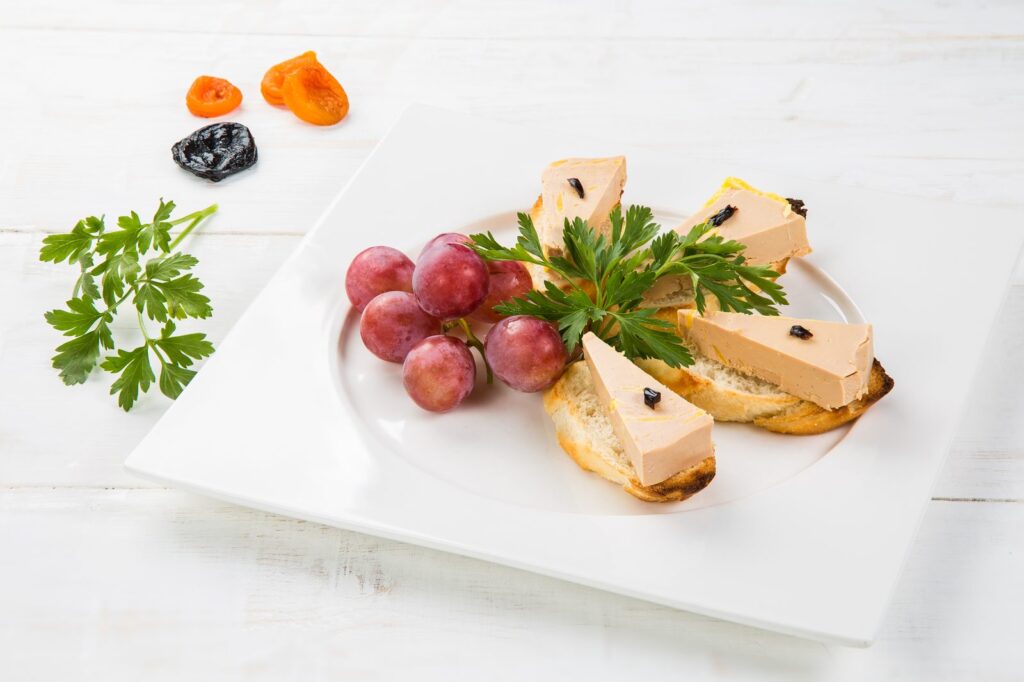
No, foie gras is not recommended during pregnancy. Santé publique France names it specifically among the cured and prepared meats to avoid, along with rillettes, pâtés and products in aspic, because of Listeria, a bacterium that can multiply in the fridge. There is a second risk, specific to liver: vitamin A. According to Ciqual, 50 g of whole duck foie gras provides 2,700 µg of retinol, close to the safe limit of 3,000 µg a day set by EFSA, and an excess of vitamin A can cause malformations. For the festive season, there are other starters that are just as special and carry no risk.
These guidelines follow official French recommendations. If in doubt, your midwife or doctor can advise you.
First risk: listeriosis
Listeriosis is a rare but serious infection during pregnancy: fewer than fifty cases a year in pregnant women in France according to Santé publique France, but the bacterium can cross the placenta, and a quarter of pregnancy-related cases end in intrauterine death. Listeria monocytogenes has one particular feature: it keeps multiplying in the fridge. Products that are cooked and then kept cold for days or weeks, such as semi-cooked foie gras, terrines, rillettes and pâtés, are therefore the ones that concentrate it.
Manger Bouger lists among the foods to avoid « certain shop-bought cooked cured meats that need to be kept cold », and the 1000 premiers jours website from Santé publique France names foie gras explicitly.
Second risk: vitamin A
Liver is the organ where animals store vitamin A, in the form of retinol. An excessive intake of retinol during pregnancy can cause malformations in the baby. Santé publique France therefore recommends limiting liver and liver-based products « as much as possible » during pregnancy.
| Product, 50 g | Retinol | Share of the safe limit (3,000 µg/day) |
|---|---|---|
| Whole duck foie gras, cooked | 2,700 µg | 90% |
| Duck foie gras block | 715 µg | 24% |
| Pork liver pâté | 4,400 µg | 147% |
| Poultry liver, cooked | 9,350 µg | 312% |
The content varies a great deal from one product to another, but a slice of whole foie gras on its own comes close to the day’s safe limit. The beta-carotene in fruit and vegetables does not pose this problem: the body converts it to vitamin A only as needed.
Vitamin A: what EFSA confirmed in 2024
Vitamin A is essential during pregnancy, but at a reasonable dose. The European Food Safety Authority (EFSA) sets two benchmarks:
| EFSA benchmark | Pregnant woman | What it means |
|---|---|---|
| Reference intake | 700 µg a day | covers the needs of almost all pregnant women |
| Tolerable upper intake level | 3,000 µg a day | not to be regularly exceeded, food and supplements combined |
In 2024, EFSA reviewed this limit on the basis of systematic reviews of studies. It took the risk of malformations as the critical effect, kept the limit at 3,000 µg a day, and specified that it also applies to pregnant women and those who wish to become pregnant. Above all, it gives explicit advice: women who are pregnant or planning a pregnancy are advised not to eat liver-based products. For the rest of the population, it considers that the limit is not exceeded if liver and offal are limited to once a month or less.
Put side by side, the figures speak for themselves: a 50 g slice of whole foie gras provides nearly four times the day’s reference intake, and 90% of the safe limit.
Retinol, portion by portion
Foie gras is not the only product concerned. Here is the preformed vitamin A, retinol, provided by common portions, calculated from the Ciqual table:
| Food and indicative portion | Retinol | Share of the 3,000 µg limit |
|---|---|---|
| Poultry liver, cooked, 100 g | 18,700 µg | more than 6 times the limit |
| Calf’s liver, cooked, 100 g | 10,500 µg | 3.5 times the limit |
| Chicken liver, cooked, 100 g | 3,980 µg | 133% |
| Whole duck foie gras, 50 g | 2,700 µg | 90% |
| Pork liver pâté, 30 g on a slice of bread | 2,640 µg | 88% |
| Duck terrine, 50 g | 2,175 µg | 73% |
| Cod liver oil, 5 g | 1,500 µg | 50% |
| Tinned cod liver, drained, 30 g | 1,250 µg | 42% |
| Pork liver mousse, 30 g | 825 µg | 28% |
| Duck foie gras block, 50 g | 715 µg | 24% |
| Goose liver pâté, 50 g | 500 µg | 17% |
| Whole milk, 250 g | 83 µg | 3% |
| Comté, 30 g | 79 µg | 3% |
| Raw carrot, 100 g | 0 µg of retinol, 13,200 µg of beta-carotene | 0% |
Two lessons. First, all liver-based products are in a different category from the rest of the diet: milk or cheese provide a few per cent of the limit, whereas liver reaches or exceeds it in a single portion. Second, the differences between products are huge, even within foie gras, between the whole and the block: there is no way of knowing, faced with a plate, how much you are swallowing.
The carrot shows the other side of vitamin A. It contains no retinol but beta-carotene, which the body converts into vitamin A only as needed. Orange and green fruit and vegetables are therefore the right way to meet your needs during pregnancy.
The trap of supplements and cod liver oil
The 3,000 µg limit applies to total intake: food and supplements. Some multivitamin supplements can contain vitamin A in the form of retinol or retinyl acetate, and cod liver oil is very rich in it, 1,500 µg in 5 g according to Ciqual.
- Read the label of your supplements: vitamin A is shown in µg, sometimes with its form.
- Avoid combining a supplement containing retinol with liver-based products.
- Do not take cod liver oil during pregnancy without talking to your doctor or midwife.
Vitamin A in the form of beta-carotene, sometimes listed that way in supplements, is not covered by this limit, which applies only to preformed vitamin A. EFSA does, however, advise smokers to avoid beta-carotene supplements.
The traffic-light guide to foie gras and similar products
| Product | Pregnant | Why |
|---|---|---|
| Semi-cooked foie gras, fresh, from the chilled aisle | 🔴 avoid | Listeria and vitamin A |
| Raw foie gras, to be made into a terrine at home | 🔴 avoid | gentle cooking and cold storage; vitamin A |
| Tinned foie gras, block or whole | 🔴 avoid | sterilisation destroys Listeria, but not vitamin A; Santé publique France makes no exception |
| Pan-fried foie gras, served hot | 🔴 avoid | often undercooked in the centre; vitamin A |
| Rillettes, pâtés, terrines, liver mousses | 🔴 avoid | Listeria; vitamin A for liver-based products |
| Well-cooked duck breast | 🟢 allowed | meat, not liver; cooked through |
| Baked salmon, well-cooked scallops | 🟢 allowed | fish and shellfish cooked |
And a small bite at a festive meal? The risk of listeriosis from one bite is very low, and an excess of vitamin A is about repeated intakes more than a single occasion. But the authorities give no « safe » amount: the recommendation is to go without for the whole nine months. If you ate some without knowing, don’t panic: if you get a fever, even a mild one, in the following weeks, tell your doctor or midwife, as it is the main warning sign of listeriosis.
The festive menu, course by course
Foie gras rarely comes alone: it is eaten at Christmas or New Year, among other products that raise questions too. Here is the festive menu checked against the official recommendations.
| Part of the meal | To avoid | To choose instead |
|---|---|---|
| Drinks and nibbles | 🔴 champagne, wine, cocktails: no alcohol during pregnancy; 🔴 taramasalata, surimi | 🟢 alcohol-free cocktails, sparkling juices; 🟢 well-washed crudités |
| Seafood starter | 🔴 oysters and raw shellfish; 🔴 smoked salmon and smoked fish; 🔴 peeled prawns sold cooked | 🟢 well-cooked scallops; 🟢 prawns cooked at home and served hot |
| Meat starter | 🔴 foie gras in any form; 🔴 shop-bought terrines, pâtés, rillettes | 🟢 chestnut or pumpkin soup, served hot |
| Main course | 🔴 meat served pink or rare | 🟢 capon, turkey, guinea fowl or duck breast cooked through, stuffing included |
| Cheeses | 🔴 raw-milk cheeses, except cooked pressed cheeses; 🔴 soft cheeses with a bloomy or washed rind, even if pasteurised | 🟢 comté, beaufort, emmental; 🟢 cheeses melted or heated until steaming |
| Dessert | 🔴 chocolate mousse, tiramisu or yule log made with raw eggs | 🟢 cooked custard-filled yule log, cooked cream desserts, well-washed fresh fruit |
For details on each product, see our pages on smoked salmon when pregnant, prawns when pregnant, taramasalata when pregnant, camembert when pregnant and tiramisu when pregnant.
In a restaurant or at someone’s home, the difficulty is knowing how the dishes were prepared. Don’t hesitate to ask whether a terrine contains liver, whether the meat can be served well done, or whether the dessert mousse contains raw eggs. And if someone insists that you try « just a little » foie gras, the official answer remains the same: during pregnancy, go without.
Is plant-based « fake foie gras » a solution?
Plant-based alternatives to foie gras, made from cashew nuts, almond milk or vegetables, contain no liver, so no excess vitamin A. But they are not safe from Listeria either. In January 2023, Santé publique France reported 5 serious cases of listeriosis, including 4 in pregnant women who gave birth prematurely, linked to plant-based specialities made with almond and cashew milk from a single brand, sold as alternatives to cheese and foie gras. The products were withdrawn from sale.
The lesson goes beyond that brand: a ready-to-eat product, sold in the chilled aisle and kept cold, has the same risk profile as cured meats, whether animal or plant-based. A homemade « fake foie gras » eaten quickly, or a tinned preparation, limits this risk.
Listeriosis: the signs to watch for after the festive season
If you ate foie gras or another risky product without knowing, here is what you need to know, according to Santé publique France:
- the delay: in pregnant women, the illness often appears around 4 weeks after the meal, with a median incubation of 27.5 days and extremes of 17 to 67 days. Symptoms in January or February can therefore come from a Christmas meal;
- the symptoms: fever, higher or lower, headaches, sometimes digestive upset; they can resemble those of flu;
- the diagnosis: it relies on identifying the bacterium, most often in a blood test, the blood culture;
- the treatment: antibiotics; if left untreated or unnoticed, the infection can reach the placenta and then the baby.
In practice: if you have a fever during pregnancy, even a mild one, see a doctor without delay and say what you have eaten. During the 2023 recall, the authorities advised seeing a doctor in the event of fever, headaches or digestive upset within 10 days to 2 months of eating the product.
And the nutrients?
Foie gras provides nothing essential during pregnancy. According to Ciqual, 50 g of whole foie gras provides 263 kcal, 27 g of fat of which 11.5 g saturated, and 0.6 g of salt. The iron, folate and vitamin B12 that a pregnant woman needs can be found safely in well-cooked meat, pulses, green vegetables and cooked fish. See our guides to foods high in iron and foods high in vitamin B12.
Safe festive alternatives
- Duck breast, cooked through: the taste of duck, without the liver.
- Baked salmon: an oily fish rich in omega-3, cooked through, instead of smoked salmon.
- Pan-fried scallops, well cooked, with parsnip or sweet potato mash.
- A homemade vegetable terrine, eaten within 3 days.
- Hot goat’s cheese toasts, with the cheese heated until soft and steaming.
For all the rules, see our guide to eating during pregnancy.
And while breastfeeding?
While breastfeeding, the precautions against listeriosis that apply to pregnancy no longer apply, and foie gras becomes possible again, in moderation because of the vitamin A and saturated fat. The alcohol in the wine that often goes with it, however, passes into breast milk. See our guide to eating while breastfeeding.
Frequently asked questions
Can you eat foie gras when pregnant?
No: Santé publique France advises against it throughout pregnancy, because of the risk of listeriosis and because it is rich in vitamin A.
Is tinned foie gras allowed when pregnant?
Sterilisation destroys Listeria, but not vitamin A, and the authorities make no exception for tinned products. As a precaution, it is better to go without.
Is cooked or pan-fried foie gras safe?
Thorough cooking destroys Listeria, but pan-fried foie gras is often pink in the centre, and the vitamin A remains. It is not recommended either.
I ate foie gras when pregnant, what should I do?
Don’t panic: the risk from a one-off occasion is low. Watch for a fever in the following weeks and tell your doctor or midwife if you get one.
Is duck breast allowed when pregnant?
Yes, if it is well cooked through: it is meat, not liver. Manger Bouger specifies that well-cooked meat loses its red colour.
How much vitamin A a day during pregnancy?
The EFSA reference intake is 700 µg a day, and the safe limit is 3,000 µg a day, supplements included. A 50 g slice of whole foie gras provides 2,700 µg.
Is plant-based foie gras allowed when pregnant?
It does not contain the excess vitamin A of liver, but a chilled-aisle product can contain Listeria: in 2023, plant-based alternatives caused 4 serious cases of listeriosis in pregnant women. Choose a homemade version eaten quickly.
How long after eating foie gras can listeriosis appear?
In pregnant women, the median incubation is 27.5 days, with extremes of 17 to 67 days. See a doctor if you get a fever within the following two months.
Can you drink champagne with foie gras when pregnant?
No: the official recommendation is no alcohol throughout pregnancy. A sparkling juice or an alcohol-free cocktail does the job very well.
And foie gras before pregnancy, when trying to conceive?
EFSA also advises women planning a pregnancy not to eat liver-based products, because of the risk of malformations linked to excess vitamin A.
Can you eat it when pregnant? The series
Food by food, what is allowed, allowed with conditions or best avoided during pregnancy: cheesecake when pregnant, feta when pregnant, mozzarella when pregnant, raclette when pregnant, surimi when pregnant, cured meats when pregnant, smoked salmon when pregnant, tiramisu when pregnant, chorizo when pregnant, taramasalata when pregnant, honey when pregnant, camembert and brie when pregnant, prawns when pregnant, soft-boiled egg when pregnant, sushi when pregnant, raw ham when pregnant, hummus when pregnant, tinned tuna when pregnant.
Our sources
- Santé publique France, 1000 premiers jours website: « Les précautions alimentaires pendant la grossesse » (foie gras, rillettes, pâtés; liver and vitamin A).
- Manger Bouger (Santé publique France), « Quels aliments éviter et quelles précautions prendre quand on est enceinte ? », updated 2026.
- Santé publique France, listeriosis surveillance data; Ameli, foods to avoid during pregnancy.
- EFSA, tolerable upper intake level for preformed vitamin A: 3,000 µg a day for adults.
- Ciqual 2025 table (Anses): whole duck foie gras and block, pork liver pâté, poultry liver.
- EFSA. Scientific Opinion on Dietary Reference Values for vitamin A. EFSA Journal, 2015 (reference intake of 700 µg a day during pregnancy).
- EFSA. Scientific opinion on the tolerable upper intake level for preformed vitamin A and β-carotene. EFSA Journal, 2024.
- Santé publique France, incubation period of listeriosis by clinical form, based on Goulet et al., 2013.
- Santé publique France, press release of 20 January 2023: listeriosis cases and withdrawal-recall of plant-based specialities, alternatives to cheese and foie gras.