Feta when pregnant: yes if pasteurised, the rules
The short answer
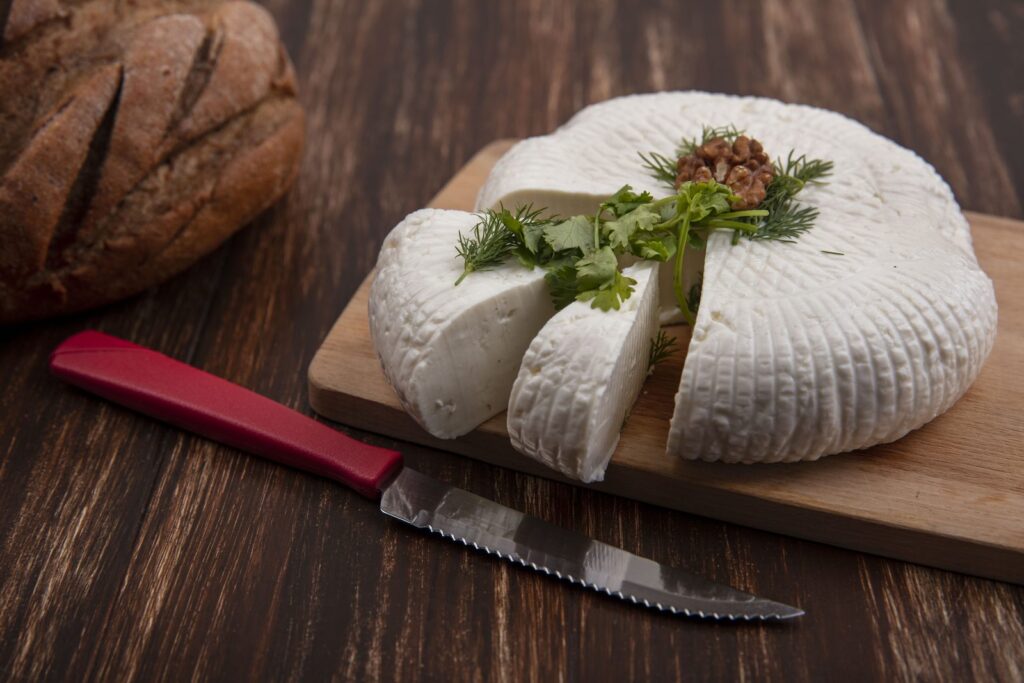
Yes, you can eat feta when pregnant if it is made with pasteurised milk. Feta is a brined cheese with no rind: it is not one of the soft cheeses with a bloomy or washed rind that Santé publique France advises against. The only real criterion is the milk: read the label, and avoid raw-milk feta unless it is cooked. Take care too with crumbled feta sold in tubs and with Greek salad in restaurants, because of the raw vegetables.
These guidelines follow official French recommendations. If in doubt, your midwife or doctor can advise you.
What exactly is feta?
Since 2002, « feta » has been a protected designation of origin (PDO) in the European Union, registered by Regulation (EC) No 1829/2002. Only a Greek cheese meeting a precise specification can carry the name:
- sheep’s milk, alone or mixed with at most 30% goat’s milk;
- drained without pressure, salted, then matured in brine for at least two months;
- produced in defined regions of Greece.
This is the composition described by the Ciqual table, « feta made with at least 70% sheep’s milk and at most 30% goat’s milk ». Greek-style brined cheeses made elsewhere, often with cow’s milk, cannot carry the name and are sold under other names, such as « Greek-style cheese ».
For pregnancy, it is not the designation that matters, but how the milk was treated. A PDO feta and a Greek-style cheese follow the same rule: pasteurised, yes; made with raw milk, only if cooked. The words « au lait cru » (raw milk) remain the only reliable indicator on the packaging.
The real risk: listeriosis
The bacterium Listeria monocytogenes is the reason some cheeses are not recommended during pregnancy. Listeriosis is rare, with fewer than fifty cases a year in pregnant women in France according to Santé publique France, but serious: the bacterium can cross the placenta. It is found mainly in raw milk and multiplies even in the fridge. Pasteurising the milk destroys it, and so does cooking.
During pregnancy, Santé publique France advises against:
- raw milk and raw-milk cheeses, except cooked pressed cheeses such as comté or gruyère;
- soft cheeses with a bloomy or washed rind, such as camembert, brie or munster;
- blue cheeses;
- pre-grated cheese;
- cheese rinds.
Feta, a sheep’s and goat’s milk cheese matured in brine, falls into none of these categories when it is made with pasteurised milk.
The traffic-light guide to feta
| Form | Pregnant | Why |
|---|---|---|
| Pasteurised feta, in a block | 🟢 allowed | pasteurised milk, no rind |
| Cooked feta: baked, in a pie, in a börek, in a gratin | 🟢 allowed | cooking destroys Listeria, even if the milk is raw |
| Raw-milk feta, uncooked | 🔴 avoid | raw milk |
| Crumbled or diced feta, sold in a tub | 🟠 with conditions | already-cut cheese, close to the pre-grated cheese that is not recommended; eat soon after opening, or cooked |
| Feta cut to order, at the market or from a cheesemonger | 🟠 with conditions | ask whether the milk is pasteurised |
| Greek salad in a restaurant | 🟠 with conditions | feta often pasteurised, but raw vegetables outside the home are not recommended because of toxoplasmosis |
| Homemade Greek salad, vegetables well washed | 🟢 allowed | pasteurised feta, washed vegetables |
| Tub opened several days ago | 🔴 avoid | Listeria multiplies in the cold |
How can you tell whether a feta is pasteurised? The words « au lait cru » (raw milk) are compulsory on the packaging of cheeses that contain it. Without them, the milk has been heat-treated. Check each time you buy: both kinds exist.
Feta, mozzarella, ricotta… comparing fresh and brined cheeses
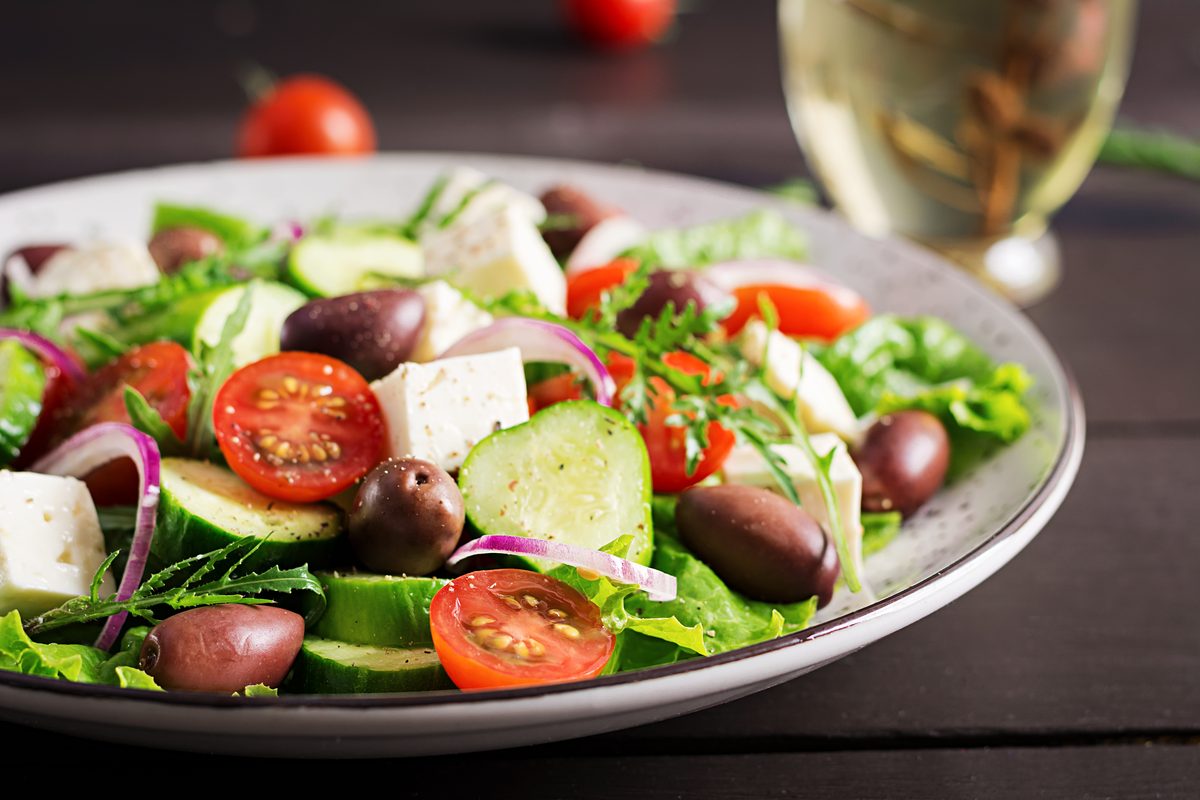
Feta belongs to a family of fresh or brine-matured cheeses with no rind, which pregnant women often wonder whether they can eat. What they have in common: they are not covered by the restrictions on soft cheeses with a rind, and the rule is the same for all of them, pasteurised milk or cooking. Their nutrient content, however, is very different.
| For 30 g | Calories | Salt | Calcium | Pregnant |
|---|---|---|---|---|
| Feta | 85 kcal | 0.68 g | 66 mg | 🟢 if pasteurised or cooked |
| Cow’s milk mozzarella | 68 kcal | 0.18 g | 179 mg | 🟢 if pasteurised or cooked |
| Mozzarella di bufala | 78 kcal | 0.15 g | 78 mg | 🟢 if pasteurised or cooked |
| Burrata | 78 kcal | 0.16 g | 62 mg | 🟠 pasteurised, and eaten on the day of opening |
| Ricotta | not measured | 0.08 g | 94 mg | 🟢 if pasteurised or cooked |
| Fresh goat’s cheese, disc or log | 58 kcal | 0.35 g | 51 mg | 🟢 if pasteurised; some are made with raw milk, read the label |
| Soft cream cheese for spreading | 68 kcal | 0.27 g | 29 mg | 🟢 if pasteurised |
| Mascarpone | 111 kcal | 0.04 g | 39 mg | 🟢 if pasteurised |
| For comparison: comté | 124 kcal | 0.25 g | 272 mg | 🟢 even when made with raw milk, cooked pressed cheese |
Feta stands out on two points: it is by far the saltiest in the table, nearly four times more than mozzarella, and one of the lowest in calcium. For details on the other cheeses, see our pages on mozzarella when pregnant and cheesecake when pregnant, for mascarpone and cream cheese.
How much and how often
| For | Calories | Protein | Calcium | Salt | Saturated fat |
|---|---|---|---|---|---|
| 30 g of feta, one portion | 85 kcal | 4.5 g | 66 mg | 0.68 g | 5.0 g |
| 50 g, on a salad | 142 kcal | 7.6 g | 110 mg | 1.14 g | 8.4 g |
| 100 g | 284 kcal | 15.1 g | 220 mg | 2.27 g | 16.8 g |
Feta is a very salty cheese: 2.27 g of salt per 100 g, three to four times more than emmental. A 30 g portion, as part of the day’s dairy products, is a good guide. If you are watching your blood pressure, keep it for small amounts.
The salt in feta and your day
The World Health Organization recommends not exceeding 5 g of salt a day for adults. Here is the share of that budget taken by feta:
| Amount of feta | Salt | Share of the WHO’s 5 g |
|---|---|---|
| 30 g, one portion of cheese | 0.68 g | 14% |
| 50 g, on a mixed salad | 1.14 g | 23% |
| 100 g, a generous salad or a baked dish | 2.27 g | 45% |
In a Greek salad, feta is not alone: the olives and dressing add salt. To keep some margin, count the feta as the cheese of the meal and avoid salting the rest of the dish. If your doctor or midwife is monitoring your blood pressure, talk to them about how much salty cheese you eat.
Useful nutrients during pregnancy
Feta provides protein and a little calcium, 66 mg per 30 g. For calcium, needs for which remain high during pregnancy, other cheeses do much better, notably cooked pressed cheeses, allowed even when made with raw milk: 30 g of comté provides 272 mg of calcium. See our ranking of foods high in calcium and our guide to how much cheese per day.
Meeting your calcium needs when pregnant
According to the European Food Safety Authority (EFSA), calcium needs do not change during pregnancy, because the body absorbs calcium better at this time. The reference intake remains the same as for all women of your age: 1,000 mg a day from 18 to 24 years, 950 mg a day from 25 years.
| Portion | Calcium | Share of 950 mg |
|---|---|---|
| Feta, 30 g | 66 mg | 7% |
| Cow’s milk mozzarella, 30 g | 179 mg | 19% |
| Comté, 30 g | 272 mg | 29% |
| Emmental, 30 g | 293 mg | 31% |
Feta therefore provides mainly flavour and a little protein; for calcium, cooked pressed cheeses such as comté or emmental do four times better, and they are allowed even when made with raw milk during pregnancy. Yoghurt, milk, some mineral waters, green vegetables and almonds complete your intake.
Greek salad: toxoplasmosis too
With feta, Greek salad raises a second question: raw vegetables. Toxoplasmosis, an infection caused by a parasite, can be passed on by vegetables or herbs that are poorly washed and soiled with earth. If you are not immune, which your blood test early in pregnancy shows, here are the rules to follow, according to Ameli and Santé publique France:
- wash tomatoes, cucumber, pepper, onion and herbs thoroughly, and peel when possible;
- in restaurants, prefer cooked vegetables to raw ones, as you do not know how they were washed;
- wash your hands after handling vegetables with soil on them.
If you are immune to toxoplasmosis, only the feta question arises. For all the rules, see our guide to eating during pregnancy.
Safe recipe ideas
- Horiatiki Greek salad, homemade with well-washed vegetables and pasteurised feta.
- Lentil, feta and tomato salad: cooked lentils, diced feta.
- Chickpea, cucumber and feta salad.
- Green bean, almond and feta salad.
- Feta roasted in the oven with cherry tomatoes and thyme: cooked, it is fine even if you are not sure about the milk.
The site’s recipes with feta, checked
| Recipe | The feta is | Pregnant |
|---|---|---|
| Spinach and feta gözleme | cooked in the flatbread | 🟢 whatever the milk |
| Vegetable börek | baked in the oven | 🟢 whatever the milk |
| Cretan dakos salad | raw, crumbled on top | 🟢 with pasteurised feta and well-washed tomatoes |
| Orzo, vegetable and feta salad | raw, mixed into the salad | 🟢 with pasteurised feta; to be eaten within the day |
For a salad prepared in advance, keep it in the fridge and eat it within the day: Listeria multiplies in the cold, and leftovers should be eaten quickly.
And while breastfeeding?
While breastfeeding, the precautions against listeriosis that apply to pregnancy no longer apply: all fetas become possible again. See our guide to eating while breastfeeding.
Frequently asked questions
Can you eat feta when pregnant?
Yes, if it is made with pasteurised milk, which is indicated by the absence of the words « au lait cru » (raw milk) on the packaging. Raw-milk feta is best avoided, unless cooked.
Is feta a soft cheese?
It is a fresh cheese matured in brine, with no rind. It is not one of the soft cheeses with a bloomy or washed rind, such as camembert or brie, that are not recommended during pregnancy.
Is cooked feta allowed when pregnant?
Yes: cooking destroys Listeria. Feta baked, in a pie or in a gratin is allowed, whatever the milk.
Can you eat Greek salad when pregnant?
Yes, homemade with pasteurised feta and thoroughly washed vegetables. In a restaurant, Ameli advises choosing cooked vegetables over raw ones.
I ate raw-milk feta when pregnant, what should I do?
The risk from a one-off occasion is low. If you get a fever in the following weeks, even a mild one, tell your doctor or midwife.
What is PDO feta?
A Greek sheep’s milk cheese, with at most 30% goat’s milk, matured for at least two months in brine, protected by the European Union since 2002. For pregnancy, it is how the milk was treated that matters.
Is Greek-style cow’s milk cheese allowed when pregnant?
Yes if it is pasteurised, like feta. The same rule applies: without the words « au lait cru » (raw milk), it is fine.
Is feta too salty during pregnancy?
It is very salty, 0.68 g of salt per 30 g, or 14% of the WHO’s 5 g a day guideline. One portion per meal, without adding more salt to the dish, remains reasonable.
Does feta provide a lot of calcium?
No: 66 mg per 30 g, compared with 272 mg per 30 g of comté. For calcium, cooked pressed cheeses do much better.
Can you eat it when pregnant? The series
Food by food, what is allowed, allowed with conditions or best avoided during pregnancy: cheesecake when pregnant, foie gras when pregnant, mozzarella when pregnant, raclette when pregnant, surimi when pregnant, cured meats when pregnant, smoked salmon when pregnant, tiramisu when pregnant, chorizo when pregnant, taramasalata when pregnant, honey when pregnant, camembert and brie when pregnant, prawns when pregnant, soft-boiled egg when pregnant, sushi when pregnant, raw ham when pregnant, hummus when pregnant, tinned tuna when pregnant.
Our sources
- Santé publique France, 1000 premiers jours website: « Les précautions alimentaires pendant la grossesse ».
- Manger Bouger (Santé publique France), « Quels aliments éviter et quelles précautions prendre quand on est enceinte ? », updated 2026.
- Ameli, « Les aliments à éviter et les précautions d’hygiène pendant la grossesse ».
- Santé publique France, listeriosis surveillance data.
- Ciqual 2025 table (Anses): feta, emmental, comté.
- Commission Regulation (EC) No 1829/2002, registration of the protected designation of origin « Feta ».
- EFSA. Scientific Opinion on Dietary Reference Values for calcium. EFSA Journal, 2015.
- WHO, guideline on sodium intake for adults and children: less than 5 g of salt per day.
- Ciqual 2025 table (Anses): cow’s milk mozzarella and di bufala, burrata, ricotta, fresh goat’s cheese, soft cream cheese for spreading, mascarpone, comté, emmental.