Hummus when pregnant: allowed, with one precaution to take
The short answer
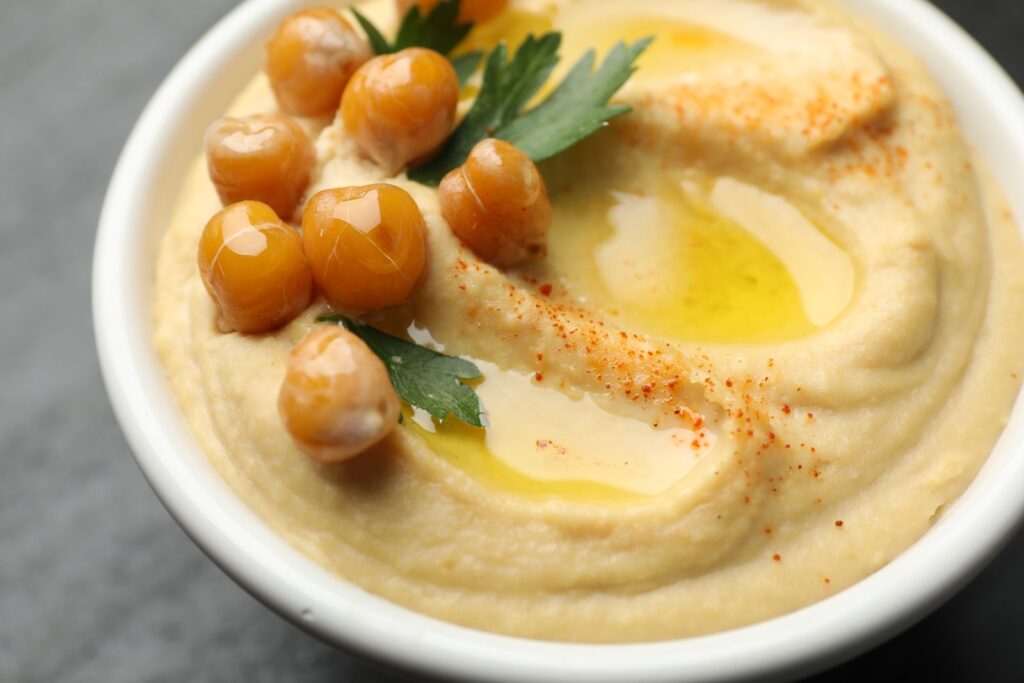
Yes, you can eat hummus during pregnancy. Hummus is not among the foods to avoid in the official French recommendations: it is made from cooked chickpeas, sesame paste (tahini), olive oil, lemon and garlic. The only precaution is the one that applies to all cold ready-to-eat foods: respect the use-by date, keep it in the fridge and eat it within a few days of opening. Homemade hummus, prepared with cooked chickpeas and eaten within 3 days, is the simplest option.
These guidelines follow the official French recommendations. If in doubt, your midwife or doctor can advise you.
Why hummus is not advised against
Foods are advised against during pregnancy for three main reasons: listeriosis, toxoplasmosis and salmonella. Manger Bouger, Ameli and Santé publique France target raw-milk and rind cheeses, cured meats, raw or smoked fish, raw eggs, undercooked meat and poorly washed raw vegetables. Hummus falls into none of these families: the chickpeas are cooked, and it contains no raw dairy, meat, fish or raw egg.
Like any cold ready-to-eat food, a shop-bought hummus that has been open for a long time could in theory allow bacteria to develop, including Listeria, which multiplies in the cold. Hence the general hygiene rule from Manger Bouger for pregnancy: respect use-by dates, eat quickly after opening, keep leftovers for 3 days at most and keep your fridge at 4 °C or below.
What hummus recalls show
The public RappelConso database lists 8 hummus recalls for products sold in France between 2021 and September 2026. They confirm that the risk is low, but not zero:
| Reason | Recalls |
|---|---|
| Detection of Listeria monocytogenes | 2, in 2024 and 2025 |
| Microbiological contamination or non-compliance | 2, in 2024 |
| Ethylene oxide in the sesame or ginger used | 2, in 2021 |
| Abnormal acidity, undeclared allergens | 2 |
Eight recalls in more than five years is very few given the quantities sold. But they are a reminder that shop-bought hummus is a fresh product, which must stay cold and be eaten within its dates.
Tahini and salmonella
One ingredient in hummus deserves a mention: tahini, the sesame paste. The seeds are generally roasted and then ground, and the resulting paste is not heated afterwards. Several salmonellosis outbreaks abroad have been linked to sesame products:
- in the United States in 2011, 23 cases linked to hummus and tahini served in restaurants;
- in New Zealand in 2012, an outbreak linked to hummus made with imported tahini;
- in Europe in 2016 and 2017, 47 cases in five countries, including Greece and Germany, attributed to sesame products.
These episodes remain rare, and tahini is not among the foods advised against during pregnancy. They simply justify the usual precautions: buy tahini from a known brand, respect its date, and keep homemade or shop-bought hummus in the fridge once prepared or opened.
The hummus traffic light
| Form | Pregnant | Why |
|---|---|---|
| Homemade hummus, cooked chickpeas | 🟢 allowed | eat within 3 days |
| Shop-bought hummus, before the use-by date | 🟢 allowed | eat quickly after opening |
| Hummus opened several days ago | 🔴 avoid | general rule: leftovers kept 3 days at most |
| Hummus in a restaurant, at a buffet | 🟠 with conditions | you do not know how long it has been out; prefer it served to order |
| Raw vegetables for dipping, washed at home | 🟢 allowed | carefully washed vegetables, against toxoplasmosis |
| Raw vegetables in a restaurant | 🟠 with conditions | Ameli advises preferring cooked vegetables when eating out |
What hummus gives you
| For | Calories | Protein | Fibre | Fat | Salt |
|---|---|---|---|---|---|
| 50 g of shop-bought hummus | 129 kcal | 4.0 g | 2.6 g | 10.0 g | 0.54 g |
| 100 g of shop-bought hummus | 258 kcal | 8.1 g | 5.2 g | 19.9 g | 1.08 g |
| 100 g of cooked chickpeas | 148 kcal | 8.3 g | 8.2 g | – | 0.03 g |
Hummus provides fibre, useful against the constipation that is common in pregnancy, and plant protein. It is also high in fat, mostly good-quality fat thanks to the olive oil and sesame, but it is calorie-dense: 50 g gives 129 kcal. Pulses are recommended at least twice a week by the PNNS (the French national nutrition and health programme). See our guides on lentils and diabetes, for pulses in gestational diabetes, and on plant proteins.
Folate, iron, calcium: why hummus is of interest in pregnancy
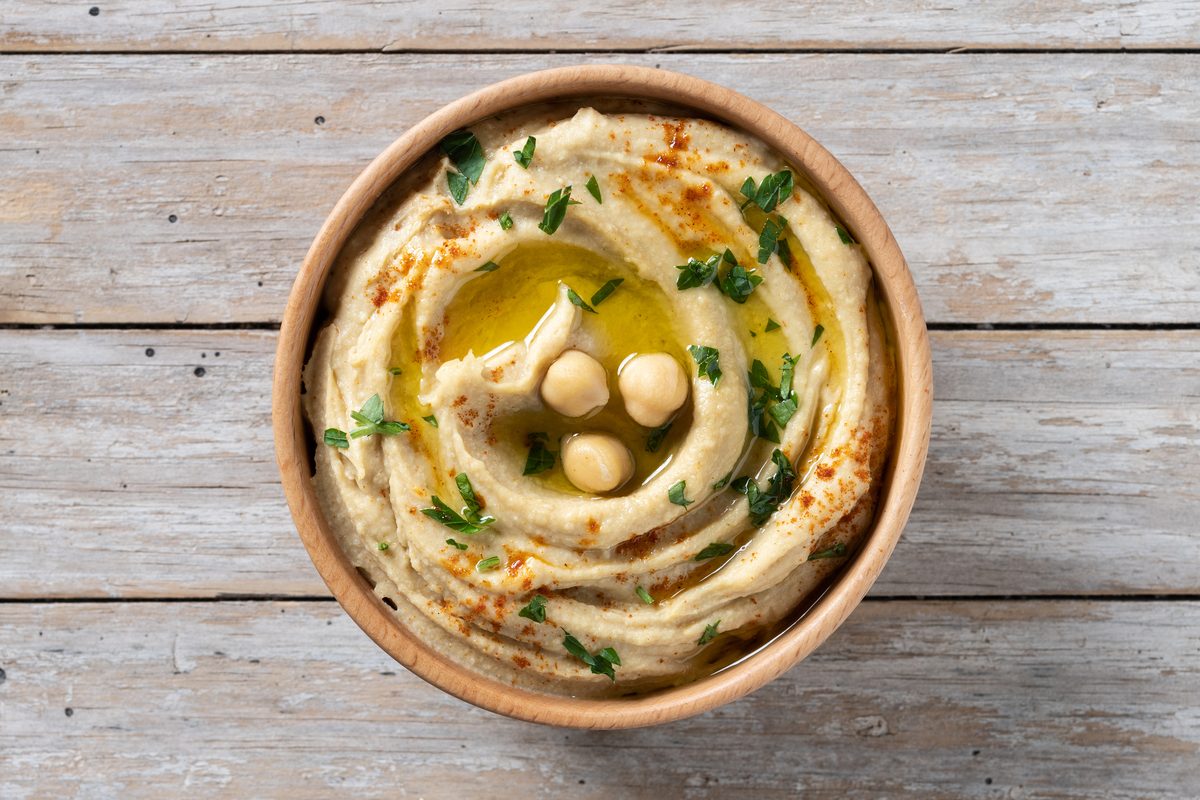
Chickpeas and sesame provide valuable nutrients during pregnancy, in particular folate, or vitamin B9, for which EFSA sets the adequate intake at 600 µg a day during pregnancy.
| Portion | Folate | Iron | Calcium |
|---|---|---|---|
| Chickpeas boiled in water, 100 g | 84 µg | 1.3 mg | 72 mg |
| Tinned chickpeas, drained, 100 g | 37 µg | 1.2 mg | 41 mg |
| Tahini, one 15 g tablespoon | 15 µg | 1.0 mg | 43 mg |
Chickpeas cooked at home provide more than twice as much folate as tinned ones: a good reason to prepare them yourself, soaking them the night before and then boiling them in water. Food alone is not enough, however, to meet the needs of very early pregnancy: in France, folic acid supplementation is recommended before conception and during the first weeks of pregnancy, to be discussed with your doctor or midwife.
The iron in chickpeas and sesame is plant (non-haem) iron, which is less well absorbed than iron from meat. A squeeze of lemon in the hummus, rich in vitamin C, helps you absorb it: to go further, see our guide to foods high in iron.
Hummus and gestational diabetes: the glycaemic index
Hummus is often recommended in gestational diabetes. International glycaemic index tables, which compile published measurements, confirm that chickpeas are among the low glycaemic index foods:
| Food | Measured glycaemic index | In whom |
|---|---|---|
| Dried chickpeas, boiled in water | 31 | people with type 2 diabetes |
| Tinned chickpeas, in brine | 42 | people with type 2 diabetes |
| Hummus, two measurements | 6 and 22 | people without diabetes |
| White Lebanese bread with hummus | 86 | people without diabetes |
The last figure is the most useful: it is the white bread that raises blood sugar, not the hummus. With gestational diabetes, serve it instead with well-washed raw vegetables or wholemeal bread in a measured amount, and follow the advice of the team looking after you. See also our guide on which bread for people with diabetes.
A homemade hummus, in numbers
Making your own hummus lets you control freshness and salt. Here is a simple recipe, and what it provides:
- 250 g of tinned chickpeas, drained and rinsed, or cooked at home;
- 60 g of tahini;
- 30 g of olive oil, about two tablespoons;
- the juice of one lemon, about 40 g, and a little water for texture;
- one clove of garlic, cumin, and salt to taste.
| Per 50 g | Calories | Protein | Fat | Fibre | Salt |
|---|---|---|---|---|---|
| Homemade hummus, no added salt | 115 kcal | 3.3 g | 8.2 g | 2.1 g | 0.17 g |
| Shop-bought hummus | 129 kcal | 4.0 g | 10.0 g | 2.6 g | 0.54 g |
The homemade version is slightly lower in fat and above all three times lower in salt, as long as you measure the salt yourself. On the hygiene side: wash the blender thoroughly, keep the hummus in a closed container in the fridge, and eat it within 3 days.
Shop-bought hummus: what the labels say
Not all hummus is the same. We collected the nutritional values of 51 hummus products sold in France and listed on the collaborative Open Food Facts database: national brands, supermarket own brands and organic products.
| Per 100 g | Lowest | Median | Highest |
|---|---|---|---|
| Calories | 146 kcal | 276 kcal | 368 kcal |
| Fat | 5.1 g | 21.1 g | 33.1 g |
| Salt | 0.1 g | 0.9 g | 1.4 g |
| Protein | 4.5 g | 6.7 g | 10.6 g |
From one tub to another, calories therefore vary from simple to more than double, depending on the amount of oil and tahini added. For a 50 g portion, that is from 73 to 184 kcal. Salt varies too: 0.45 g in a portion of median hummus, or nearly a tenth of the 5 g a day recommended by the WHO. A few tips at the chilled counter:
- Read the ingredients list: chickpeas should come first, before the oil.
- Compare the fat: it ranges from 5 to 33 g per 100 g depending on the tub, and accounts for most of the calorie gap.
- Check the use-by date and buy the tub with the latest date, since hummus keeps only a short time once opened.
Homemade hummus remains the most controlled version, since you choose the amount of oil and salt: our homemade hummus recipe gives an example.
Should you avoid sesame to prevent an allergy in the baby?
Sesame is one of the 14 allergens that must be flagged on the label, and some mothers-to-be wonder whether it is better to avoid it during pregnancy to protect their child from an allergy. The answer from European specialists is no.
The European Academy of Allergy and Clinical Immunology, EAACI, updated its guidelines on preventing food allergy in infants in 2020. It recommends not restricting potentially allergenic foods during pregnancy or breastfeeding for this purpose: studies show no benefit from these exclusions, which can on the contrary impoverish the mother’s diet.
There is therefore no reason to avoid hummus or tahini for fear of an allergy in the baby. The situation is different if you are yourself allergic to sesame or pulses: in that case, avoidance is necessary, pregnant or not, and hummus should be ruled out.
Ideas for eating it
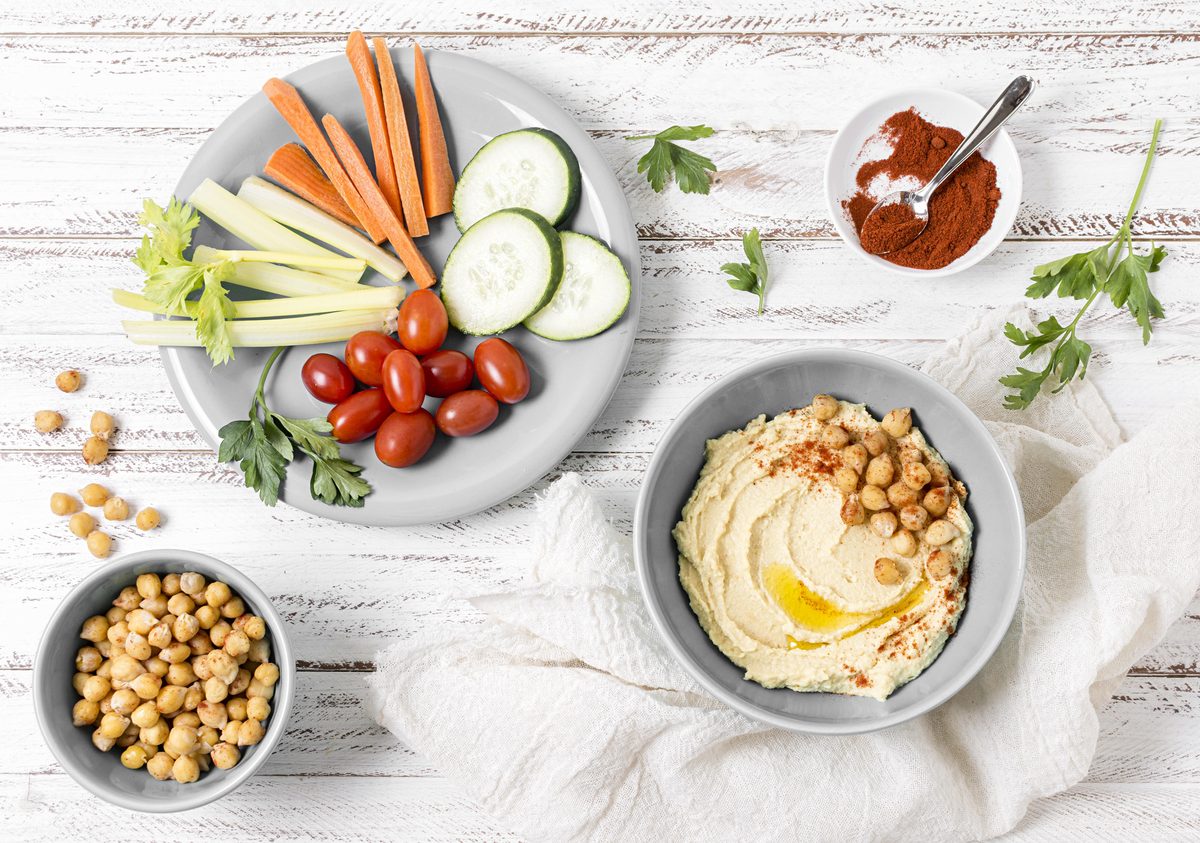
- Homemade hummus, with washed carrot and cucumber sticks.
- On a slice of wholemeal bread, with a hard-boiled egg.
- Chickpea, cucumber and feta salad, with a pasteurised feta.
- As a sauce on roasted vegetables or grilled chicken.
For party nibbles, see also our guide on taramasalata when pregnant and, for all the rules, eating during pregnancy.
And while breastfeeding?
Hummus remains a good food while breastfeeding. See our guide on eating while breastfeeding.
Frequently asked questions
Can you eat hummus when pregnant?
Yes: it is not advised against during pregnancy. Respect the use-by date and eat it quickly after opening.
Is shop-bought hummus safe when pregnant?
Yes, before its use-by date and in the days after opening, as long as you keep it in the fridge.
Is tahini allowed during pregnancy?
Yes: sesame paste is not among the foods advised against.
How long can you keep homemade hummus?
3 days at most in the fridge, like all leftovers, according to Manger Bouger.
Is hummus suitable for gestational diabetes?
Yes in reasonable amounts: chickpeas are pulses with a low glycaemic index. Watch the calories, 129 kcal per 50 g.
Can tahini contain salmonella?
It has happened abroad, in a few outbreaks linked to sesame products. Tahini is not advised against during pregnancy, but buy it from a known brand and respect its date.
Have there been hummus recalls for Listeria?
Yes, two in 2024 and 2025 according to RappelConso, out of 8 hummus recalls since 2021. Hence the value of respecting the date and eating it quickly after opening.
Does hummus provide folic acid?
It provides natural folate thanks to the chickpeas and sesame, but does not replace the folic acid supplementation recommended in early pregnancy.
Tinned or dried chickpeas for hummus when pregnant?
Both are fine. Dried chickpeas cooked at home provide more folate, 84 µg per 100 g against 37 µg for tinned ones.
Which shop-bought hummus should you choose when pregnant?
One where chickpeas are the first ingredient, with as little fat as possible, and furthest from its use-by date. Among the 51 hummus products surveyed, calories range from 146 to 368 kcal per 100 g.
Should you avoid sesame when pregnant to prevent an allergy in the baby?
No: the European EAACI guidelines advise against restricting allergenic foods during pregnancy for this purpose. Only women who are themselves allergic to sesame need to avoid it.
Can you eat it when pregnant? The series
Food by food, what is allowed, allowed with conditions or to be avoided during pregnancy: cheesecake when pregnant, foie gras when pregnant, feta when pregnant, mozzarella when pregnant, raclette when pregnant, surimi when pregnant, cured meats when pregnant, smoked salmon when pregnant, tiramisu when pregnant, chorizo when pregnant, taramasalata when pregnant, honey when pregnant, camembert and brie when pregnant, prawns when pregnant, soft-boiled egg when pregnant, sushi when pregnant, cured ham when pregnant, tinned tuna when pregnant.
Our sources
- Manger Bouger (Santé publique France), « Quels aliments éviter et quelles précautions prendre quand on est enceinte ? », updated 2026.
- Ameli, foods to avoid and hygiene precautions during pregnancy.
- PNNS (Santé publique France): pulses at least twice a week.
- Ciqual 2025 table (Anses): pre-packaged hummus, cooked chickpeas.
- RappelConso, public product recall dataset (data.economie.gouv.fr), hummus, 2021 to September 2026.
- CDC. Multistate outbreak of Salmonella serotype Bovismorbificans infections associated with hummus and tahini, United States, 2011. MMWR, 2012 (PMID 23169315).
- Paine S et al. An outbreak of multiple serotypes of Salmonella in New Zealand linked to consumption of contaminated tahini imported from Turkey. Foodborne Pathog Dis, 2014 (PMID 25393669).
- Meinen A et al. Salmonellosis outbreak attributable to sesame products in five European countries, 2016 to 2017. Euro Surveill, 2019 (PMID 31507266).
- Ciqual 2025 table (Anses): chickpeas, tahini; USDA, SR Legacy: weight of a spoonful of tahini (15 g).
- Atkinson FS et al. International tables of glycemic index and glycemic load values: 2008. Diabetes Care, 2008: chickpeas, hummus.
- Open Food Facts, hummus sold in France (« hummus » category), survey of 26 September 2026.
- Halken S et al. EAACI guideline: preventing the development of food allergy in infants and young children, 2020 update. Pediatr Allergy Immunol, 2021 (PMID 33710678).