Vitamin D: role, deficiency and supplements

Vitamin D is first and foremost what fixes calcium and phosphorus in your bones. Your skin makes it in the sun, but in France, from October to March, this production drops. The result: according to Anses, more than 70% of French adults have an insufficient status and 6.5% are deficient. Food alone rarely covers the reference of 15 µg a day. Here is what it really does, where to find it, what the large studies say about supplements, and how to avoid overdosing, which does exist.
👉 Free tool: Calorie needs – calculate in 30 seconds, no sign-up.
What is vitamin D for?
Vitamin D is a fat-soluble vitamin (it dissolves in fat and is stored in the body). Anses points out that it exists in two forms: D2 (ergocalciferol), produced by plants and fungi, and D3 (cholecalciferol), of animal origin and made by your skin. Both have equivalent biological activity in humans, but D2 has a shorter half-life.
Once absorbed or synthesised, it is converted by the liver into 25-hydroxyvitamin D (25-OH-D), the form measured in the blood, then by the kidney into its active form. Its main role, according to Anses: maintaining the balance of calcium and phosphorus, with the help of parathyroid hormone, and ensuring the mineralisation of bones, cartilage and teeth during and after growth.
What happens when it is lacking
A true, prolonged deficiency reduces the intestinal absorption of calcium and phosphorus. In children this causes rickets; in adults, osteomalacia (poorly mineralised bones). In older people, especially postmenopausal women, a deficiency lowers bone density and predisposes to osteoporosis and fractures. For everything to do with the skeleton, our guide to bone health and osteoporosis goes further.
You will often read that vitamin D “boosts immunity” and protects against cancer or heart disease. These links exist in observational studies, but the large controlled trials are disappointing: we come back to this below, with figures. For immunity in general, see our guide to strengthening your immunity through diet.
How much do you need? The official references
In France, the reference is the 2021 Anses opinion on vitamins and minerals. For vitamin D, the agency uses an adequate intake (AI) and a tolerable upper intake level (UL), the latter taken from EFSA. The AI of 15 µg a day was calculated by EFSA to cover needs when skin synthesis is minimal. If you get sun exposure, your dietary need is lower, or even zero.
| Population | Adequate intake (µg/day) | Tolerable upper intake level (µg/day) |
|---|---|---|
| Infants (0 to 12 months) | 10 | 25 |
| Children aged 1 to 10 | 15 | 50 |
| Adolescents aged 11 to 17 | 15 | 100 |
| Adults (men and women) | 15 | 100 |
| Pregnant or breastfeeding women | 15 | 100 |
A useful conversion: supplement labels often use international units (IU). The Anses report gives the equivalence 10 to 15 µg = 400 to 600 IU, that is 1 µg = 40 IU. The 15 µg of the AI therefore correspond to 600 IU, and the limit of 100 µg to 4,000 IU a day.
Why countries do not agree
References vary from one agency to another, because they do not start from the same assumptions about sunshine. The Anses report compares them: 15 µg for EFSA and for the American IOM in adults (20 µg beyond age 70 for the IOM), 20 µg for the German-speaking countries (D-A-CH) in the absence of skin synthesis, 10 µg for the Nordic countries (20 µg after age 75). They all agree on one point: the less sun you get, the more your plate and, if needed, a supplement must take over.
Why deficiency is so common in France
Skin makes vitamin D under the effect of UVB. According to Anses, this synthesis depends on latitude, season, age, skin pigmentation, clothing and sunscreen. WHO and FAO estimate that between latitudes 42° North and 42° South, about 30 minutes of exposure of the arms and face, without sunscreen, is generally enough. But mainland France lies almost entirely north of the 42nd parallel, and the Anses report places winter beyond this latitude among the periods when endogenous synthesis is low.
Several factors add to this:
- Age: the agencies cited by Anses (SCF, Afssa, WHO) describe less efficient skin synthesis and often insufficient exposure in older people. See our guide to nutrition for seniors.
- Dark skin, which produces less vitamin D for the same exposure.
- Excess weight: EFSA reports an inverse relationship between BMI and blood 25-OH-D, perhaps because the vitamin is stored in fat tissue or “diluted” in a larger volume.
- Living indoors and covering clothing.
The French figures are clear: in its 2021 opinion, Anses cites data from the nutritional surveillance team of Santé publique France (Esen, 2019): more than 70% of adults have an insufficiency of vitamin D and 6.5% a deficiency. The agency judges that meeting vitamin D needs remains a public health issue, on a par with iron, iodine and vitamin B9. It recommends an individualised approach and mentions several avenues: personalised supplementation through the healthcare system, sun exposure advice compatible with skin cancer prevention, and food fortification regulated by the public authorities.
The foods that really provide it
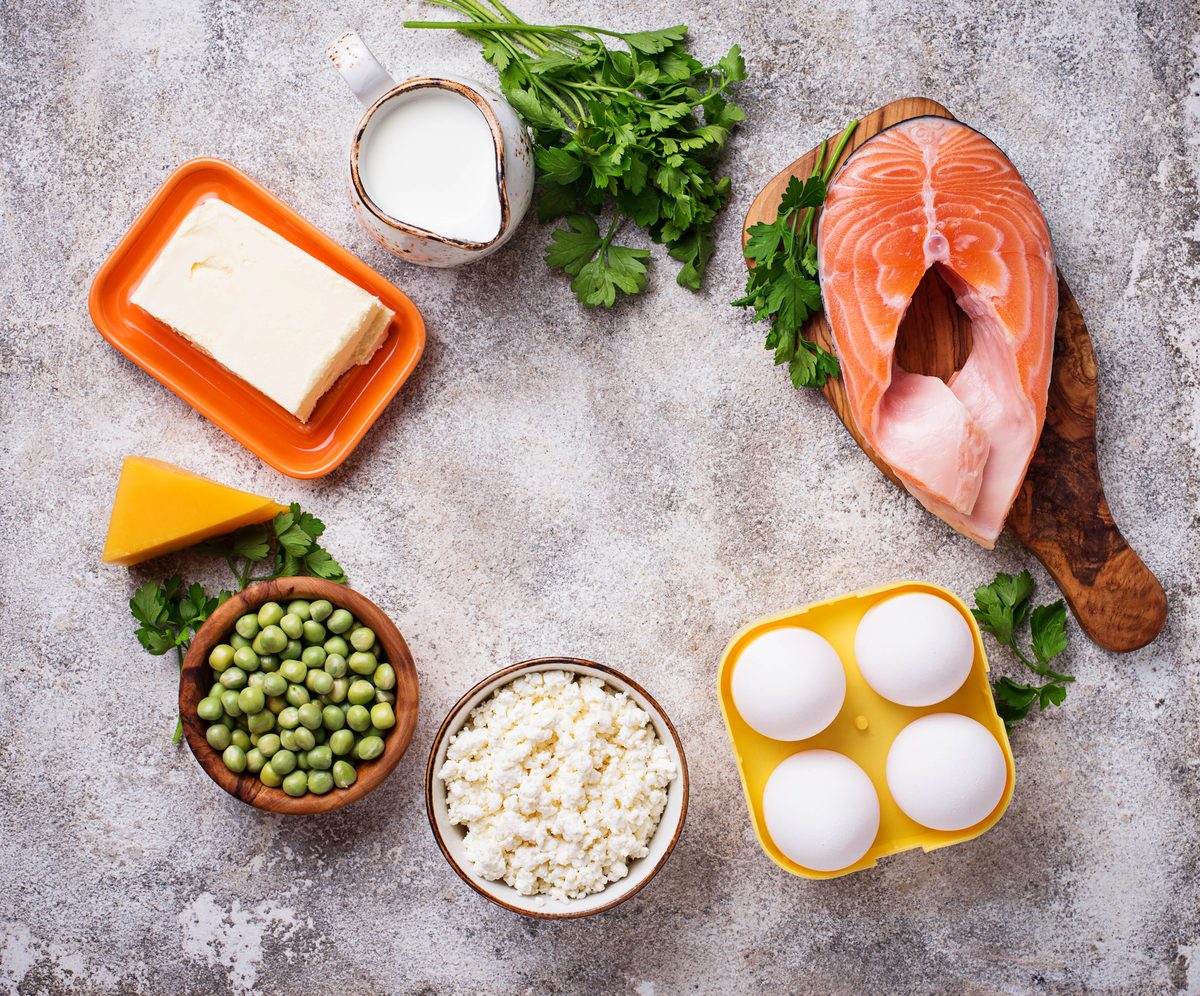
Vitamin D is rare in food. Anses cites three main sources: oily fish, cod liver oil and egg yolk. The full ranking, portion by portion, is in our guide to foods high in vitamin D. Here, mainly remember the orders of magnitude.
| Food (Ciqual) | Vitamin D (µg per 100 g) | Share of the 15 µg AI |
|---|---|---|
| Cod liver oil | 250 | more than 16 times the AI |
| Roasted farmed rainbow trout | 15 | 100% |
| Grilled or pan-fried sardine | 12.3 | 82% |
| Grilled or pan-fried herring | 10.8 | 72% |
| Steamed salmon | 8.7 | 58% |
| Baked mackerel | 7.72 | 51% |
| Canned yellowfin tuna in brine, drained | 6.1 | 41% |
| Raw chanterelle | 5.3 | 35% |
| Raw egg | 2 | 13% |
| UHT semi-skimmed milk fortified with vitamin D | 0.78 | 5% |
| Raw button mushroom | 0.3 | 2% |
Three practical lessons:
- Oily fish is the only common source that really counts. Santé publique France recommends eating fish twice a week, including one oily fish (sardines, mackerel, herring, salmon). Details in how much fish per week.
- Not all mushrooms are equal. Button mushrooms contain very little according to Ciqual; chanterelles and morels clearly more. It is vitamin D2.
- Fortified products remain modest. Fortified milk or some plant-based drinks provide a top-up, not a solution. Read the label: not all are fortified (Ciqual gives 1.16 µg for a calcium-fortified soya drink, less than 0.5 µg for an unfortified version).
Do the maths: even with two oily fish meals a week, your daily average stays far from 15 µg if the sun does not do its part. This is why the question of a supplement arises in winter.
The blood test: useful or not?
The marker of status is blood 25-OH-D. But beware, the thresholds are not agreed. The Anses report shows this: the European Scientific Committee on Food (SCF) considered a range of 25 to 100 nmol/L desirable; Afssa set the deficiency threshold at 30 nmol/L without defining an “optimal” threshold; the American IOM aimed for a median concentration of 40 nmol/L for bone health.
The French Haute Autorité de santé (HAS) settled the question of testing in 2013: in most cases, testing vitamin D provides no useful information. It restricts testing (and its reimbursement by the French health insurance system) to a few situations:
- suspected rickets or osteomalacia;
- an older person who falls repeatedly;
- follow-up of an adult kidney transplant recipient, more than three months after the transplant;
- before and after obesity surgery;
- compliance with the leaflet of a medicine that requires this test.
In plain terms: if you are in good health, a test “just to see” will generally not change the decision. The decision to supplement therefore does not necessarily go through a blood test.
What the studies say about supplements
Vitamin D is one of the most studied vitamins. The results of the large randomised trials are more nuanced than the marketing promises.
| Study | Population | Main result |
|---|---|---|
| Cochrane, Avenell et al., 2014 (53 trials, 91,791 participants) | Postmenopausal women and older men | Vitamin D alone: no demonstrated effect on hip fracture (RR 1.12). Vitamin D + calcium: slight reduction (RR 0.84), equivalent to one fewer hip fracture per 1,000 older people living at home per year. |
| Cochrane, Bjelakovic et al., 2014 (56 trials, 95,286 participants) | Adults, mostly women over 70 | Vitamin D3: slightly lower mortality (RR 0.94), meaning 150 people treated for five years to prevent one death. D2: no significant effect. |
| VITAL trial, Manson et al., 2019 (25,871 participants) | Men aged 50 and over, women aged 55 and over, United States | 2,000 IU a day for a median of 5.3 years: no reduction in invasive cancers (HR 0.96) or major cardiovascular events (HR 0.97). |
| Meta-analysis Jolliffe et al., 2025 (40 trials, 61,589 participants) | All ages | Acute respiratory infections: OR 0.94 (confidence interval 0.88 to 1.00), non-significant protective effect. |
How do you read this table? In an older person, especially in a care home, the combination of vitamin D and calcium has a real but modest benefit for the bones. In a healthy adult, taking vitamin D daily prevents neither cancer nor heart attack. And the effect on colds and respiratory infections, often highlighted, is no longer statistically significant in the most recent meta-analysis. In 2013 the HAS also found no demonstrated usefulness of testing for the prevention of cancers, cardiovascular disease, type 2 diabetes or infections.
Should you take a supplement?
In France there is no official recommendation for systematic supplementation of all adults. Anses favours an individualised approach, given the wide variability of needs (age, skin colour, time spent outdoors, latitude). In practice, the decision is made with your doctor, taking your situation into account.
The situations where the question arises most
- Children and adolescents: the ANSM (the French medicines agency) relays the updated French recommendations, aligned with European references: 400 IU a day from 0 to 18 years in healthy children with no risk factors, 800 IU a day where there are risk factors.
- Older people, who combine low exposure and reduced skin synthesis, and in whom combining with calcium has shown a small benefit on hip fractures.
- People who rarely go outside, cover their skin or have dark skin.
- Pregnancy: the AI stays at 15 µg, as for other women. Follow-up is by your midwife or doctor; see our guide to eating during pregnancy.
Daily, weekly or ampoule?
Vitamin D is taken as drops, tablets or high-dose ampoules spaced out over time. The choice of schedule is a matter for prescription. If you buy a supplement, compare the dose per serving with the references in the table above, and add up everything you already take (multivitamins, cod liver oil, fortified foods). Our best vitamin D supplement comparison scrutinises the products on the market (dose, D3 form, excipients).
As it is a fat-soluble vitamin, taking it with a meal that contains fat is consistent with its nature; however, we found no official figure on this point.
Overdosing: a real risk
Vitamin D is stored. Taking too much is not harmless. EFSA set the limit of 100 µg a day for adults from studies showing no hypercalcaemia at doses of 234 and 275 µg a day, with a safety margin. The main danger of an excess is hypercalcaemia (too much calcium in the blood).
In children, the health authorities have raised the alarm. In 2021, the ANSM reported cases of hypercalcaemia in infants after taking food supplements fortified with vitamin D, with possible kidney damage (stones, nephrocalcinosis). Some products contain 500 to 10,000 IU per drop. Anses published an opinion on these poisonings. The ANSM’s instructions to parents:
- prefer medicines to food supplements for children’s vitamin D;
- check the amount of vitamin D per drop and control the dose given;
- do not combine products that contain it;
- avoid buying non-compliant products online.
In older people too, the 2009 Cochrane review observed more cases of hypercalcaemia with vitamin D or its analogues (RR 2.35), especially with calcitriol, an active form reserved for prescription.
Common myths about vitamin D
“In summer, 5 minutes of sun is enough to stock up for the year”
None of the official sources consulted gives a precise duration suited to France. The WHO and FAO reference (about 30 minutes, arms and face) applies to latitudes below 42°. Reserves built up in summer help, but Anses finds an insufficiency in more than 70% of adults: summer clearly does not suffice for everyone.
“D3 is absorbed much better than D2”
A nuance: Anses states that both forms have equivalent biological activity, with D2 having a shorter half-life. In the Cochrane review on mortality, only D3 was associated with lower mortality, which partly explains the current preference for D3.
“The more I take, the better I feel”
No. The large trials in healthy adults show no benefit for cancer or the heart, and an excess exposes you to hypercalcaemia. Above 100 µg (4,000 IU) a day without medical advice, you go beyond the safety framework defined by EFSA.
“Mushrooms replace fish”
Not button mushrooms: 0.3 µg per 100 g according to Ciqual, or 2% of the AI. Some wild mushrooms contain more, but they are not eaten every day.
A typical week to put vitamin D on the menu
No miracle on the plate, but habits that count:
- Monday: grilled sardines with lemon with a lentil salad.
- Wednesday: a spinach and avocado omelette for dinner.
- Thursday: baked mustard mackerel.
- Weekend: baked salmon fillet with broccoli, and a proper outing in daylight when the weather allows.
Canned sardines and mackerel are convenient and remain good sources according to Ciqual (for example 12.5 µg per 100 g of drained sardines in tomato sauce).
Precautions
- Add up all your sources of vitamin D (supplement, multivitamins, cod liver oil) before adding a new one.
- If you have a kidney problem or an abnormal calcium level, do not take vitamin D without medical advice: excess vitamin D acts precisely on calcium and the kidneys.
- For a child, follow the paediatrician’s prescription and prefer a medicine to a food supplement, as the ANSM asks.
- Sun exposure still needs to be measured: exposure advice must remain compatible with skin cancer prevention, Anses reminds us.
Interested in micronutrition? Discover our supplements & micronutrition guides and the micronutrition training course to make it your career.
💼 Careers & guidance: interested in this field professionally? Discover our career profiles: micronutritionist.

Frequently asked questions
How much vitamin D a day for an adult?
Anses sets an adequate intake of 15 µg a day (600 IU) for adults, including pregnant and breastfeeding women. This reference covers needs when the skin makes very little. The safety limit is 100 µg (4,000 IU) a day.
Do you need a blood test before taking a supplement?
Not necessarily. The HAS considers that testing provides no useful information in most cases and restricts it to a few situations: suspected rickets or osteomalacia, repeated falls in older people, kidney transplant, obesity surgery.
Which food contains the most vitamin D?
Cod liver oil, with 250 µg per 100 g according to Ciqual. Among everyday foods, oily fish dominate: trout, sardine, herring, salmon, mackerel.
Does vitamin D protect against colds or flu?
The most recent meta-analysis (Jolliffe, 2025, 40 trials and 61,589 participants) no longer finds a significant protective effect on acute respiratory infections (OR 0.94, interval 0.88 to 1.00).
What dose for a child?
According to the French recommendations relayed by the ANSM: 400 IU a day from 0 to 18 years with no risk factors, 800 IU a day with risk factors. Prefer a prescribed medicine to a food supplement.
Can you overdose on vitamin D?
Yes. An excess causes hypercalcaemia, which can damage the kidneys. Serious cases have been reported in infants with very concentrated supplements (up to 10,000 IU per drop).
This article is for information only and does not replace the advice of your doctor or a dietitian.
Our sources
- Anses. Opinion on the update of the French nutritional reference values for vitamins and minerals, and collective expert report (in French) (referral 2018-SA-0238). March 2021.
- Anses. Ciqual food composition table (in French). 2025.
- Haute Autorité de santé. Clinical usefulness of vitamin D testing: HAS does not recognise any usefulness in routine vitamin D testing (in French). October 2013.
- ANSM. Vitamin D in children: use medicines, not food supplements, to prevent the risk of overdose (in French). January 2021, updated March 2021.
- Avenell A, Mak JC, O’Connell D. Vitamin D and vitamin D analogues for preventing fractures in post-menopausal women and older men. Cochrane Database of Systematic Reviews, 2014. PMID 24729336.
- Avenell A, Gillespie WJ, Gillespie LD, O’Connell D. Vitamin D and vitamin D analogues for preventing fractures associated with involutional and post-menopausal osteoporosis. Cochrane Database of Systematic Reviews, 2009. PMID 19370554.
- Bjelakovic G, Gluud LL, Nikolova D et al. Vitamin D supplementation for prevention of mortality in adults. Cochrane Database of Systematic Reviews, 2014. PMID 24414552.
- Manson JE, Cook NR, Lee IM et al. Vitamin D Supplements and Prevention of Cancer and Cardiovascular Disease (VITAL). New England Journal of Medicine, 2019. PMID 30415629.
- Jolliffe DA, Camargo CA, Sluyter JD et al. Vitamin D supplementation to prevent acute respiratory infections: systematic review and meta-analysis of stratified aggregate data. Lancet Diabetes & Endocrinology, 2025. PMID 39993397.
- Santé publique France, Manger Bouger. Alternate between oily and lean fish (in French) (sante.fr).