Taramasalata in pregnancy: why to avoid it, and alternatives
The short answer
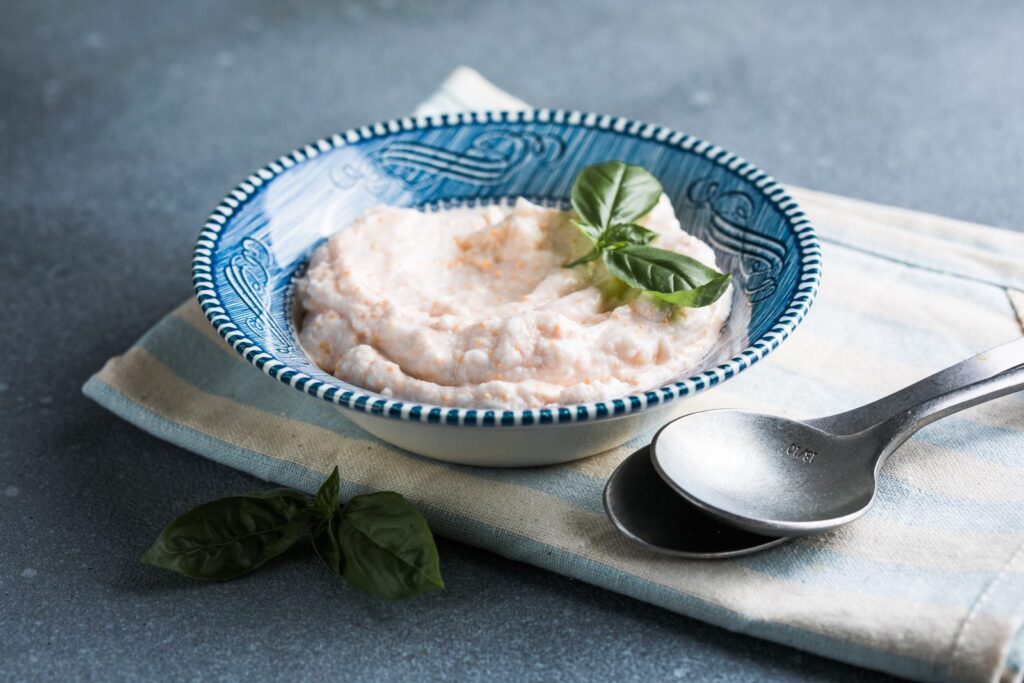
No, taramasalata (tarama in French) is not recommended during pregnancy. Ameli, Manger Bouger and Santé publique France name it specifically among the seafood products to avoid, along with smoked fish, raw fish and surimi. Tarama is made from fish roe, often cod roe, salted and sometimes smoked but not cooked, blended with oil and breadcrumb, then sold in the chilled aisle. It is the typical profile of foods in which Listeria, the bacterium behind listeriosis, can multiply in the fridge. For nibbles and drinks, home-made hummus, aubergine dip or tzatziki are good alternatives.
These guidelines follow the official French recommendations. If in doubt, your midwife or doctor can answer your questions.
Why is taramasalata not recommended?
Three characteristics of taramasalata make it risky during pregnancy:
- It is based on raw fish roe, salted and sometimes cold-smoked, a process that does not cook it.
- It is ready to eat and eaten cold, with no cooking step that would destroy bacteria.
- It is kept chilled for several weeks. Yet Listeria monocytogenes is one of the few bacteria able to multiply in the fridge.
Listeriosis is rare, fewer than fifty cases a year in pregnant women in France according to Santé publique France, but it is serious: the bacterium can cross the placenta and cause a miscarriage, a premature birth or an infection in the newborn. Hence the precautionary principle applied to the whole family of raw, smoked or marinated seafood products.
What taramasalata labels say
To find out what a shop-bought taramasalata really contains, we went through the ingredient lists of 64 taramas sold in France, as they appear on Open Food Facts:
| What you find on the label | Survey result |
|---|---|
| Fish roe content stated, when it is | from 9% to 52%, most common value around 26% |
| Fish roe stated as smoked | 49 products out of 64 |
| Mention of pasteurisation | none of the 64 products |
In other words, a taramasalata is made up of roughly three quarters oil, breadcrumb and water, and its roe is most often smoked, which puts it in the family of smoked fish that the authorities advise against. No label surveyed mentions pasteurisation: the question of a “pasteurised taramasalata” therefore does not really arise in practice.
Pink, white, salmon: what the colourings say
The pink of taramasalata most often comes from a colouring. We looked at the 48 taramas sold in France whose ingredient list is legible on Open Food Facts:
| On the label | Taramas concerned |
|---|---|
| A colouring or a colouring vegetable concentrate | 31 out of 48 |
| of which cochineal carmine, E120 | 16 |
| of which paprika extract | 7, mostly salmon taramas |
| of which sweet potato, purple carrot concentrates or anthocyanins | 8 |
| of which beetroot red | 4 |
| of which azorubine, E122 | 1 |
| No colouring, so-called “white” taramas | 17 |
| At least one preservative: benzoate, sorbate, acetates | 38 out of 48 |
The colour makes no difference to the risk. A white taramasalata, with no colouring, contains the same uncooked fish roe as a pink one. And the presence of a preservative does not make it any safer during pregnancy: the authorities make no exception. Anses, in its fact sheet on Listeria, explicitly lists tarama with raw fish, alongside sushi and sashimi, among the foods pregnant women should avoid.
A detail for other family members: azorubine, E122, is one of the six colourings whose label must carry the statement “may have an adverse effect on activity and attention in children”, under the European regulation on additives.
What taramasalata recalls show
The public RappelConso database lists 22 recall notices for tarama and seafood spreads between 2021 and September 2026:
| Reason | Notices |
|---|---|
| Presence of Listeria monocytogenes | 4, in 2022 and 2026, including trout roe taramas |
| Break in the cold chain | 12, across a whole range in 2025 and spreads in 2026 |
| Possible presence of Escherichia coli | 3, in 2021 |
| Undeclared milk allergen, use-by date error | 3 |
Half of the recalls concern the cold chain: a taramasalata is only safe if it stays cold the whole time, from the manufacturer to your plate. This is precisely the weak point of chilled-aisle products, and the reason why Listeria, which multiplies in the fridge, thrives there.
The traffic light for taramasalata and spreads
| Spread | Pregnant | Why |
|---|---|---|
| Taramasalata, plain or with smoked salmon | 🔴 avoid | uncooked fish roe, product kept chilled |
| Lumpfish roe, salmon roe, caviar | 🔴 avoid | raw fish roe |
| Shop-bought fish rillettes, from the chilled aisle | 🔴 avoid | ready-to-eat product kept chilled |
| Home-made sardine or tuna rillettes, tinned fish | 🟢 allowed | cooked fish; eat within 3 days |
| Home-made hummus | 🟢 allowed | cooked chickpeas; eat within 3 days |
| Shop-bought hummus, chilled aisle | 🟠 conditional | eat soon after opening |
| Home-made aubergine dip | 🟢 allowed | cooked aubergine |
| Home-made tzatziki | 🟢 allowed | pasteurised yoghurt, cucumber washed thoroughly |
What taramasalata contains
| For | Calories | Fat | Protein | Salt |
|---|---|---|---|---|
| 30 g of cod roe taramasalata | 155 kcal | 15.9 g | 1.8 g | 0.46 g |
| 100 g of cod roe taramasalata | 518 kcal | 53.0 g | 6.1 g | 1.53 g |
| 100 g of smoked salmon taramasalata | 501 kcal | 50.0 g | 7.7 g | 1.33 g |
Nutritionally, taramasalata is mostly oil: 53 g of fat per 100 g, and very little protein: 30 g already comes to 155 kcal. Going without it during pregnancy does not deprive you of any important nutrient.
Fish roe: which kinds are possible?
Taramasalata is just one of the many ways of eating fish roe. They all follow the same logic: raw or smoked, they are to be avoided; cooked, they become possible again.
| Product | Pregnant |
|---|---|
| Taramasalata, bottarga, smoked cod roe | 🔴 avoid |
| Lumpfish roe, salmon roe, caviar, tobiko in sushi | 🔴 avoid |
| Fish roe cooked in a hot dish, for example pasta with a cooked fish roe sauce | 🟢 allowed, heated right through |
| Cooked herring milt or roe, pan-fried | 🟢 allowed, well cooked |
For fish roe sauce, the rule is the same as for smoked salmon: Anses recommends reheating hot dishes to above 70 °C right through. The roe must therefore cook in the sauce, not be placed raw on hot pasta.
Fish roe: what it really provides
A paradox: Santé publique France lists fish roe among the seafood products to favour during pregnancy, provided it is well cooked and not smoked. Nutritionally, the roe itself is rich. It is taramasalata that dilutes it in oil:
| 100 g of | Calories | Protein | EPA + DHA | Iodine | Vitamin B12 | Salt |
|---|---|---|---|---|---|---|
| Cod roe taramasalata | 518 kcal | 6.1 g | 0.73 g | 10 µg | 2.7 µg | 1.53 g |
| Smoked cod roe | 154 kcal | 29.0 g | 1.21 g | 173 µg | not measured | 2.04 g |
| Lumpfish roe | 78 kcal | 10.4 g | 1.48 g | 60 µg | 5.5 µg | 4.56 g |
| Salmon roe | 240 kcal | 30.8 g | 3.50 g | 330 µg | 48.6 µg | 2.34 g |
| Caviar | 254 kcal | 25.0 g | 3.13 g | 117 µg | 5.5 µg | not measured |
Smoked cod roe contains nearly five times more protein than taramasalata, where the roe is diluted in oil and breadcrumb, and seventeen times more iodine. But in these forms, smoked or semi-preserved, it is still not recommended during pregnancy. Its place is in a hot dish, cooked right through. Note the salt too: lumpfish roe provides 4.56 g per 100 g, almost the 5 g of salt a day advised by the WHO.
At a Greek or Lebanese restaurant: mezze under the microscope
Taramasalata is often served as part of a mezze platter. Here is how to find your way around, using the rules of Santé publique France and Ameli:
| Mezze | Pregnant | Why |
|---|---|---|
| Taramasalata | 🔴 avoid | uncooked fish roe, often smoked |
| Aubergine dip, melitzanosalata | 🟢 allowed | cooked aubergine |
| Hummus | 🟠 conditional | cooked chickpeas; prepared in advance and served cold |
| Tzatziki | 🟠 conditional | pasteurised yoghurt, but raw cucumber and herbs outside the home |
| Feta in a salad | 🟠 conditional | pasteurised, but raw vegetables outside the home; see feta when pregnant |
| Saganaki, fried cheese served piping hot | 🟢 allowed | cheese heated right through |
| Souvlaki, well-cooked skewers | 🟢 allowed | meat cooked right through |
| Grilled octopus or squid | 🟢 allowed | cooked seafood |
At a restaurant, the safest approach is to favour hot, cooked mezze, and keep cold preparations for home, where you control how the vegetables are washed and how fresh they are.
Nutrients to get elsewhere
If you like taramasalata for its taste of the sea, cooked fish will give you what it does not provide: omega-3, iodine, vitamin D. Manger Bouger advises eating fish twice a week during pregnancy, including one oily fish, well cooked and not smoked. See our guides to smoked salmon when pregnant, how much fish per week and foods high in iodine.
Taramasalata or alternatives: the comparison in numbers
Here is what a 30 g portion, a generous slice of toast or two spoonfuls, of taramasalata and its possible replacements provides during pregnancy:
| For 30 g | Calories | Fat | Protein | Fibre | Omega-3 EPA + DHA | Pregnant |
|---|---|---|---|---|---|---|
| Cod roe taramasalata | 155 kcal | 15.9 g | 1.8 g | 0.1 g | 0.22 g | 🔴 avoid |
| Drained sardines in oil, base for home-made rillettes | 65 kcal | 4.1 g | 7.0 g | 0 | 0.50 g | 🟢 allowed, cooked tinned fish |
| Hummus | 77 kcal | 6.0 g | 2.4 g | 1.6 g | not measured | 🟢 home-made; 🟠 shop-bought, soon after opening |
| Guacamole | 57 kcal | 5.2 g | 0.5 g | 1.5 g | not measured | 🟢 home-made, the same day |
| Aubergine dip | 46 kcal | 4.1 g | 0.4 g | 1.1 g | not measured | 🟢 home-made |
| Yoghurt tzatziki | 41 kcal | 3.3 g | 1.9 g | not measured | traces | 🟢 home-made, washed cucumber |
The comparison is clear-cut: taramasalata is by far the highest in calories and fat, for very little protein. And contrary to a common belief, it is not a good source of omega-3: 30 g of sardines in oil provide more than twice as much. Home-made sardine rillettes, tinned sardines mashed with pasteurised soft cheese, lemon and chives, offer the taste of the sea, omega-3 and protein, without the risk.
For shop-bought hummus, see our page on hummus when pregnant.
A safe party spread during pregnancy
- Home-made hummus with well-washed carrot and cucumber sticks.
- Aubergine dip on toasted bread.
- Tzatziki made with yoghurt, with washed raw vegetables.
- Home-made guacamole, eaten the same day.
- Home-made sardine rillettes: tinned sardines mashed with pasteurised soft cheese and lemon.
For the full set of rules, see our guide to eating during pregnancy.
And while breastfeeding?
While breastfeeding, the listeriosis precautions specific to pregnancy no longer apply: taramasalata becomes possible again, in moderation given its high fat content. See our guide to eating while breastfeeding.
Frequently asked questions
Can you eat taramasalata when pregnant?
No: tarama is named by Ameli and Santé publique France among the products to avoid during pregnancy, because of the risk of listeriosis.
Is taramasalata cooked?
No: it is made from salted fish roe, sometimes smoked, but not cooked, then kept chilled.
Is pasteurised taramasalata allowed when pregnant?
The authorities make no exception for tarama. If in doubt, it is better to go without for the nine months.
Is lumpfish roe allowed when pregnant?
No, like other raw fish roe: salmon roe, caviar.
I ate taramasalata while pregnant, what should I do?
The risk from a one-off portion is low. If you get a fever in the following weeks, even a mild one, tell your doctor or midwife.
Is taramasalata made with smoked roe?
Most often, yes: 49 of the 64 taramas surveyed on Open Food Facts list smoked fish roe. They are not cooked.
Have there been taramasalata recalls for Listeria?
Yes: the RappelConso database lists 4 since 2021, and 12 recalls for a break in the cold chain.
Is bottarga allowed when pregnant?
No: it is salted and dried fish roe, uncooked, like taramasalata.
How much fish roe is there in taramasalata?
From 9 to 52% depending on the products surveyed, around 26% most often: the rest is mainly oil, breadcrumb and water.
Is white taramasalata safer than pink?
No. The difference comes from the colouring, often cochineal carmine or beetroot. The uncooked fish roe is the same.
Can you eat taramasalata on warm blinis?
No: lukewarm blinis do not heat the taramasalata. Anses recommends more than 70 °C right through to destroy bacteria, which is impossible without cooking it.
Is home-made taramasalata allowed when pregnant?
No, if it is made with raw or smoked fish roe, as in the traditional recipe. The risk comes from the roe, not from industrial production.
Can you eat it when pregnant? The series
Food by food, what is allowed, conditional or to avoid during pregnancy: cheesecake when pregnant, foie gras when pregnant, feta when pregnant, mozzarella when pregnant, raclette when pregnant, surimi when pregnant, cured meats when pregnant, smoked salmon when pregnant, tiramisu when pregnant, chorizo when pregnant, honey when pregnant, camembert and brie when pregnant, prawns when pregnant, soft-boiled egg when pregnant, sushi when pregnant, cured ham when pregnant, hummus when pregnant, tinned tuna when pregnant.
Our sources
- Ameli, “Les aliments à éviter et les précautions d’hygiène pendant la grossesse”.
- Manger Bouger (Santé publique France), “Quels aliments éviter et quelles précautions prendre quand on est enceinte ?”, 2026 update.
- Santé publique France, 1000 premiers jours website: “Les précautions alimentaires pendant la grossesse”.
- Santé publique France, listeriosis surveillance data.
- Ciqual 2025 table (Anses): cod roe tarama, smoked salmon tarama.
- Open Food Facts, ingredient lists of 64 taramas sold in France, data collected on 25 September 2026.
- RappelConso, public dataset of product recalls (data.economie.gouv.fr), tarama, 2021 to September 2026.
- Anses, “Qu’est-ce que la listériose et comment s’en prémunir ?”: reheating to above 70 °C.
- Anses, biological hazard fact sheet: Listeria monocytogenes, updated April 2020: “raw fish (sushi, sashimi, tarama)” among the foods pregnant women should avoid.
- Santé publique France, guide “De la grossesse à l’arrivée de bébé” (Manger Bouger, ref. DT05-535-26B): fish roe among the products to favour, if well cooked and not smoked.
- Open Food Facts, ingredient lists of 48 taramas sold in France, data collected on 26 September 2026: colourings and preservatives.
- Regulation (EC) No 1333/2008 on food additives, Annex V: mandatory statement for six colourings, including azorubine E122.
- Ciqual 2025 table (Anses): smoked cod roe, lumpfish roe, salmon roe, caviar. WHO: less than 5 g of salt a day.