Losing weight healthily: the principles of a slimming diet
Losing weight healthily means losing weight slowly, without deficiencies and without putting it back on. The recipe isn’t a miracle diet: a moderate calorie deficit, a plate rich in filling, low-calorie foods, physical activity and time. For a person with obesity, the Haute Autorité de santé (HAS, the French national health authority) considers that a loss of 5 to 15% of starting weight is both realistic and enough to improve health. This pillar guide brings together what is established, the official benchmarks and how to apply them day to day.
👉 Free tool: Calorie deficit – calculate in 30 seconds, no sign-up.
First of all: do you really need to lose weight?
The question seems odd in a weight-loss guide, yet it is central. In its 2010 report on slimming diets, Anses points out that more than 30% of women with a « normal » BMI and 15% of slim women (BMI under 22) had been on a diet during the INCA2 survey or the year before. Yet trying to lose weight without a medical reason carries risks, especially with unbalanced practices.
Benchmarks to place your body size:
- BMI (weight in kg divided by height in metres squared): the WHO speaks of overweight from 25 and obesity from 30. You can calculate it with our BMI calculator.
- Waist circumference: the HAS considers it high from 80 cm in women and 94 cm in men, because a high waist circumference is a risk factor for diabetes and cardiovascular disease, independently of BMI.
The HAS is clear: there is no argument for pushing someone who is simply overweight, stable and with no associated illness to lose weight. The aim is then not to gain weight. If waist circumference is high, the aim is to reduce it. If there is an associated illness (diabetes, high blood pressure and so on), weight loss becomes a treatment goal.
| Situation | Official benchmark | Suggested goal |
|---|---|---|
| BMI from 18.5 to under 25 | So-called normal weight (WHO) | No slimming diet, keep good habits |
| BMI from 25 to under 30, low waist circumference | Simple overweight | Avoid gaining further weight |
| Overweight with waist circumference ≥ 80 cm (women) or ≥ 94 cm (men) | Abdominal adiposity | Stabilise weight and reduce waist circumference |
| BMI ≥ 30 | Obesity | Lose 5 to 15% of starting weight, then maintain it |
These figures concern a lot of people. In France, the 2015 Esteban study, cited by the HAS, found that 49% of adults aged 18 to 74 were overweight or had obesity. Worldwide, the WHO estimates that 43% of adults were overweight in 2022.
What science has settled: the perfect diet doesn’t exist
Low-fat, low-carbohydrate, high-protein: every decade has its star diet. Yet the major comparative trials give a consistent answer.
- In the POUNDS Lost trial (Sacks et al., 2009), 811 overweight adults followed four diets with very different proportions of fat, protein and carbohydrate. After two years, weight loss was the same whichever diet was followed, around 3 to 4 kg. Participants who attended the most group sessions lost more: 0.2 kg per session attended.
- The DIETFITS trial (Gardner et al., 2018) compared a low-fat diet with a low-carbohydrate diet in 609 adults over a year: -5.3 kg against -6.0 kg, with no significant difference.
- A meta-analysis of 48 trials (Johnston et al., 2014) concludes that the differences between « branded » diets are small and that it is better to recommend the one the person will be able to stick to.
The HAS and Anses say the same thing: no diet defined by its proportion of macronutrients has shown superiority over a standard low-calorie diet, and it is overall calorie intake that matters most. The real criterion for choosing is therefore adherence: a way of eating you can keep up for years.
The calorie deficit, but a moderate one
To lose body fat, your intake has to be a little lower than your expenditure: this is the principle of energy balance. The HAS’s 2011 supporting document uses the following European benchmarks:
- a reduction in intake of 15 to 30% compared with usual intake is enough for a person whose weight is stable;
- a deficit of about 600 kcal a day goes with a loss of about 0.5 kg a week;
- diets below 1,200 kcal a day can lead to undernutrition, deficiencies and rebound weight gain after stopping;
- diets below 800 kcal a day must be supervised by a doctor specialising in nutrition.
The detailed calculation, the pitfalls and worked examples are in our guide to the calorie deficit: how to calculate it without frustration. To estimate your starting point, use the calorie needs tool.
Energy density: eat as much, for fewer calories
Energy density is the number of calories per 100 g of food. A food rich in water and fibre, such as a vegetable, fills your plate and your stomach for very little energy. A dry, fatty food packs a lot of calories into a small volume. The HAS advises steering your diet towards a lower energy density and controlling portion sizes.
This strategy has been tested. In a one-year trial (Ello-Martin et al., 2007), 97 women with obesity were advised either to reduce fat, or to reduce fat and eat more water-rich foods, mainly fruit and vegetables, with no calorie target. The second group lost 7.9 kg against 6.4 kg, while eating a greater weight of food, and reported less hunger.
| Food (per 100 g) | Energy (kcal) |
|---|---|
| Lettuce, raw | 14.7 |
| Courgette, cooked | 15.5 |
| Tomato, raw | 19.2 |
| Broccoli, cooked | 30 |
| Apple, raw with skin | 54 |
| Potato, boiled | 81 |
| Lentils, boiled | 125 |
| Chicken breast fillet, grilled | 141 |
| Pasta, cooked | 167 |
| White bread (baguette, round loaf) | 287 |
| Emmental | 373 |
| Croissant | 417 |
| Potato crisps | 532 |
| Walnuts, shelled | 709 |
| Extra virgin olive oil | 899 |
Read this table without turning it into a list of forbidden foods. Walnuts and olive oil are very high in calories, but the PNNS (the French national nutrition and health programme) recommends a small handful of nuts a day and favours rapeseed, walnut and olive oils. The lever is to fill your plate first with the foods at the top, and to measure out those at the bottom. You will find the content of hundreds of foods in our calorie table and on the courgette, broccoli or lentils pages.
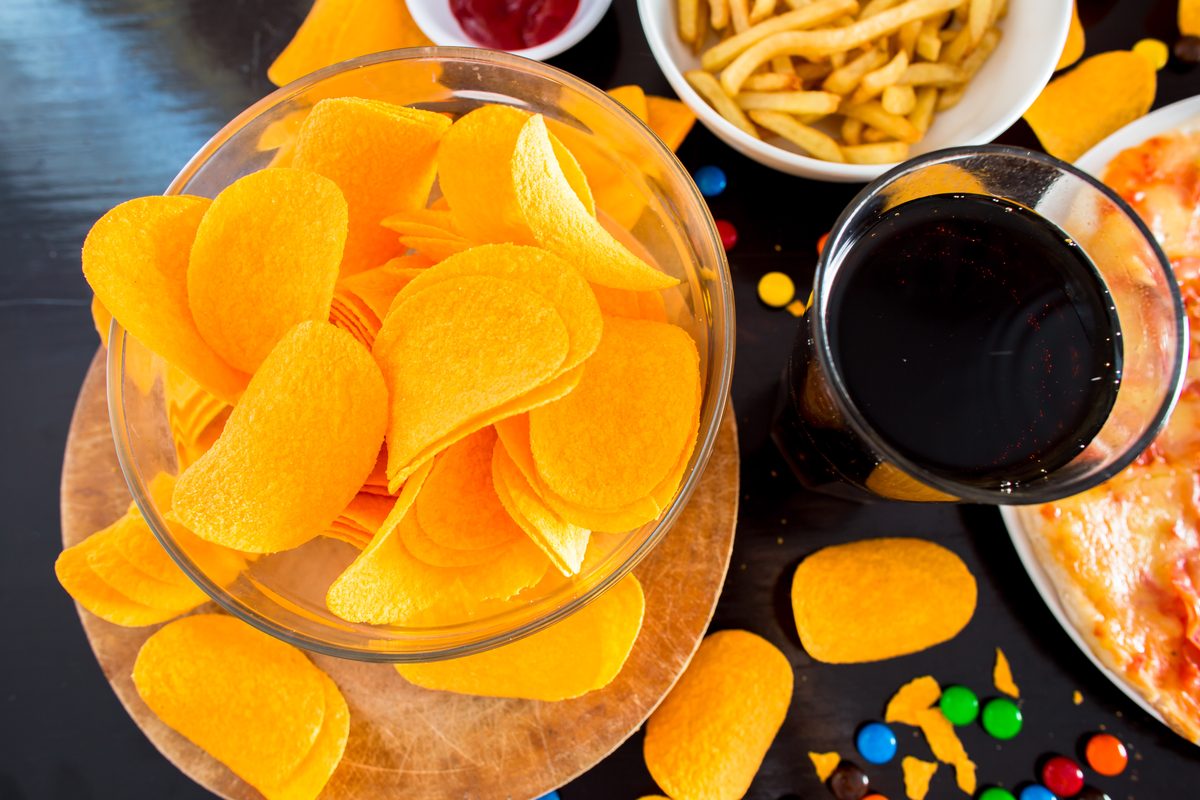
Ultra-processed products: the best-documented trap
In 2019, a team from the National Institutes of Health housed 20 adults for four weeks (Hall et al., Cell Metabolism). For two weeks they were given an ultra-processed diet, and for another two a minimally processed diet, with the same calories, sugars, salt and fibre on offer. They could eat as much as they wanted. The result: 508 kcal more a day on the ultra-processed diet, and a gain of 0.9 kg in two weeks, against a loss of 0.9 kg on the minimally processed diet.
Santé publique France recommends limiting sugary drinks and fatty, sugary, salty and ultra-processed foods, and suggests using the Nutri-Score to help, limiting products rated D and E. Our food label guide helps you spot these products, and the one on hidden sugar shows where it hides.
Building a slimming plate with the official benchmarks
A way of eating that helps you lose weight healthily looks a lot like a balanced diet in general, with adjusted portions. The Santé publique France recommendations (2019) provide the framework:
- At least 5 fruit and vegetables a day, for example 3 portions of vegetables and 2 of fruit, fresh, frozen or canned. A portion weighs 80 to 100 g. No more than one glass of fruit juice a day.
- Pulses at least twice a week: lentils, beans, chickpeas. They provide fibre and plant protein.
- At least one wholegrain starchy food a day: wholemeal bread, wholewheat pasta or brown rice.
- A small handful of nuts a day, unsalted.
- Water as you like: it is the only recommended drink. Sugary drinks, even diet ones, should be limited as much as possible, and in any case to one glass a day at most.
- Meat other than poultry limited to 500 g a week and cured meats to 150 g a week.
When it comes to protein, one point deserves attention. Anses establishes that all slimming diets cause a loss of lean mass, about 15% of the weight lost, and that only physical activity done at the same time limits this. A meta-analysis of 24 trials (Wycherley et al., 2012) shows that, at equal calories, a higher-protein diet slightly limits this loss of lean mass (0.43 kg preserved on average) and leads to slightly more fat loss. There is no need to overdo it: the idea is to have a source of protein at every meal. Our protein needs tool and the guide to the highest-protein foods help you get the amount right.
A typical day, for inspiration
- Breakfast: a bowl of oat flakes cooked in milk or a plant-based drink, a piece of fruit, a plain dairy product.
- Lunch: a large plate of vegetables (half the plate), a portion of fish, poultry or eggs, a portion of wholegrain starchy food, a spoonful of rapeseed or olive oil.
- Optional snack: a piece of fruit and a few almonds, or plain fromage blanc.
- Dinner: a smooth vegetable soup, a pulse-based dish (dahl, lentil salad), a dairy product or a piece of fruit.
Quantities depend on your needs. The structure follows the one advised by the HAS: three main meals and an optional snack, without skipping meals.
Habits that matter as much as what is on your plate
The HAS’s dietary advice sheet (2011) stresses some simple behaviours:
- make a shopping list, and shop when you aren’t hungry;
- cook for yourself when you can, and prepare suitable quantities;
- serve food on the plate rather than leaving the dish on the table, and don’t go back for seconds;
- use standard or small plates;
- eat sitting down, slowly, paying attention to what you are eating;
- don’t cut out your favourite foods, but eat them in moderation: the HAS even speaks of reassuring people about their right to enjoy eating.
The HAS’s 2023 care pathway guide adds a mealtime of at least 20 minutes, with no screens or television. Speed really matters: a meta-analysis of 22 studies (Robinson et al., 2014) shows that people eat less when they eat more slowly. Batch cooking also helps: when a balanced meal is already ready, the ready meal loses its appeal.
Moving: less to lose weight than to avoid putting it back on
Anses makes an important distinction. During the restriction phase, physical activity alone leads to little weight loss, but it preserves muscle mass. After the loss, it becomes one of the most powerful factors, perhaps the most powerful, in maintaining weight. In the study by Jakicic et al. (2008) cited by Anses, the women who had kept off a loss of at least 10% at 24 months were those who had maintained at least 300 minutes of activity a week.
Benchmarks for adults according to Santé publique France: at least 30 minutes of dynamic physical activity a day, and twice a week muscle-strengthening, flexibility and balance activities. For people who are overweight, the HAS cites a volume of about 225 to 300 minutes of moderate activity a week. And between sessions, break up sedentary time: a few minutes of walking at least every 2 hours spent sitting. Practical ideas in our guide to daily physical activity, and the calories burned tool to estimate your expenditure.
Sleep, a discreet lever
In a small crossover trial (Nedeltcheva et al., 2010), ten overweight adults followed the same moderately low-calorie diet for two weeks, once with 8.5 hours of possible sleep, once with 5.5 hours. When sleeping less, the share of weight lost as fat fell by 55%, the loss of lean mass rose by 60%, and hunger was stronger. The study is short and small, but it is in line with the HAS, which includes sleep among the lifestyle habits to assess: getting up at a regular time, limiting screens in the evening, not skipping dinner to avoid night-time cravings. See also our guide to food and sleep.
Getting support: what the studies show
Follow-up is not a luxury. The HAS (2023) states that frequent, sustained therapeutic education allows weight to be stabilised or a loss of at least 5% to be maintained at 12 and 18 months, and that people regain weight once the sessions stop, but less than those who did not receive them. In the Johnston meta-analysis (2014), behavioural support added an average of 3.2 kg of loss at 6 months.
This support can come from your GP, a dietitian or a structured programme. If you are considering a commercial offer, compare the methods, the prices and the place given to a balanced diet in our comparison of slimming programmes. For going it alone, our guide to a balanced diet sets out the steps.
Slimming recipes that fill you up
Light but delicious: the courgette and turmeric soup, the chicken, avocado and walnut salad, the gazpacho, the light courgette gratin, the lentil and spinach dahl or the white fish and vegetable parcel. Find all our slimming recipes.
Myths about slimming diets
« You have to lose weight fast to stay motivated »
Very restrictive diets lead to fast weight loss, but diets under 1,200 kcal a day expose you to undernutrition and rebound weight gain, the HAS points out. In the Anses report, the most popular diets analysed ranged from 574 to 2,600 kcal a day, and some, such as the « detox lemon » or the « cabbage soup » diet, provided under 800 kcal. Losing weight more slowly means losing it for longer.
« Cutting out carbohydrates melts the weight off faster »
A Cochrane review of 61 trials (Naude et al., 2022) probably finds little or no difference in weight loss up to two years between a low-carbohydrate diet and a diet balanced in carbohydrates. The detail is in our guide to the keto and low-carb diet.
« A fat-burner supplement can do the job »
The HAS asks healthcare professionals to warn against supplements taken without a prescription and products sold online whose benefit is questionable. None replaces a moderate deficit held over time.
« If I’m not losing weight, it’s because I lack willpower »
The HAS stresses that there are many factors that resist weight loss, physiological, genetic, environmental and psychological, and asks that any blaming language be avoided. Stabilising your weight is already a result.
Precautions
- Pregnancy: Anses is categorical, no energy restriction should be undertaken during pregnancy.
- Children and teenagers: a diet can disrupt growth. Follow-up goes through the doctor.
- Older people: the HAS points out that a BMI of 30 or more does not rule out undernutrition, and Anses notes that after 65, cycles of loss and regain lead to losing muscle and gaining fat. See our guide to senior nutrition.
- Eating disorders: binge eating with loss of control, permanent restriction, vomiting. The HAS recommends referral to a specialist professional before any weight-loss project.
- Chronic illness or long-term treatment: talk to your doctor, some treatments cause weight gain and weight loss may change the doses.

Frequently asked questions
How many kilos a week can you healthily lose?
The European benchmarks used by the HAS link a deficit of about 600 kcal a day with a loss of about 0.5 kg a week. Beyond that, the risk of losing muscle and then putting weight back on increases.
What is a realistic weight-loss goal?
For a person with obesity, the HAS recommends aiming for 5 to 15% of starting weight. According to the HAS (2023), a lasting loss of 3 to 5% already improves triglycerides and blood glucose, and a loss of 5 to 10% improves blood pressure and cholesterol.
Do you have to count calories to lose weight?
It isn’t compulsory. In the Ello-Martin trial (2007), the women who lost the most weight had no calorie target: they had learned to choose foods of low energy density. Counting can help at the start to get your bearings, with our meal calories tool.
Can you lose weight without exercising?
Yes, diet does most of the work of weight loss. But Anses shows that physical activity limits muscle loss during a diet and remains one of the best factors for not regaining the weight lost.
This article is for information only and does not replace the advice of your doctor or a dietitian.
Our sources
- Haute Autorité de santé. Surpoids et obésité de l’adulte : prise en charge médicale de premier recours. Recommandations pour la pratique clinique, argumentaire. Septembre 2011.
- Haute Autorité de santé. Guide du parcours de soins : surpoids et obésité de l’adulte, et sa synthèse. Janvier 2023, mis à jour en février 2024.
- Anses. Évaluation des risques liés aux pratiques alimentaires d’amaigrissement. Rapport d’expertise collective. Novembre 2010.
- Santé publique France. Recommandations relatives à l’alimentation, à l’activité physique et à la sédentarité pour les adultes. 2019.
- Organisation mondiale de la santé. Obésité et surpoids, aide-mémoire. Mise à jour 2025.
- Anses. Table de composition nutritionnelle des aliments Ciqual. 2025.
- Sacks FM, Bray GA, Carey VJ et al. Comparison of weight-loss diets with different compositions of fat, protein, and carbohydrates. N Engl J Med. 2009. PMID 19246357.
- Gardner CD, Trepanowski JF, Del Gobbo LC et al. Effect of low-fat vs low-carbohydrate diet on 12-month weight loss in overweight adults: the DIETFITS randomized clinical trial. JAMA. 2018. PMID 29466592.
- Johnston BC, Kanters S, Bandayrel K et al. Comparison of weight loss among named diet programs in overweight and obese adults: a meta-analysis. JAMA. 2014. PMID 25182101.
- Ello-Martin JA, Roe LS, Ledikwe JH, Beach AM, Rolls BJ. Dietary energy density in the treatment of obesity: a year-long trial comparing 2 weight-loss diets. Am J Clin Nutr. 2007. PMID 17556681.
- Hall KD, Ayuketah A, Brychta R et al. Ultra-processed diets cause excess calorie intake and weight gain: an inpatient randomized controlled trial of ad libitum food intake. Cell Metab. 2019. PMID 31105044.
- Wycherley TP, Moran LJ, Clifton PM, Noakes M, Brinkworth GD. Effects of energy-restricted high-protein, low-fat compared with standard-protein, low-fat diets: a meta-analysis of randomized controlled trials. Am J Clin Nutr. 2012. PMID 23097268.
- Robinson E, Almiron-Roig E, Rutters F et al. A systematic review and meta-analysis examining the effect of eating rate on energy intake and hunger. Am J Clin Nutr. 2014. PMID 24847856.
- Nedeltcheva AV, Kilkus JM, Imperial J, Schoeller DA, Penev PD. Insufficient sleep undermines dietary efforts to reduce adiposity. Ann Intern Med. 2010. PMID 20921542.
- Naude CE, Brand A, Schoonees A et al. Low-carbohydrate versus balanced-carbohydrate diets for reducing weight and cardiovascular risk. Cochrane Database Syst Rev. 2022. PMID 35088407.
Further reading
Food pages: Courgette, Avocado
Recipes to try: Quinoa, chickpea and roasted vegetable Buddha bowl, Oven-baked sea bream with Mediterranean vegetables, Quinoa stir-fry with spring vegetables
💼 Careers & guidance: interested in this field professionally? Discover our career profiles: dietitian, fitness coach.