Keto and low-carb diet: principles and foods

Keto (ketogenic) and low-carb diets are built on a sharp reduction in carbohydrate in favour of fat and protein. According to the definitions used by Anses (the French food safety agency), a low-carbohydrate diet provides 50 to 150 g of carbohydrate a day, and a ketogenic diet less than 50 g, even less than 20 g. Do they help you lose more weight? A Cochrane review of 61 trials concludes there is little or no difference in weight loss for up to two years compared with a diet balanced in carbohydrate. They may suit some people, provided you know the principles, the side effects and the situations where they are not advised.
👉 Free tool: Calorie deficit – calculate in 30 seconds, no sign-up.
Keto, low carb: the definitions
To put these diets in context, start with the French reference values. Anses (2016) recommends that carbohydrate provides 40 to 55% of energy over the day for adults, fat 35 to 40% and protein 10 to 20%. On a 2,000 kcal day, 40% of energy from carbohydrate is 800 kcal, or 200 g of carbohydrate, since one gram of carbohydrate provides 4 kcal.
| Type of diet | Carbohydrate per day | Share of energy |
|---|---|---|
| Anses reference values for adults | 200 to 275 g for 2,000 kcal (calculation) | 40 to 55% |
| « Balanced-carbohydrate » diet (Cochrane review) | Variable | 45 to 65% |
| Low carb, low in carbohydrate | 50 to 150 g | Less than 45% according to Cochrane |
| Keto, ketogenic | Less than 50 g, even less than 20 g | Less than 10% according to Cochrane; Anses describes ketogenic as under 20% |
Low carb is therefore a marked reduction, keto a drastic one: 50 g of carbohydrate is roughly what you find in 300 g of cooked lentils (48.6 g according to the Ciqual table). You can work out your own split with our macro calculator.
Ketosis: how it works
When carbohydrate runs short, the liver makes ketone bodies (acetoacetate and beta-hydroxybutyrate) from fat, and the brain, muscles and other organs can use them as fuel. This is the state of ketosis. According to the definitions used by Anses, a diet of 50 to 150 g of carbohydrate a day does not produce ketones in the urine in most people, whereas a diet under 50 g does.
On a ketogenic diet, Anses describes the following split of the body’s fuels: about 70% of energy comes from fatty acids, about 20% from ketone bodies and about 10% from glucose, made by the liver from protein and glycerol. The brain then reduces its glucose use.
Anses also cites an explanation for the effect of these diets on weight at 3 to 6 months: a drop in appetite, linked to the high protein content, the ketogenic nature of the diet and the absence of sugars. In plain terms, people often eat less without necessarily counting.
What the studies show on weight
| Study | Participants and duration | Result |
|---|---|---|
| Cochrane review, Naude et al. (2022) | 61 trials, 6,925 participants with overweight or obesity | Probably little or no difference: -1.07 kg over 3 to 8.5 months, -0.93 kg over 1 to 2 years in favour of low carb (moderate certainty) |
| Meta-analysis, Bueno et al. (2013) | 13 trials of at least 12 months, ketogenic versus low-fat | -0.91 kg in favour of ketogenic; LDL cholesterol up, triglycerides down |
| DIETFITS, Gardner et al. (2018) | 609 adults, 12 months | -6.0 kg on low carb versus -5.3 kg on low fat, difference not significant |
| Johnston et al. (2014) | 48 trials, 7,286 people | Low carb and low fat produce comparable weight loss; minimal differences between branded diets |
| Hall et al. (2021) | 20 hospitalised adults, 2 weeks on each diet | Eating freely, people on the low-fat diet ate 689 kcal a day less than on the ketogenic diet |
The HAS (the French National Authority for Health), in its 2011 background report, cites a recommendation that low-carbohydrate diets lead to faster weight loss in the short term, over 3 to 6 months, but that their long-term safety and effectiveness have not been adequately studied. It concludes that no diet defined by its macronutrient proportions has shown superiority over a standard low-calorie diet. The Hall (2021) trial also contradicts the idea that cutting carbohydrate necessarily makes you eat less: under controlled conditions, the opposite was observed over two weeks.
What about blood sugar and diabetes?
This is the argument most often put forward in favour of low carb. The data are more nuanced than is often claimed. In the short studies of 4 to 12 weeks cited by Anses, very-low-carbohydrate diets lowered triglycerides, blood sugar, insulin and insulin resistance, including in obese people with diabetes. The National Lipid Association statement (Kirkpatrick et al., 2019) recognises possible benefits for appetite control, lower triglycerides and reduced medication in type 2 diabetes.
Over the longer term, though, the Cochrane review (2022) found in people with type 2 diabetes a weight difference of -1.26 kg at 3 to 6 months, falling to -0.33 kg at 1 to 2 years, with no notable difference in glycated haemoglobin, blood pressure or LDL cholesterol at 1 to 2 years. In practice, low carb can be an option if you have diabetes, but never without your doctor, since treatment often needs adjusting. The details are in our guide to type 2 diabetes and diet.
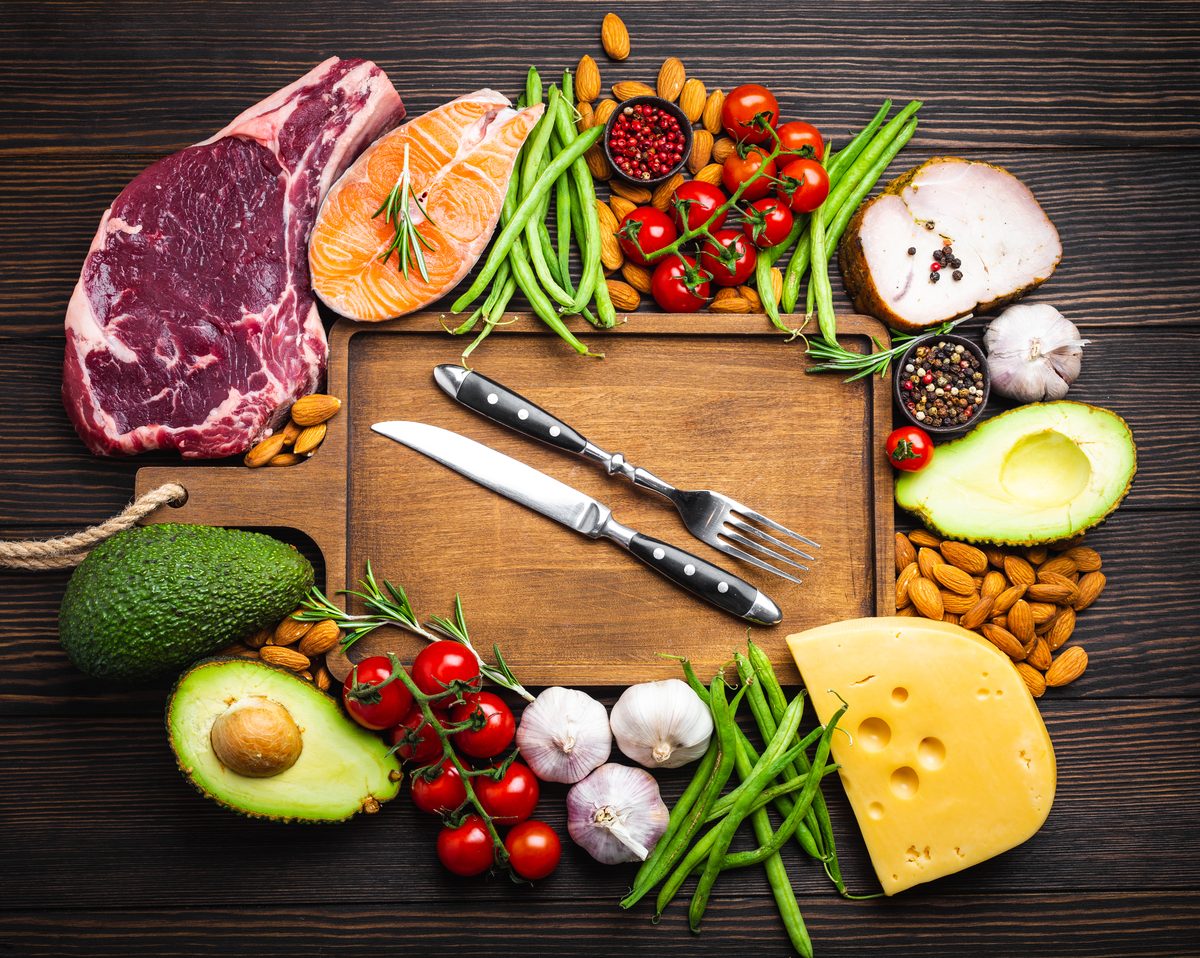
The foods on a low-carbohydrate plate
Carbohydrate content varies enormously from one food to another. Here are some reference values:
| Food (per 100 g) | Carbohydrate (g) |
|---|---|
| Chicken breast fillet, grilled | 0 |
| Avocado | traces |
| Emmental | traces |
| Spinach, cooked | 0.25 |
| Hard-boiled egg | 0.52 |
| Salmon, cooked | 0.61 |
| Lettuce, raw | 1.22 |
| Courgette, cooked | 1.4 |
| Cauliflower, boiled | 1.6 |
| Broccoli, cooked | 1.79 |
| Raspberry | 5.83 |
| Walnut, kernels | 6.88 |
| Almond, with skin | 9.51 |
| Apple | 11.6 |
| Lentils, cooked | 16.2 |
| Potato, boiled | 16.8 |
| Banana | 19.7 |
| Pasta, cooked | 31.4 |
| White rice, cooked | 33.2 |
| White bread (baguette, round loaf) | 58.3 |
- Protein: eggs, meat, fish, tofu.
- Fat: avocado, olive oil, rapeseed oil, walnuts, almonds, cheese.
- Low-carbohydrate vegetables: courgette, broccoli, spinach, cauliflower, salad leaves.
- To limit strictly: sugars, starchy foods, bread, the sweetest fruits. To keep some fruit, see our guide to the least sugary fruits.
The quality of the fat makes the difference
A low-carbohydrate diet is inevitably richer in fat. The type matters. Anses (2010) notes that a large observational study associated a low-carbohydrate diet high in protein and fat from animal sources with higher mortality, whereas the plant-based version was associated with lower mortality. These are observational studies and hard to generalise, but the trend is consistent with a four-week trial cited by Anses, in which a plant-based version (« Eco-Atkins ») lowered LDL cholesterol more than a high-carbohydrate diet, with identical weight loss.
The HAS (2023) advises moving towards rapeseed, walnut and olive oils and a Mediterranean-type diet. If you go low carb, build it around oily fish, eggs, small amounts of pulses, nuts and seeds and vegetable oils, rather than around processed meats, which Santé publique France recommends limiting to 150 g a week. You will also hear about MCT oils in the keto world: our comparison of MCT oils presents the products, without making them a requirement.
Side effects and points to watch
Early digestive problems
Anses reports that high-fat, low-carbohydrate diets can cause bad breath, thirst, diarrhoea, constipation, nausea or vomiting. These effects are said to remain mild and limited to the first week, even on very strict diets of 20 g of carbohydrate a day.
Constipation and lack of fibre
Constipation is well documented with diets low in fibre, and can eventually lead to haemorrhoids or diverticulosis if they are followed for a long time, according to Anses. The adequate intake is 30 g of fibre a day: on keto, green vegetables, nuts and seeds become essential. See our guide to high-fibre vegetables.
Cholesterol
In the Bueno meta-analysis (2013), the ketogenic diet raised LDL cholesterol slightly (+0.12 mmol/l) while also raising HDL and lowering triglycerides. Anses notes that the rise in LDL is inconsistent, and a National Lipid Association statement (Kirkpatrick et al., 2019) describes mixed effects, with an increase in some studies. A lipid profile before and during the diet is prudent. Our cholesterol guide details the foods to favour.
Heart, liver and kidneys
According to Anses, the safety of very-low-carbohydrate diets has not been established as far as the cardiovascular system is concerned, and the data do not allow a conclusion on liver safety. When the diet becomes high in protein without being low in calories, intakes can exceed 2.2 g of protein per kilo per day: a kidney check is then essential for people at risk of kidney failure.
Lack of long-term evidence
The National Lipid Association statement stresses that little data exists on effectiveness and safety beyond two years.
Who should avoid keto or seek medical advice
- People with diabetes on treatment: these diets can reduce the need for medication according to Kirkpatrick et al. (2019), which means the treatment must be adjusted with your doctor to avoid hypoglycaemia. In the Hall (2021) trial, one participant had to stop because of hypoglycaemia during the low-carbohydrate phase. See our guide to type 2 diabetes.
- Genetic lipid disorders: the National Lipid Association statement calls for particular caution in these high-risk people.
- Kidney or liver disease: for the reasons given above.
- Pregnancy and breastfeeding: Anses rules out any energy restriction during pregnancy.
- Children and teenagers: risk to growth, according to Anses. The ketogenic diet is also used as a treatment for certain drug-resistant forms of epilepsy, within a medical framework, as Anses mentions.
- A history of eating disorders: a strict exclusion diet can reawaken restriction.
If you want to try it: the most sensible version
- Start with a moderate low carb, between 100 and 150 g of carbohydrate a day, first cutting out sugars, sugary drinks and refined products. That is already a clear reduction compared with the Anses reference values.
- Keep vegetables at every meal, in good quantity, for fibre, vitamins and minerals.
- Choose plant fats and fish rather than excess processed meats and butter.
- Keep an eye on your test results: cholesterol, blood sugar and kidney function if you have risk factors.
- Review after three months: if you feel well and can keep it up, carry on; otherwise, a standard calorie deficit gives comparable results. A low glycaemic index approach is also a more flexible alternative.
Example of a low-carb day
- Breakfast: spinach omelette, a few raspberries, tea or coffee without sugar.
- Lunch: salmon, roasted broccoli and cauliflower with rapeseed oil, green salad, a plain yoghurt.
- Snack: a small handful of walnuts or almonds.
- Dinner: courgettes stuffed with beef, salad, a piece of cheese.
Keto and low-carb recipes
Try the spinach and avocado omelette, the baked eggs with spinach, the courgettes stuffed with beef, the oven-baked salmon fillet with broccoli or the light cauliflower gratin. All our keto and low-carb recipes are here.
Common myths about keto and low carb
« Without carbohydrate, insulin falls and fat melts away by itself »
This is the so-called carbohydrate-insulin hypothesis. The Hall (2021) trial tested it under controlled conditions: eating freely, participants ate 689 kcal a day less on the low-fat diet than on the ketogenic diet, contrary to what this hypothesis predicted. In the long term, the Cochrane review finds no clear advantage for low carb.
« More protein is always better »
A low-carb diet easily slides towards being high in protein. Anses points out that beyond 2.2 g of protein per kilo per day, you exceed the threshold of adequate intakes, and that a kidney check is essential for people at risk of kidney failure. The recommended intake for adults is 0.83 g per kilo per day.
« All fruit is off limits »
Raspberries contain 5.83 g of carbohydrate per 100 g according to Ciqual, less than apples (11.6 g) or bananas (19.7 g). On a moderate low-carb diet, some fruit remains possible.
« Keto is the best diet for losing weight »
For the HAS as for the Cochrane review, no diet defined by its macronutrients has shown lasting superiority. The best diet is the one you can stick to, without risk to your health.

Frequently asked questions
How much carbohydrate a day on keto?
Less than 50 g a day, even less than 20 g, according to the definitions used by Anses. Low carb sits between 50 and 150 g a day.
Does keto lead to more weight loss than a standard diet?
Very little. The 2022 Cochrane review finds a difference of about 1 kg, judged probably unimportant, up to two years of follow-up.
What is the « keto flu »?
The term refers to the early symptoms. With high-fat, low-carbohydrate diets, Anses describes bad breath, thirst, digestive problems and nausea, generally limited to the first week.
Does keto raise cholesterol?
LDL cholesterol can rise: +0.12 mmol/l on average in the Bueno meta-analysis (2013), inconsistently according to Anses. A blood test is recommended if you follow this diet for a long time.
Can you do keto as a vegetarian?
It is possible but more complicated, because pulses provide carbohydrate (16.2 g per 100 g of cooked lentils according to Ciqual). Tofu, eggs, nuts and seeds and vegetable oils become central.
This article is for information only and does not replace the advice of your doctor or a dietitian.
Our sources
- Naude CE, Brand A, Schoonees A et al. Low-carbohydrate versus balanced-carbohydrate diets for reducing weight and cardiovascular risk. Cochrane Database Syst Rev. 2022. PMID 35088407.
- Bueno NB, de Melo IS, de Oliveira SL, da Rocha Ataide T. Very-low-carbohydrate ketogenic diet v. low-fat diet for long-term weight loss: a meta-analysis of randomised controlled trials. Br J Nutr. 2013. PMID 23651522.
- Gardner CD, Trepanowski JF, Del Gobbo LC et al. Effect of low-fat vs low-carbohydrate diet on 12-month weight loss in overweight adults: the DIETFITS randomized clinical trial. JAMA. 2018. PMID 29466592.
- Johnston BC, Kanters S, Bandayrel K et al. Comparison of weight loss among named diet programs in overweight and obese adults: a meta-analysis. JAMA. 2014. PMID 25182101.
- Hall KD, Guo J, Courville AB et al. Effect of a plant-based, low-fat diet versus an animal-based, ketogenic diet on ad libitum energy intake. Nat Med. 2021. PMID 33479499.
- Kirkpatrick CF, Bolick JP, Kris-Etherton PM et al. Review of current evidence and clinical recommendations on the effects of low-carbohydrate and very-low-carbohydrate (including ketogenic) diets for the management of body weight and other cardiometabolic risk factors: a scientific statement from the National Lipid Association. J Clin Lipidol. 2019. PMID 31611148.
- Anses. Évaluation des risques liés aux pratiques alimentaires d’amaigrissement. Rapport d’expertise collective. Novembre 2010.
- Anses. Actualisation des repères du PNNS : révision des repères de consommations alimentaires. Avis et rapport d’expertise collective. Décembre 2016.
- Anses. Table de composition nutritionnelle des aliments Ciqual. 2025.
- Haute Autorité de santé. Surpoids et obésité de l’adulte : prise en charge médicale de premier recours. Argumentaire. Septembre 2011.
- Haute Autorité de santé. Guide du parcours de soins : surpoids et obésité de l’adulte. Janvier 2023, mis à jour en février 2024.
- Santé publique France. Recommandations relatives à l’alimentation, à l’activité physique et à la sédentarité pour les adultes. 2019.
- Règlement (UE) n° 1169/2011 concernant l’information des consommateurs sur les denrées alimentaires, annexe XIV (coefficients de conversion énergétique).
Further reading
Food pages: Courgette, Spinach, Egg, Broccoli
Recipes to try: Quinoa, chickpea and roasted vegetable Buddha bowl, Green shakshuka with spinach, Oven-baked vegetable börek