Omega-3: roles, sources and getting supplements right
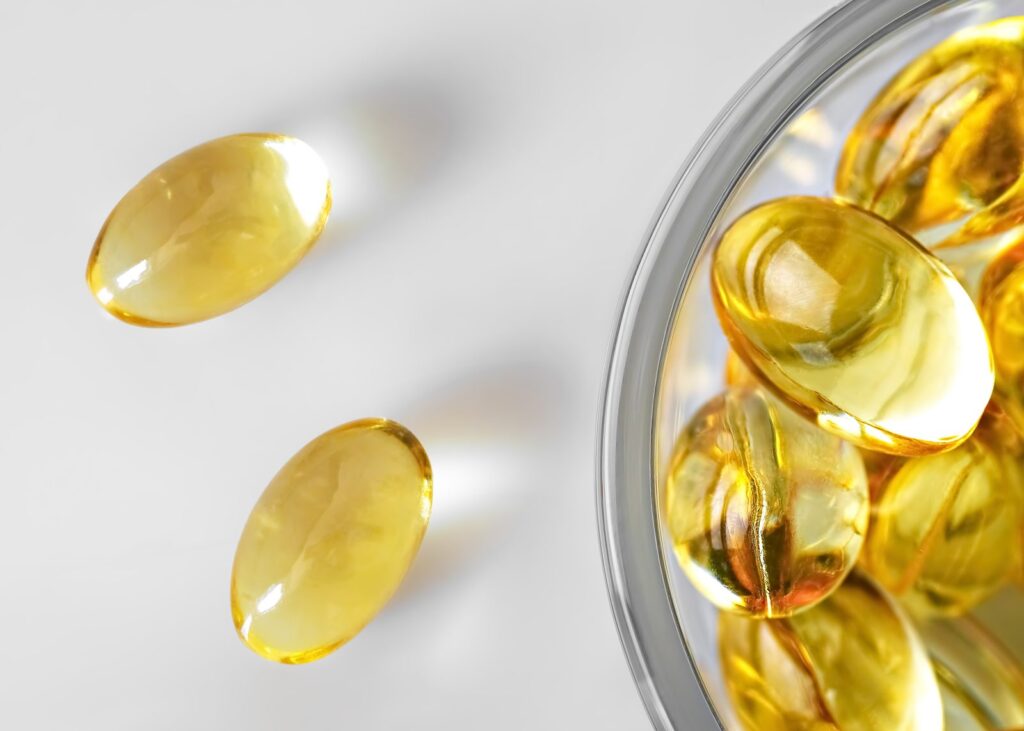
Omega-3s are fatty acids that your body cannot make from scratch: you have to eat them. There are three main ones, and they are not equal. ALA comes from plants (rapeseed, walnuts, flax), EPA and DHA from oily fish. The French reference values are precise: 1% of your energy as ALA, and 500 mg a day of EPA + DHA, of which 250 mg is DHA. Two portions of fish a week, one of them oily, get you close. As for capsules, the large studies are far less enthusiastic than the labels. Here is what matters, backed by official figures.
👉 Free tool: Calorie needs – calculate it in 30 seconds, no sign-up needed.
Three omega-3s to tell apart
- Alpha-linolenic acid (ALA) is the « parent » of the family. It is essential: your body cannot produce it. It is found in rapeseed, walnut, flaxseed and soya oils, walnuts, and flaxseeds and chia seeds.
- Docosahexaenoic acid (DHA) is, according to the 2010 opinion of Afssa (now Anses), a major component of the structure and functioning of the brain and retina. It is also considered essential.
- Eicosapentaenoic acid (EPA) plays essential roles (it is the precursor of signalling molecules, the eicosanoids), but the agency does not class it as strictly essential.
Why ALA is not enough
In theory, the body can convert ALA into EPA and then into DHA. In practice, Afssa noted that in humans ALA is « extremely catabolisable » (it is mostly burned to produce energy) and is very poorly converted into DHA. Anses sums it up: the conversion rate of ALA into DHA is too low to cover the body’s DHA needs. Conversion into EPA is better, provided that ALA intake is sufficient and that intake of linoleic acid (omega-6) is not excessive, as the two families compete.
Practical consequence: if you never eat fish, walnuts and rapeseed do not completely replace the DHA from seafood.
What are omega-3s for?
Anses states that omega-3s are necessary for the development and functioning of the retina, brain and nervous system. It also cites cardiovascular effects: lower blood pressure, lower triglycerides and reduced cardiovascular illness in people who have already had heart disease.
The European regulation on health claims (No. 432/2012) authorises four wordings, subject to dose conditions:
- DHA contributes to normal brain function (effect obtained with 250 mg of DHA a day);
- DHA contributes to the maintenance of normal vision (250 mg of DHA a day);
- EPA and DHA contribute to normal heart function (250 mg of EPA and DHA a day);
- ALA contributes to the maintenance of normal blood cholesterol levels (2 g of ALA a day).
For the heart in general, our guide to exercise and heart health and the one on cholesterol complement this point.
How much do you need?
The French references for fatty acids date from the Afssa opinion of 1 March 2010. They remain the basis of current recommendations.
| Fatty acid | Recommended nutritional intake (adult) | What this represents |
|---|---|---|
| ALA (plant omega-3) | 1% of energy intake | about 2.2 g a day for 2,000 kcal (minimum requirement: 0.8%, or 1.8 g) |
| DHA | 250 mg a day | minimum physiological requirement, twice the 2001 value |
| EPA | 250 mg a day | obtained by subtraction from the EPA + DHA target |
| EPA + DHA | 500 mg a day | value used for risk prevention |
| Linoleic acid (omega-6) | 4% of energy intake | omega-6 / omega-3 ratio (LA/ALA) below 5 |
Where do people in France stand? According to the Anses INCA 3 study (2017), adults consume on average 286 mg of EPA + DHA a day, a little over half of the recommended 500 mg. These fatty acids come mainly from fish (58% of EPA and 67% of DHA). In its 2016 opinion on the PNNS guidelines, Anses also recommends that consumption of oils rich in ALA, such as rapeseed and walnut oils, become daily.
For teenagers, the values are those of adults (250 mg of DHA and 500 mg of EPA + DHA). Children aged 3 to 9 have a recommended intake of 125 mg of DHA and 250 mg of EPA + DHA. For pregnant or breastfeeding women, the opinion maintains 250 mg of DHA and 500 mg of EPA + DHA.
And the famous omega-6 / omega-3 ratio?
In 2010, Afssa judged that it is of less interest as long as ALA and linoleic acid needs are met and EPA and DHA are well supplied. It remains a practical guide, especially if you are short of ALA, if you consume a lot of omega-6 and even more so if you are short of EPA and DHA. The choice of oil plays a major role here: according to Ciqual, rapeseed oil contains 18.6 g of linoleic acid for 7.83 g of ALA (ratio 2.4), whereas sunflower oil contains 56.3 g of linoleic acid for only 0.05 g of ALA.
Where to find omega-3s
The full ranking, portion by portion, is in our guide to omega-3-rich foods. Here are the orders of magnitude, separated by type, because adding ALA and EPA + DHA together makes no sense.
| Seafood (Ciqual) | EPA + DHA (mg per 100 g) |
|---|---|
| Sardines in tomato sauce, tinned, drained | 2,770 |
| Herring, grilled or pan-fried | 2,280 |
| Mackerel, baked | 2,140 |
| Salmon, steamed | 1,750 |
| Raw anchovies | 1,410 |
| Farmed rainbow trout, baked | 950 |
| Cooked mussels | 510 |
| Yellowfin tuna in water, drained | 472 |
| Cod, steamed | 270 |
| Hard-boiled egg | 36 |
| Plant sources (Ciqual) | ALA (g per 100 g) |
|---|---|
| Flaxseed oil | 53.4 |
| Flaxseeds | 19.6 |
| Dried chia seeds | 17.8 |
| Walnut oil | 11.9 |
| Rapeseed oil | 7.83 |
| Walnuts (kernels) | 7.5 |
| Soya oil | 6.79 |
| Extra virgin olive oil | 0.65 |
| Sunflower oil | 0.05 |
Olive oil, excellent in other ways, is not a source of omega-3. To get your ALA, the simplest way is to use rapeseed or walnut oil for your dressings: 10 g of rapeseed oil provides 0.78 g of ALA, 10 g of walnut oil 1.19 g. For amounts of seeds and nuts, see our guides on how many walnuts a day and how many seeds a day.

The « fish twice a week » guideline
Santé publique France recommends eating fish twice a week, one of them an oily fish (sardines, mackerel, herring, salmon). Do the sum with Ciqual: 100 g of baked mackerel (2,140 mg of EPA + DHA) and 100 g of cod (270 mg) provide 2,410 mg over the week, about 344 mg a day. That is below the recommended 500 mg, but you can get closer by choosing two oily fish, or by adding mussels or tinned sardines. Details in our guide how much fish per week.
A week that hits both targets
- EPA + DHA: 100 g of tinned sardines in tomato sauce (2,770 mg) one lunchtime, 100 g of steamed salmon (1,750 mg) one evening. Total: 4,520 mg over the week, about 646 mg a day, above the 500 mg.
- ALA, every day: 10 g of rapeseed oil in the dressing (0.78 g) and 10 g of walnut kernels (0.75 g), making 1.53 g. Add 10 g of ground flaxseeds (1.96 g) a few days a week and you exceed 2.2 g.
Calculated from the Ciqual 2025 table. They show that you do not need huge quantities: it is the choices (oily rather than lean fish, rapeseed rather than sunflower) that make the difference.
Why not eat it every day?
Because of contaminants (mercury in particular) that build up in some fish. The Anses recommendations, relayed by sante.fr, ask you to vary the species and the places of supply. For pregnant or breastfeeding women and children under 3, they specify:
- avoid swordfish, marlin, siki shark, shark and lamprey, as well as cod liver;
- limit wild predatory fish (monkfish, wild sea bass, bonito, emperor fish…) and tuna, including tinned;
- limit certain freshwater fish (eel, barbel, bream, carp, catfish, wels catfish) to once every two months.
Oily fish is still recommended during pregnancy: it is the type of fish that provides the most omega-3. More details in our pregnancy guide.
Omega-3 supplements: what the studies say
Fish oil capsules are among the best-selling supplements. Here is what the most solid data show.
| Study | Population | Main result |
|---|---|---|
| Cochrane, Abdelhamid et al., 2020 (86 trials, 162,796 participants) | Adults with varying cardiovascular risk | EPA + DHA: little or no effect on all-cause mortality (RR 0.97) or on cardiovascular events (RR 0.96). Possible slight reduction in coronary heart disease mortality (RR 0.90; 334 people to treat to prevent one death). Triglycerides lowered by about 15%. |
| VITAL trial, Manson et al., 2019 (25,871 participants) | Men aged 50 and over, women aged 55 and over | 1 g a day for a median of 5.3 years: no significant reduction in major cardiovascular events (HR 0.92) or cancers (HR 1.03). Fewer heart attacks (HR 0.72), a secondary result. |
| Cochrane, Middleton et al., 2018 (70 trials, 19,927 women) | Pregnant women | Fewer births before 37 weeks (11.9% versus 13.4%; RR 0.89) and before 34 weeks (RR 0.58). Pregnancies prolonged beyond 42 weeks slightly more frequent (2.6% versus 1.6%). |
| Meta-analysis Abuknesha et al., 2026 (35 trials, 114,592 participants) | Adults aged 50 and over | Atrial fibrillation more frequent (OR 1.43) only in people at high cardiovascular risk treated at a high dose (more than 1,500 mg a day of EPA + DHA). |
In short: in a healthy person, a daily capsule has not been shown to protect against heart attack, stroke or cancer. Cochrane also notes that there is little evidence of an effect of eating fish itself in randomised trials. The best-established benefits concern triglycerides and, during pregnancy, premature birth. For ALA, the same Cochrane review concludes there is probably a slight reduction in arrhythmias and cardiovascular events.
If you take a supplement
Who may need one?
- You do not eat fish: an EPA and DHA supplement, or algal oil if you are vegetarian or vegan, can close the gap with the recommended 500 mg.
- You are pregnant and eat little fish: talk to your midwife or doctor, in view of the Cochrane results on premature birth.
- You have high triglycerides: it is for your doctor to judge, since the lowering of triglycerides is the best-demonstrated effect.
Doses and limits
- In 2012, EFSA concluded that supplemental intakes of up to 5 g a day of EPA + DHA pose no safety concern in adults, nor up to 1.8 g a day of EPA alone. In 2026, it confirmed a safe intake level of 1 g a day for DHA alone, taking the risk of bleeding as the critical effect.
- Above 1.5 g a day of EPA + DHA, people at high cardiovascular risk have an increased risk of atrial fibrillation according to the 2026 meta-analysis. This is therefore not a dose to take without medical advice.
- As EFSA took the risk of bleeding as the critical effect of DHA, if you take an anticoagulant or an antiplatelet drug, ask your doctor or pharmacist for advice before any omega-3 supplement.
Choosing well
Look at the actual EPA and DHA content per capsule, not the amount of « fish oil »: that is what you compare with the recommended 500 mg. Our best omega-3 comparison details the contents, forms and oil origin of products on the market.
Myths about omega-3s
« Chia seeds replace fish »
Not for DHA. They are very rich in ALA (17.8 g per 100 g according to Ciqual), but conversion into DHA is very low in humans, Anses points out.
« All vegetable oils provide omega-3 »
No. Sunflower contains almost none (0.05 g of ALA per 100 g) and olive very little (0.65 g). It is rapeseed, walnut, flaxseed and soya that provide it.
« Smoked salmon or tinned tuna is the same as mackerel »
Not for tuna: in water, it provides 472 mg of EPA + DHA per 100 g according to Ciqual, against 2,140 mg for baked mackerel. And Anses advises limiting it in pregnant women.
« An omega-3 capsule protects the heart »
The large reviews and the VITAL trial do not confirm this in healthy people. The authorised claim speaks of « normal heart function », not of preventing heart attacks.
Omega-3-rich recipes

Treat yourself to baked salmon fillet with broccoli or homemade mackerel rillettes. On the plant side, a mango chia pudding, ground flaxseeds on your porridge, and a dressing made with rapeseed or walnut oil. Omega-3s are one of the pillars of an anti-inflammatory diet.
Precautions
- No high-dose supplement without medical advice, especially if you have heart disease or take treatment that thins the blood.
- If you are pregnant or breastfeeding, follow the Anses guidance on fish to avoid and to limit.
Go further with our micronutrition guides and the micronutrition course.
💼 Careers & guidance: interested in this field professionally? Discover our career profiles: micronutritionist.
Frequently asked questions
How much omega-3 a day?
For an adult, Anses recommends 1% of energy as ALA (about 2.2 g for 2,000 kcal), 250 mg of DHA and 500 mg of EPA + DHA a day.
Which fish contains the most omega-3?
Among common fish, sardines, herring, mackerel and salmon: from 1,750 to 2,770 mg of EPA + DHA per 100 g according to Ciqual.
Can vegetarians meet their needs?
For ALA, yes, with rapeseed oil, walnuts and flaxseeds. For DHA, it is harder because conversion from ALA is very low. Algal oil supplements are sold for this purpose: discuss it with a professional.
Do omega-3s lower triglycerides?
Yes: the 2020 Cochrane review finds a reduction of about 15%, proportional to the dose of EPA + DHA. The effect on cardiovascular disease, on the other hand, is small.
What is the maximum dose as a supplement?
EFSA considers up to 5 g a day of EPA + DHA combined safe in adults, and 1 g a day of DHA alone. Above 1.5 g a day, people at high heart risk have an increased risk of atrial fibrillation.
This article is for information only and does not replace the advice of your doctor or a dietitian.
Our sources
- Afssa (Anses). Avis relatif à l’actualisation des apports nutritionnels conseillés pour les acides gras (saisine 2006-SA-0359). 1er mars 2010.
- Anses. Les acides gras oméga-3 (page thématique).
- Anses. Table de composition nutritionnelle des aliments Ciqual. 2025.
- Service public d’information en santé (sante.fr), d’après l’Anses. Les femmes enceintes doivent-elles éviter de manger du poisson ? 2025. Et Santé publique France, Manger Bouger : aller vers les poissons gras et maigres en alternance.
- Anses. Étude individuelle nationale des consommations alimentaires 3 (INCA 3), rapport d’expertise collective. Avril 2017. Et avis relatif à l’actualisation des repères du PNNS (saisine 2012-SA-0103). 2016.
- Commission européenne. Règlement (UE) n° 432/2012 établissant une liste des allégations de santé autorisées. 2012.
- EFSA NDA Panel. Scientific Opinion on the Tolerable Upper Intake Level of EPA, DHA and DPA. EFSA Journal, 2012. Et Scientific Opinion on the tolerable upper intake level for supplemental docosahexaenoic acid. EFSA Journal, 2026.
- Abdelhamid AS, Brown TJ, Brainard JS et al. Omega-3 fatty acids for the primary and secondary prevention of cardiovascular disease. Cochrane Database of Systematic Reviews, 2020. PMID 32114706.
- Manson JE, Cook NR, Lee IM et al. Marine n-3 Fatty Acids and Prevention of Cardiovascular Disease and Cancer (VITAL). New England Journal of Medicine, 2019. PMID 30415637.
- Middleton P, Gomersall JC, Gould JF et al. Omega-3 fatty acid addition during pregnancy. Cochrane Database of Systematic Reviews, 2018. PMID 30480773.
- Abuknesha NR, O’Keefe JH, Qian F et al. Effects of Omega-3 Fatty Acid Treatment on Risk for Atrial Fibrillation: An Updated Meta-Analysis of 35 Trials including 114 592 Individuals. Circulation: Arrhythmia and Electrophysiology, 2026. PMID 42517224.