Surimi in pregnancy: not recommended cold, fine well cooked
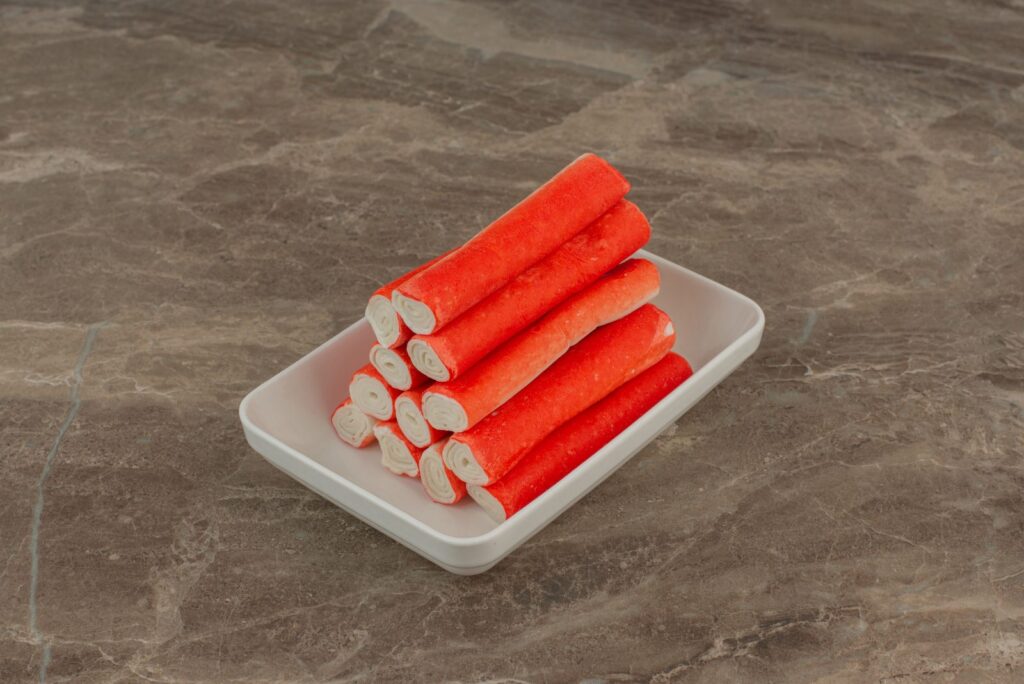
The short answer
No, cold surimi is not recommended during pregnancy; it becomes an option again once well cooked and served hot. Ameli names it specifically among the seafood to avoid, along with smoked fish, raw fish, raw shellfish and taramasalata. The reason is listeriosis: surimi is a ready-to-eat product, kept in the fridge, where the Listeria bacterium can multiply. On the other hand, surimi heated right through, in a quiche, a gratin, a stir-fry or a piping hot soup, no longer poses this problem, because cooking destroys the bacterium.
These guidelines follow official French recommendations. If you are in any doubt, your midwife or doctor can advise you.
Why is surimi not recommended?
Surimi is made from white fish flesh, minced, washed, mixed with starch, egg white and flavourings, then moulded and cooked. So it is cooked during manufacture, but then cut, packed and sold in the chilled aisle, to be eaten cold, often several days or weeks later. This is the profile that causes the problem during pregnancy: Listeria monocytogenes is one of the few bacteria able to multiply in the fridge, and ready-to-eat products kept cold are the ones where it has time to develop.
Listeriosis is rare, fewer than fifty cases a year among pregnant women in France according to Santé publique France, but it is serious: the bacterium can cross the placenta and cause a miscarriage, a premature birth or an infection in the newborn. That is why the authorities apply a precautionary principle to this whole family of products: surimi, taramasalata, smoked fish, cooked charcuterie kept cold.
What is really in a surimi stick?
Surimi is often presented as « fish ». In reality, fish is only one ingredient among others. We noted the ingredients list of 47 surimi stick products sold in France, as they appear on Open Food Facts:
| Fish flesh content shown | Survey result |
|---|---|
| Lowest | 26% |
| Highest | 49% |
| Most common value, the median | 38% |
| Products with less than 35% fish | 7 out of 47, mostly budget lines where water is the first ingredient |
The rest of the recipe is mainly water, starches, egg white, rapeseed oil, sugar, salt and flavourings. This explains why Ciqual finds only 7.5 g of protein per 100 g, three times less than a fish fillet.
For allergies, the survey is telling: of these 47 products, 44 contain wheat or gluten, 43 egg, 44 crustaceans, often in the « crab flavour » flavourings, and 14 milk. If you are allergic to any of these foods, surimi is not « just fish »: always read the label.
The fish used is generally a lean white fish, Alaska pollock, hake or blue whiting according to the labels, not much affected by mercury.
What product recalls show
The risk is not theoretical. The public RappelConso database, where product recalls in France are published, lists 16 recall notices concerning products containing surimi since 2021 (search of 25 September 2026). Their reasons illustrate the two weaknesses of this type of product: contamination and the cold chain.
| Reason for recall | Products concerned |
|---|---|
| Presence of Listeria monocytogenes | 3 products, in 2021, 2022 and 2024: two tagliatelle salads with surimi and crab-flavour surimi flakes |
| Break in the cold chain | several products of surimi sticks and fish rillettes sold in the same shop, in August 2026 |
| Staphylococcal enterotoxins | surimi sticks, in 2022 |
| Other: labelling, use-by date, allergens, ethylene oxide, taste defect | several products between 2022 and 2025 |
Two lessons. First, it is mainly mixed salads with surimi, prepared and then kept cold, that appear in the recalls for Listeria. Second, a product that is fine to begin with can become a risk if the cold chain is broken, in the shop as at home: this is exactly what the official recommendation seeks to avoid. The recalls concern only a tiny fraction of the surimi sold, but they show why the authorities prefer the precautionary principle for this whole family of products.
The traffic light for surimi
| Form | Pregnant | Why |
|---|---|---|
| Cold surimi sticks, as a nibble | 🔴 avoid | chilled ready-to-eat product |
| Grated or shredded surimi in a cold salad | 🔴 avoid | same reason |
| Pasta salad or « Alaska salad » with surimi, pre-packed | 🔴 avoid | cold ready-to-eat dish, kept cold |
| Surimi filled with cream cheese | 🔴 avoid | same reason |
| Surimi in a quiche, a gratin, a savoury cake baked in the oven | 🟢 allowed | cooked right through and served hot |
| Surimi in a stir-fry, a wok, a piping hot soup | 🟢 allowed | heated until piping hot |
| Leftovers of a dish with surimi, reheated | 🟢 allowed | to be reheated until properly hot, leftovers kept 3 days at most |
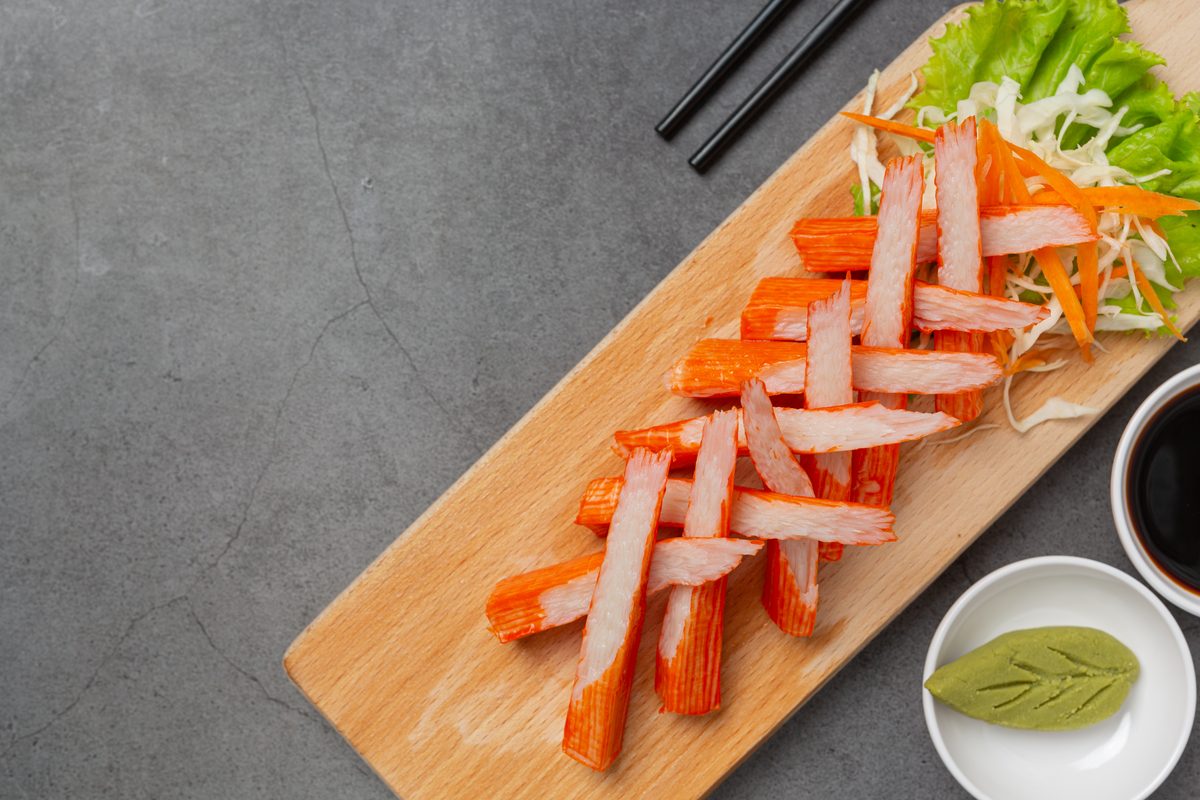
What surimi contains
| 100 g of | Calories | Protein | Carbohydrate | Salt |
|---|---|---|---|---|
| Crab-flavour surimi | 117 kcal | 7.5 g | 11.8 g | 1.77 g |
| Cooked prawns | 100 kcal | 22.5 g | 0.6 g | 1.66 g |
| Smoked salmon | 184 kcal | 22.2 g | 0.1 g | 2.86 g |
Nutritionally, surimi is an average product: three times less protein than prawns, carbohydrate added in the form of starch, and plenty of salt, 1.77 g per 100 g. It does not provide the benefits of real fish. Going without it during pregnancy therefore deprives you of nothing important.
Surimi or real fish: omega-3 and iodine
During pregnancy, fish is recommended mainly for two nutrients: long-chain omega-3, EPA and DHA, which contribute to the development of the baby’s brain and eyes, and iodine, essential for the baby’s thyroid. Surimi provides very little of either:
| Per 100 g | EPA + DHA | Iodine | Protein |
|---|---|---|---|
| Crab-flavour surimi | 0.31 g | 10 µg | 7.5 g |
| Steamed salmon | 1.75 g | 17 µg | 23 g |
| Baked mackerel | 2.14 g | 46 µg | not compared |
| Grilled herring | 2.28 g | 48 µg | 21.6 g |
| Steamed cod | 0.27 g | 110 µg | 24.5 g |
| Hake cooked in its own juices | 0.39 g | 42 µg | 21.2 g |
Oily fish, salmon, mackerel, herring, provide five to seven times more omega-3 than surimi; cod, eleven times more iodine. EFSA sets the adequate intake of iodine at 200 µg a day during pregnancy: 100 g of cod covers more than half of it, 100 g of surimi 5%. In practice, replacing surimi with real cooked fish is a clear nutritional gain, as well as being risk-free.
Frozen, filled, flaked: the variants of surimi
The chilled aisle offers surimi in several forms. None changes the rule, and some misconceptions deserve to be corrected:
- Frozen surimi is not any safer. Santé publique France points this out for seafood: freezing does not eliminate Listeria. Only cooking destroys it.
- Surimi filled with cream cheese combines two ready-to-eat products kept cold. According to Ciqual, it provides 148 kcal and only 6.6 g of protein per 100 g, even less than the plain stick.
- Grated or flaked surimi does not escape the rule: crab-flavour surimi flakes are among the products recalled for Listeria since 2021.
On the labels, one detail also stands out. Of 96 surimi products sold in France for which Open Food Facts has the ingredients list, 92 contain paprika extract (E160c), the colouring that gives the orange band. 13 contain glutamate (E621), 7 sorbitol (E420) and 5 carmine (E120). Across the 100 products surveyed, salt ranges from 1.2 to 3.5 g per 100 g. None of this is forbidden during pregnancy, but it confirms that surimi is a processed product, not a portion of fish.
Replacing surimi in a cold salad
Surimi is mainly used to fill salads, wraps or cold open sandwiches. Here are cold toppings that remain an option during pregnancy, compared with surimi:
| 100 g of | Protein | Salt | EPA + DHA | Iodine | Pregnant, cold |
|---|---|---|---|---|---|
| Crab-flavour surimi | 7.5 g | 1.77 g | 0.31 g | 10 µg | 🔴 avoid |
| Sardines in oil, tinned, drained | 23.3 g | 0.88 g | 1.67 g | 80 µg | 🟢 allowed |
| Mackerel in brine or water, tinned, drained | 18.8 g | 0.86 g | 3.36 g | less than 20 µg | 🟢 allowed |
| Hard-boiled egg | 13.5 g | 0.31 g | 0.04 g | 50 µg | 🟢 allowed, well cooked |
| Tuna in brine or water, tinned, drained | 26.8 g | 0.74 g | 1.07 g | 16 µg | 🟠 to be limited |
Sardines in oil are the most complete replacement: three times more protein than surimi, half the salt, five times more omega-3 and eight times more iodine. Santé publique France also lists tinned sea fish among the sources of iodine during pregnancy, and tinned oily fish among the sources of vitamin D. Mackerel in brine provides even more omega-3. Tuna is one of the fish to be limited because of pollutants, even tinned: keep it for the occasional meal.
Surimi in restaurants and from the deli counter
Surimi hides in many cold dishes, where you do not necessarily think of it:
- California rolls and maki with surimi: served cold, they are to be avoided, as our page sushi in pregnancy explains.
- Mixed salads from the deli counter: pasta salad, rice salad, Piedmontese salad or « Alaska salad » with surimi are precisely the products most often found in the recalls.
- Verrines and party bites: mousses, fish rillettes or surimi filled with cream cheese, prepared in advance and kept cold.
- Gimbap and spring rolls: surimi is sometimes added cold, with raw vegetables. Our vegetable gimbap recipe offers an egg or tofu version, to be preferred during pregnancy, with well-washed vegetables and a well-cooked egg.
The rule remains simple: if the surimi is served cold, go without; if it is cooked in a dish served piping hot, it is allowed.
How to cook it properly
« Hot » surimi is safe only if it has genuinely been heated right through. Anses recommends reheating dishes that are eaten hot to an internal temperature above 70 °C. In practice:
- in a quiche, a savoury cake or a gratin, the dish must be cooked all the way through and served steaming hot;
- in a stir-fry or a wok, toss the pieces until they are piping hot in the middle;
- in a soup, add them to the simmering stock and leave them to heat for a few minutes;
- leftovers keep in the fridge for three days at most and are reheated until properly hot.
The fish to favour during pregnancy
Manger Bouger recommends eating fish twice a week, including one oily fish, rich in omega-3, well cooked and not smoked: salmon, sardine, mackerel, herring, trout, cod, pollock, whiting, sole. It advises limiting eel, monkfish, sea bass, sea bream, skate and tuna, including tinned, and avoiding swordfish, marlin, dogfish (saumonette), shark and lamprey, because of mercury and pollutants.
See our guides how much fish a week and foods high in omega-3.
Safe recipe ideas
- Baked salmon fillet: the oily fish of the week, cooked right through.
- Grilled sardines with lemon: rich in omega-3.
- Salmon en papillote.
- A quiche or savoury cake with surimi, baked in the oven and eaten hot: the only way to enjoy it during pregnancy.
And while breastfeeding?
While breastfeeding, the precautions against listeriosis that apply to pregnancy no longer apply: cold surimi is an option again. See our guide eating while breastfeeding.
Frequently asked questions
Can you eat surimi when pregnant?
Cold, no: Ameli advises against it during pregnancy because of the risk of listeriosis. Cooked and served hot, in a quiche or a stir-fry, yes.
Is surimi cooked?
Yes, it is cooked during manufacture. But it is then kept cold and eaten cold, which gives Listeria time to multiply.
Is cooked surimi allowed in pregnancy?
Yes, if it is heated right through, until piping hot, and eaten straight away.
I ate surimi while pregnant, what should I do?
Don’t panic: the risk from a one-off portion is low. If you have a fever in the following weeks, even a mild one, tell your doctor or midwife.
Does surimi contain mercury?
It is made from white fish, such as pollock, which are not much affected by mercury. The problem with surimi during pregnancy is listeriosis, not mercury.
Is a surimi California roll allowed in pregnancy?
No: the surimi in it is served cold, which Ameli advises against during pregnancy. Prefer vegetarian maki, cucumber or avocado.
Does surimi provide omega-3?
Very little: 0.31 g of EPA and DHA per 100 g, against 1.75 g for cooked salmon and more than 2 g for mackerel or herring, according to Ciqual.
Have there been surimi recalls for Listeria?
Yes: since 2021 the RappelConso database lists recalls for Listeria on two tagliatelle salads with surimi and on surimi flakes, as well as recalls for a break in the cold chain.
What temperature should surimi be reheated to?
Anses recommends reheating hot dishes to above 70 °C at the centre: surimi must be piping hot in the middle.
Is frozen surimi allowed in pregnancy?
Not cold. Santé publique France specifies that freezing does not eliminate Listeria in seafood. Frozen or not, surimi must be cooked and served piping hot.
What can you replace surimi with in a salad when pregnant?
With tinned sardines or mackerel, or a hard-boiled egg. According to Ciqual, sardines in oil provide 23.3 g of protein per 100 g, against 7.5 g for surimi.
Is surimi filled with cheese allowed in pregnancy?
Not cold: it is a ready-to-eat surimi, filled with a cream cheese, all kept in the fridge. It follows the same rule as plain surimi.
Can you eat it when pregnant? The series
Food by food, what is allowed, conditional or to be avoided during pregnancy: cheesecake in pregnancy, foie gras in pregnancy, feta in pregnancy, mozzarella in pregnancy, raclette in pregnancy, charcuterie in pregnancy, smoked salmon in pregnancy, tiramisu in pregnancy, chorizo in pregnancy, taramasalata in pregnancy, honey in pregnancy, camembert and brie in pregnancy, prawns in pregnancy, soft-boiled egg in pregnancy, sushi in pregnancy, cured ham in pregnancy, hummus in pregnancy, tinned tuna in pregnancy.
Our sources
- Ameli, « Les aliments à éviter et les précautions d’hygiène pendant la grossesse ».
- Manger Bouger (Santé publique France), « Quels aliments éviter et quelles précautions prendre quand on est enceinte ? », updated 2026.
- Santé publique France, listeriosis surveillance data.
- Ciqual 2025 table (Anses): crab-flavour surimi, cooked prawn, smoked salmon.
- RappelConso, public product recall dataset (data.economie.gouv.fr), notices containing « surimi », consulted on 25 September 2026.
- Anses, « Qu’est-ce que la listériose et comment s’en prémunir ? »: reheating above 70 °C.
- EFSA, dietary reference values for iodine: adequate intake of 200 µg a day during pregnancy.
- Ciqual 2025 table (Anses): surimi, salmon, mackerel, herring, cod, hake.
- Open Food Facts, ingredients lists of 47 surimi stick products sold in France, survey of 25 September 2026.
- Santé publique France, guide « De la grossesse à l’arrivée de bébé » (Manger Bouger): freezing fish does not eliminate Listeria; tinned sea fish a source of iodine, tinned oily fish a source of vitamin D; tuna to be limited including tinned.
- Ciqual 2025 table (Anses): surimi filled with cream cheese, tinned sardines in oil, tinned mackerel in brine, hard-boiled egg, tinned tuna in brine.
- Open Food Facts, ingredients lists and nutritional values of 100 surimi products sold in France (96 usable lists), survey of 26 September 2026.