Gluten-free eating: a guide to flours and alternatives
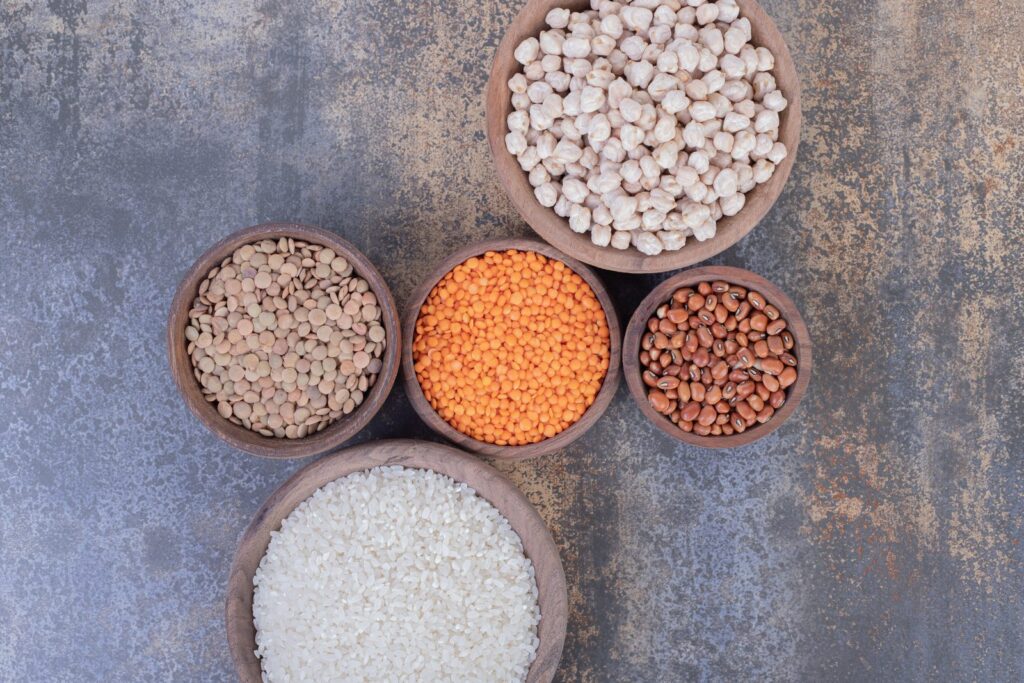
Eating gluten-free means cutting out wheat (including spelt and kamut), barley and rye, and replacing them with flours and grains that contain none: buckwheat, rice, maize, millet, quinoa, chickpea, chestnut, almond. For someone with coeliac disease, this diet is the only treatment and must be strict for life. For everyone else, it has no proven benefit. This guide focuses on the practical side: which flours to choose, how they compare nutritionally, how to read labels and how to avoid the pitfalls.
👉 Free tool: Calorie deficit: get your result in 30 seconds, no sign-up needed.
Who really needs to eat gluten-free?
Gluten is a group of water-insoluble proteins, the prolamins, found in wheat (gliadins and glutenins), rye (secalins) and barley (hordeins). The French National Authority for Health (HAS) points out that oats also contain them (avenins), but in smaller amounts and in a less immunogenic form. Gluten is what gives bread dough its elasticity.
Three situations need to be distinguished, according to the HAS recommendation published in July 2026.
- Coeliac disease: an autoimmune disease of the small intestine, triggered by gluten in genetically predisposed people. Its prevalence is estimated at between 0.8 and 1% of the general population, and a large share of cases go undiagnosed. The only effective treatment is a strict gluten-free diet for life.
- Non-coeliac gluten hypersensitivity: a functional digestive disorder, with no antibodies or intestinal damage, and without the complications of coeliac disease. The HAS stresses that the responsibility of gluten itself has not been demonstrated: other components of wheat, such as FODMAPs, may be involved.
- Wheat allergy: an immune reaction to various wheat proteins, more common in children, with a worldwide prevalence estimated at around 0.4%.
Worldwide, a 2018 meta-analysis estimates the prevalence of coeliac disease at 1.4% based on blood tests and 0.7% when the diagnosis is confirmed by biopsy. The causes, symptoms and diagnosis are covered in our guide to understanding gluten intolerance and managing it.
The golden rule: diagnosis before diet
The HAS recommends not starting a gluten-free diet before the diagnosis has been confirmed. The tests (blood test, then biopsy if needed) must be done while you are still eating gluten, because the diet lowers antibody levels and partly repairs the intestine, which skews the results. If you have already stopped eating gluten, the HAS advises reintroducing it for 6 to 8 weeks, at least 3 g a day and preferably 8 to 10 g a day, before having the tests.
To give you an idea, the HAS estimates that 3 g of gluten corresponds approximately to:
| Food | Amount providing about 3 g of gluten |
|---|---|
| Rusks (biscottes) | 3 rusks of 10 g |
| Sliced sandwich bread | 2 slices of 25 g |
| Baguette | 40 g, or 1/6 of a baguette |
| Petit-beurre type biscuits | 5 biscuits |
| Raw pasta | 30 g |
| Wheat flour T55 (plain white flour) | 30 g |
This table also shows how present gluten is in a typical French diet: a few slices of bread are enough to go well beyond these amounts.
Grains to exclude and grains to keep
According to the French health insurance body (Assurance Maladie), the grains that contain gluten are wheat, including durum wheat, spelt and kamut, barley, rye and their hybrids such as triticale. This includes everything made from them: bread, pasta, semolina, couscous, bulgur, biscuits, breadcrumbs, beer.
Naturally gluten-free foods include: rice, maize, buckwheat (despite its French name « blé noir », literally « black wheat », it is not wheat), potatoes, millet, quinoa, chestnuts, pulses, fruit and vegetables, eggs, unprocessed meat and fish, milk and plain cheeses.
The case of oats
Pure oats can be eaten by more than 95% of people who are intolerant to gluten, according to the Assurance Maladie. A 2017 meta-analysis (28 studies, including 8 controlled trials with 661 patients) found no effect of pure oats on symptoms, the gut or antibodies in coeliac patients after 12 months, although the level of evidence is low. The problem is contamination: European regulations point out that oats can be contaminated with wheat, rye or barley during harvest, transport, storage or processing. European regulations therefore require that the oats in a « gluten-free » product have been produced in a way that avoids this contamination, with no more than 20 mg of gluten per kilo. Choose only oats labelled gluten-free, and ask your doctor before introducing them.
The guide to gluten-free flours
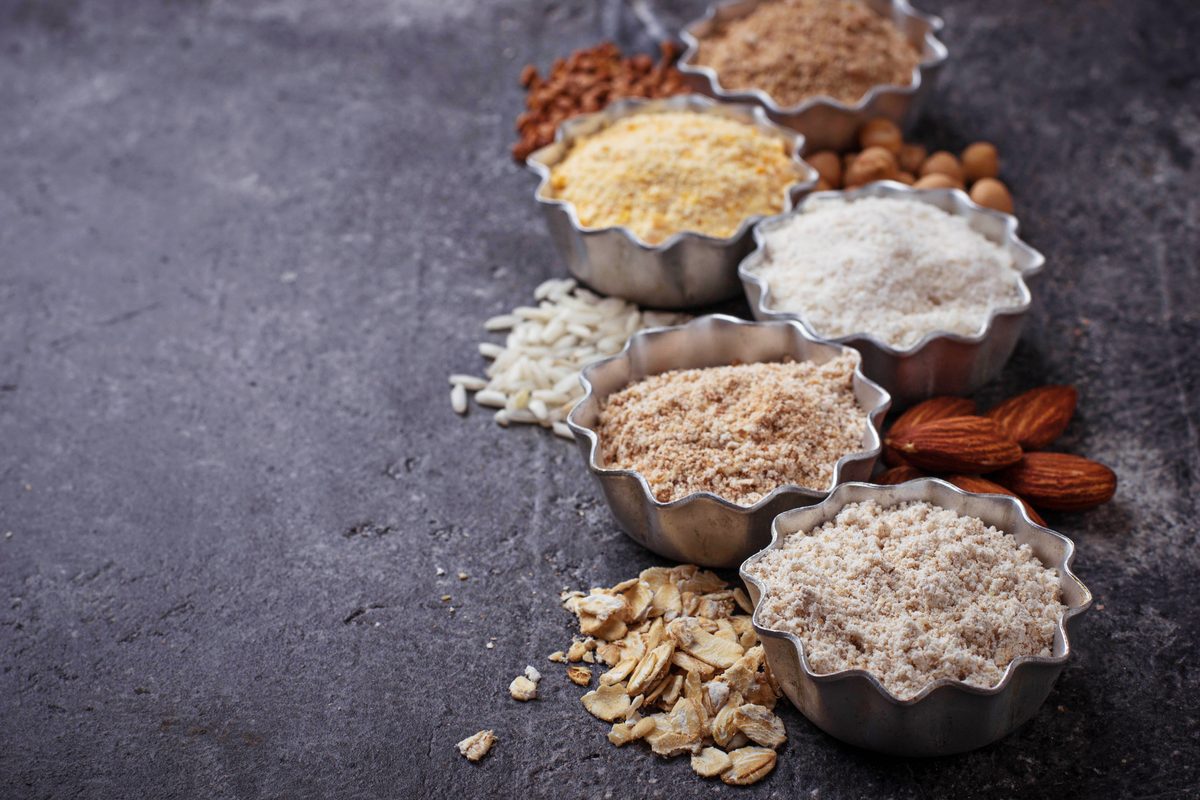
No gluten-free flour can replace wheat flour on its own: without gluten, there is no elastic network. In baking and bread-making, you therefore often mix a « base » flour (rice, maize), a flour that adds flavour or protein (buckwheat, chickpea, chestnut, almond) and a binding starch (potato starch, cornflour). Here is what each one provides per 100 g, according to the Anses Ciqual table.
| Flour (per 100 g) | Energy (kcal) | Protein (g) | Fibre (g) | Iron (mg) | Uses |
|---|---|---|---|---|---|
| Wheat flour T55 (reference, contains gluten) | 350 | 9.03 | 3.2 | 1 | Bread, baking |
| Buckwheat flour | 348 | 11.5 | 4.2 | 2.5 | Savoury galettes, crêpes, rustic bread |
| Rice flour | 357 | 7.62 | 3.3 | 0.79 | Neutral base, baking, tempura |
| Maize flour | 362 | 5.59 | 1.9 | 0.91 | Tortillas, moist cakes |
| Chickpea flour | 359 | 22.4 | 10.8 | 4.86 | Socca, panisse, fritter batter, binder |
| Chestnut flour | 362 | 5.69 | 12.6 | < 0.1 | Cakes, crêpes, sweet flavour |
| Millet flour | 350 | 10.2 | 9.7 | 3.8 | Bread, crêpes, in blends |
| Quinoa (raw grain) | 358 | 13.2 | 7 | 4.57 | Ground into flour, in blends |
| Almond, blanched (base of ground almonds) | 631 | 21.4 | 9.9 | 3.28 | Financiers, moist cakes |
| Potato starch | 348 | 0 | 0.55 | 0.84 | Binder, lightness |
| Cornflour (maize starch) | 365 | 0.26 | 0.9 | 0.47 | Binder, sauces, custards |
What this table tells you:
- Chickpea flour is the champion: more than twice as much protein as T55 wheat flour, more than three times as much fibre and almost five times as much iron.
- Buckwheat and millet also beat white flour on fibre and iron.
- Rice flour and maize flour are lower in protein than T55 flour, and no higher in fibre (3.3 g and 1.9 g against 3.2 g).
- Starches (potato starch, cornflour) provide almost nothing but energy: useful in the kitchen, not for nutrition.
- Ground almonds have almost twice the calories, because of their 52.5 g of fat per 100 g.
If you mix rice flour and starch for your cakes, add a share of chickpea, buckwheat or millet: you gain in protein, fibre and iron.
A few combinations that work
- Galettes and crêpes: 100% buckwheat, like these buckwheat galettes with ham, egg and cheese. Check the label: a blend with wheat flour is possible.
- Socca and crackers: chickpea flour, water, olive oil. Try the socca or the chickpea crackers.
- Moist cakes: ground almonds and rice flour, or chestnut flour for an autumn flavour.
- White sauce and other sauces: cornflour or rice flour instead of wheat flour.
- Coating: maize flour, fine polenta, or chickpea flour.
- Pasta: rice, maize or lentil pasta, or 100% buckwheat soba noodles (some soba also contain wheat, so read the ingredients list carefully).
Shop-bought « gluten-free » products: what they are worth
Substitute products are helpful, but they are not always equivalent to the original. The Ciqual table lets you compare.
| Per 100 g | Protein (g) | Fibre (g) | Fat (g) | Sugars (g) |
|---|---|---|---|---|
| Standard white sliced bread | 7.06 | 2.83 | 4.37 | 6.14 |
| Gluten-free white sliced bread | 3.36 | 7.4 | 5.1 | 5.16 |
| Standard pasta, cooked | 6.1 | 2.2 | 1.1 | 0.87 |
| Gluten-free rice and maize pasta, cooked | 3.15 | 1.3 | 0.8 | traces |
| Gluten-free red lentil pasta, cooked | 11.7 | 4.9 | 0.8 | 1.03 |
| Standard petit-beurre biscuit | 7.78 | 2.54 | 13.3 | 22 |
| Gluten-free petit-beurre biscuit | 3.8 | 0.9 | 14 | 21 |
What they have in common: gluten-free versions made from rice and maize contain about half the protein. Gluten-free sliced bread, on the other hand, contains more fibre. And red lentil pasta does better than wheat pasta on protein, fibre and iron (2.7 mg against 0.68 mg per 100 g cooked). A gluten-free biscuit is still a biscuit: just as fatty and sugary as the original.
Reading labels: what the law says
Implementing Regulation (EU) No 828/2014 governs two claims:
- « Gluten-free »: the food as sold contains no more than 20 mg of gluten per kilo.
- « Very low gluten »: for products made from cereals specially processed to reduce gluten, no more than 100 mg per kilo. The Assurance Maladie advises coeliac people against these products.
Why 20 mg/kg? A double-blind randomised trial published in 2007, in 49 coeliac adults, compared a placebo, 10 mg and 50 mg of gluten a day. With 50 mg, the ratio of villus height to crypt depth in the intestine fell by 20%, whereas it rose by 9% on placebo. The authors recommend keeping « contaminating » gluten below 50 mg a day. At 20 mg/kg, you would have to eat 2.5 kg of gluten-free products in a day to reach that 50 mg: the margin is comfortable.
Villi are the folds of the small intestine that absorb nutrients. In coeliac people exposed to gluten, they become atrophied.
The pitfalls of hidden gluten
The Assurance Maladie lists several places where gluten often hides:
- cold cuts and processed meats;
- icing sugar;
- ground peppers, spice blends and seasonings (for example garlic powder);
- medicines.
Add to that flour-thickened sauces, coatings, ready meals and beer, which is made from barley. Cereals containing gluten are among the allergens that must be declared in the ingredients list, with the name of the cereal (EU Regulation No 1169/2011): it is the first place to look. Our guide to food labels explains how to spot them.
At home, also think about cross-contamination: a shared toaster, chopping board, or butter that someone has dipped a crumb-covered knife into. For a coeliac person, dedicated utensils make life simpler.
Balancing a gluten-free diet
Removing wheat also removes an important source of fibre, iron and B vitamins when you eat wholemeal bread and pasta. A few habits to adopt:
- Rely first on naturally gluten-free foods rather than substitute products: potatoes, brown rice, buckwheat, quinoa, pulses.
- Include pulses at least twice a week, as Manger Bouger recommends for everyone: lentils, chickpeas, beans. They provide protein, fibre and iron.
- Vary your flours: chickpea, buckwheat, millet rather than rice and maize alone.
- Limit gluten-free biscuits and cakes, often as high in fat and sugar as the originals.
Our guides to dietary fibre and iron-rich foods help you fill these two weak spots.
A typical gluten-free day
- Breakfast: quinoa porridge with fruit, or certified gluten-free oat flakes if your doctor agrees.
- Lunch: buckwheat and vegetable salad, an egg, a piece of fruit.
- Afternoon snack: a plain yoghurt and a handful of almonds.
- Dinner: quinoa and mushroom risotto or oven-baked falafels with a salad.
More ideas: grilled polenta with vegetables, chickpea and courgette fritters. All our ideas are gathered in the gluten-free recipes. Remember to check every processed ingredient (stock, sauce, spices).
Reimbursement for coeliac people
In France, the Assurance Maladie (the national health insurance) reimburses 60% of the cost of gluten-free dietetic foods for people whose coeliac disease has been confirmed by biopsy. Reimbursement is capped at EUR 45.73 per month for an adult and EUR 33.54 for a child under 10. Talk to your doctor about it.
Myths about gluten-free
« Eating gluten-free is healthier for everyone »
Nothing shows this. A large American study published in the BMJ in 2017 followed more than 110,000 adults without coeliac disease for 26 years: gluten consumption was not associated with cardiovascular risk. The authors even warn that avoiding gluten may reduce the consumption of wholegrains, which benefit the heart, and they advise against promoting gluten-free eating among people who are not coeliac.
« Going gluten-free makes you lose weight »
Gluten-free products are not lower in calories: gluten-free sliced bread provides 242 kcal per 100 g against 279 for the standard version, but a gluten-free petit-beurre provides 460 against 450 for its wheat version, according to Ciqual. There is no reason to see them as « slimming » foods.
« Spelt and kamut are gluten-free »
No, they are wheats. The Assurance Maladie explicitly lists them among the cereals that are off limits in coeliac disease.
« A little gluten now and then does no harm »
For a coeliac person, it does. The HAS reminds us that the diet must be strict and lifelong, and in the 2007 trial, 50 mg a day was enough to alter the intestinal lining.
Frequently asked questions
Which flour is the best replacement for wheat flour?
None on its own. For baking, a blend of rice flour, starch and a more nutritious flour (chickpea, buckwheat, millet or ground almonds) gives the best results. For galettes, pure buckwheat works very well.
Does buckwheat contain gluten?
No. Despite its French name « blé noir » (black wheat), it is not a cereal of the wheat genus. Just watch out for flours and soba noodles mixed with wheat: read the ingredients list.
Can you eat gluten-free oats?
Pure oats are suitable for more than 95% of coeliac people according to the Assurance Maladie, provided they are certified gluten-free (no more than 20 mg/kg). Ask your doctor before introducing them.
What does « gluten-free » mean on packaging?
That the product contains no more than 20 mg of gluten per kilo, according to European Regulation 828/2014. The claim « very low gluten » (up to 100 mg/kg) is not recommended for coeliac people.
Should you stop eating gluten before having the tests?
No, definitely not. The HAS recommends having the tests while eating gluten. If you have already stopped, you need to reintroduce it for 6 to 8 weeks (at least 3 g a day) before the tests.
Is gluten-free useful for irritable bowel syndrome?
Not necessarily. The HAS states that the symptoms attributed to gluten in non-coeliac people may come from other components of wheat, including FODMAPs. Our guide to the FODMAP diet explains this approach.
This article is for information only and does not replace the advice of your doctor or a dietitian.
Our sources
- Haute Autorité de santé (HAS). Maladie cœliaque : diagnostic chez l’enfant et l’adulte. Good practice recommendation, July 2026.
- European Commission. Implementing Regulation (EU) No 828/2014 on the requirements for the provision of information to consumers on the absence or reduced presence of gluten in food. 2014.
- Assurance Maladie (ameli.fr). Régime alimentaire sans gluten en cas de maladie cœliaque.
- European Parliament and Council. Regulation (EU) No 1169/2011 on the provision of food information to consumers, Annex II (substances or products causing allergies or intolerances). 2011.
- Singh P, Arora A, Strand TA et al. Global Prevalence of Celiac Disease: Systematic Review and Meta-analysis. Clinical Gastroenterology and Hepatology, 2018. PMID 29551598.
- Catassi C, Fabiani E, Iacono G et al. A prospective, double-blind, placebo-controlled trial to establish a safe gluten threshold for patients with celiac disease. American Journal of Clinical Nutrition, 2007. PMID 17209192.
- Pinto-Sánchez MI, Causada-Calo N, Bercik P et al. Safety of Adding Oats to a Gluten-Free Diet for Patients With Celiac Disease: Systematic Review and Meta-analysis of Clinical and Observational Studies. Gastroenterology, 2017. PMID 28431885.
- Lebwohl B, Cao Y, Zong G et al. Long term gluten consumption in adults without celiac disease and risk of coronary heart disease: prospective cohort study. BMJ, 2017. PMID 28465308.
- Santé publique France, Manger Bouger. Augmenter les légumes secs. 2019 recommendations.
- Anses. Table de composition nutritionnelle des aliments Ciqual, 2025.
Further reading
Food pages: Wheat flour, Chickpeas, Chestnuts, Rye, Almonds
Recipes to try: Buddha bowl with quinoa, chickpeas and roasted vegetables, Buddha bowl with beetroot, quinoa and feta, Buddha bowl with sweet potato and roasted chickpeas