Rice and diabetes: which rice to choose? The GI of 11 rices compared
The short answer
Yes, a person with diabetes can eat rice, by choosing the right rice and the right portion. Rices are not all equal: in people with diabetes, parboiled rice has an average glycaemic index of 48 across twelve studies, ordinary white rice 59, and glutinous rice 75. In people without diabetes, jasmine rice climbs to 89 and above. Rice is above all a carbohydrate-dense food: 200 g of cooked white rice provide 66 g, twice as much as 200 g of lentils. The right portion: 100 to 150 g of cooked rice, parboiled or basmati rather than jasmine or round-grain, with vegetables and a protein.
This guide gives general guidelines. If you are treated with insulin or with a medicine that can cause hypoglycaemia, your carbohydrate amount per meal is set with your doctor or dietitian.
Glycaemic index of rices: the measurements
The international glycaemic index tables (Atkinson, Foster-Powell and Brand-Miller, 2008) contain a very large number of rice measurements:
| Rice | People | Glycaemic index |
|---|---|---|
| High-amylose brown rice, Philippines | 9 people with type 2 diabetes | 39 |
| High-amylose white rice, Bangladesh | 9 to 12 people with type 2 diabetes | 37 and 39 |
| Parboiled rice | people with diabetes, 12 studies | 48 on average |
| Long-grain rice | people with diabetes, 8 studies | 57 on average |
| Wild rice | 9 people with diabetes | 57 |
| White rice, unspecified | people with diabetes, 8 studies | 59 on average |
| White rice, 4 French studies | people with type 2 diabetes | 43 to 52 |
| Glutinous rice, Thailand | 8 people with type 2 diabetes | 75 |
| White basmati rice | people without diabetes, 6 studies | 43 to 69 |
| Arborio rice (risotto) | 10 people without diabetes | 69 |
| White jasmine rice | people without diabetes, 2 studies | 89 and 109 |
What explains these differences: amylose. Rice starch is made of two molecules, amylose, which is compact and slow to digest, and amylopectin, which is branched and quickly attacked by enzymes. Glutinous, jasmine and round-grain rices are low in amylose, hence their sticky texture and high GI. Long-grain, basmati and parboiled rices contain more. Parboiling, which pre-cooks the grain with steam before husking, hardens the starch further. For the notion of GI, see our guide to the glycaemic index.
What a portion of rice contains
| 150 g cooked | Calories | Carbohydrate | Fibre | Protein |
|---|---|---|---|---|
| Thai rice | 215 kcal | 47.1 g | less than 0.8 g | 3.6 g |
| Parboiled white rice | 219 kcal | 47.6 g | 1.7 g | 4.4 g |
| Basmati rice | 222 kcal | 49.4 g | less than 0.8 g | 4.5 g |
| White rice | 233 kcal | 49.8 g | 2.1 g | 4.7 g |
| Brown rice | 281 kcal | 56.4 g | 3.2 g | 5.8 g |
For the same cooked weight, white rices provide 47 to 50 g of carbohydrate per 150 g. Brown rice provides a little more, because it absorbs less water during cooking: for the same weight of raw rice, the carbohydrate is similar. Its advantage lies in the fibre, the minerals and a lower GI. For details on portions and equivalences, see our guide to how much rice per person.
Red rice, wild rice: less carbohydrate per cooked weight
| 150 g cooked | Carbohydrate | Fibre |
|---|---|---|
| Semi-wholegrain rice | 51.6 g | 2.6 g |
| Red rice | 42.3 g | 6.0 g |
| Pre-cooked white rice | 42.2 g | 1.5 g |
| Wild rice | 29.6 g | 2.7 g |
Wild rice is the lightest in carbohydrate per cooked weight: 150 g provide 29.6 g, 40% less than white rice, because it swells a lot during cooking. Red rice provides three times more fibre than white rice. Both mix well with white or brown rice to lighten the plate. Pre-cooked white rice contains less carbohydrate per 100 g cooked because it absorbs more water; but heavily processed rices often have a higher GI, as seen above.
Work out the glycaemic load of your portion
| Cooked portion | Carbohydrate | Glycaemic index | Glycaemic load |
|---|---|---|---|
| 100 g parboiled rice | 31.7 g | 48 | 15 |
| 150 g parboiled rice | 47.6 g | 48 | 23 |
| 150 g white rice | 49.8 g | 59 | 29 |
| 150 g brown rice | 56.4 g | 39 | 22 |
| 200 g white rice | 66.4 g | 59 | 39 |
| 150 g lentils, for comparison | 24.3 g | 21 to 30 | 5 to 7 |
Rice is one of the foods whose glycaemic load climbs fastest with portion size, because it is dense in carbohydrate. Even a low-GI parboiled rice reaches a high load at 150 g. This is why the portion matters more than the variety, and why replacing part of the rice with pulses is so effective. See lentils and diabetes.
Which rice to choose when you have diabetes
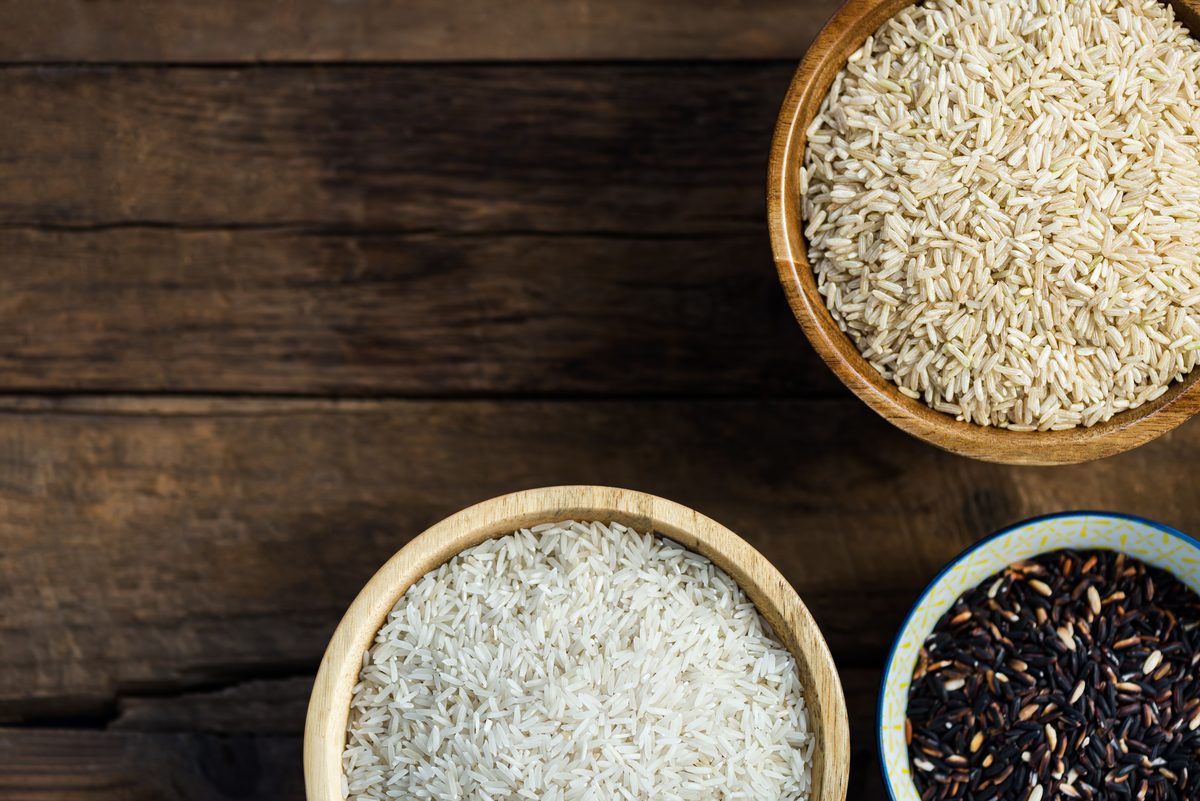
- Parboiled rice: GI of 48 on average in people with diabetes, easy to find and it does not stick.
- Brown rice: more fibre and minerals, low GI in the only study in people with diabetes.
- Basmati rice: low to medium GI, from 43 to 69 depending on the brand, in people without diabetes.
- To avoid day to day: glutinous rice, jasmine rice, round-grain rice for desserts, and instant or overcooked rices.
Wild rice, which is not really a rice but the seed of another plant, has a GI of 57 in people with diabetes.
Cooled rice: resistant starch
When cooked rice cools, part of its starch reorganises into a form that our enzymes digest poorly: resistant starch, which behaves a little like a fibre. Two trials have measured it:
- Sonia et al., 2015 (Indonesia, 15 healthy adults): resistant starch rose from 0.64 g per 100 g in freshly cooked white rice to 1.65 g after 24 hours in the fridge at 4 °C followed by reheating. The glycaemic response was about 18% lower with this cooled then reheated rice (125 versus 152 mmol.min/L).
- Peng et al., 2024 (China, 18 healthy women): a non-glutinous rice kept for 24 hours at 4 °C raised blood glucose 24.4% less over four hours than the same freshly cooked rice. Glutinous rice did not benefit from cooling.
The effect is real but modest, and it was measured in people without diabetes. It does not change the amount of carbohydrate in the rice: 150 g of cooled rice counts as 150 g of hot rice. It is a small bonus, not permission to double the portion.
Cooling rice safely
Rice can contain spores of Bacillus cereus, a bacterium that survives cooking and multiplies between 4 and 55 °C. Anses recommends cooling and refrigerating straight away cooked food that is not eaten immediately, and throwing away dishes left for several hours at room temperature, even if reheated. In the Indonesian study, rice left for 10 hours at room temperature also contained more resistant starch: this is precisely what you should not do. Stick with the fridge version.
Good habits
- 100 to 150 g of cooked rice per meal, or about 45 to 65 g of raw white rice, rather than the 200 to 250 g of institutional catering.
- Half rice, half pulses: 75 g of rice and 75 g of lentils or kidney beans, as in a chilli or an Indian plate.
- Plenty of vegetables on the plate: they add volume without carbohydrate.
- A protein and a little fat: fish, egg, chicken, tofu, a drizzle of oil.
- Careful cooking: al dente rice that keeps its shape, rather than overcooked, sticky rice.
What about rice pudding, sushi, risotto?
- Rice pudding combines sticky round-grain rice and sugar: a dessert, not a starchy food.
- Sushi uses round-grain rice, often seasoned with sugar and vinegar. Count it as a starchy food, and favour sashimi and vegetable makis for part of the meal.
- Risotto is made with arborio rice, with a GI of 69 in people without diabetes. In a moderate portion, with vegetables, it remains possible.
Rice cakes, vermicelli, rice pudding: rice-based products
| Product | Carbohydrate per 100 g | Glycaemic index |
|---|---|---|
| Puffed brown rice cake | 77.9 g | 61 to 91 depending on the rice; 82 for white rice cakes (6 people without diabetes) |
| Plain puffed rice (cereal) | 86.3 g, of which 7.9 g sugars | not measured here |
| Rice vermicelli, cooked | 20.1 g | 40 (fresh) to 61 (dried), people without diabetes |
| Rice pudding, chilled aisle | 18.9 g, of which 10.8 g sugars | not measured here |
| Congee, rice porridge | not listed | 69 (China) and 88 (Australia), people without diabetes |
| White sushi rice | not listed | 85, people without diabetes |
- Puffed rice cakes have a reputation for being light. Yet they contain almost 78 g of carbohydrate per 100 g, more than white bread, 58.3 g, and their GI exceeds 80 for ordinary rices. A cake spread with a protein, fresh cheese, hummus or egg, is better than a cake on its own, and it counts as bread.
- Rice vermicelli is very hydrated once cooked, 20.1 g of carbohydrate per 100 g. Its GI ranges from 40 to 61 depending on whether it is fresh or dried.
- Congee and rice porridges have a high GI: the starch, cooked for a long time in plenty of water, is fully gelatinised. The same logic applies to overcooked rice.
- Shop-bought rice pudding provides 10.8 g of sugars per 100 g: it is a dessert. See also our recipe for light rice pudding, to be counted as such.
Rice and diabetes risk: what population studies say
Two major pieces of work have looked at whether rice consumption is linked to the risk of becoming diabetic:
- A BMJ meta-analysis (Hu et al., 2012) pooled seven cohorts, 352,384 people followed for 4 to 22 years. In China and Japan, where people eat three to four portions of white rice a day, the biggest consumers had a type 2 diabetes risk 55% higher than the smallest. In Western countries, where it is eaten once or twice a week, the difference was not significant. Overall, each extra daily portion of white rice was associated with an 11% higher risk.
- Three large American cohorts (Sun et al., 2010), nearly 200,000 health professionals: eating white rice at least five times a week was associated with a 17% higher risk, and brown rice at least twice a week with an 11% lower risk. The authors estimated that replacing 50 g of cooked white rice a day with brown rice was associated with a 16% lower risk, and with wholegrain cereals in general, 36% lower.
These studies concern prevention and do not prove a cause. But they point in the same direction as the GI measurements: the amount of white rice matters, and partly replacing it with brown rice or other wholegrain cereals is a useful swap. See type 2 diabetes: diet and prevention.
What about arsenic?
Rice also concentrates more inorganic arsenic than other cereals. If you eat it often, cooking in plenty of water reduces exposure and varying your starchy foods remains the best protection. The details, with the European maximum levels, are in our guide to how much rice per person.
Special cases
Gestational diabetes
During pregnancy, prefer parboiled or brown rice, in a portion of 100 to 150 g cooked, with vegetables and a protein. See eating during pregnancy.
Sport
For an athlete with diabetes, rice is a good recovery starch; the portion is adjusted to the effort, with the care team for people on insulin.
Gluten-free
Rice is naturally gluten-free, useful in coeliac disease, which is more common in type 1 diabetes. See gluten-free.
3 recipes to eat it
- Chilli con carne: rice and kidney beans, with 75 g of cooked rice per person.
- Pea risotto: the peas replace part of the rice.
- Vegetable paella: a plate where the vegetables take up as much space as the rice.
More ideas in our low glycaemic index recipes.
Other plates where rice shares the space
- Kitchari and mujadara: rice and lentils cooked together, half the carbohydrate comes from the pulses.
- Bean and rice burrito bowl and gallo pinto: the Latin American rice and bean pairing.
- Salmon, brown rice and broccoli: to prepare ahead, with the rice cooled in the fridge then reheated.
- Vegetable and egg fried rice: the ideal recipe for leftover rice from the day before, kept cold.
Frequently asked questions
Can a person with diabetes eat rice?
Yes, in a portion of 100 to 150 g cooked, with vegetables and a protein. Parboiled rice has an average GI of 48 in people with diabetes, white rice 59.
Which rice for someone with diabetes?
Parboiled, brown or basmati rice. Avoid glutinous, jasmine and round-grain rices day to day, as their GI is high.
Is basmati rice suitable for diabetes?
Yes, its GI ranges from 43 to 69 depending on the brand, in people without diabetes, lower than jasmine rice, 89 to 109.
Brown rice or white rice for someone with diabetes?
Brown rice: more fibre and a lower GI, 39 in the only study in people with diabetes. But it contains as much carbohydrate for the same raw weight: the portion stays the same.
How much rice for someone with diabetes?
100 to 150 g cooked per meal, or about 45 to 65 g of raw white rice, and less if the meal contains bread or another starchy food.
Does rice raise blood glucose more than pasta?
Often, yes: it is denser in carbohydrate per cooked weight, 33 g per 100 g against 31 g for pasta, and al dente pasta generally has a lower GI.
Does reheated rice raise blood glucose less?
A little: rice kept for 24 hours in the fridge then reheated gave a glycaemic response about 18% lower in one trial, and rice cooled for 24 hours 24% lower in another. Its carbohydrate amount stays the same. Put it in the fridge straight after cooking.
Are rice cakes a good snack for someone with diabetes?
Not really on their own: their GI exceeds 80 for ordinary rices, with 78 g of carbohydrate per 100 g. With a protein on top and in a small amount, they remain possible.
Is wild rice suitable for diabetes?
Yes: GI of 57 in people with diabetes and only 19.7 g of carbohydrate per 100 g cooked, against 33.2 g for white rice.
Does eating rice cause diabetes?
Observational studies associate a high consumption of white rice, especially in Asia, with a higher risk of type 2 diabetes; brown rice is associated with a lower risk. These are associations, not proof of cause.
The foods and diabetes series
Glycaemic index, glycaemic load and the right portion, food by food: apples and diabetes, pears and diabetes, oranges and diabetes, bananas and diabetes, grapes and diabetes, dates and diabetes, melon and diabetes, strawberries and diabetes, pineapple and diabetes, cheese and diabetes, mango and diabetes, honey and diabetes, dark chocolate and diabetes, lentils and diabetes, potatoes and diabetes, avocado and diabetes, porridge oats and diabetes, bread and diabetes, kiwi and diabetes, sweet potatoes and diabetes.
Going further
How much rice per person, lentils and diabetes, potatoes and diabetes, which bread for someone with diabetes, glycaemic index.
Our sources
- Atkinson FS, Foster-Powell K, Brand-Miller JC. International Tables of Glycemic Index and Glycemic Load Values: 2008. Diabetes Care, 2008.
- GEMRCN: portion weights for cooked starchy foods.
- Ciqual 2025 table (Anses): cooked white, parboiled, brown, basmati and Thai rice; cooked lentils and pasta.
- Sonia S, Witjaksono F, Ridwan R. Effect of cooling of cooked white rice on resistant starch content and glycemic response. Asia Pacific Journal of Clinical Nutrition, 2015. PMID 26693746.
- Peng X et al. Fresh-Cooked but Not Cold-Stored Millet Exhibited Remarkable Second Meal Effect Independent of Resistant Starch: A Randomized Crossover Trial. Nutrients, 2024. PMID 39683424.
- Hu EA, Pan A, Malik V, Sun Q. White rice consumption and risk of type 2 diabetes: meta-analysis and systematic review. BMJ, 2012. PMID 22422870.
- Sun Q, Spiegelman D, van Dam RM et al. White rice, brown rice, and risk of type 2 diabetes in US men and women. Archives of Internal Medicine, 2010. PMID 20548009.
- Anses: Bacillus cereus, advice on cooling and storing cooked food.
- Ciqual 2025 table (Anses): cooked semi-wholegrain, red, pre-cooked and wild rice, puffed rice cake, puffed rice, rice vermicelli, rice pudding.