Dark chocolate and diabetes: the right chocolate, the right squares

The short answer
Yes, a person with diabetes can eat dark chocolate, and it is the best chocolate for them. A 70% cocoa chocolate contains 26.9 g of carbohydrate per 100 g, half as much as milk chocolate, and its measured glycaemic index is low, at 23. 20 g, or two to four squares, provides only 5.4 g of carbohydrate, of which 3.6 g is sugars. The limit is not blood sugar but calories and saturated fat: 20 g gives 118 kcal. Milk chocolate and white chocolate, by contrast, contain three times as much sugar.
This guide gives general guidelines. If you are treated with insulin or with a medicine that can cause hypoglycaemia, your carbohydrate amount per meal should be set with your doctor or dietitian.
Which chocolate for someone with diabetes: the comparison
| 20 g of | Calories | Carbohydrate | of which sugars | Fibre | Glycaemic index |
|---|---|---|---|---|---|
| 70% dark chocolate | 118 kcal | 5.4 g | 3.6 g | 2.6 g | 23 (1 study) |
| Dark chocolate with no added sugars | 105 kcal | 6.8 g, of which 5.8 g polyols | 0.4 g | 2.0 g | not measured |
| 50% dark chocolate | 104 kcal | 10.6 g | 9.3 g | 1.7 g | not measured |
| White chocolate | 113 kcal | 11.4 g | 11.2 g | 0.2 g | 44 (1 study) |
| Milk chocolate | 110 kcal | 11.8 g | 11.3 g | 0.6 g | 43 (4 studies) |
Three lessons:
- The cocoa percentage is the real criterion: the higher it is, the less room is left for sugar. At 70%, 20 g provides 3.6 g of sugars; at 50%, 9.3 g.
- Milk chocolate and white chocolate contain more than 56 g of sugars per 100 g. Their GI is moderate thanks to the fat, which slows digestion, but their sugar load is three times higher.
- « No added sugars » chocolate replaces sugar with polyols, often maltitol. They raise blood sugar less than sugar does, but they are not neutral, and above 10% polyols the label must warn of a possible laxative effect. See our guide to maltitol. It is no lower in calories than a good dark chocolate.
The « dark » bars that hide sugar
The word « dark » on the packaging does not guarantee a low-sugar bar. Ciqual distinguishes several families of dark chocolate, and their sugars vary fourfold.
| 20 g of | Carbohydrate | of which sugars | Calories |
|---|---|---|---|
| 70% dark chocolate, plain | 5.4 g | 3.6 g | 118 kcal |
| Dark chocolate with dried fruit and nuts (hazelnuts, almonds, raisins) | 8.1 g | 7.6 g | 113 kcal |
| Dark chocolate with fruit (orange, raspberry, pear) | 9.1 g | 7.1 g | 108 kcal |
| Dark baking chocolate, 40% cocoa and above | 10.3 g | 8.3 g | 109 kcal |
| Dark chocolate with a mint filling | 14.0 g | 13.8 g | 89 kcal |
- Baking chocolate is a common trap: it is often used to « tide over » a craving, yet it contains more than twice as much sugar as 70% eating chocolate.
- Flavoured bars (orange, raspberry) double the sugars of plain 70%. If you like these flavours, add a little orange zest or a few fresh raspberries to your square of 70%.
- Mint-filled chocolate is almost entirely sugar: 69 g per 100 g, more than a milk chocolate.
- « No added sugars » milk chocolate contains 11.3 g of sugars per 100 g, those from the milk, but 54.2 g of carbohydrate in total: the « no added sugars » label does not mean « no carbohydrate ».
The rule to remember: read the « of which sugars » line on the back of the bar. Above 20 g per 100 g, it is no longer a dark eating chocolate in the sense used in this guide.
Glycaemic index and glycaemic load
The only measurement of the GI of a dark chocolate in the international tables gives 23, for an American bar tested in 10 people without diabetes. Milk chocolate has an average GI of 43 across four studies, and white chocolate 44. Dark chocolate combines two strengths: few sugars, and plenty of fat and fibre, which slow absorption.
| Portion | Carbohydrate | Glycaemic load |
|---|---|---|
| 20 g of 70% dark chocolate | 5.4 g | 1 |
| 50 g of 70% dark chocolate | 13.5 g | 3 |
| 20 g of milk chocolate | 11.8 g | 5 |
| 50 g of milk chocolate | 29.5 g | 13 |
For blood sugar, dark chocolate is therefore one of the safest sweet treats. For the concept of GI, see our guide to the glycaemic index.
How much dark chocolate a day
There is no official guideline for chocolate. Our guide how much dark chocolate a day sets out the calculation that leads to 10 to 20 g a day: this is what the WHO free sugars budget, the reference intake for saturated fat and cadmium exposure allow. For a person with diabetes, this guideline holds too:
- 20 g provides 5.4 g of carbohydrate, the equivalent of a third of a portion of fruit: easy to fit into a meal.
- But also 118 kcal and 5.7 g of saturated fat, nearly 30% of the reference intake of 20 g a day. Since diabetes increases cardiovascular risk, these are what you need to watch.
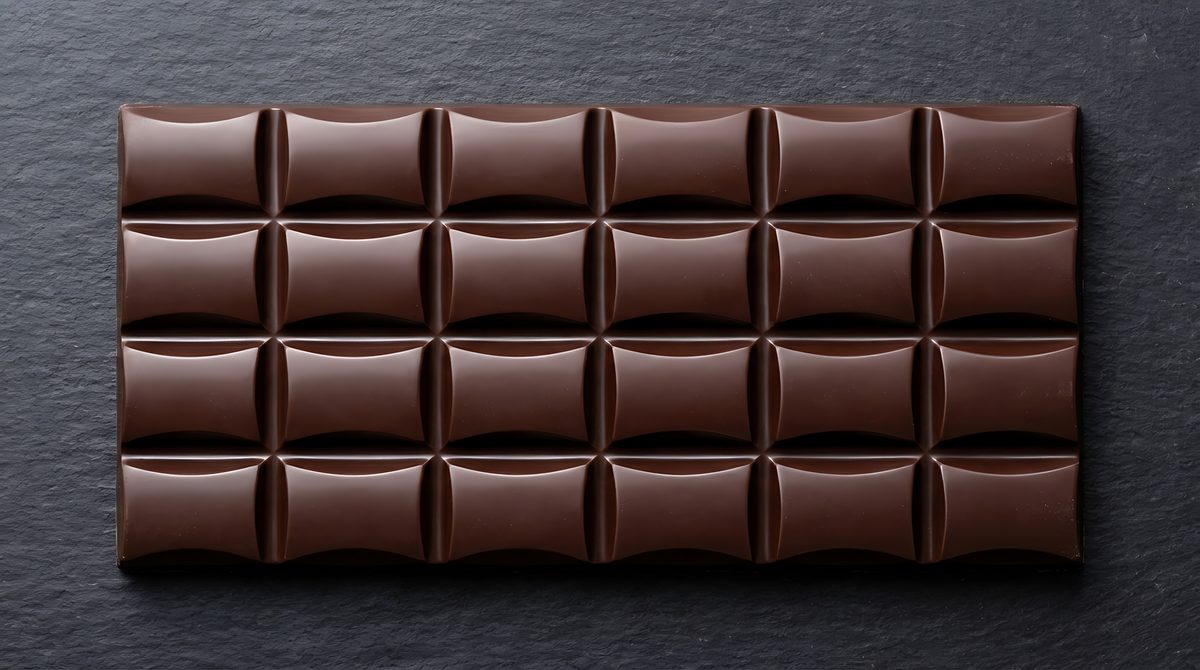
- The weight of a square varies: divide the weight of the bar by its number of squares. On a 100 g bar with 20 squares, 20 g is 4 squares.
Chocolate and diabetes: what the studies say
- A meta-analysis of 14 cohort studies covering more than 508,000 people (Yuan et al., Nutrients, 2017) linked chocolate consumption to a type 2 diabetes risk that was 18% lower in the biggest consumers. The benefit peaked at around two 30 g servings a week (25% lower), and disappeared beyond six servings a week. These studies do not always distinguish dark chocolate from milk chocolate.
- Two small Italian trials (Grassi et al., 2005 and 2008) showed improved insulin sensitivity after 15 days of polyphenol-rich dark chocolate, compared with white chocolate, in 15 healthy people and then 19 hypertensive people with glucose intolerance. But the dose was 100 g a day, a whole bar, for only two weeks and under controlled conditions: this cannot be transposed to everyday life.
A reasonable conclusion: dark chocolate in small amounts is not a problem for diabetes, and it may be associated with a slight benefit. It is not a treatment, and eating a lot of it does no better. For cocoa flavanols and the only health claim authorised in Europe, see our guide how much dark chocolate a day.
Trials in people with diabetes
The studies cited above mostly involve people without diabetes. Here is what the work aimed directly at diabetes or insulin contributes.
- A one-year trial in women with type 2 diabetes (Curtis et al., Diabetes Care, 2012). 93 postmenopausal women, already on treatment, ate either 27 g a day of a chocolate enriched with flavonoids, or a placebo chocolate. The enriched chocolate reduced insulin resistance (HOMA-IR minus 0.3) and LDL cholesterol (minus 0.1 mmol/L). However, there was no effect on HbA1c or blood sugar. Note: this chocolate was enriched with flavanols, 850 mg a day, and with soy isoflavones. It is not a shop-bought bar.
- A meta-analysis of 42 trials (Hooper et al., American Journal of Clinical Nutrition, 2012), covering 1,297 participants followed for 18 weeks at most. Chocolate or cocoa lowered insulin resistance (HOMA-IR minus 0.67) through a drop in blood insulin, and diastolic blood pressure by 1.6 mm Hg. The authors judge the level of evidence low to moderate and call for longer, independent trials.
- A cohort of 92,678 postmenopausal women followed for 13 years (Greenberg et al., European Journal of Clinical Nutrition, 2017). Eating a 28 g serving of chocolate between one and a half times a month and three times a week was associated with a slightly lower diabetes risk, by 7 to 8%. Beyond three times a week, the association disappeared, and it was found only in women under 65 or those who were not very active.
- A review on chocolate and diabetes (Mellor et al., Journal of Agricultural and Food Chemistry, 2015) identified 15 registered trials and 7 published trials. They report little data on weight and blood sugar control, and many use poorly chosen control products.
What this work says together: cocoa compounds may act a little on insulin, but no trial has shown that chocolate improves HbA1c in a person with diabetes. The benefit seen in cohorts is limited to moderate consumption, never daily and abundant. Dark chocolate remains a pleasure that is compatible with diabetes, not a supplement to your treatment.
When to eat it
- At the end of a meal, two squares with a coffee, in place of a sugary dessert: this is the most useful swap.
- As an afternoon snack, with a few almonds or a low-sugar fruit, strawberries or orange.
- Not as mindless snacking in front of a screen, where you lose count of the squares.
Dark chocolate is not suitable for correcting hypoglycaemia: its fat slows the arrival of the sugar. You need a fast sugar, three sugar lumps or a small glass of fruit juice, according to the Fédération Française des Diabétiques.
Pitfalls to avoid
- Filled bars: praline-filled dark chocolate contains 48.8 g of sugars per 100 g according to Ciqual, almost three times as much as plain 70%.
- Chocolates « for people with diabetes »: they are not necessary. A good dark chocolate of 70% or more does just as well, without polyols.
- Chocolate desserts: mousse, fondant and brownie add sugar and flour on top of the chocolate. Keep them for occasions; see our chocolate cake for a reasonable slice.
- Hot chocolate powder: sweetened powders are mostly sugar. Prefer unsweetened cocoa, in milk, without adding sugar.
Cocoa powder and hot chocolate: the figures
Chocolate can also be drunk. Here, the gap between products is even wider than between bars.
| Product | Per | Carbohydrate | of which sugars |
|---|---|---|---|
| Unsweetened cocoa, powder | 100 g | 11.6 g | 0.9 g |
| Sweetened cocoa drink powder | 100 g | 75.6 g | 67.9 g |
| Sweetened instant hot chocolate, made with semi-skimmed milk | a 250 mL bowl, approx. | 24 g | 22 g |
| Sweetened chocolate milk drink, ready to drink | 250 mL, approx. | 27.5 g | 26 g |
| Homemade: 250 mL of semi-skimmed milk and 10 g of unsweetened cocoa | a bowl | 14 g | 12 g, the lactose in the milk |
Breakfast cocoa powders are two-thirds sugar. A homemade bowl with unsweetened cocoa provides almost half the carbohydrate, and only that from the milk. Unsweetened cocoa is also very rich in fibre, 29.5 g per 100 g, or about 3 g in 10 g of powder. If the taste is too bitter, add a pinch of cinnamon or vanilla rather than sugar.
Chocolate desserts, in carbohydrate per serving
For comparison, 20 g of 70% dark chocolate provides 5.4 g of carbohydrate. A serving of chocolate dessert provides around three to four times more, even in a lighter version. The values below come from our recipes, calculated from Ciqual for each ingredient.
- Chocolate flan: 15 g of carbohydrate per serving, with 8.8 g of protein thanks to the milk and eggs.
- Chocolate brownie: 17 g of carbohydrate per serving, from nine servings.
- Avocado chocolate mousse: 18 g of carbohydrate per serving, sweetened with maple syrup.
- Butter-free chocolate fondant: 21 g of carbohydrate per serving, from eight servings.
One of these desserts can replace the fruit in the meal, not be added to it. Keep them for the end of a meal rich in vegetables, and cut the portions before serving.
Special cases
Gestational diabetes
Two squares of dark chocolate remain possible during pregnancy. The caffeine adds to that from coffee and tea: 20 g of dark chocolate provides about 16 mg, against a limit of 200 mg a day according to EFSA. See eating during pregnancy.
Cholesterol
More than half of the saturated fat in dark chocolate is stearic acid, which is neutral on LDL, but it also contains palmitic acid. If your cholesterol is high, stick to 10 to 20 g.
Kidneys
Dark chocolate is rich in potassium, 750 mg per 100 g, and in phosphorus, 280 mg. In kidney failure, the amount should be decided with the nephrologist.
Frequently asked questions
Can someone with diabetes eat chocolate?
Yes, preferably dark chocolate of 70% or more: 20 g provides 5.4 g of carbohydrate. Milk chocolate provides more than double.
How many squares of dark chocolate for someone with diabetes?
Two to four squares, or 10 to 20 g depending on the bar, a day. The limit is calories more than blood sugar.
Does dark chocolate raise blood sugar?
Very little: its measured GI is 23, and 20 g has a glycaemic load of about 1.
Is sugar-free chocolate better for someone with diabetes?
Not necessarily: it replaces sugar with polyols, which are not neutral and can be laxative. A 70% dark chocolate already contains few sugars, 3.6 g per 20 g.
Does dark chocolate lower blood sugar?
No. Short trials with 100 g a day improved insulin sensitivity, but it is not a treatment, and such an amount is not reasonable.
Which cocoa percentage should you choose?
70% at the very least. At 85 or 90%, the sugar drops further; check the sugars on the label.
Is baking chocolate suitable for someone with diabetes?
Less so than 70% eating chocolate: dark baking chocolate contains 41.6 g of sugars per 100 g according to Ciqual, against 17.9 g for 70%. It is fine for cooking, not for snacking.
Does chocolate improve HbA1c?
No. A one-year trial in 93 women with type 2 diabetes, using a chocolate enriched with flavonoids, slightly reduced insulin resistance but did not change HbA1c or blood sugar.
Which hot chocolate for someone with diabetes?
A homemade bowl with milk and unsweetened cocoa: about 14 g of carbohydrate, against 24 g for a sweetened instant chocolate. Avoid cocoa drink powders, which are two-thirds sugar.
The foods and diabetes series
Glycaemic index, glycaemic load and the right portion, food by food: apple and diabetes, pear and diabetes, orange and diabetes, banana and diabetes, grape and diabetes, dates and diabetes, melon and diabetes, strawberry and diabetes, pineapple and diabetes, cheese and diabetes, mango and diabetes, honey and diabetes, lentils and diabetes, potato and diabetes, avocado and diabetes, oats and diabetes, bread and diabetes, kiwi and diabetes, sweet potato and diabetes, rice and diabetes.
Further reading
How much dark chocolate a day, honey and diabetes, maltitol, type 2 diabetes: diet and prevention, dark chocolate nutrition facts.
Our sources
- Atkinson FS, Foster-Powell K, Brand-Miller JC. International Tables of Glycemic Index and Glycemic Load Values: 2008. Diabetes Care, 2008.
- Yuan S et al. Chocolate Consumption and Risk of Coronary Heart Disease, Stroke, and Diabetes: A Meta-Analysis of Prospective Studies. Nutrients, 2017.
- Grassi D et al. Short-term administration of dark chocolate is followed by a significant increase in insulin sensitivity and a decrease in blood pressure in healthy persons. American Journal of Clinical Nutrition, 2005; Grassi D et al., Journal of Nutrition, 2008.
- Ciqual 2025 table (Anses): 70% and 50% dark chocolates, with no added sugars, praline-filled, milk and white.
- Regulation (EU) No 1169/2011: reference intake for saturated fat and mandatory statement for polyols; EFSA, opinion on caffeine, 2015.
- Fédération Française des Diabétiques: treating hypoglycaemia with fast sugar.
- Hooper L, Kay C, Abdelhamid A, Kroon PA, Cohn JS, Rimm EB, Cassidy A. Effects of chocolate, cocoa, and flavan-3-ols on cardiovascular health: a systematic review and meta-analysis of randomized trials. American Journal of Clinical Nutrition, 2012. PMID 22301923.
- Curtis PJ, Sampson M, Potter J, Dhatariya K, Kroon PA, Cassidy A. Chronic ingestion of flavan-3-ols and isoflavones improves insulin sensitivity and lipoprotein status and attenuates estimated 10-year CVD risk in medicated postmenopausal women with type 2 diabetes: a 1-year, double-blind, randomized, controlled trial. Diabetes Care, 2012. PMID 22250063.
- Greenberg JA, Manson JE, Tinker L et al. Chocolate intake and diabetes risk in postmenopausal American women. European Journal of Clinical Nutrition, 2017. PMID 28402326.
- Mellor DD, Sathyapalan T, Kilpatrick ES, Atkin SL. Diabetes and chocolate: friend or foe? Journal of Agricultural and Food Chemistry, 2015. PMID 25775252.
- Ciqual 2025 table (Anses): dark chocolates with fruit, with dried fruit and nuts, baking and mint-filled, milk chocolate with no added sugars, unsweetened cocoa, cocoa powders and drinks, semi-skimmed milk. Site recipes: values per serving calculated from Ciqual.