Kiwi and diabetes: low GI, rich in vitamin C, the numbers
The short answer
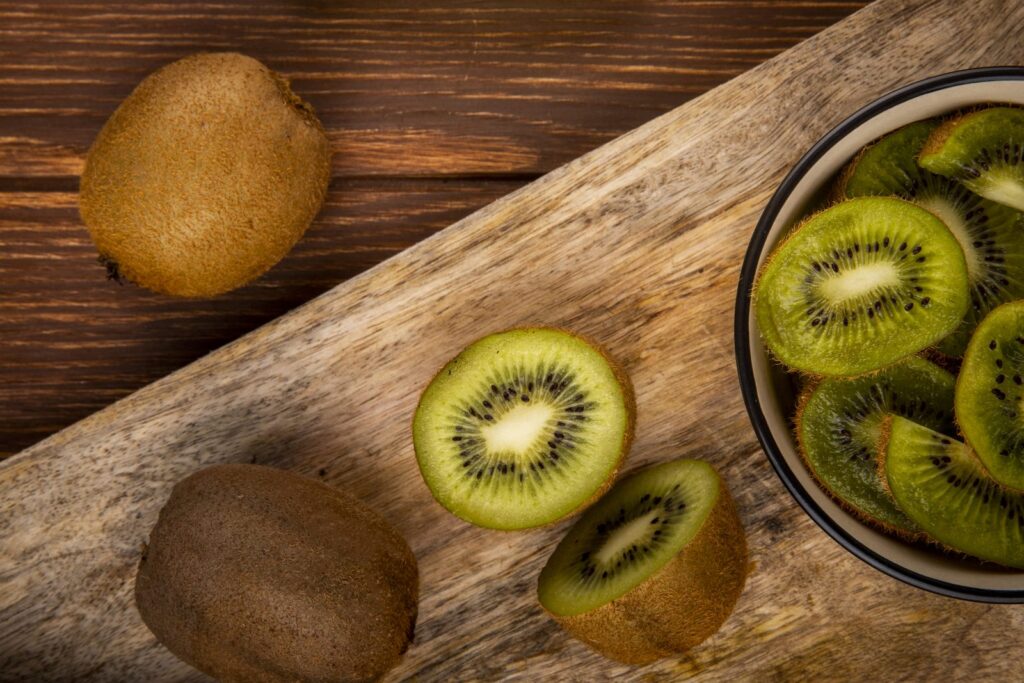
Yes, kiwi fits very well into a diet with diabetes. Its glycaemic index measured in people with diabetes or glucose intolerance is 47, a low GI, and an average 69 g kiwi provides only 7.6 g of carbohydrate. Two kiwis make one portion of fruit, 15 g of carbohydrate, and cover 140% of the day’s vitamin C. Trials even suggest that eating a kiwi with a starchy food, such as bread or cereal, lowers the blood sugar peak of the meal.
This guide gives general guidance. If you are treated with insulin or with a medicine that can cause hypos (low blood sugar), your carbohydrate amount per meal should be set with your doctor or dietitian.
What a kiwi contains
| Per | Calories | Carbohydrate | Fibre | Vitamin C | Potassium |
|---|---|---|---|---|---|
| One average kiwi, 69 g | 42 kcal | 7.6 g | 1.7 g | 57 mg | 200 mg |
| Two kiwis, 138 g | 84 kcal | 15.2 g | 3.3 g | 113 mg | 400 mg |
| 100 g of kiwi | 61 kcal | 11.0 g | 2.4 g | 82 mg | 290 mg |
The Fédération Française des Diabétiques defines a portion of fruit as 15 to 20 g of carbohydrate: two kiwis, or even two large ones, make one portion. A single kiwi provides 71% of the day’s vitamin C, almost as much as an average orange. Its sugars are split between fructose, 4.3 g per 100 g, and glucose, 3.8 g, with very little sucrose.
Glycaemic index and glycaemic load of kiwi
The international glycaemic index tables (Atkinson, Foster-Powell and Brand-Miller, 2008) list:
| Study | Participants | Glycaemic index |
|---|---|---|
| Hayward kiwi, New Zealand | 15 people with type 2 diabetes or glucose intolerance | 47 |
| Kiwi, Australia | 7 people without diabetes | 58 |
| Portion | Carbohydrate | Glycaemic load |
|---|---|---|
| One kiwi, 69 g | 7.6 g | 4 |
| Two kiwis, 138 g | 15.2 g | 7 to 9 |
| Three kiwis, 207 g | 22.8 g | 11 to 13 |
Two kiwis stay at a low load. To understand the concept, see our guide to the glycaemic index.
Is kiwi an ally of bread and cereals?
A New Zealand team studied the effect of kiwi on blood sugar when it is eaten with a starchy food. In a trial of 20 people without diabetes (Mishra et al., Nutrients, 2017), adding kiwi to wheat cereal, with equal carbohydrate, reduced the blood sugar peak compared with the same cereal accompanied by the same amount of sugars. Another study of 12 people (Inoue et al., Nutrients, 2021) found that a yellow kiwi eaten with bread reduced the blood sugar peak by 28% and the area under the curve by 29%, compared with bread alone.
The researchers attribute this effect to the kiwi’s fibre and organic acids, which slow absorption. These trials are small, short, and were carried out in people without diabetes: they do not allow us to claim an effect in people with diabetes. But they point the same way as the general advice to eat fruit during a meal rather than on its own.
What in kiwi slows the blood sugar rise
The same New Zealand team tried to understand where the kiwi’s effect came from. In a 2022 trial (Monro et al., Nutrients), 9 volunteers ate wheat cereal with either the sugars of two kiwis added as sugar, or two whole kiwis as a purée, or only certain parts of the fruit: its low-fibre juice, or its organic acids.
- The whole kiwi pulp almost halved the size of the blood sugar peak and reduced the response at 30 minutes by 50%, compared with the same sugars added.
- Fibre alone and organic acids alone each did about half as well as the whole fruit: the two contribute equally.
- The mechanism is a slowing of absorption in the gut, measured in parallel with a tracer.
Practical consequence: it is the whole fruit that counts. In the trial, low-fibre kiwi juice did half as well as the pulp.
Kiwi at the start of a meal: the rice trial
Another avenue was tested in Chinese adults, whose diet is based on rice (Lubransky et al., Nutrients, 2018). The researchers compared a rice meal eaten all at once, the same meal split into two stages, and a meal where kiwis, eaten first, replaced part of the rice:
- at breakfast, the blood sugar peak was 0.9 mmol/L lower with kiwis as a starter than with rice eaten all at once;
- at lunch, it was 1.1 mmol/L lower with kiwis, and 1.0 mmol/L lower by simply splitting the rice into two stages;
- the amount of insulin secreted was lower with kiwis than with split rice;
- participants did not eat more at the next meal.
These people did not have diabetes, and this is an effect over a single meal. But the idea is easy to apply: start the meal with your two kiwis, in exchange for part of the starchy food, rather than adding them at the end.
How many a day and when
- One to two kiwis a day, among the day’s fruit spread out, as the Fédération Française des Diabétiques advises.
- At breakfast, with a slice of wholemeal bread or a bowl of oats: this is the moment when the effect seen in trials would be most useful. See which bread for people with diabetes and oats and diabetes.
- As a dessert, plain, with a spoon.
Should you limit fruit? A Danish randomised trial (Christensen et al., 2013) in 63 people newly diagnosed with type 2 diabetes found no difference in HbA1c between the group that ate at least two pieces of fruit a day and the one that ate at most two.
Two kiwis a day for weeks: the trials
Single-meal trials do not tell us what happens when you eat kiwis every day. Three studies looked at this:
| Study | Participants | Kiwis | Results |
|---|---|---|---|
| Monro et al., 2022 | 43 healthy Asian adults, randomised | 2 a day before breakfast, 7 weeks | Fasting blood sugar and insulin unchanged; systolic pressure 2.7 mmHg lower; no rise in uric acid or triglycerides despite the extra fructose |
| Wilson et al., 2018 | Adults with prediabetes, no control group | 2 yellow kiwis a day, 12 weeks | Waist 3.1 cm smaller; blood pressure down 6 mmHg systolic and 4 mmHg diastolic; HbA1c and fasting blood sugar almost unchanged |
| Svendsen et al., 2015 | 118 adults with slightly raised blood pressure, randomised | 3 kiwis a day versus 1 apple, 8 weeks | 24-hour pressure 3.6 mmHg lower systolic and 1.9 mmHg lower diastolic than with the apple |
Two lessons. First, eating two kiwis a day did not worsen blood sugar, which is reassuring about their sugars. Second, the most consistent effect concerns blood pressure. A meta-analysis of six randomised trials (Mohammadi et al., 2026) found an average drop of 5.7 mmHg in systolic pressure and 4.1 mmHg in diastolic, more marked in people whose blood pressure was high at the start. The authors urge caution: there are few trials. Blood pressure is the other number to watch with diabetes, for the heart and kidneys: it is a benefit that matters.
Green or yellow kiwi: same effect on blood sugar
Ciqual only gives the green kiwi. But New Zealand researchers directly measured the glycaemic impact of the two commercial varieties, green Hayward and yellow SunGold, in 20 people without diabetes (Monro et al., 2018). Expressed as « glucose equivalent », that is, the grams of glucose that would raise blood sugar as much as 100 g of fruit:
- green kiwi: 6.6 g of glucose equivalent per 100 g;
- yellow kiwi: 6.7 g.
The two are equal. Green kiwi contains 11 g of carbohydrate per 100 g according to Ciqual, but it raises blood sugar like only 6.6 g of glucose: that is the translation of its low GI. The authors conclude that swapping part of a starchy food for kiwi, with equal carbohydrate, strongly increases the vitamin C of the meal at no cost to blood sugar or insulin.
Kiwi versus other fruit
| 100 g of | Carbohydrate | Fibre | Vitamin C | Glycaemic index |
|---|---|---|---|---|
| Banana | 19.7 g | 2.7 g | 7 mg | 48 (people with diabetes) |
| Apple | 11.9 g | 2.4 g | 2 mg | 36 (people with diabetes) |
| Kiwi | 11.0 g | 2.4 g | 82 mg | 47 (people with diabetes) |
| Orange | 8.0 g | 2.7 g | 48 mg | 45 (people with diabetes) |
| Strawberry | 6.0 g | 3.8 g | 54 mg | 40* |
Kiwi is one of the fruits richest in vitamin C for its carbohydrate content. See our guides to oranges and diabetes, strawberries and diabetes and apples and diabetes, and our ranking of foods rich in vitamin C.
Special cases
Digestion
Kiwi has a reputation for easing digestion and bowel movements, and two kiwis provide 3.3 g of fibre. It is a good fruit for constipation.
Anticoagulants
Kiwi contains vitamin K, 16.6 µg per 100 g according to Ciqual. If you take vitamin K antagonists, the key is to keep your intake regular: talk to your doctor.
Allergy
Kiwi is one of the fruits that cause allergies, sometimes cross-reacting with latex. Tingling in the mouth should prompt you to see a doctor.
Gestational diabetes
Rich in vitamin C and low in carbohydrate, kiwi is a good fruit during pregnancy, within the spread of carbohydrate set by your care team. See eating during pregnancy.
Hypo: kiwi is not a sugar fix
Precisely because it slows absorption, kiwi is not suitable for treating a hypo. The Fédération Française des Diabétiques recommends 15 g of fast-acting sugars for this: three sugar lumps or a small 15 cL glass of fruit juice, for example. Kiwi is eaten afterwards, at the next meal or snack. See our guide to honey and diabetes, which explains how to treat a hypo.
3 ideas for eating it
- Two sliced kiwis on plain quark, with a few pumpkin seeds.
- A kiwi and a slice of wholemeal bread with egg at breakfast.
- A fruit salad without syrup: kiwi, strawberries and orange, the three fruits lowest in carbohydrate in our series.
More ideas in our low glycaemic index recipes.
Recipes on the site with kiwi
- Fresh fruit salad with mint: kiwis, mango, strawberries and orange, without syrup; the recipe states 23 g of carbohydrate per portion, which is one fruit portion and a little more.
- Fresh fruit skewers: kiwis, strawberries, melon and grapes, to share for dessert.
- Vanilla chia pudding: the recipe suggests kiwi among the fruits to add, along with the fibre of the chia seeds.
Fruit smoothies are less worthwhile: blended and drunk quickly, fruit is less filling than when you bite into it, and its fibre, which accounts for part of the kiwi’s effect, is broken down.
Frequently asked questions
Can people with diabetes eat kiwis?
Yes: its GI measured in people with diabetes is 47, and a kiwi provides only 7.6 g of carbohydrate.
How many kiwis a day with diabetes?
One to two. Two average kiwis make one portion of fruit, 15 g of carbohydrate.
Does kiwi raise blood sugar?
Little: two kiwis have a low glycaemic load of 7 to 9. Trials even suggest it reduces the blood sugar peak of a meal containing bread or cereal.
Green or yellow kiwi?
Ciqual only gives the green kiwi. The yellow kiwi was used in one of the studies that show a lower blood sugar peak with bread; its composition is not in Ciqual.
Can you eat the skin of a kiwi?
Yes, well washed, it is edible. In the yellow kiwi study, eating the skin did not change the effect on blood sugar.
Kiwi or orange for vitamin C?
Kiwi: 82 mg per 100 g against 48 mg for orange, with a comparable glycaemic load.
Should you eat kiwi before or after the meal?
Preferably at the start. In a trial in Chinese adults, kiwis eaten first, in place of part of the rice, lowered the blood sugar peak by 0.9 to 1.1 mmol/L compared with rice eaten all at once.
Does kiwi lower blood pressure?
Several trials suggest so: a meta-analysis of six trials finds an average drop of 5.7 mmHg in systolic pressure. The effect is clearer in people with high blood pressure. It does not replace treatment.
Is the fructose in kiwi a problem?
Not at a normal dose: two kiwis a day for seven weeks did not raise uric acid or triglycerides, and did not change fasting blood sugar.
Does kiwi juice have the same effect?
No: in the 2022 trial, a low-fibre juice reduced the blood sugar peak half as much as the whole fruit. Eat the whole kiwi.
The foods and diabetes series
Glycaemic index, glycaemic load and the right portion, food by food: apples and diabetes, pears and diabetes, oranges and diabetes, bananas and diabetes, grapes and diabetes, dates and diabetes, melon and diabetes, strawberries and diabetes, pineapple and diabetes, cheese and diabetes, mango and diabetes, honey and diabetes, dark chocolate and diabetes, lentils and diabetes, potatoes and diabetes, avocado and diabetes, oats and diabetes, bread and diabetes, sweet potatoes and diabetes, rice and diabetes.
Further reading
Oranges and diabetes, strawberries and diabetes, which bread for people with diabetes, glycaemic index, nutrition facts for kiwi.
Our sources
- Atkinson FS, Foster-Powell K, Brand-Miller JC. International Tables of Glycemic Index and Glycemic Load Values: 2008. Diabetes Care, 2008.
- Mishra S et al. Kiwifruit Non-Sugar Components Reduce Glycaemic Response to Co-Ingested Cereal in Humans. Nutrients, 2017.
- Inoue Y et al. The Effects of Gold Kiwifruit Intake Timing with or without Pericarp on Postprandial Blood Glucose Level. Nutrients, 2021.
- Christensen AS et al. Effect of fruit restriction on glycemic control in patients with type 2 diabetes, a randomized trial. Nutrition Journal, 2013.
- Fédération Française des Diabétiques: fruit portion, spread across the day.
- Table Ciqual 2025 (Anses): kiwi and raw fruit; USDA FoodData Central, SR Legacy: weight of a kiwi; Regulation (EU) No 1169/2011: reference intake for vitamin C.
- Monro J, Mishra S, Stoklosinski H et al. Dietary Fibre and Organic Acids in Kiwifruit Suppress Glycaemic Response Equally by Delaying Absorption. Nutrients, 2022. PMID 35956366.
- Lubransky A, Monro J, Mishra S et al. Postprandial Glycaemic, Hormonal and Satiety Responses to Rice and Kiwifruit Preloads in Chinese Adults: A Randomised Controlled Crossover Trial. Nutrients, 2018. PMID 30126094.
- Monro J, Lubransky A, Mishra S, Haszard J, Venn B. Metabolic and Blood Pressure Effects of Consuming Two Kiwifruit Daily for 7 Weeks: A Randomised Controlled Trial. Nutrients, 2022. PMID 35807858.
- Wilson R et al. SunGold Kiwifruit Supplementation of Individuals with Prediabetes Alters Gut Microbiota and Improves Vitamin C Status, Anthropometric and Clinical Markers. Nutrients, 2018. PMID 30002355.
- Svendsen M et al. The effect of kiwifruit consumption on blood pressure in subjects with moderately elevated blood pressure: a randomized, controlled study. Blood Pressure, 2015. PMID 25483553.
- Mohammadi SG et al. Effects of Kiwifruit Consumption on Blood Pressure in Adults: A Systematic Review and Meta-Analysis. Health Science Reports, 2026. PMID 42657351.
- Monro J, Bentley-Hewitt K, Mishra S. Kiwifruit Exchanges for Increased Nutrient Richness with Little Effect on Carbohydrate Intake, Glycaemic Impact, or Insulin Response. Nutrients, 2018. PMID 30413045.
- Fédération Française des Diabétiques: treating hypos (resucrage).