Apples and diabetes: one of the best fruits, the numbers
The short answer
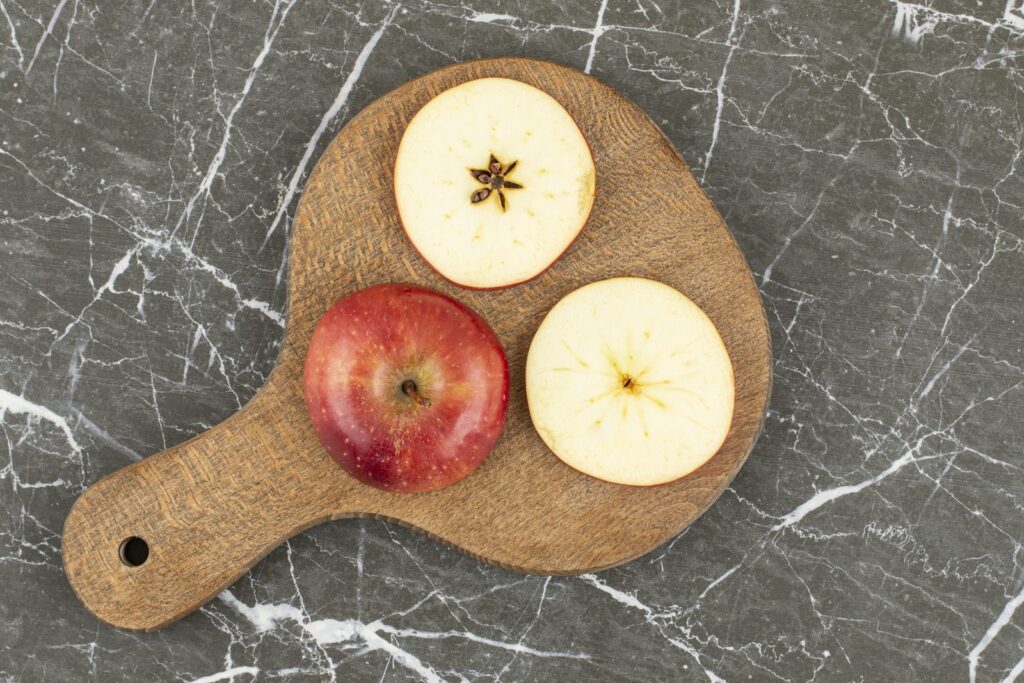
Yes, the apple is one of the fruits best suited to diabetes. In people with type 2 diabetes, its average glycaemic index is 36 (average of five studies), one of the lowest among common fruits. A medium apple of about 180 g provides 21 g of carbohydrate and a glycaemic load of about 8, which is low. The whole apple can be eaten without worry, once or twice a day among your other fruit. It is as juice, sweetened apple sauce or dried apple that it becomes a problem.
This guide gives general benchmarks. If you are treated with insulin or with a medicine that can cause hypoglycaemia (a « hypo »), your carbohydrate amount per meal should be set with your doctor or dietitian.
What an apple contains
| For | Calories | Carbohydrate | of which fructose | of which glucose | of which sucrose | Fibre |
|---|---|---|---|---|---|---|
| 100 g of apple | 51 kcal | 11.9 g | 6.7 g | 1.5 g | 3.2 g | 2.4 g |
| A small apple, 150 g | 77 kcal | 17.9 g | 10.1 g | 2.2 g | 4.8 g | 3.6 g |
| A medium apple, 180 g | 92 kcal | 21.4 g | 12.1 g | 2.6 g | 5.7 g | 4.3 g |
The Fédération Française des Diabétiques (the French diabetes federation) defines a portion of fruit as 15 to 20 g of carbohydrate, which fits in the palm of the hand. A small 150 g apple, with 17.9 g of carbohydrate, is exactly one portion; a medium apple only just exceeds it.
Why the glycaemic index of the apple is so low
Two reasons, both measurable:
- Its sugars are mostly fructose. According to Ciqual, of the 11.4 g of sugars per 100 g, 6.7 g is fructose, or 59%, and only 1.5 g is glucose. Fructose has a glycaemic index of 15 in the international tables, against 103 for glucose: it goes through the liver before reaching the blood and raises blood sugar very little.
- Its fibre and its structure: biting into a whole apple takes time, and the fibre, including pectin, slows the digestion of the sugars.
The international glycaemic index tables (Atkinson, Foster-Powell and Brand-Miller, 2008) list five measurements in people with type 2 diabetes, for a 120 g portion:
| Study | Glycaemic index | Glycaemic load (120 g) |
|---|---|---|
| Denmark, 8 people | 28 | 4 |
| New Zealand, Braeburn, 15 people | 32 | 4 |
| Canada | 34 | 5 |
| United States, 7 people | 40 | 6 |
| Italy, 7 people | 44 | 6 |
| Average of the 5 studies | 36 | 5 |
Even the highest measurement, 44, is still a low GI. In people without diabetes, a Canadian study on the Golden found 39. Variety and ripeness play a small part, but the apple remains a low-GI fruit in every case. For the concept itself, see our guide to the glycaemic index.
Work out the glycaemic load of your apple
The glycaemic load is the glycaemic index multiplied by the carbohydrate in the portion, divided by 100. With the average GI of 36, and in brackets the range between the lowest measurement (28) and the highest (44):
| Portion | Carbohydrate | Glycaemic load |
|---|---|---|
| 100 g | 11.9 g | 4 (3 to 5) |
| A small apple, 150 g | 17.9 g | 6 (5 to 8) |
| A medium apple, 180 g | 21.4 g | 8 (6 to 9) |
| A large apple, 220 g | 26.2 g | 9 (7 to 12) |
Even a large apple stays below the threshold of a moderate glycaemic load in most cases. For comparison, a medium banana has a load of about 11: see our guide to bananas and diabetes.
Juice, apple sauce, baked apple, dried apple: what changes
The whole apple and its derivatives do not have the same effect at all:
| Product | Carbohydrate per 100 g | Usual portion | Carbohydrate in the portion | What to know |
|---|---|---|---|---|
| Raw apple | 11.9 g | one apple, 180 g | 21 g | GI 36, fibre intact |
| Baked apple | 12.9 g | one apple, 180 g | 23 g | softened structure, less fibre according to Ciqual |
| Apple purée with no added sugar | 11.6 g | one 100 g pot | 12 g | a good option for dessert |
| Standard apple sauce | 22.4 g | one 100 g pot | 22 g | twice as much carbohydrate: added sugar |
| Apple juice, pure juice | 11.4 g | a 25 cl glass | about 28 g | GI 41, load 12, no fibre |
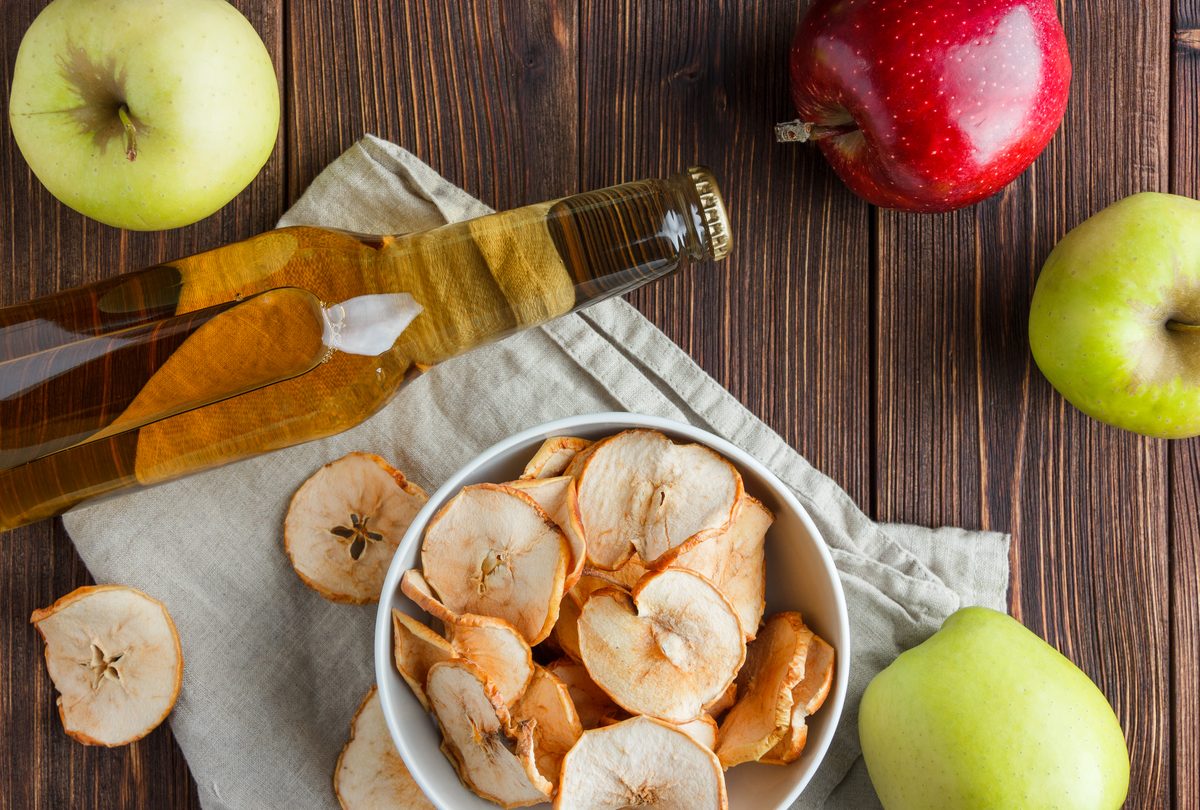
| Dried apple | 55 g | a 30 g handful | 16.5 g | very concentrated, portion quickly exceeded |
The juice deserves a special mention. Its glycaemic index measured in people with diabetes, 41, is still low, thanks to the fructose. But a glass provides a little more carbohydrate than a medium apple, without the fibre or the chewing time, and it does not fill you up. The Fédération Française des Diabétiques recommends avoiding juice. In a large cohort study (Muraki et al., 2013), fruit juice was associated with a higher risk of type 2 diabetes, whereas apples and pears were associated with a lower risk.
There is one exception, and it is an important one: in the case of hypoglycaemia, a small 15 cl fruit juice is one of the fast-acting options recommended by the Fédération Française des Diabétiques to bring blood sugar back up, along with three sugar lumps. It is precisely because it is absorbed quickly.
Apple, purée or juice: the classic experiment
An experiment published in The Lancet (Haber et al., 1977) showed, as early as the 1970s, why the whole apple and the juice do not have the same effect. Ten healthy adults were given three meals each providing 60 g of carbohydrate: whole apples, apple purée, or apple juice without fibre.
- Speed: the juice was drunk eleven times faster than the apples were eaten, and four times faster than the purée.
- Fullness: at equal speed, the juice filled people up less than the purée, and the purée less than the whole apples.
- Blood glucose: it rose to the same level after all three meals. But after the juice, and to a lesser extent after the purée, it then fell sharply, as a rebound effect, which did not happen with the whole apples.
- Insulin rose higher after the juice and the purée than after the apples.
Removing the fibre, or simply breaking it up, therefore changes how the body handles the same sugar. This study, carried out in people without diabetes, explains the advice of the Fédération Française des Diabétiques: an apple is for biting into, not for drinking.
Golden, Granny Smith, Pink Lady: which variety?
| 100 g of apple, without skin | Carbohydrate | Sugars | Fibre |
|---|---|---|---|
| Chantecler | 11.2 g | 10.8 g | 1.9 g |
| Granny Smith | 11.4 g | 10.6 g | 2.6 g |
| Canada | 11.6 g | 11.0 g | 1.6 g |
| Golden | 11.7 g | 11.3 g | 2.5 g |
| Gala | 11.9 g | 11.1 g | 1.9 g |
| Pink Lady | 12.8 g | 12.3 g | 2.9 g |
The gap between the least sweet and the sweetest variety is 1.6 g per 100 g, which is less than 3 g for a medium apple: choose the one you like. The Granny Smith is not much less sweet than the Golden. What matters far more is the size of the apple and the form in which you eat it.
How much a day and when
The Fédération Française des Diabétiques does not set a number of apples. It advises spreading fruit through the day, for example one in the morning, one as a lunchtime dessert and one as an afternoon snack. One to two apples a day fit in among that fruit.
Should you limit fruit? A Danish randomised trial (Christensen et al., 2013) in 63 people newly diagnosed with type 2 diabetes compared the advice to eat at least two pieces of fruit a day with the advice to eat at most two, for 12 weeks: HbA1c fell in both groups, with no difference. Restricting fruit achieved nothing.
The best times
- As a dessert, at the end of a meal that contains vegetables and protein.
- As an afternoon snack, with a few almonds, a walnut or a piece of cheese.
- At breakfast, grated into a bowl of porridge.
On its own, as a snack, an apple is still a good choice thanks to its low GI: it is one of the few fruits for which the question of timing matters little.
Apple or another fruit
| 100 g of | Carbohydrate | Glycaemic index | Glycaemic load |
|---|---|---|---|
| Banana | 19.7 g | 48 (9 studies) | 9.5 |
| Grapes | 16.3 g | 43 to 49 (2 studies) | 7 to 8 |
| Mango | 14.3 g | 41 (1 study) | 5.9 |
| Pear | 12.3 g | 38 (4 studies) | 4.7 |
| Apple | 11.9 g | 36 (5 studies) | 4.3 |
| Kiwi | 11 g | 47 (1 study) | 5.2 |
| Orange | 8.0 g | 45 (5 studies) | 3.6 |
The apple has the lowest glycaemic index measured in people with diabetes among these fruits, and a glycaemic load half that of the banana weight for weight. Only the orange does better on load, because it contains less carbohydrate. Our ranking of the lowest-sugar fruits gives the full list.
On the prevention side, in the Muraki study of more than 187,000 people followed for up to 24 years, every three portions of apples or pears a week were associated with a 7% lower risk of type 2 diabetes. Only blueberries and grapes did clearly better. An observational study does not prove causation, but it gives no reason to deny yourself apples.
Special cases
Gestational diabetes
The whole apple is one of the simplest fruits to fit into the spread of meals and snacks proposed by the team following the pregnancy, thanks to its low GI. Avoid juice, however. See our guide to eating during pregnancy.
Prediabetes
Whole fruit has its full place. Replacing a morning juice with a whole apple is one of the simplest swaps. The general benchmarks are in our guide type 2 diabetes: diet and prevention.
Sport
Before a session, an apple provides slow-release carbohydrate. During a long effort, however, its carbohydrate arrives too slowly: a banana or a sports drink suits better. See what to eat before and after exercise.
Irritable bowel
The apple is rich in fructose and sorbitol, two FODMAPs. If you have a sensitive gut, it can cause bloating and discomfort: see our FODMAP diet guide.
3 ideas for eating it
- Apple and cinnamon overnight oats: a breakfast prepared the night before, with the fibre of the oats.
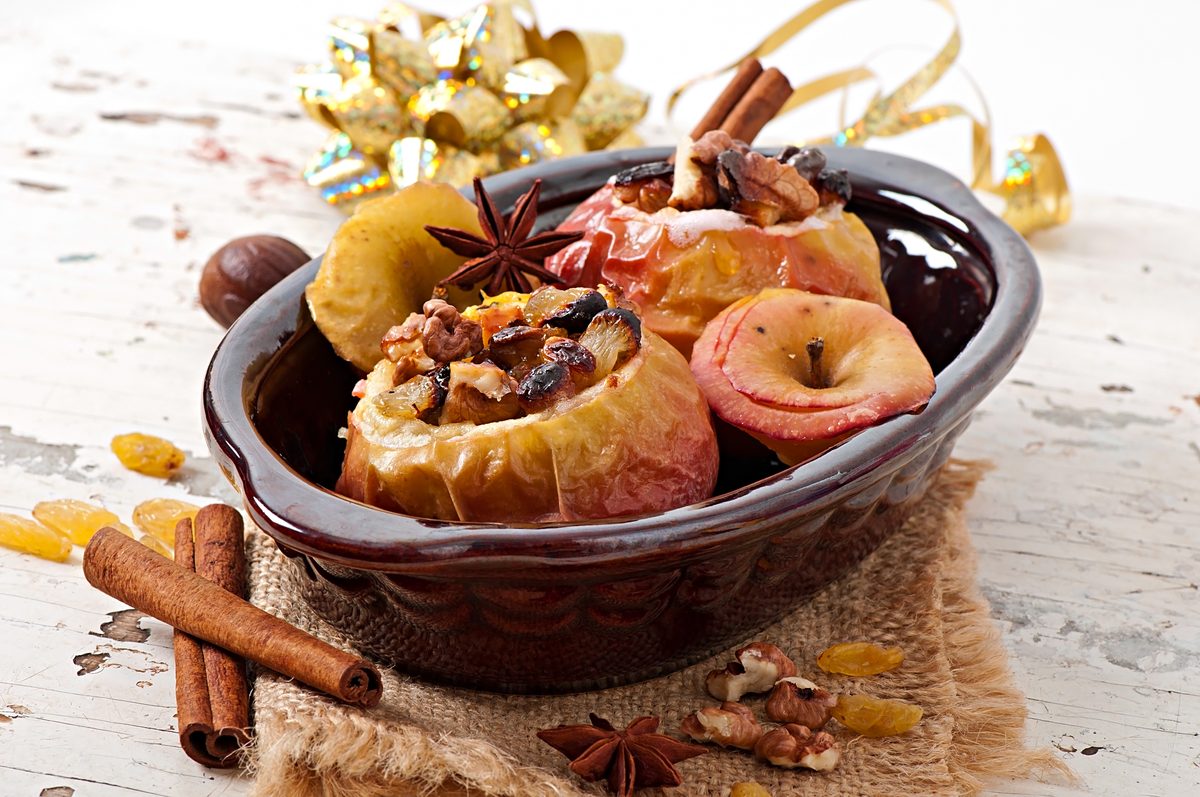
- Cinnamon baked apples: a warm dessert with no added sugar, to keep as an end-of-meal dessert.
- Homemade stewed apple: with no added sugar, it stays close to the raw fruit in carbohydrate, unlike the standard shop-bought apple sauce.
More ideas in our low glycaemic index recipes.
Our apple recipes, in carbohydrate per serving
These values are calculated from Ciqual for each ingredient in our recipes. They hold a few surprises.
- Kale, apple and walnut salad: 15 g of carbohydrate per serving, half an apple per person, as a starter.
- Cinnamon baked apples: 20.5 g of carbohydrate per apple, with walnuts. One portion of fruit, no more.
- Homemade stewed apple: 27 g of carbohydrate per bowl, because a bowl contains one and a half apples. Serve two thirds of it to stay at one portion.
- Apple tart and light apple tart: 27 and 31 g of carbohydrate per slice. The « light » version contains more, with 200 g of flour and two spoonfuls of brown sugar: light in fat does not mean light in carbohydrate.
- Apple and porridge oat crumble: 34 g of carbohydrate per serving, with 6.7 g of fibre.
- Apple and cinnamon overnight oats: 63 g of carbohydrate per bowl, with 19 g of protein and 9 g of fibre. It is a complete breakfast, replacing the morning bread and fruit; depending on your carbohydrate benchmark, half a bowl may be enough.
Frequently asked questions
Can someone with diabetes eat apples?
Yes, and it is one of the best fruits for them: average GI of 36 in people with type 2 diabetes, glycaemic load of about 8 for a medium apple.
How many apples a day with diabetes?
One to two, among the day’s fruit, spread over different times. A small 150 g apple makes a portion of fruit of 15 to 20 g of carbohydrate.
What is the glycaemic index of the apple?
36 on average in five studies in people with type 2 diabetes, ranging from 28 to 44. It is a low GI, due to the fructose, which makes up nearly 60% of its sugars.
Is apple sauce suitable for diabetes?
Apple purée with no added sugar, yes: 11.6 g of carbohydrate per 100 g, like the fruit. Standard apple sauce contains 22.4 g, double.
Does apple juice raise blood sugar?
A 25 cl glass provides about 28 g of carbohydrate, without fibre, with a glycaemic load of 12. The whole apple is better, except to correct hypoglycaemia.
Apple or banana with diabetes?
The apple has a lower GI, 36 against 48, and half the carbohydrate weight for weight. Both have their place; the apple is simply easier to fit in at any time.
Is the Granny Smith better with diabetes?
Barely: 11.4 g of carbohydrate per 100 g, against 11.7 g for the Golden and 12.8 g for the Pink Lady according to Ciqual. The size of the apple matters far more than the variety.
Why does apple juice fill you up less than an apple?
Because it no longer has fibre and is drunk very quickly. In a classic study, the juice was drunk eleven times faster than the apples were eaten, filled people up less, and blood glucose then fell sharply as a rebound effect.
The foods and diabetes series
Glycaemic index, glycaemic load and the right portion, food by food: pears and diabetes, oranges and diabetes, bananas and diabetes, grapes and diabetes, dates and diabetes, melon and diabetes, strawberries and diabetes, pineapple and diabetes, cheese and diabetes, mango and diabetes, honey and diabetes, dark chocolate and diabetes, lentils and diabetes, potatoes and diabetes, avocado and diabetes, porridge oats and diabetes, bread and diabetes, kiwi and diabetes, sweet potatoes and diabetes, rice and diabetes.
Going further
Bananas and diabetes, type 2 diabetes: diet and prevention, glycaemic index, lowest-sugar fruits, nutrition facts for the apple.
Our sources
- Atkinson FS, Foster-Powell K, Brand-Miller JC. International Tables of Glycemic Index and Glycemic Load Values: 2008. Diabetes Care, 2008.
- Christensen AS et al. Effect of fruit restriction on glycemic control in patients with type 2 diabetes, a randomized trial. Nutrition Journal, 2013.
- Muraki I et al. Fruit consumption and risk of type 2 diabetes: results from three prospective longitudinal cohort studies. BMJ, 2013.
- Fédération Française des Diabétiques: fruit portion and spreading through the day; fast-acting carbohydrate for hypoglycaemia.
- Ciqual 2025 table (Anses): raw apple, baked, dried, apple sauce, purée with no added sugar, apple juice; USDA FoodData Central, SR Legacy: apple weights.
- Haber GB, Heaton KW, Murphy D, Burroughs LF. Depletion and disruption of dietary fibre. Effects on satiety, plasma-glucose, and serum-insulin. Lancet, 1977. PMID 71495.
- Ciqual 2025 table (Anses): Chantecler, Granny Smith, Canada, Golden, Gala and Pink Lady apples. Site recipes: values per serving calculated from Ciqual.