Mango and diabetes: a third of a fruit, GI and portion
The short answer
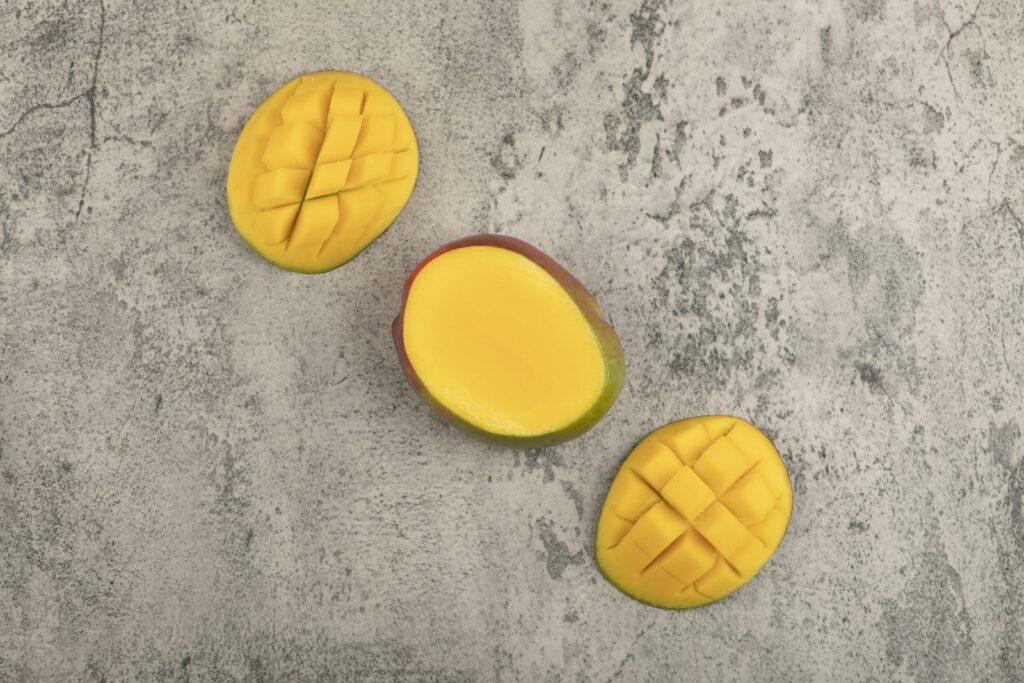
Yes, a person with diabetes can eat mango, as long as they stick to a third of a fruit. Its glycaemic index is low to moderate: 41 in the only measurement made in people with type 2 diabetes, and 51 to 60 in people without diabetes. But it is sweet, with 14.3 g of carbohydrate per 100 g, and a whole mango weighs about 340 g of flesh. The right portion: about 120 g, a third of a mango, which is one portion of fruit at 15 to 20 g of carbohydrate. Nectar and dried mango are much more concentrated.
This guide gives general guidelines. If you are treated with insulin or with a medicine that can cause hypoglycaemia, your carbohydrate amount per meal should be set with your doctor or dietitian.
What a mango contains
| Per | Calories | Carbohydrate | Fibre | Vitamin C | Beta-carotene |
|---|---|---|---|---|---|
| 100 g of mango | 71 kcal | 14.3 g | 1.6 g | 25 mg | 864 µg |
| A third of a mango, 120 g | 85 kcal | 17.2 g | 1.9 g | 30 mg | 1,037 µg |
| Half a mango, 168 g | 119 kcal | 24.0 g | 2.7 g | 42 mg | 1,452 µg |
| A whole mango, 336 g | 239 kcal | 48.0 g | 5.4 g | 84 mg | 2,903 µg |
The Fédération Française des Diabétiques defines a portion of fruit as 15 to 20 g of carbohydrate. In mango, that is 105 to 140 g of flesh, or a third of a medium fruit, or the equivalent of a slightly less than full bowl of diced pieces. Half a mango is already one and a half portions, and a whole mango, eaten in one go, nearly three.
Not all mangoes are equal: the José mango from La Réunion contains 19.3 g of carbohydrate per 100 g according to Ciqual, a third more than the average. The riper and more fragrant the mango, the sweeter it is.
Green, julie, José, moussache: from 12 to 21 g of carbohydrate
Ciqual analysed several varieties sampled in the French Antilles and La Réunion. The gap is wide, and it changes the size of the right portion:
| Mango | Carbohydrate per 100 g | Fibre | Portion for 15 to 20 g of carbohydrate |
|---|---|---|---|
| Green mango, Martinique | 12.2 g | 3.4 g | 125 to 165 g |
| Mango, average food | 14.3 g | 1.6 g | 105 to 140 g |
| Julie mango, Martinique | 18.3 g | 2.8 g | 80 to 110 g |
| José mango, La Réunion | 19.3 g | 1.8 g | 80 to 105 g |
| Moussache mango, Martinique | 20.9 g | 2.0 g | 70 to 95 g |
Green mango contains 40% less carbohydrate than moussache and twice as much fibre as the average mango. Conversely, the julie, José and moussache varieties are clearly sweeter than average: if you eat them often, reduce the portion by about a quarter.
Glycaemic index and glycaemic load of mango
The international glycaemic index tables (Atkinson, Foster-Powell and Brand-Miller, 2008) list three measurements:
| Study | People | Glycaemic index |
|---|---|---|
| Philippines | 10 people with type 2 diabetes | 41 |
| Australia | 7 people without diabetes | 51 |
| India, ripe mango | 12 to 15 people without diabetes | 60 |
The gap between 41 and 60 comes down to ripeness and variety: a very ripe mango has turned its starch into sugars. The sugars in mango are mostly sucrose, 8.5 g per 100 g, with little free glucose. For the concept of GI, see our guide to the glycaemic index.
Work out the glycaemic load of your portion
| Portion | Carbohydrate | Glycaemic load |
|---|---|---|
| 100 g | 14.3 g | 6 to 9 |
| A third of a mango, 120 g | 17.2 g | 7 to 10 |
| Half a mango, 168 g | 24.0 g | 10 to 14 |
| A whole mango, 336 g | 48.0 g | 20 to 29 |
A third of a mango stays at a low load. A whole mango reaches a high load, the equivalent of several fruits at once.
Fresh, as nectar, dried: what changes
| Product | Carbohydrate per 100 g | Portion | Carbohydrate in the portion |
|---|---|---|---|
| Fresh mango | 14.3 g | a third of a mango, 120 g | 17 g |
| Fresh mango juice | 9.5 g | a 25 cL glass | about 24 g |
| Mango nectar | 11.3 g | a 25 cL glass | about 28 g |
- Mango nectar often contains added sugar and almost no fibre, 0.16 g per 100 g: a glass provides more than a third of a mango. The Fédération Française des Diabétiques recommends avoiding juices and nectars, except to treat hypoglycaemia.
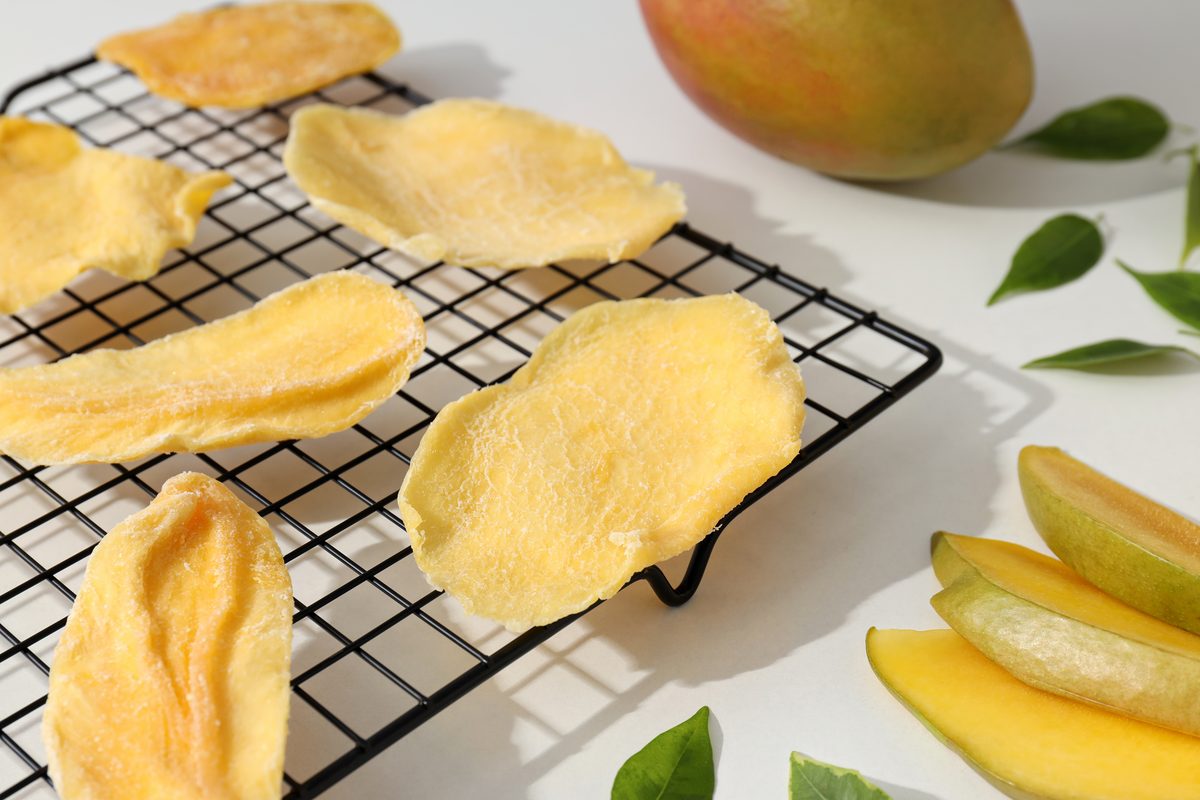
- Dried mango concentrates the sugars by removing the water, and it is often sweetened as well. Ciqual does not list it; read the label and count it as a dried fruit, in a small amount. See dates and diabetes for the case of dried fruit.
- Mango lassi and smoothies often add sugar. A smoothie is drunk quickly and fills you up less than the fruit.
What mango provides
Mango has real nutritional strengths: a third of a fruit provides 30 mg of vitamin C, 38% of the reference intake, and more than 1,000 µg of beta-carotene, the precursor of vitamin A. It is, however, low in fibre, 1.6 g per 100 g, half as much as pear, which explains why it fills you up little for its calories. For other sources of vitamin C, see our ranking of foods rich in vitamin C.
What the trials on mango say
Mango was long discouraged for people with diabetes. Several recent trials have tested it directly:
| Trial | People | What was tested | Results |
|---|---|---|---|
| Kehar et al., 2025, India | 35 people with type 2 diabetes | 250 g of mango a day in place of bread at breakfast, 8 weeks, in a calorie-controlled diet | Compared with bread: fasting blood sugar lower by 27 to 36 mg/dL, HbA1c lower by 0.5 to 0.9 points, weight lower by 2.1 to 2.4 kg |
| Kehar et al., 2025, India | 95 people, including 45 with type 2 diabetes | Three mango varieties against white bread and glucose, then 3 days of glucose sensor | In people with diabetes, a response comparable to bread; smaller blood sugar swings on the sensor |
| Basiri et al., 2025, United States | 23 adults with prediabetes | About 300 g of mango a day against a cereal bar with the same calories, 24 weeks | Lower fasting blood sugar and better insulin sensitivity; HbA1c stable with mango, rising with the bar |
| Pinneo et al., 2022, United States | 23 overweight adults | 100 kcal of mango against 100 kcal of low-fat biscuits | Smaller rise in blood sugar and insulin, better satiety with mango |
These results are encouraging, but look closely at what was compared. In all these trials, the mango replaced another carbohydrate food, bread, a cereal bar or biscuits, and in the Indian trial in people with diabetes, it was within a calorie-controlled diet. The 250 g of mango in that trial provides about 36 g of carbohydrate: it took the place of the bread, it was not added to it. The numbers are also very small, 10 to 15 people per group in the eight-week trial.
What you can take from it: eating fresh mango instead of white bread or a biscuit does not worsen blood sugar, and may even improve it. Eating a whole mango on top of your usual breakfast is another matter.
Fresh mango or dried mango: the trial
One trial compared three 100 kcal snacks in 34 healthy adults: fresh mango, dried mango and white bread (Stamper et al., 2023). Results:
- fresh mango gave the steadiest blood sugar and the fastest drop after the peak, with less desire to eat afterwards;
- dried mango did less well than fresh, but better than white bread;
- 100 kcal of fresh mango is about 140 g of flesh according to Ciqual.
Dried mango is therefore not forbidden, but fresh mango remains the best choice, for blood sugar and for satiety alike.
How much a day and when
The Fédération Française des Diabétiques advises spreading fruit through the day. A mango can therefore be shared into three portions, over a day or between three people.
- For dessert, after a meal with vegetables and protein.
- With dairy: diced mango in plain yoghurt or fromage frais.
- In savoury cooking: a few diced pieces in a prawn or chicken salad, a homemade chutney with no added sugar, a curry.
Should you limit fruit? A Danish randomised trial (Christensen et al., 2013) in 63 people newly diagnosed with type 2 diabetes found no difference in HbA1c between the group that ate at least two fruits a day and the one that ate at most two. It is the portion that counts.
Mango or another fruit
| 100 g of | Carbohydrate | Fibre | Glycaemic index | Glycaemic load |
|---|---|---|---|---|
| Banana | 19.7 g | 2.7 g | 48 (people with diabetes) | 9.5 |
| Charentais melon | 14.8 g | 1.3 g | 65 to 70* | 10 |
| Mango | 14.3 g | 1.6 g | 41 (people with diabetes) | 5.9 |
| Pineapple | 11.7 g | 1.2 g | 51 (people with diabetes) | 6.0 |
| Apple | 11.9 g | 2.4 g | 36 (people with diabetes) | 4.3 |
| Strawberry | 6.0 g | 3.8 g | 40* | 2.4 |
Among exotic fruits, mango and pineapple are on a par weight for weight; banana is heavier. See our guides pineapple and diabetes, banana and diabetes and apple and diabetes.
Special cases
Gestational diabetes
Mango is not forbidden during pregnancy. Keep it to small portions, with dairy, within the spacing of meals set by the care team. See eating during pregnancy.
Allergy
Mango skin contains substances close to those in poison ivy, which can irritate the mouth of sensitive people. Peel it thoroughly before eating it.
Prediabetes
Fresh mango has its place, in a portion. Replacing nectars and smoothies with the fruit is the swap that counts. See type 2 diabetes: diet and prevention.
3 ideas for eating it
- Diced mango in plain fromage frais, with a little lime.
- A prawn, mango and avocado salad: a third of a mango for two people is enough to flavour the dish.
- A mango, tomato, red onion and coriander salsa to go with grilled fish.
More ideas in our low glycaemic index recipes.
The site’s mango recipes, with figures
- Chicken, mango and avocado salad: 29 g of carbohydrate per serving according to the recipe, with 34 g of protein, a complete dish.
- Mango chia pudding: 32 g of carbohydrate per serving; you can leave out the maple syrup in the recipe, the mango sweetens enough.
- Fresh fruit salad with mint: mango, kiwis, strawberries and orange, 23 g of carbohydrate per serving.
Smoothies are clearly heavier: 43 g of carbohydrate per serving for the mango and passion fruit smoothie, 56 g for the mango smoothie bowl, each of which adds a banana. Keep them for occasions, or share them.

Frequently asked questions
Can someone with diabetes eat mango?
Yes, in a portion: about 120 g, a third of a mango, for 17 g of carbohydrate. Its GI measured in people with diabetes is 41.
How much mango a day for someone with diabetes?
A third of a mango, or 105 to 140 g of flesh, is one portion of fruit. A whole mango provides 48 g of carbohydrate.
Does mango raise blood sugar?
Moderately in a small portion, with a glycaemic load of 7 to 10 for 120 g. A whole mango has a high load, of 20 to 29.
Is mango sweeter than banana?
No: 14.3 g of carbohydrate per 100 g, against 19.7 g for banana. But people often eat more mango in one go.
Is mango nectar not recommended?
Not every day: about 28 g of carbohydrate per 25 cL glass, often with added sugar, and almost no fibre.
Green mango or ripe mango?
A less ripe mango is a little less sweet: the GI varies from 41 to 60 depending on the study. Choose it firm rather than very soft.
Studies say you can eat a mango a day: is that true?
In the trials, 250 to 300 g of mango a day gave good results, but in place of another carbohydrate food, bread or a cereal bar, and sometimes in a calorie-controlled diet. On top of your usual meals, stick to a third of a mango.
Should you avoid dried mango?
It raises blood sugar more than fresh mango at equal calories, but less than white bread in one trial. Ciqual does not list it: read the label, and keep it to a very small amount.
Which mango variety should you choose?
According to Ciqual, green mango contains 12.2 g of carbohydrate per 100 g, the average mango 14.3 g and moussache 20.9 g. The sweeter the mango, the smaller the portion should be.
Mango or biscuit as a snack?
Mango: at an equal 100 kcal, it raised blood sugar and insulin less than low-fat biscuits, and filled people up better.
The foods and diabetes series
Glycaemic index, glycaemic load and the right portion, food by food: apple and diabetes, pear and diabetes, orange and diabetes, banana and diabetes, grape and diabetes, dates and diabetes, melon and diabetes, strawberry and diabetes, pineapple and diabetes, cheese and diabetes, honey and diabetes, dark chocolate and diabetes, lentils and diabetes, potato and diabetes, avocado and diabetes, oats and diabetes, bread and diabetes, kiwi and diabetes, sweet potato and diabetes, rice and diabetes.
Further reading
Pineapple and diabetes, banana and diabetes, glycaemic index, mango nutrition facts.
Our sources
- Atkinson FS, Foster-Powell K, Brand-Miller JC. International Tables of Glycemic Index and Glycemic Load Values: 2008. Diabetes Care, 2008.
- Christensen AS et al. Effect of fruit restriction on glycemic control in patients with type 2 diabetes, a randomized trial. Nutrition Journal, 2013.
- Fédération Française des Diabétiques: fruit portion, spreading through the day, fruit juices.
- Ciqual 2025 table (Anses): raw mango, José mango, fresh mango juice, mango nectar; USDA FoodData Central, SR Legacy: weight of the flesh of a mango.
- Regulation (EU) No 1169/2011, Annex XIII: reference intake for vitamin C.
- Kehar S, Bhatt SP, Pandey RM et al. Glycemic, lipid, anthropometric and body composition responses to two Mango varieties versus white bread in people with type 2 diabetes: an 8-week randomised controlled trial. Journal of Diabetes and Metabolic Disorders, 2025. PMID 40761695.
- Kehar S et al. Glycemic responses of three mango varieties in subjects with and without T2D: a pilot crossover study using OTT and CGM. European Journal of Clinical Nutrition, 2025. PMID 40946099.
- Basiri R et al. Daily Mango Intake Improves Glycemic and Body Composition Outcomes in Adults with Prediabetes: A Randomized Controlled Study. Foods, 2025. PMID 40941087.
- Pinneo S et al. Fresh Mango Consumption Promotes Greater Satiety and Improves Postprandial Glucose and Insulin Responses in Healthy Overweight and Obese Adults. Journal of Medicinal Food, 2022. PMID 34813369.
- Stamper C et al. Effects of fresh vs dried mango consumption on satiety and postprandial glucose in healthy adults. Metabolism Open, 2023. PMID 37520177.
- Ciqual 2025 table (Anses): green mango, julie mango and moussache mango (Martinique).