Pineapple and diabetes: how many slices? GI and portion

The short answer
Yes, a person with diabetes can eat pineapple, as long as you count the slices. Its glycaemic index is moderate: 51 in the only measurement made in people with type 2 diabetes, 66 in people without diabetes. It contains 11.7 g of carbohydrate per 100 g, as much as an apple, but little fibre. The right portion: two medium slices, about 170 g, which is one portion of fruit at 15 to 20 g of carbohydrate. Juice and pineapple in syrup, on the other hand, are best limited.
This guide gives general guidelines. If you are treated with insulin or with a medicine that can cause hypoglycaemia, your carbohydrate amount per meal should be set with your doctor or dietitian.
What pineapple contains
| For | Calories | Carbohydrate | of which sucrose | Fibre | Vitamin C |
|---|---|---|---|---|---|
| One thin slice, 56 g | 29 kcal | 6.6 g | 3.6 g | 0.7 g | 26 mg |
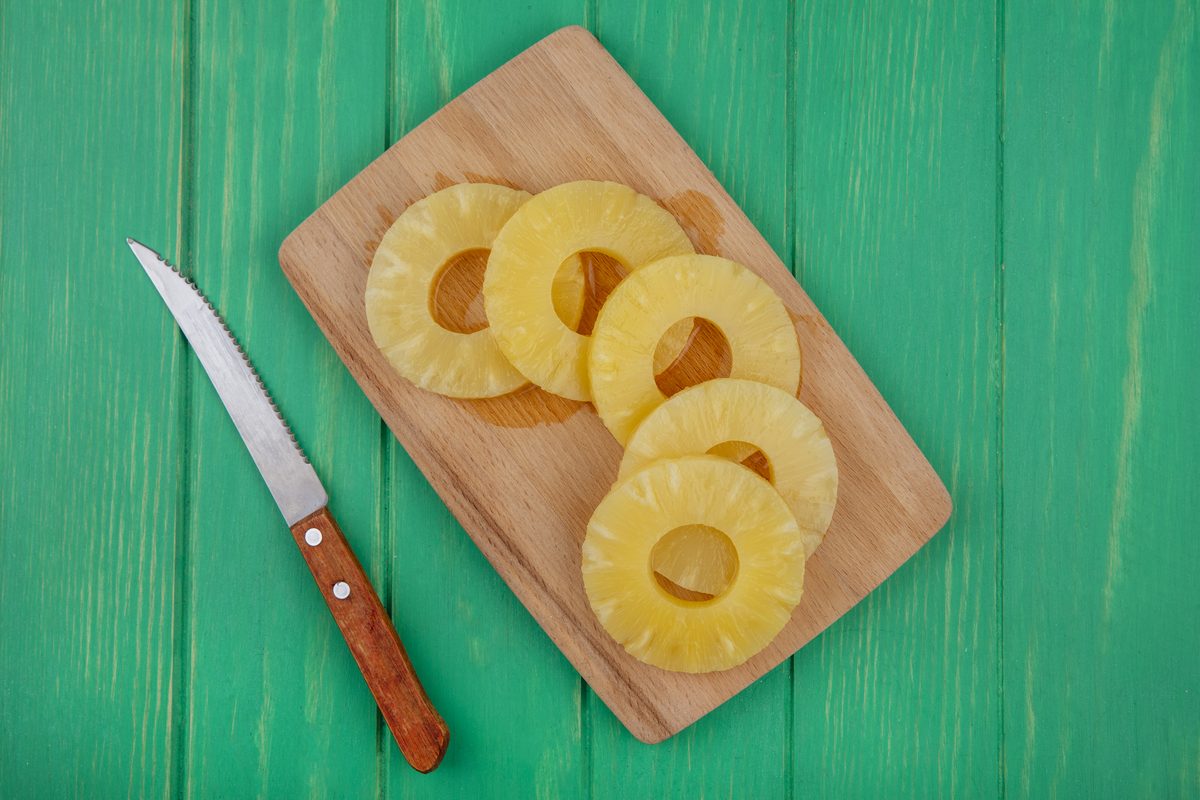
| One medium slice, 84 g | 43 kcal | 9.8 g | 5.4 g | 1.0 g | 39 mg |
| 100 g of pineapple | 52 kcal | 11.7 g | 6.4 g | 1.2 g | 46 mg |
| Two medium slices, 168 g | 87 kcal | 19.7 g | 10.8 g | 2.0 g | 77 mg |
| One bowl of chunks, 165 g | 85 kcal | 19.3 g | 10.6 g | 2.0 g | 76 mg |
The Fédération Française des Diabétiques (the French diabetes federation) defines a portion of fruit as 15 to 20 g of carbohydrate. In pineapple, that is 130 to 170 g, or two medium slices or a bowl of chunks. Two slices also cover nearly all of the day’s vitamin C, 97%.
Watch out for varieties: the Victoria pineapple, small and very fragrant, contains 15.1 g of carbohydrate per 100 g according to Ciqual, 30% more than the standard pineapple. For it, the portion drops to about 100 to 130 g.
Glycaemic index and glycaemic load of pineapple
The international glycaemic index tables (Atkinson, Foster-Powell and Brand-Miller, 2008) list:
| Product | People | Glycaemic index |
|---|---|---|
| Raw pineapple, Philippines | 10 people with type 2 diabetes | 51 |
| Raw pineapple, Australia | 8 people without diabetes | 66 |
| Pineapple chunks in juice (two brands) | 10 people without diabetes | 43 and 55 |
| Pineapple juice with no added sugar, Canada | 13 people with type 2 diabetes | 46 |
Pineapple is therefore on the border between low and moderate GI. Its sugars are mostly sucrose, 6.4 g out of 10.5 g, which breaks down into glucose and fructose, and it contains little fibre, 1.2 g per 100 g. It therefore sits above the apple (36) and the pear (38), but well below the melon (65 to 70). For the notion of GI, see our guide to the glycaemic index.
Work out the glycaemic load of your portion
| Portion | Carbohydrate | Glycaemic load |
|---|---|---|
| One medium slice, 84 g | 9.8 g | 5 to 7 |
| 100 g | 11.7 g | 6 to 8 |
| Two medium slices, 168 g | 19.7 g | 10 to 13 |
| A quarter of a pineapple, about 225 g | 26.3 g | 13 to 17 |
One slice is no problem. Two slices are at the limit of a moderate load, like a medium banana. A quarter of a pineapple for dessert, on the other hand, is already a clearly moderate load.
Fresh, tinned, juice: what changes
| Product | Carbohydrate per 100 g | Portion | Carbohydrate in the portion |
|---|---|---|---|
| Fresh pineapple | 11.7 g | two slices, 168 g | 20 g |
| Pineapple in pineapple juice, drained | 12.9 g | two slices, 168 g | 22 g |
| Pineapple in light syrup, drained | 15.3 g | two slices, 168 g | 26 g |
| Pineapple juice, pure juice | 12.1 g | one 25 cL glass | about 30 g |
- Pineapple in juice, drained, stays close to fresh fruit: it is the right choice in a tin.
- Pineapple in syrup provides 30% more carbohydrate, even drained, and loses almost all its vitamin C: 5 mg per 100 g against 46 mg.
- Pineapple juice provides about 30 g of carbohydrate per glass, one and a half portions of fruit, with no fibre. The Fédération Française des Diabétiques recommends avoiding fruit juices, except to treat a hypoglycaemic episode.
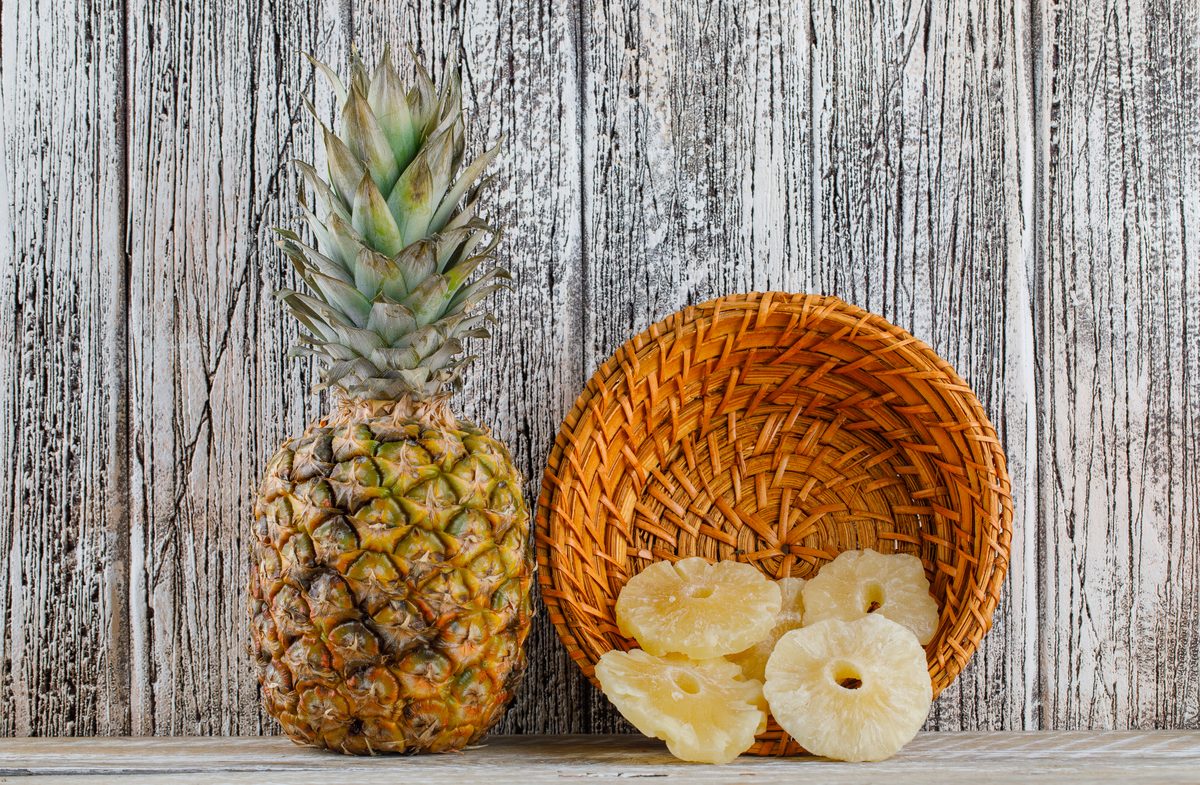
10 g or 15 g of carbohydrate: the pineapple equivalent, form by form
If you count your carbohydrate, for example because your treatment requires it, it is simpler to think in grams of fruit than in slices. Slices vary from one pineapple to another; weight does not lie. Here is what 10 g and 15 g of carbohydrate represent depending on the form of pineapple.
| Form | Carbohydrate per 100 g | For 10 g of carbohydrate | For 15 g of carbohydrate |
|---|---|---|---|
| Fresh pineapple | 11.7 g | 85 g | 128 g |
| Pineapple in juice, drained | 12.9 g | 78 g | 116 g |
| Victoria pineapple, fresh | 15.1 g | 66 g | 99 g |
| Pineapple in light syrup, drained | 15.3 g | 65 g | 98 g |
| Pineapple juice, pure juice | 12.1 g | about 8 cL | about 12 cL |
In practice, one medium 84 g slice of fresh pineapple is almost exactly 10 g of carbohydrate. That is an easy guideline to remember. With Victoria pineapple or pineapple in syrup, the same amount of carbohydrate fits in a portion that is about a quarter smaller.
Tinned pineapple: what the label does not tell you
This page already compares the carbohydrate in fresh and tinned. Two other differences matter when you buy tinned pineapple.
- Vitamin C disappears in pineapple in juice too. Ciqual measures 5.0 mg per 100 g in drained pineapple in juice, against 46.1 mg in the fresh fruit: nine times less. So the problem is not only the syrup, but the canning itself. If you are counting on pineapple for your vitamin C, have it fresh.
- The liquid in the tin counts. Undrained pineapple in juice has the same carbohydrate level as drained, 12.9 g per 100 g, but less fibre: 0.9 g against 1.4 g. For pineapple in light syrup, the liquid adds carbohydrate: 15.6 g per 100 g undrained. Always drain, and do not drink the juice from the tin.
- Victoria pineapple is richer in fibre. It contains 2.4 g per 100 g, twice as much as the standard pineapple, but also more sugars and less vitamin C (18.3 mg). Being sweeter, it is still a fruit to weigh.
If you keep a tin in the cupboard for winter, choose “in juice” rather than “in syrup”, drain it, and count it as a fruit without its vitamin C advantage.
Pineapple juice for a hypoglycaemic episode
Pineapple juice has no place in your daily diet, but it can be useful when blood sugar drops too low. The Fédération Française des Diabétiques advises topping up with 15 g of carbohydrate, for example three sugar lumps, a 15 cL carton of fruit juice or a tablespoon of jam or honey, then checking your blood sugar 15 minutes later and topping up again if it stays low.
- With pure pineapple juice, 15 g of carbohydrate is about 12 cL, a small glass.
- A 15 cL carton of pineapple juice provides about 18 g of carbohydrate, a little more than the basic dose.
- Fresh pineapple is not a good way to treat a low: you need to eat nearly 130 g, more than a slice and a half, to reach 15 g, and it takes time to chew.
If you have hypoglycaemic episodes, the exact product and quantity for your treatment should be decided with your doctor or your diabetes education nurse.
Does pineapple help you lose weight or lower blood sugar?
No. Pineapple contains bromelain, an enzyme that digests proteins, and it is often presented as a “fat burner”. No food burns fat, and none lowers blood sugar. Pineapple is a sweet fruit like any other, with the advantage of being refreshing and rich in vitamin C and manganese, 0.84 mg per 100 g, which is 42% of the reference intake. For the myths on this theme, see our guide to superfoods and marketing.
How much a day and when
The Fédération Française des Diabétiques advises spreading fruit through the day. Two slices of pineapple count as one fruit.
- For dessert, after a meal with vegetables and a protein: this is the best time for a moderate GI fruit.
- As an afternoon snack, one slice with plain yoghurt or fromage blanc (a fresh soft cheese).
- In cooking, in a savoury dish: a few chunks in a curry or a chicken stir-fry flavour the whole dish for little carbohydrate per serving.
Should you limit fruit? A Danish randomised trial (Christensen et al., 2013) in 63 people newly diagnosed with type 2 diabetes found no difference in HbA1c between the group that ate at least two fruits a day and the one that ate at most two. What matters is the portion, not a ban.
Whole fruit or juice: what the largest study says
The largest study on fruit and type 2 diabetes followed 187,382 American health professionals, in three cohorts, for 18 to 24 years depending on the cohort (Muraki et al., BMJ, 2013). During follow-up, 12,198 of them developed diabetes.
- Each three portions of whole fruit a week was associated with a slightly lower risk of diabetes: a hazard ratio of 0.98.
- The same amount of fruit juice was associated with a higher risk: a hazard ratio of 1.08, which is 8% higher.
- Results varied a lot from one fruit to another. Pineapple, however, is not among the fruits analysed one by one: no data from this study concerns it directly.
What can be taken from this for pineapple fits in one sentence: the whole fruit, cut into slices, is not associated with any risk, whereas its juice form goes in the wrong direction. This is an observational study: it shows an association, not proof of cause and effect. It does, however, match the advice of the Fédération Française des Diabétiques, which recommends avoiding fruit juices.
Pineapple or another fruit
| 100 g of | Carbohydrate | Fibre | Glycaemic index | Glycaemic load |
|---|---|---|---|---|
| Banana | 19.7 g | 2.7 g | 48 (people with diabetes) | 9.5 |
| Charentais melon | 14.8 g | 1.3 g | 65 to 70* | 10 |
| Apple | 11.9 g | 2.4 g | 36 (people with diabetes) | 4.3 |
| Pineapple | 11.7 g | 1.2 g | 51 (people with diabetes) | 6.0 |
| Orange | 8.0 g | 2.7 g | 45 (people with diabetes) | 3.6 |
| Strawberry | 6.0 g | 3.8 g | 40* | 2.4 |
Weight for weight, pineapple sits in the middle: less loaded than the banana or melon, more than the apple, orange or strawberry. See our guides apple and diabetes, melon and diabetes and strawberry and diabetes.
Special cases
Gestational diabetes
Pineapple is not forbidden during pregnancy. In normal amounts, there is no reason to avoid it; keep it for small portions, as a dessert. See eating during pregnancy.
Sore mouth
The bromelain in fresh pineapple can tingle the tongue and lips. It is harmless; cooked or tinned pineapple no longer has this effect, because heat destroys the enzyme.
Prediabetes
Fresh pineapple has its place. Swapping pineapple juice for the fruit is the exchange that counts. See type 2 diabetes: diet and prevention.
3 ideas for eating it
- A slice of pineapple and plain fromage blanc, with a few mint leaves.
- A grilled chicken and pineapple skewer: pineapple in a protein dish, see our marinated chicken skewers.
- A low-sugar fruit salad: pineapple, strawberries and kiwi, with no syrup.
More ideas in our low glycaemic index recipes.
Our pineapple recipes, portion by portion
Two recipes on the site put pineapple front and centre. Their values are calculated from Ciqual for each ingredient; they show that a “healthy” recipe can still count as two portions of fruit.
- Spiced roasted pineapple: no added sugar, but a whole pineapple for four. One serving provides 36 g of carbohydrate and 4.7 g of fibre, almost two portions of fruit. If you have diabetes, cut the pineapple into six or eight servings, or have half a serving with plain yoghurt.
- Green spinach and pineapple smoothie: 200 g of pineapple and a banana for two glasses. One glass provides 27 g of carbohydrate, more than a portion of fruit, to drink in a few seconds. Keep it for a breakfast with a source of protein, not on top of a piece of fruit.
The principle is the same for all recipes: look at the carbohydrate per portion, not just the absence of added sugar.
Frequently asked questions
Can a person with diabetes eat pineapple?
Yes, in a portion: two medium slices, about 170 g, make one portion of fruit. Its GI measured in people with diabetes is 51.
How many slices of pineapple with diabetes?
One to two medium 84 g slices. One slice provides 9.8 g of carbohydrate.
Does pineapple raise blood sugar?
Moderately: its GI is 51 to 66 depending on the measurements. As a dessert after a full meal, the effect is more gradual.
Is tinned pineapple suitable?
Pineapple in juice, drained, yes: 12.9 g of carbohydrate per 100 g, close to fresh. Pineapple in light syrup contains 15.3 g and has lost its vitamin C.
Is pineapple juice not recommended?
Day to day, no: about 30 g of carbohydrate per 25 cL glass, with no fibre. It can, however, be used in small amounts to treat a low.
Does pineapple lower blood sugar or help you lose weight?
No: no food lowers blood sugar or burns fat. Pineapple remains a sweet fruit, to be counted like the others.
Does tinned pineapple still contain vitamin C?
Very little: 5 mg per 100 g in drained pineapple in juice, against 46 mg in fresh pineapple according to Ciqual. For vitamin C, prefer the fresh fruit.
Can pineapple juice be used for a hypoglycaemic episode?
Yes. About 12 cL of pure pineapple juice provides the 15 g of carbohydrate of the top-up advised by the Fédération Française des Diabétiques. Check your blood sugar 15 minutes later.
How much pineapple for 10 g of carbohydrate?
About 85 g of fresh pineapple, which is one medium slice. With the sweeter Victoria pineapple, 66 g is enough.
The foods and diabetes series
Glycaemic index, glycaemic load and the right portion, food by food: apple and diabetes, pear and diabetes, orange and diabetes, banana and diabetes, grapes and diabetes, dates and diabetes, melon and diabetes, strawberry and diabetes, cheese and diabetes, mango and diabetes, honey and diabetes, dark chocolate and diabetes, lentils and diabetes, potato and diabetes, avocado and diabetes, oats and diabetes, bread and diabetes, kiwi and diabetes, sweet potato and diabetes, rice and diabetes.
Going further
Apple and diabetes, banana and diabetes, strawberry and diabetes, glycaemic index, nutrition facts for pineapple.
Our sources
- Atkinson FS, Foster-Powell K, Brand-Miller JC. International Tables of Glycemic Index and Glycemic Load Values: 2008. Diabetes Care, 2008.
- Christensen AS et al. Effect of fruit restriction on glycemic control in patients with type 2 diabetes, a randomized trial. Nutrition Journal, 2013.
- Fédération Française des Diabétiques: fruit portion, spreading through the day, fruit juices.
- Ciqual 2025 table (Anses): raw pineapple, Victoria pineapple, pineapple in juice and in light syrup, pineapple juice; USDA FoodData Central, SR Legacy: slice weights.
- Regulation (EU) No 1169/2011, Annex XIII: reference intakes for vitamin C and manganese.
- Muraki I, Imamura F, Manson JE, Hu FB, Willett WC, van Dam RM, Sun Q. Fruit consumption and risk of type 2 diabetes: results from three prospective longitudinal cohort studies. BMJ, 2013. PMID 23990623.
- Fédération Française des Diabétiques, “Hypoglycaemia” (in French): topping up with 15 g of carbohydrate and checking after 15 minutes.
- Site recipes (spiced roasted pineapple, green spinach and pineapple smoothie): values per portion calculated from Ciqual 2025.