Dates and Diabetes: How Many to Eat? GI and Portion
The short answer
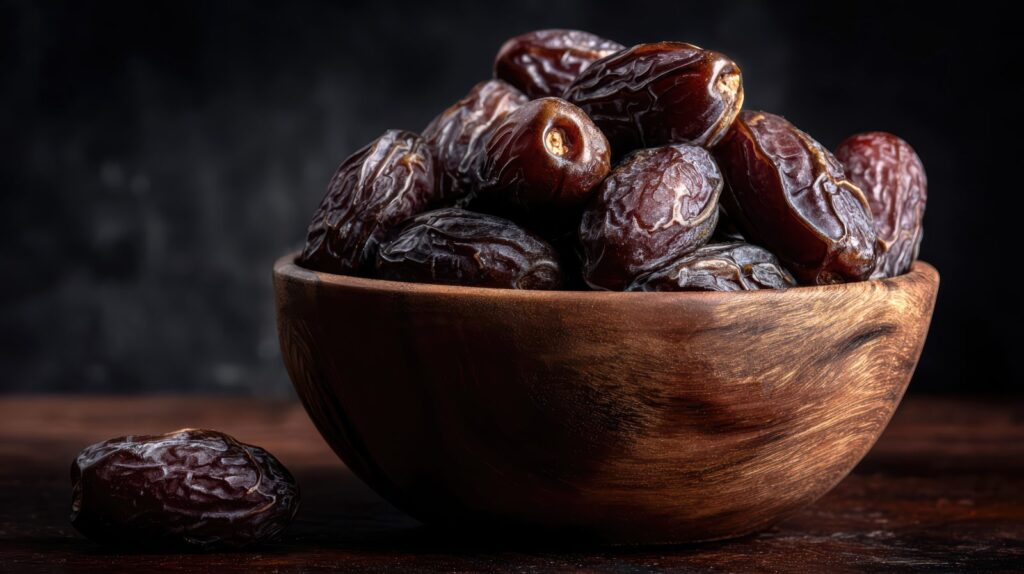
Yes, a person with diabetes can eat dates, but by counting them one by one. Their glycaemic index (GI) measured in people with type 2 diabetes is medium to low, from 44 to 53 depending on the variety. The problem is their concentration of sugars: 64.7 g of carbohydrate per 100 g, five times more than an apple. The right portion is 2 to 3 small dates (deglet nour) or a single medjool, which is one fruit portion of 15 to 20 g of carbohydrate, ideally at the end of a meal or with yoghurt.
This guide gives general guidelines. If you are treated with insulin or with a medicine that can cause hypoglycaemia (low blood sugar), your carbohydrate amount per meal should be set with your doctor or dietitian.
What a date contains
| For | Calories | Carbohydrate | Fibre | Potassium |
|---|---|---|---|---|
| One small deglet nour date, 7 g | 20 kcal | 4.6 g | 0.5 g | 49 mg |
| 3 deglet nour dates, 21 g | 61 kcal | 13.6 g | 1.5 g | 146 mg |
| One medjool date, 24 g | 69 kcal | 15.5 g | 1.8 g | 167 mg |
| 100 g of dates | 287 kcal | 64.7 g | 7.3 g | 696 mg |
The sugars in dates are almost all simple sugars, in equal parts glucose (32.8 g per 100 g) and fructose (31.1 g). The French Diabetes Federation (Fédération Française des Diabétiques) defines a fruit portion as 15 to 20 g of carbohydrate: that is 3 to 4 small dates, or one large medjool. A handful of ten dates, on the other hand, provides 46 g of carbohydrate, more than two and a half portions.
Glycaemic index: what the studies measure
Despite their reputation as « nature’s sweets », dates have a rather medium glycaemic index. The most useful study for a person with diabetes is that of Alkaabi et al. (Nutrition Journal, 2011), carried out in the United Arab Emirates in 10 people with type 2 diabetes and 13 people without diabetes, on five common varieties:
| Variety | GI, without diabetes | GI, type 2 diabetes |
|---|---|---|
| Fara’d | 54 | 46 |
| Lulu | 54 | 44 |
| Bo ma’an | 46 | 52 |
| Dabbas | 49 | 50 |
| Khalas | 55 | 53 |
The authors found no significant difference between varieties, or between people with and without diabetes. The international tables (Atkinson et al., 2008) give an average of 42 for five studies in people without diabetes, ranging from 31 to 50. Two measurements stand out: 103 for dried dates tested in Australia, and 62 in women with gestational diabetes in Israel. The varieties sold in France, deglet nour and medjool, were not measured in these studies: remember a medium GI, around 45 to 55, without making it a reason to eat more.
Another Emirati study (Miller et al., 2003) compared dates eaten alone or with plain full-fat yoghurt: the yoghurt lowered the GI slightly, from 35 to 29 for shop-bought dates, a difference that was not significant. To understand the concept of GI, see our guide to the glycaemic index.
Fresh date, stored date, shop-bought date
The study by Miller et al. (European Journal of Clinical Nutrition, 2003), already cited for the yoghurt, also compared the same variety, khalas, at three stages of storage, in volunteers without diabetes:
- « Rutab » dates, still fresh and soft: a GI of 47.
- Traditionally stored dates: a GI of 45.
- Shop-bought « tamer » dates, well dried: a GI of 36.
Only the difference between rutab dates and shop-bought dates was significant. All remain low GI. This result goes against a widespread idea: the fresh, soft date is not gentler on blood glucose than the dried date, quite the opposite.
Work out the glycaemic load of your portion
This is where dates stand out: their GI is medium, but they contain so much carbohydrate that the glycaemic load climbs quickly with the number of dates. With the GIs measured in people with diabetes, from 44 to 53:
| Portion | Carbohydrate | Glycaemic load |
|---|---|---|
| 1 small date, 7 g | 4.6 g | 2 |
| 3 small dates, 21 g | 13.6 g | 6 to 7 |
| 1 medjool date, 24 g | 15.5 g | 7 to 8 |
| 5 small dates, 35 g | 23 g | 10 to 12 |
| 10 small dates, 71 g | 46 g | 20 to 24 |
Up to 3 or 4 small dates, the load stays low. At ten dates, it becomes high.
Dates and other dried fruit
| 30 g of | Calories | Carbohydrate | Fibre | Glycaemic index |
|---|---|---|---|---|
| Raisins | 97 kcal | 22.0 g | 1.3 g | 56 to 66 |
| Dates | 86 kcal | 19.4 g | 2.2 g | 44 to 53 (diabetes) |
| Dried apricots | 72 kcal | 17.7 g | 2.5 g | 31 (3 studies) |
| Prunes | 69 kcal | 16.6 g | 1.5 g | 29 (1 study) |
| Dried figs | 78 kcal | 16.5 g | 2.4 g | 61 (1 study) |
| Dried apple | 74 kcal | 16.5 g | 2.6 g | 29 (1 study) |
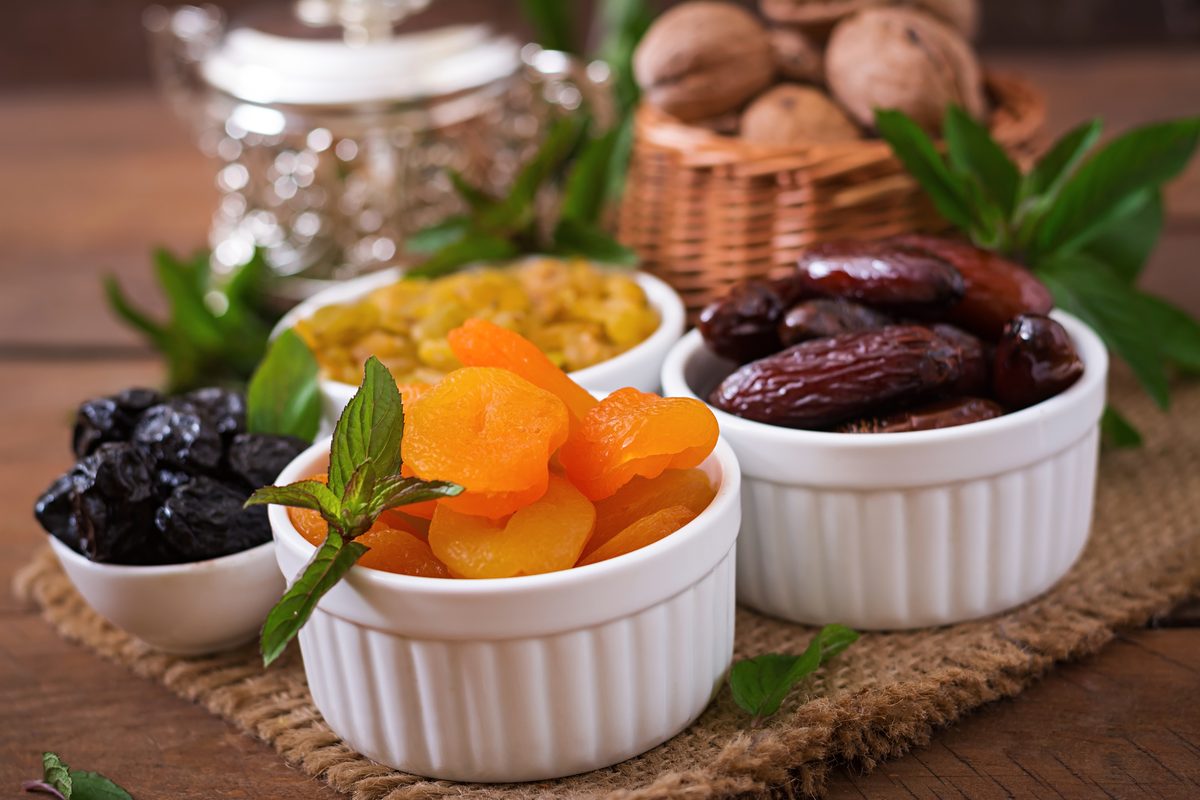
Weight for weight, dates are among the dried fruits richest in carbohydrate, just behind raisins. Dried apricots and prunes have the lowest GI. In every case, 30 g of dried fruit is already a fruit portion: a handful quickly fits in your hand, but not in your carbohydrate budget. See also grapes and diabetes.
The potassium in dates is real, 696 mg per 100 g, but a portion of three dates provides only 146 mg: a fresh fruit or a potato does better without the sugar. See our ranking of foods rich in potassium.
A date or an apple? The same sugar in a very different volume
For 15 g of carbohydrate, here is how much you need to eat of dates and a few fresh fruits. The calculation is based on Ciqual.
| For 15 g of carbohydrate | Weight | Calories | Fibre |
|---|---|---|---|
| Dried dates | 23 g, one medjool or 3 deglet nour | 67 kcal | 1.7 g |
| Banana | 76 g | 67 kcal | 2.1 g |
| Apple, peeled | 126 g | 65 kcal | 3.0 g |
| Pear | 132 g | 66 kcal | 4.1 g |
| Orange | 187 g | 79 kcal | 5.0 g |
| Strawberries | 249 g | 87 kcal | 9.5 g |
A single medjool date provides as much carbohydrate as a whole apple. But the apple weighs five times more, contains nearly twice as much fibre and more than 100 g of water. That is the whole issue with dates: their GI is fine, but it is easy to go over the portion, since ten small dates weigh only 71 g. If you fancy something sweet at the end of a meal, one date is enough; if you are hungry, choose a fresh fruit instead.
Date paste, date syrup: still sugar
Dates are often presented as a « natural sugar » to replace sugar in baking and energy balls. For blood glucose, it is sugar first and foremost: 100 g of dates provide 64.7 g of carbohydrate, almost all of it simple sugars. Replacing 50 g of sugar with 80 g of dates in a cake provides roughly the same carbohydrate, 52 g, with an extra 6 g of fibre and a little potassium. That is a slight improvement, not a « sugar-free » food. Date syrups, for their part, have lost the fibre. For other sweeteners, see our guide on how much sugar per day and our view on agave syrup.
Eating dates every day: what one trial measured
A small trial (Rock et al., Journal of Agricultural and Food Chemistry, 2009) had 10 healthy volunteers eat 100 g of dates a day for 4 weeks, of the medjool or hallawi variety.
- Fasting blood glucose did not rise, nor did weight or cholesterol.
- Triglycerides even fell, by 8% with medjool and 15% with hallawi.
- Oxidative stress in the blood fell by 33%, but only with the hallawi variety, which is richer in polyphenols.
This is reassuring, but it must be read with caution. The participants did not have diabetes, there were only ten of them, and 100 g of dates is 64.7 g of carbohydrate, more than three fruit portions. The trial measured only fasting blood glucose, not blood glucose after meals. It does not allow such a quantity to be recommended to a person with diabetes; it only shows that dates do not behave like pure sugar on blood fats.
How many per day and when
- 2 to 3 small dates or one medjool per day, counted as one of the day’s fruits, not on top.
- At the end of a meal, in place of a sweet dessert, rather than as a snack.
- With a dairy product or nuts: a date stuffed with an almond or a walnut half, or two dates with plain yoghurt.
The French Diabetes Federation (Fédération Française des Diabétiques) gives no specific rule for dates, but advises spreading fruit through the day and keeping to the portion of 15 to 20 g of carbohydrate.
During Ramadan
Breaking the fast with dates is a tradition compatible with diabetes, provided you stick to one to three dates, then move on to a balanced meal with vegetables, a protein and wholegrain starchy foods. Fasting itself can expose you to hypoglycaemia and dehydration, especially on insulin or sulfonylureas: it should be prepared with your doctor a few weeks beforehand.
Special cases
Gestational diabetes
The only measurement in women with gestational diabetes found a GI of 62, higher than elsewhere. During pregnancy, keep dates to small amounts, one or two, with a dairy product. See eating during pregnancy.
Sport
For a long effort, dates are an excellent fuel: compact, easy to digest, rich in carbohydrate. This is where they are most useful. See what to eat before and after sport.
Hypoglycaemia
Dates are not the recommended way to treat low blood sugar: their fibre slows the arrival of the sugar a little. The French Diabetes Federation (Fédération Française des Diabétiques) advises 15 g of fast-acting sugar, for example three sugar lumps or a small 15 cL glass of fruit juice.
Kidney failure
With 696 mg of potassium per 100 g, dates and dried fruit are among the foods to watch with kidney failure: the amount is decided with your nephrologist.
3 ideas for eating them
- A date stuffed with an almond and a coffee, at the end of a meal.
- Two dates chopped into plain yoghurt, instead of sugar or jam.
- A medjool date in a vegetable and chickpea tagine: it flavours the whole dish, and each serving contains only a fraction of it.
More ideas in our low glycaemic index recipes.
Date energy balls: our recipe, in numbers
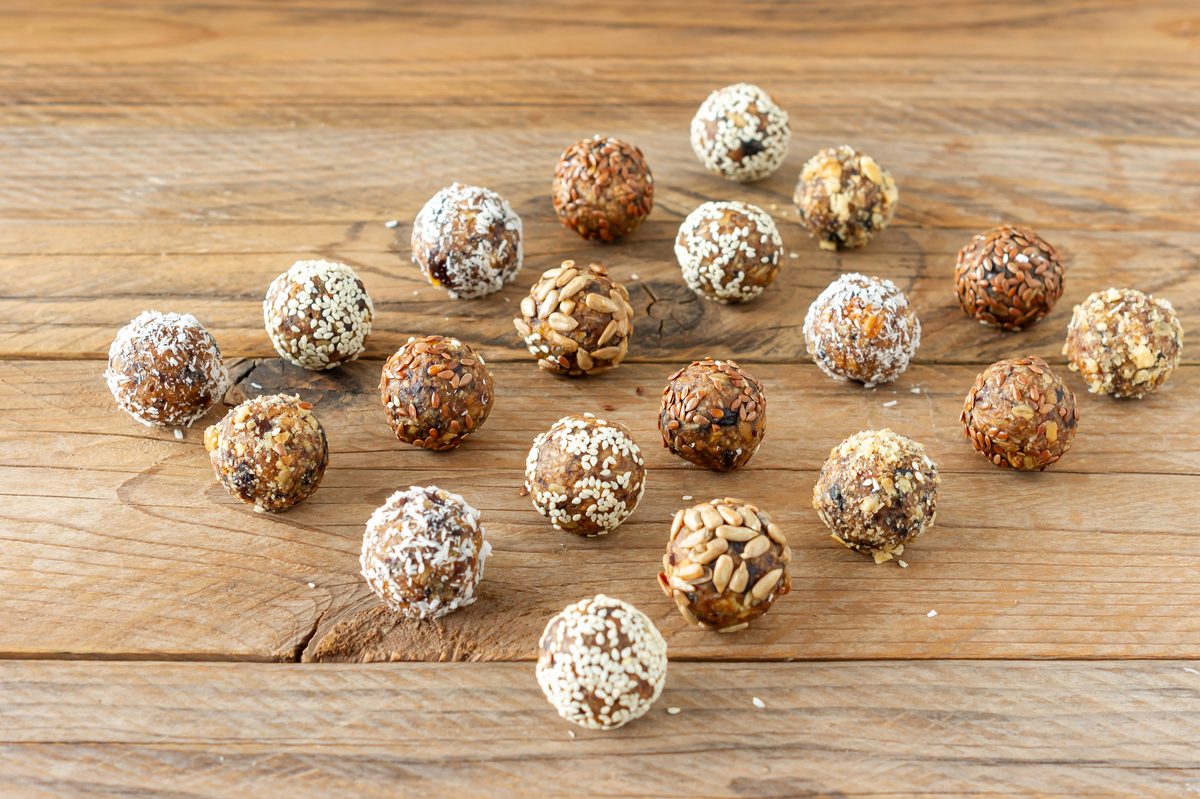
Energy balls made with dates are often presented as a « sugar-free » snack. Our recipe for date, almond and cocoa energy balls uses 200 g of dates and 100 g of almonds for twelve balls. Calculated from Ciqual, each ball provides:
- 13.8 g of carbohydrate, almost a fruit portion on its own;
- 109 kcal, 4.4 g of fat and 2.3 g of fibre.
One ball is therefore the equivalent of three small dates, with almonds on top. For a person with diabetes, one ball as a snack, with tea or coffee, counts as the afternoon fruit. Two or three balls in a row, however, make 28 to 41 g of carbohydrate, two to three fruit portions. Keep them mainly for a hike or a bike ride, where the carbohydrate will be used.
Frequently asked questions
Can someone with diabetes eat dates?
Yes, in small amounts: 2 to 3 small dates or one medjool, counted as one fruit. Their GI in people with type 2 diabetes is 44 to 53.
How many dates a day for someone with diabetes?
2 to 3 small dates, about 14 g of carbohydrate, or one large medjool, about 15 g. From 5 dates, the glycaemic load goes above 10.
Do dates raise blood glucose?
Yes, like any sweet food, but less than their taste suggests, thanks to their fibre. It is the quantity that makes the difference: ten dates have a high glycaemic load.
Medjool or deglet nour dates?
The same composition gram for gram, but the medjool weighs more than three times as much: one medjool equals three or four deglet nour.
Does date paste replace sugar for someone with diabetes?
No: it provides almost as much carbohydrate as the sugar it replaces, with a little extra fibre. It is a slight improvement, not a sugar-free food.
Are dates fine during Ramadan when you have diabetes?
One to three dates to break the fast, yes. The fast itself should be discussed with your doctor before Ramadan.
Do fresh dates have a lower GI than dried dates?
No. In a study on the khalas variety, fresh « rutab » dates had a GI of 47 and shop-bought dried dates 36. All remain low GI.
How much fresh fruit is a date equivalent to?
One medjool date, about 15 g of carbohydrate, is equivalent to a 126 g apple or a 250 g punnet of strawberries. Fresh fruit also provides water and more fibre.
Are date energy balls suitable for diabetes?
One per snack, yes: our recipe provides 13.8 g of carbohydrate per ball, almost a fruit portion. Beyond that, they add up quickly.
The foods and diabetes series
Glycaemic index, glycaemic load and the right portion, food by food: apples and diabetes, pears and diabetes, oranges and diabetes, bananas and diabetes, grapes and diabetes, melon and diabetes, strawberries and diabetes, pineapple and diabetes, cheese and diabetes, mango and diabetes, honey and diabetes, dark chocolate and diabetes, lentils and diabetes, potatoes and diabetes, avocado and diabetes, porridge oats and diabetes, bread and diabetes, kiwi and diabetes, sweet potatoes and diabetes, rice and diabetes.
Further reading
Grapes and diabetes, bananas and diabetes, type 2 diabetes: diet and prevention, glycaemic index, date nutrition facts.
Our sources
- Alkaabi JM et al. Glycemic indices of five varieties of dates in healthy and diabetic subjects. Nutrition Journal, 2011.
- Miller CJ, Dunn EV, Hashim IB. The glycaemic index of dates and date/yoghurt mixed meals. European Journal of Clinical Nutrition, 2003.
- Atkinson FS, Foster-Powell K, Brand-Miller JC. International Tables of Glycemic Index and Glycemic Load Values: 2008. Diabetes Care, 2008.
- Fédération Française des Diabétiques (French Diabetes Federation): fruit portion, spreading through the day, treating low blood sugar.
- Ciqual 2025 table (Anses): dried date and dried fruit; USDA FoodData Central, SR Legacy: weight of deglet nour and medjool dates.
- Rock W, Rosenblat M, Borochov-Neori H et al. Effects of date (Phoenix dactylifera L., Medjool or Hallawi variety) consumption by healthy subjects on serum glucose and lipid levels and on serum oxidative status: a pilot study. Journal of Agricultural and Food Chemistry, 2009. PMID 19681613.
- Ciqual 2025 table (Anses): raw banana, apple, pear, orange and strawberry, for the equivalences. Recipe from this site: date, almond and cocoa energy balls, values calculated from Ciqual.