Pears and Diabetes: Low GI, High Fibre, the Numbers
The short answer
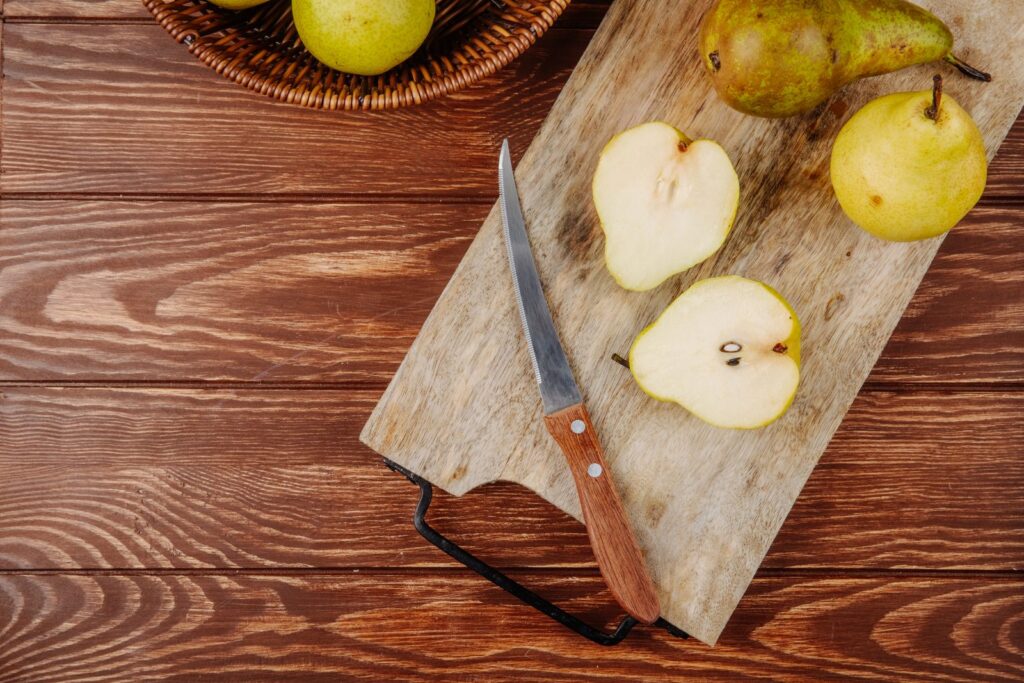
Yes, pears are a very good fit for diabetes. Their glycaemic index (GI) measured in people with type 2 diabetes is 38 on average (four studies), one of the lowest of any fruit, just behind the apple. A medium pear of 178 g provides 20 g of carbohydrate, a glycaemic load of about 8, and 5.5 g of fibre, which makes it one of the fruits richest in fibre. One a day, whole, among your fruits: it is a very good choice. The only caveats: pears in syrup, nectar, and sensitive guts.
This guide gives general guidelines. If you are treated with insulin or with a medicine that can cause hypoglycaemia (low blood sugar), your carbohydrate amount per meal should be set with your doctor or dietitian.
What a pear contains
| For | Calories | Carbohydrate | of which fructose | of which glucose | Fibre | Polyols |
|---|---|---|---|---|---|---|
| 100 g of pear | 50 kcal | 11.4 g | 6.9 g | 1.1 g | 3.1 g | 1.9 g |
| A small pear, 148 g | 74 kcal | 16.9 g | 10.2 g | 1.6 g | 4.6 g | 2.7 g |
| A medium pear, 178 g | 88 kcal | 20.3 g | 12.3 g | 2.0 g | 5.5 g | 3.3 g |
| A large pear, 230 g | 114 kcal | 26.2 g | 15.9 g | 2.5 g | 7.1 g | 4.3 g |
The French Diabetes Federation (Fédération Française des Diabétiques) defines a fruit portion as 15 to 20 g of carbohydrate. A small pear, or a medium pear, matches that. A medium pear also covers 18% of the 30 g of fibre a day recommended by Anses (the French food safety agency), three times more than a bowl of grapes.
Why the glycaemic index of pears is low
The pear is one of the fruits lowest in glucose. According to Ciqual, out of 9.4 g of sugars per 100 g, 6.9 g is fructose and only 1.1 g is glucose, or 12% of the sugars. Fructose has a glycaemic index of 15 in the international tables, against 103 for glucose. The pear also contains 1.9 g of polyols, mostly sorbitol, which hardly raises blood glucose at all, and plenty of fibre.
The international glycaemic index tables (Atkinson, Foster-Powell and Brand-Miller, 2008) list four measurements in people with diabetes, for a 120 g portion:
| Study | Glycaemic index | Glycaemic load (120 g) |
|---|---|---|
| Canada, pear with no variety specified | 33 | 4 |
| New Zealand, Winter Nellis, 15 people | 34 | 4 |
| Canada, Williams (Bartlett), 13 people | 41 | 3 |
| Italy, 8 people | 42 | 5 |
| Average of the 4 studies | 38 | 4 |
All the measurements lie between 33 and 42: the pear is a low GI fruit whatever the variety. To understand the concept, see our guide to the glycaemic index.
Williams, Conference, with or without skin: what Ciqual measures
Ciqual analyses separately the two best-selling pears in France, and the pear eaten with its skin. The differences are small, but they confirm what makes the pear worthwhile.
| 100 g of | Carbohydrate | Fructose | Glucose | Sucrose | Sorbitol and polyols | Fibre |
|---|---|---|---|---|---|---|
| Williams pear, peeled | 11.5 g | 7.2 g | 1.0 g | 1.2 g | 1.9 g | 3.1 g |
| Conference pear, peeled | 11.4 g | 6.6 g | 1.2 g | 1.6 g | 1.8 g | 3.1 g |
| Pear with skin | 12.3 g | 6.4 g | 2.6 g | 0.7 g | 2.0 g | 2.9 g |
- Williams or Conference, it is the same for blood glucose: the same carbohydrate, the same fibre, and in both cases less than 1.2 g of glucose per 100 g. Choose the one you prefer.
- The skin does not add fibre according to Ciqual: 2.9 g with the skin, 3.1 g without, two different samples. So you can peel your pear if you digest it better that way, without losing its benefits. Just wash it if you eat it whole.
- Size varies with the variety: the USDA weighs a medium Williams at 177 g, a Bosc at 179 g and a green Anjou at 202 g. A large Anjou, 242 g, already exceeds one fruit portion: for that one, have half a pear at one time and the other half later.
Work out the glycaemic load of your pear
| Portion | Carbohydrate | Glycaemic load |
|---|---|---|
| Half a pear, 90 g | 10.3 g | 4 (3 to 4) |
| A small pear, 148 g | 16.9 g | 6 (6 to 7) |
| A medium pear, 178 g | 20.3 g | 8 (7 to 9) |
| A large pear, 230 g | 26.2 g | 10 (9 to 11) |
Even a large pear stays at the limit of a low glycaemic load. By comparison, a medium banana is at 11: see bananas and diabetes.
Raw pear, cooked, in syrup, nectar: what changes
| Product | Carbohydrate per 100 g | Portion | Carbohydrate in the portion | What to know |
|---|---|---|---|---|
| Raw pear | 11.4 g | one pear, 178 g | 20 g | GI 38, 5.5 g of fibre |
| Pear in light syrup, drained | 13.9 g | two halves, 120 g | 17 g | a little more carbohydrate, added sugar |
| Pear in light syrup, with the syrup | 14.5 g | 120 g | 17 g | fibre cut by two and a half |
| Pear nectar | 14.8 g | a 25 cL glass | about 37 g | almost no fibre left: 0.45 g per 100 g |
| Poire belle Hélène (pear with chocolate sauce) | 23.5 g | a 150 g portion | 35 g | 196 kcal per 100 g, a dessert, not just a fruit |
Pear in light syrup, drained, remains acceptable: it was measured at a GI of 25 in an Australian study in people without diabetes, and at 44 for a pear in juice in people with diabetes. The real trap is nectar: one glass provides nearly twice the carbohydrate of a pear, without its fibre. The French Diabetes Federation (Fédération Française des Diabétiques) recommends avoiding juices and nectars, except to treat low blood sugar.
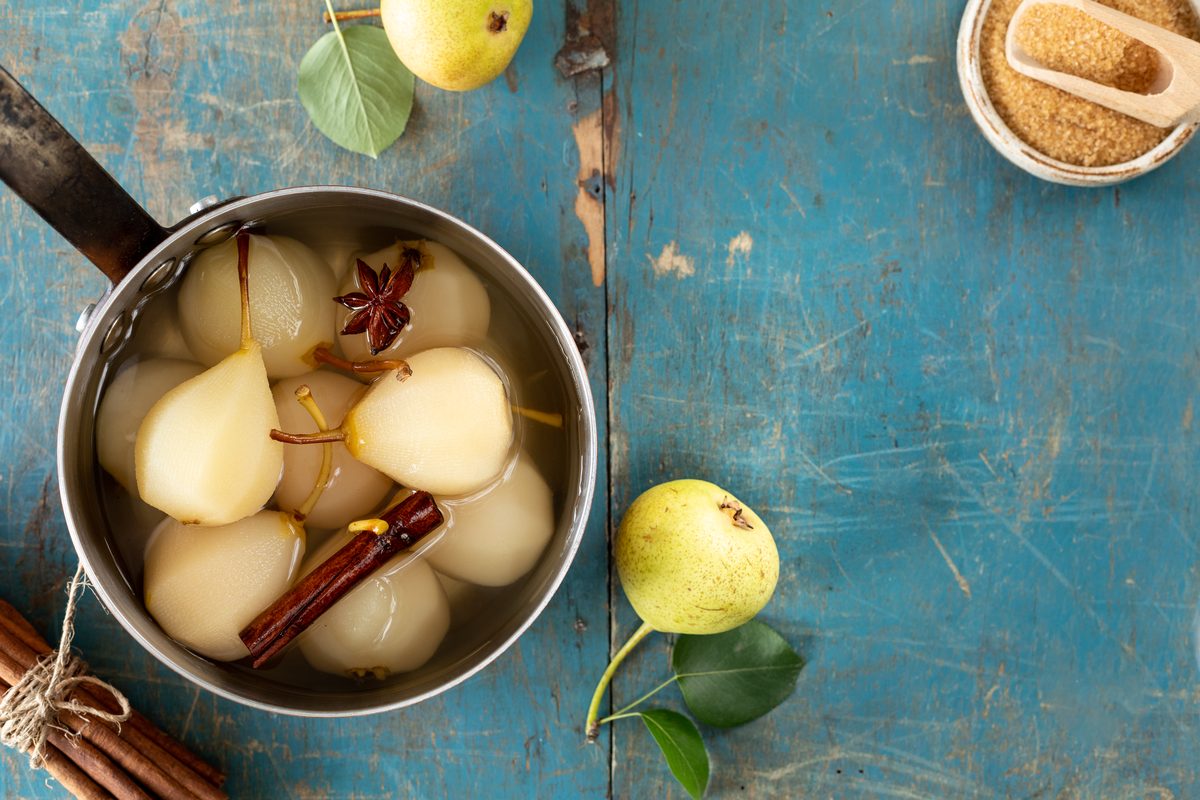
And what about cooked pear? Poached without sugar or baked, it keeps its carbohydrate. Cooking softens the flesh, but the pear remains a fruit rich in fructose and fibre: it is a good dessert, as long as you do not add syrup or chocolate.
How many per day and when
The French Diabetes Federation (Fédération Française des Diabétiques) advises spreading fruit through the day, for example one in the morning, one as lunchtime dessert and one as an afternoon snack. One pear a day, or even two if your other fruits are not very sweet, fits in easily.
Should fruit be limited? A Danish randomised trial (Christensen et al., 2013) in 63 people newly diagnosed with type 2 diabetes found no difference in HbA1c after 12 weeks between the group that ate at least two fruits a day and the group that ate at most two.
The best times
- For dessert, raw or poached without sugar.
- As an afternoon snack, with a few walnuts or a piece of cheese: a classic that slows absorption.
- At breakfast, diced into plain yoghurt or porridge.
Choose it ripe but firm: a very ripe, melting pear is eaten faster and makes you want another.
What the long-term studies say
In the study by Muraki et al. (BMJ, 2013), which followed more than 187,000 people for up to 24 years, every three portions of apples or pears a week were associated with a 7% lower risk of type 2 diabetes. By contrast, fruit juice was associated with an 8% higher risk. An observational study does not prove causation, but it confirms that whole fruit is not a problem.
A meta-analysis on apples and pears
A meta-analysis of five large cohorts (Guo et al., Food and Function, 2017) pooled 228,315 people, of whom 14,120 developed diabetes during follow-up. Those who ate the most apples and pears had a risk of type 2 diabetes 18% lower than those who ate the least, with very consistent results from one cohort to another. Each additional portion a week was associated with a 3% lower risk.
Two limits: the studies do not separate pears from apples, and they are observational studies. So this result does not say that a pear protects against diabetes; it says that a pear a day has no reason to be avoided, quite the opposite.
Pear or another fruit
| 100 g of | Carbohydrate | Fibre | Glycaemic index | Glycaemic load |
|---|---|---|---|---|
| Banana | 19.7 g | 2.7 g | 48 (9 studies) | 9.5 |
| Grapes | 16.3 g | 1.1 g | 43 to 49 (2 studies) | 7 to 8 |
| Apple | 11.9 g | 2.4 g | 36 (5 studies) | 4.3 |
| Pear | 11.4 g | 3.1 g | 38 (4 studies) | 4.3 |
| Orange | 8.0 g | 2.7 g | 45 (5 studies) | 3.6 |
The pear and the apple are almost level, with the pear having the advantage in fibre. See our guides on apples and diabetes, oranges and diabetes and grapes and diabetes, as well as our guide to dietary fibre.
Special cases
Sensitive gut
The pear is rich in fructose and sorbitol, two FODMAPs. In people with irritable bowel syndrome, it can cause bloating and diarrhoea; sorbitol also has a laxative effect in large amounts. If that is you, half a pear often goes down better than a whole one. See our guide to the FODMAP diet.
Gestational diabetes
The whole pear, low GI and rich in fibre, is a good snack fruit during pregnancy, within the meal pattern set by your care team. See eating during pregnancy.
Prediabetes
Fibre-rich fruits like the pear have their place. What matters most is still replacing juices and nectars with whole fruit. See type 2 diabetes: diet and prevention.
3 ideas for eating it
- Spiced poached pears: a warm dessert, to make with little or no sugar in the poaching syrup.
- A pear and a few walnuts as an afternoon snack: the fibre of one, the fat of the other. How many walnuts: see how many walnuts a day.
- An endive, pear and walnut salad: the pear as a starter, with a vegetable that has almost no carbohydrate.
More ideas in our low glycaemic index recipes.
Our pear recipes, in carbohydrate per serving
The pear can be cooked in starters, soups or desserts. Here is what our recipes provide, calculated from Ciqual for each ingredient:
- Rocket, pear and Parmesan salad: 11 g of carbohydrate per serving, half a pear per person with walnuts and cheese. The pear as a starter, for half a fruit portion.
- Squash and pear velouté soup: 23 g of carbohydrate and 9 g of fibre per bowl. The squash counts too: this soup replaces part of the starchy food in the meal.
- Apple and pear compote with no added sugar: 23 g of carbohydrate per bowl, for five fruits shared between four. A little over one fruit portion.
- Spiced poached pears: 27 g of carbohydrate per pear, with the orange and the spoonful of honey in the syrup. The honey and orange juice in the syrup add about 7 g to the 20 g of a medium raw pear: poach them in water and spices alone if you want to stay at one portion.
- Pear and almond crumble: 35 g of carbohydrate per serving, but also 7.9 g of fibre thanks to the porridge oats. A dessert that counts as a fruit and a starchy food.
The best balance of carbohydrate and enjoyment is still the pear raw or poached in water and spices, without honey.
Frequently asked questions
Can someone with diabetes eat pears?
Yes. The average GI of pear in people with diabetes is 38, and a medium pear has a low glycaemic load of about 8.
How many pears a day for someone with diabetes?
One, or even two if the day’s other fruits are not very sweet, spread over different times. A small or medium pear is one fruit portion of 15 to 20 g of carbohydrate.
Pear or apple for someone with diabetes?
Almost level: GI of 38 against 36, and the same glycaemic load per 100 g. The pear provides a little more fibre, 3.1 g against 2.4 g.
Is pear in syrup not recommended?
Drained, it remains acceptable: 13.9 g of carbohydrate per 100 g, against 11.4 g for raw pear. Avoid drinking the syrup.
Does pear raise blood glucose?
Only a little: it contains very little glucose, 1.1 g per 100 g, and mostly fructose and sorbitol, which raise blood glucose little.
Why does pear cause bloating?
Because of its fructose and sorbitol, two sugars that some guts absorb poorly. Half a pear often goes down better.
Williams or Conference pear for someone with diabetes?
No notable difference: 11.5 g and 11.4 g of carbohydrate per 100 g, 3.1 g of fibre, and about 1 g of glucose in both according to Ciqual.
Should you eat pear with the skin on?
It is not essential: according to Ciqual, pear with the skin contains 2.9 g of fibre per 100 g, against 3.1 g without. Peel it if you digest it better that way.
Which pear compote should you choose in the shop?
A fruit purée with “no added sugars”: 13.3 g of carbohydrate per 100 g according to Ciqual, close to raw fruit. A reduced-sugar compote made with fruits other than apple contains 15.4 g, a standard compote 23.9 g, twice the raw pear.
Can pear nectar be used for low blood sugar?
Yes: with 14.8 g of carbohydrate per 100 g, about 10 cL of pear nectar provides the 15 g of carbohydrate of the treatment advised by the French Diabetes Federation (Fédération Française des Diabétiques). Check your blood glucose 15 minutes later.
Do pears protect against diabetes?
That cannot be stated. A meta-analysis of five cohorts links a high consumption of apples and pears to an 18% lower risk, but these are observational studies that do not prove cause.
The foods and diabetes series
Glycaemic index, glycaemic load and the right portion, food by food: apples and diabetes, oranges and diabetes, bananas and diabetes, grapes and diabetes, dates and diabetes, melon and diabetes, strawberries and diabetes, pineapple and diabetes, cheese and diabetes, mango and diabetes, honey and diabetes, dark chocolate and diabetes, lentils and diabetes, potatoes and diabetes, avocado and diabetes, porridge oats and diabetes, bread and diabetes, kiwi and diabetes, sweet potatoes and diabetes, rice and diabetes.
Further reading
Apples and diabetes, oranges and diabetes, bananas and diabetes, grapes and diabetes, pear nutrition facts.
Our sources
- Atkinson FS, Foster-Powell K, Brand-Miller JC. International Tables of Glycemic Index and Glycemic Load Values: 2008. Diabetes Care, 2008.
- Muraki I et al. Fruit consumption and risk of type 2 diabetes: results from three prospective longitudinal cohort studies. BMJ, 2013.
- Christensen AS et al. Effect of fruit restriction on glycemic control in patients with type 2 diabetes, a randomized trial. Nutrition Journal, 2013.
- Fédération Française des Diabétiques (French Diabetes Federation): fruit portion, spreading through the day, fruit juice.
- Ciqual 2025 table (Anses): raw pear, pear in syrup, pear nectar, poire belle Hélène; USDA FoodData Central, SR Legacy: weight of pears. Anses: adequate fibre intake of 30 g a day.
- Guo XF, Yang B, Tang J, Jiang JJ, Li D. Apple and pear consumption and type 2 diabetes mellitus risk: a meta-analysis of prospective cohort studies. Food and Function, 2017. PMID 28186516.
- Ciqual 2025 table (Anses): Williams pear, Conference pear, pear flesh and skin; USDA FoodData Central, SR Legacy: weight of Williams (Bartlett), Bosc and Anjou pears. Ciqual: fruit purées and compotes, pear nectar. Recipes from this site: values per serving calculated from Ciqual.
- Fédération Française des Diabétiques (French Diabetes Federation), “Hypoglycaemia” (in French): treatment with 15 g of carbohydrate, check at 15 minutes.