Grapes and diabetes: how many, GI and raisins
The short answer
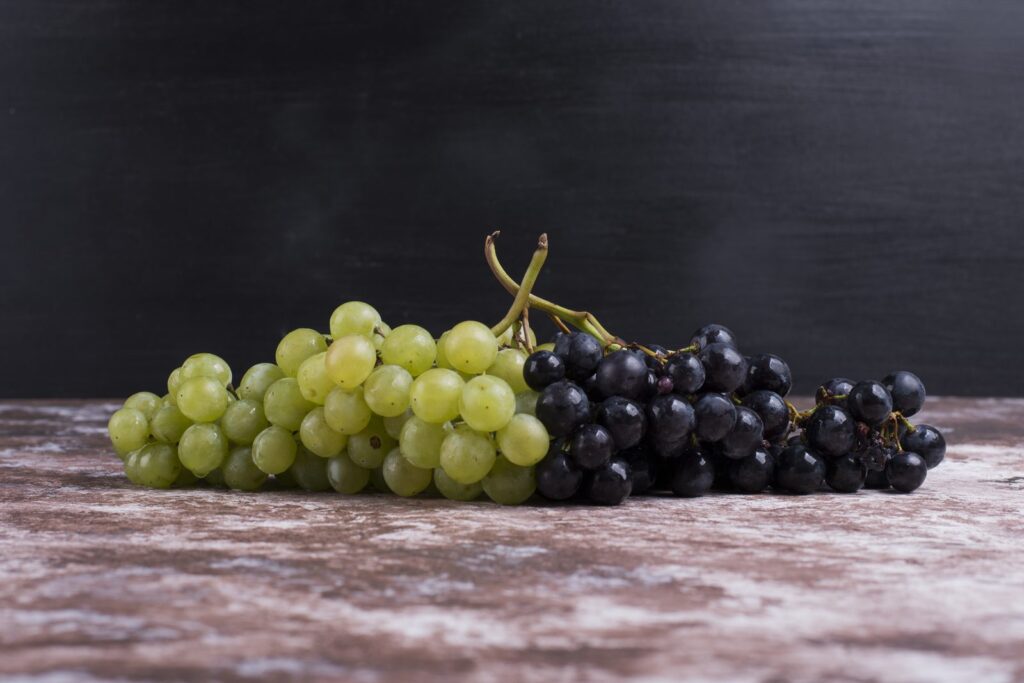
Yes, a person with diabetes can eat grapes, as long as you count the grapes. Their glycaemic index measured in people with type 2 diabetes is 43 to 49, a low GI. But grapes are one of the richest fresh fruits in sugars, 16.3 g of carbohydrate per 100 g. The right portion: about twenty grapes, roughly 100 g, which is one portion of fruit and a glycaemic load of 7 to 8. Raisins and grape juice are different products, far more concentrated.
This guide gives general benchmarks. If you are treated with insulin or with a medicine that can cause hypoglycaemia (a « hypo »), your carbohydrate amount per meal should be set with your doctor or dietitian.
What grapes contain
| For | Calories | Carbohydrate | of which fructose | of which glucose | Fibre |
|---|---|---|---|---|---|
| 10 grapes, 49 g | 35 kcal | 8.0 g | 4.0 g | 3.5 g | 0.5 g |
| 20 grapes, about 100 g | 71 kcal | 16.3 g | 8.1 g | 7.1 g | 1.1 g |
| A bowl, 151 g | 107 kcal | 24.6 g | 12.3 g | 10.7 g | 1.7 g |
The Fédération Française des Diabétiques (the French diabetes federation) defines a portion of fruit as 15 to 20 g of carbohydrate, and lists grapes among the « particularly sweet » fruits. In grapes, that portion is 100 to 120 g, or 20 to 25 grapes. The problem with grapes is not their glycaemic index, it is that they invite picking: a bowl left on the table disappears fast, and it contains one and a half portions.
Not all varieties are equal: black muscat reaches 20 g of carbohydrate per 100 g according to Ciqual, against 15.6 g for ordinary black grapes and 16.6 g for large white grapes of the Italia type.
Glycaemic index and glycaemic load of grapes
The international glycaemic index tables (Atkinson, Foster-Powell and Brand-Miller, 2008) list two measurements in people with type 2 diabetes, and one in people without diabetes:
| Study | People | Glycaemic index | Glycaemic load (120 g) |
|---|---|---|---|
| Canada | type 2 diabetes | 43 | 7 |
| Italy, 9 people | type 2 diabetes | 49 | 9 |
| Australia, black grapes, 11 people | no diabetes | 59 | 11 |
Why do grapes have a higher GI than the apple, measured at 36 in people with diabetes? The composition of their sugars explains it. In grapes, glucose makes up 46% of the sugars, 7.1 g out of 15.4 g, against 13% in the apple. Glucose has a glycaemic index of 103 and fructose of 15. Grapes also contain little fibre, 1.1 g per 100 g. For the concept of the glycaemic index, see our guide to the glycaemic index.
Work out the glycaemic load of your portion
The glycaemic load is the glycaemic index multiplied by the carbohydrate in the portion, divided by 100. With the two measurements made in people with diabetes, 43 and 49:
| Portion | Carbohydrate | Glycaemic load |
|---|---|---|
| 10 grapes, 49 g | 8.0 g | 3 to 4 |
| 20 grapes, 100 g | 16.3 g | 7 to 8 |
| 25 grapes, 120 g | 19.6 g | 8 to 10 |
| A bowl, 151 g | 24.6 g | 11 to 12 |
| A whole 300 g bunch | 48.9 g | 21 to 24 |
Up to 25 grapes, the load stays low. A whole bunch eaten in one go, on the other hand, has a high glycaemic load, above 20.
Raisins and grape juice
| Product | Carbohydrate per 100 g | Portion | Carbohydrate in the portion | Glycaemic index |
|---|---|---|---|---|
| Fresh grapes | 16.3 g | 20 grapes, 100 g | 16 g | 43 to 49 |
| Raisins | 73.2 g | a small handful, 30 g | 22 g | 56 to 66 |
| Grape juice, pure juice | 16.3 g | a 25 cl glass | about 41 g | not measured in people with diabetes |
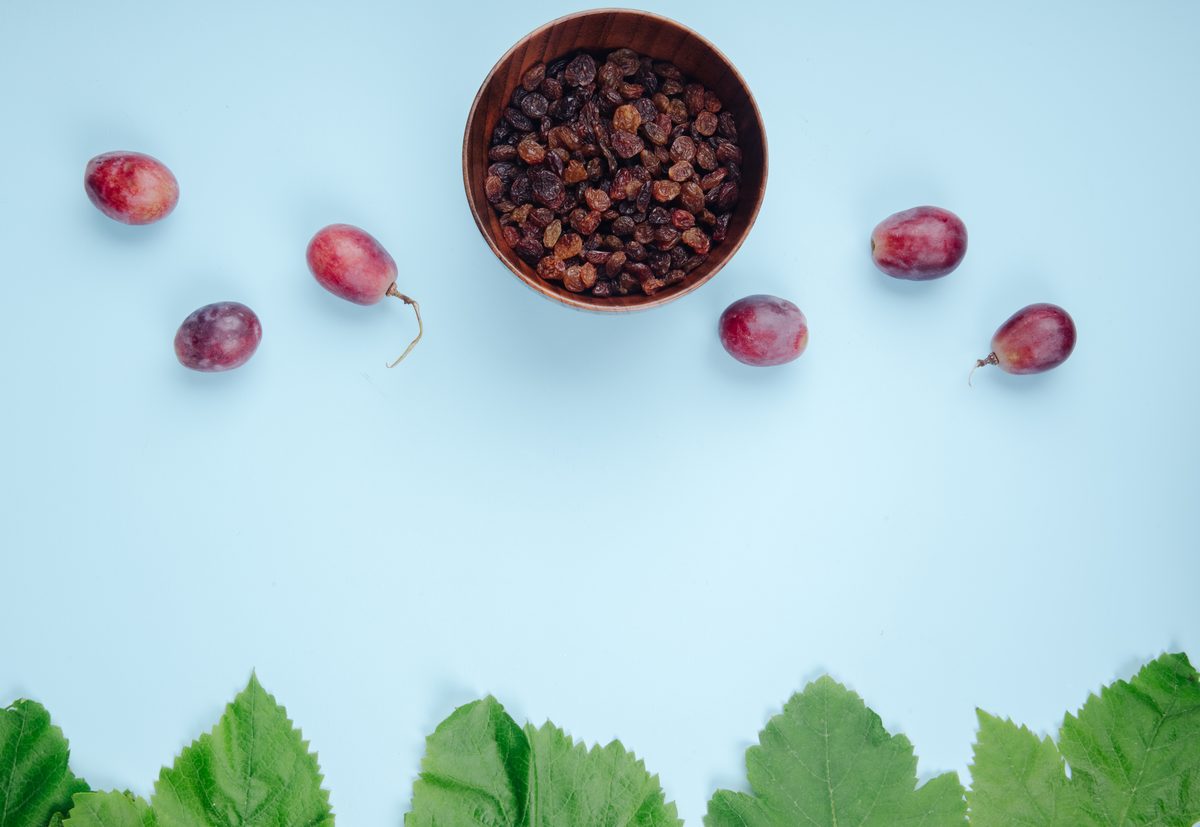
- Raisins concentrate the sugars: 73.2 g of carbohydrate per 100 g, 4.5 times more than fresh grapes. A small 30 g handful already provides more than a portion of fruit. Their GI, from 56 to 66, is moderate. If you use them, count them as a fruit: a spoonful in a yoghurt or a salad, not a packet as a snack.
- Grape juice is one of the sweetest juices: a 25 cl glass provides about 41 g of carbohydrate, more than two portions of fruit, without fibre. The Fédération Française des Diabétiques recommends avoiding fruit juice, except to correct hypoglycaemia: a small 15 cl juice is then one of the fast-acting options advised to bring blood sugar back up.
The GI of raisins, measured in people with diabetes and prediabetes
The measurements in the international tables have been supplemented by two more recent studies, which directly concern people with diabetes or at risk:
- In people with prediabetes (Kim et al., Nutrition Research, 2008), the GI of raisins was 50 in 10 adults with prediabetes, 49 in 10 sedentary adults and 62 in 11 athletes, with no significant difference between the groups. Their insulin index, the amount of insulin they trigger, was also low, around 50.
- In people with type 2 diabetes (Kanellos et al., Plant Foods for Human Nutrition, 2013), 15 people with type 2 diabetes and 15 people without diabetes ate 74 g of Corinthian raisins or 50 g of glucose. In both groups, the blood glucose peak and the insulin response were lower with the raisins. The authors estimate their GI at around 66.
Raisins therefore have a low to moderate GI, between 50 and 66 depending on the study. It is not their index that is the problem, but their density: 74 g of raisins, the amount tested in the second trial, provide 54 g of carbohydrate.
How much a day and when
One portion of grapes, 20 to 25 grapes, a day, among the day’s fruit spread over several moments, as the Fédération Française des Diabétiques advises. If you eat grapes, the other fruit of the day can be less sweet: orange, strawberries, apple.
Should you limit fruit? A Danish randomised trial (Christensen et al., 2013) in 63 people newly diagnosed with type 2 diabetes found no difference in HbA1c between the group that ate at least two pieces of fruit a day and the one that ate at most two, after 12 weeks.
Three tips against grazing
- Count your grapes and serve them in a small dish, rather than eating straight from the bunch.
- Pair them with protein or fat: a few grapes with a piece of cheese or a few walnuts, a classic that slows the absorption of sugars. For the amount of cheese, see how much cheese a day.
- Freeze a few grapes: frozen, they are eaten slowly, one at a time.
What the long-term studies say
Grapes do have a pleasant surprise in store. In the study by Muraki et al. (BMJ, 2013), which followed more than 187,000 people for up to 24 years, every three portions of grapes or raisins a week were associated with a 12% lower risk of type 2 diabetes. It was the second-best result among the fruits studied, after blueberries (26% lower), ahead of apples and pears (7% lower). By contrast, fruit juice was associated with an 8% higher risk.
An observational study does not prove that grapes protect against diabetes, but it shows there is no reason to ban them. The difference between whole fruit and juice comes up again in all these data: form is what counts.
Raisins versus snack biscuits: two 12-week trials
Two trials from the same team replaced processed snacks, biscuits and crackers, with raisins, three times a day for 12 weeks.
- In 46 adults (Anderson et al., Postgraduate Medicine, 2014), 31 in the raisin group and 15 in the biscuit group. With the raisins, blood glucose after meals fell by 13.1 mg/dL and HbA1c by 0.12 points, both larger falls than with the biscuits. Fasting blood glucose and weight did not change. Systolic blood pressure fell by 6 to 10 mm Hg depending on when it was measured.
- In 51 people with type 2 diabetes (Bays et al., Physician and Sportsmedicine, 2015), blood glucose after meals fell 23% more with the raisins than with the biscuits, and systolic blood pressure fell 8.7 mm Hg more. The fall in HbA1c, 0.12 points, was not significant in this trial, nor were the changes in weight or cholesterol.
These trials do not show that raisins lower blood sugar. They show that as a replacement for biscuits or crackers, they do no worse, and rather better. The numbers are small, and the control group ate processed products, not fruit. For a person with diabetes, the practical conclusion is simple: if you need a snack, a small handful of raisins is better than a packet of biscuits, as long as you count it as a fruit.
Grapes or another fruit
| 100 g of | Carbohydrate | Glycaemic index | Glycaemic load |
|---|---|---|---|
| Banana | 19.7 g | 48 (9 studies) | 9.5 |
| Grapes | 16.3 g | 43 to 49 (2 studies) | 7 to 8 |
| Mango | 14.3 g | 41 (1 study) | 5.9 |
| Pear | 12.3 g | 38 (4 studies) | 4.7 |
| Apple | 11.9 g | 36 (5 studies) | 4.3 |
| Orange | 8.0 g | 45 (5 studies) | 3.6 |
Grapes come just behind the banana for glycaemic load weight for weight. For other fruit, see our guides to apples and diabetes and bananas and diabetes, and our ranking of the lowest-sugar fruits.
Special cases
Gestational diabetes
Fresh grapes remain possible in a small portion, with a dairy product, within the spread of meals and snacks set by the team following the pregnancy. Raisins, measured at a GI of 66 in women with gestational diabetes, are best kept for small amounts. See our guide to eating during pregnancy.
Prediabetes
Whole grapes have their place. The change that matters most is to replace juices with whole fruit. See type 2 diabetes: diet and prevention.
Sport
For a long effort, a handful of raisins is a compact, easy-to-carry source of carbohydrate. That is actually where they are most useful. See what to eat before and after exercise.
3 ideas for eating them
- About twenty grapes and a piece of cheese, at the end of a meal.
- A green salad with a few grapes cut in half and walnuts: the grape becomes a seasoning, not a dessert.
- A tablespoon of raisins in porridge or a plain yoghurt, instead of sugar. For a recipe, see our oat and raisin cookies, to keep for occasions.
More ideas in our low glycaemic index recipes.
Our raisin cookies, in numbers
Our oat and raisin cookies are made with no added sugar: porridge oats, banana, egg, almond butter and 60 g of raisins for fifteen cookies. Calculated from Ciqual, one cookie provides:
- 10.7 g of carbohydrate, about half a portion of fruit;
- 82 kcal, 3.1 g of protein and 1.8 g of fibre.
One cookie with a plain yoghurt makes a reasonable snack. Two cookies, 21 g of carbohydrate, count as one whole fruit. The raisins account for only 4 g per cookie.

Frequently asked questions
Can someone with diabetes eat grapes?
Yes, in a portion: 20 to 25 grapes, that is 100 to 120 g, make a portion of fruit of 15 to 20 g of carbohydrate. Their GI in people with type 2 diabetes is 43 to 49.
How many grapes with diabetes?
About twenty, roughly 100 g. Ten grapes weigh about 49 g and provide 8 g of carbohydrate.
Do grapes raise blood sugar?
More than the apple, because they contain more glucose and more carbohydrate. In a 100 g portion, their glycaemic load stays low, at 7 to 8. A whole bunch goes over 20.
Are raisins allowed?
In small amounts: 30 g provide 22 g of carbohydrate, more than a portion of fruit. Use them as an ingredient, a spoonful in a yoghurt, not as a snack.
White grapes or black grapes?
Little difference: 15.6 g of carbohydrate per 100 g for black grapes and 16.6 g for large white grapes, according to Ciqual. Muscat is sweeter, at 20 g.
Is grape juice not recommended?
Not for everyday drinking: a 25 cl glass provides about 41 g of carbohydrate without fibre. It can, however, be used to correct hypoglycaemia, in a small amount.
What is the glycaemic index of raisins in someone with prediabetes?
About 50, according to a study in 10 adults with prediabetes. In people with type 2 diabetes, the GI of Corinthian raisins was estimated at around 66.
How many raisins for 15 g of carbohydrate?
About 20 g of raisins, which contain 73.2 g of carbohydrate per 100 g according to Ciqual. That is far less than a handful.
How much grape juice for hypoglycaemia?
About 9 cl of pure grape juice provides the 15 g of carbohydrate in the top-up advised by the Fédération Française des Diabétiques. A 15 cl carton provides about 24 g. Check your blood sugar 15 minutes later.
The foods and diabetes series
Glycaemic index, glycaemic load and the right portion, food by food: apples and diabetes, pears and diabetes, oranges and diabetes, bananas and diabetes, dates and diabetes, melon and diabetes, strawberries and diabetes, pineapple and diabetes, cheese and diabetes, mango and diabetes, honey and diabetes, dark chocolate and diabetes, lentils and diabetes, potatoes and diabetes, avocado and diabetes, porridge oats and diabetes, bread and diabetes, kiwi and diabetes, sweet potatoes and diabetes, rice and diabetes.
Going further
Apples and diabetes, bananas and diabetes, type 2 diabetes: diet and prevention, glycaemic index, nutrition facts for grapes.
Our sources
- Atkinson FS, Foster-Powell K, Brand-Miller JC. International Tables of Glycemic Index and Glycemic Load Values: 2008. Diabetes Care, 2008.
- Muraki I et al. Fruit consumption and risk of type 2 diabetes: results from three prospective longitudinal cohort studies. BMJ, 2013.
- Christensen AS et al. Effect of fruit restriction on glycemic control in patients with type 2 diabetes, a randomized trial. Nutrition Journal, 2013.
- Fédération Française des Diabétiques: fruit portion, « particularly sweet » fruits, fast-acting carbohydrate for hypoglycaemia.
- Ciqual 2025 table (Anses): raw grapes, raisins, grape juice; USDA FoodData Central, SR Legacy: grape weights.
- Kim Y, Hertzler SR, Byrne HK, Mattern CO. Raisins are a low to moderate glycemic index food with a correspondingly low insulin index. Nutrition Research, 2008. PMID 19083424.
- Kanellos PT, Kaliora AC, Liaskos C et al. A study of glycemic response to Corinthian raisins in healthy subjects and in type 2 diabetes mellitus patients. Plant Foods for Human Nutrition, 2013. PMID 23564595.
- Anderson JW, Weiter KM, Christian AL, Ritchey MB, Bays HE. Raisins compared with other snack effects on glycemia and blood pressure: a randomized, controlled trial. Postgraduate Medicine, 2014. PMID 24393750.
- Bays H, Weiter K, Anderson J. A randomized study of raisins versus alternative snacks on glycemic control and other cardiovascular risk factors in patients with type 2 diabetes mellitus. The Physician and Sportsmedicine, 2015. PMID 25609549.
- Fédération Française des Diabétiques, « Hypoglycémie »: top-up of 15 g of carbohydrate, check at 15 minutes. Site recipe: oat and raisin cookies, values calculated from Ciqual.