Healthy snacks: what to eat between meals

A healthy snack is a planned bite, eaten because you are hungry or because there is a long gap before your next meal, and made up of foods that the official guidelines encourage. When you are hungry between meals, Manger Bouger, the Santé publique France website, advises fresh fruit or a small handful of unsalted nuts; plain dairy or wholegrain bread also fit these guidelines. The problem is not the snack: it is mindless nibbling when you are not hungry, in front of a screen, on fatty, sugary or salty products.
👉 Free tool: Calorie needs – calculate in 30 seconds, no sign-up.
Snack, afternoon snack, nibbling: three different things
Manger Bouger draws a clear distinction. Nibbling is eating outside meals, often without being hungry, at any time of day. The afternoon snack (the French “goûter”) is a structured snack that helps tide you over until dinner, especially for children and teenagers.
The triggers for nibbling identified by Manger Bouger are meals that are not filling enough, stress, boredom, and sedentary activities such as watching television or using a computer, often accompanied by fatty, salty, sugary or ultra-processed products and sugary drinks. The solutions it suggests are practical:
- keep to a rhythm of three meals a day and take the time to eat;
- include foods rich in fibre in those meals, such as pulses and wholegrain starchy foods;
- plan your menus for the week;
- move more and sit less, replacing screens with other activities.
A snack is therefore not compulsory. It has its place when hunger is real, when the gap between two meals is long, around a workout, or for children’s afternoon snack.
Does a snack make you put on or lose weight?
Neither can be claimed. In 2024, the scientific committee responsible for the US dietary guidelines reviewed the studies on meal and snack frequency. Its conclusion for adults: no conclusion can be drawn on the link between snacking and total energy intake. The five available trials involved people with overweight following a weight-loss programme and cannot be generalised. The same applies to children, owing to a lack of consistent data.
What matters, then, is what you eat and the place it takes in your day. A snack that replaces part of a meal changes nothing in the total; a snack added on top of full meals does. To fine-tune this, our calorie needs tool gives an idea of your energy expenditure.
The case of nuts
Almonds, walnuts and hazelnuts are very high in calories (over 600 kcal per 100 g according to Ciqual), and yet eating them is not associated with a higher body weight. A 2023 meta-analysis (27 studies, 1,121 participants) looked into why. It points to compensation: part of the calories in nuts is made up for by eating less afterwards, to a highly variable extent depending on the form (whole or chopped) and the context (alone or as part of a meal). However, it finds no significant increase in resting energy expenditure. This is one of the arguments that make the “small handful” a good snack choice. Quantities are detailed in our guides how many almonds a day and how many walnuts a day.
Putting together a good snack
The Santé publique France guidelines (PNNS 2019) provide the framework. Pick from these groups rather than from the biscuit and sweet aisles:
- A piece of fresh fruit: it counts towards the “at least 5 fruit and vegetables a day”. An adult portion is 80 to 100 g, roughly the size of your fist: an apple, two apricots, four or five strawberries, a banana.
- A small handful of nuts: walnuts, hazelnuts, almonds, pistachios, unsalted, unsweetened and chocolate-free, recommended once a day.
- A dairy product: a plain yoghurt, a glass of milk, a 30 g piece of cheese. Manger Bouger recommends 2 a day for adults and 3 for children and teenagers.
- A wholegrain starchy food: a slice of wholemeal bread, a few rolled oats.
- Water: the only recommended drink; sugary drinks should be limited to one glass a day at most.
Combining two of these groups, for example a piece of fruit and a handful of almonds, or a yoghurt and a slice of wholemeal bread, gives a snack that provides fibre, protein or good fats all at once. The foods that keep you full best are detailed in our guide to natural appetite suppressants.

The numbers: simple snacks versus processed products
| Snack | Portion | Energy | Sugars | Fibre | Protein |
|---|---|---|---|---|---|
| Apple | 150 g | 81 kcal | 15.9 g | 2.1 g | 0.4 g |
| Banana | 120 g | 105 kcal | 18.7 g | 3.2 g | 1.3 g |
| Almonds | 30 g | 184 kcal | 1.3 g | 3.8 g | 5.6 g |
| Walnuts (kernels) | 20 g | 142 kcal | 0.6 g | 1.3 g | 2.7 g |
| Plain yoghurt | 125 g | 63 kcal | 5.0 g | traces | 4.8 g |
| Fromage frais 2-3% fat | 100 g | 76 kcal | 3.9 g | 0 g | 7.3 g |
| Hard-boiled egg | 50 g (1 egg) | 67 kcal | 0.3 g | 0 g | 6.8 g |
| Raw carrot sticks | 100 g | 30 kcal | 4.8 g | 2.9 g | 0.8 g |
| Chocolate biscuit bar | 50 g | 246 kcal | 21.6 g | 1.9 g | 2.8 g |
| Plain biscuit with a chocolate square | 30 g | 146 kcal | 12.2 g | 1.1 g | 1.7 g |
| Fruit cereal bar | 25 g | 95 kcal | 7.4 g | 0.9 g | 1.4 g |
| Sugary cola | 33 cl | 132 kcal | 33.0 g | 0 g | 0 g |
Three lessons. First, for comparable calories, an apple or a banana gives more fibre than a cereal bar or a chocolate biscuit. Second, almonds are high in calories but rich in protein and fibre, and almost free of sugars. Finally, a can of cola provides 33 g of sugars with no fibre at all, which is a third of the 100 g of sugars a day that Anses recommends adults do not exceed (excluding lactose and galactose). The sugars in fruit count towards this total too: that is a reason to prefer whole fruit to juice, not to cut out fruit. To go further: how much sugar a day and hidden sugar.
Five snack combinations with the numbers
Here is what a few simple pairings give, calculated with the same Ciqual values. They show that you can build a snack of 100 to 250 kcal that provides fibre or protein, with no processed product.
| Combination | Energy | Protein | Fibre |
|---|---|---|---|
| 1 apple (150 g) + 30 g of almonds | 265 kcal | 6.0 g | 5.9 g |
| 1 plain yoghurt (125 g) + 40 g of wholemeal bread | 156 kcal | 8.3 g | 2.9 g |
| 100 g of fromage frais 2-3% fat + 1 banana (120 g) | 181 kcal | 8.6 g | 3.2 g |
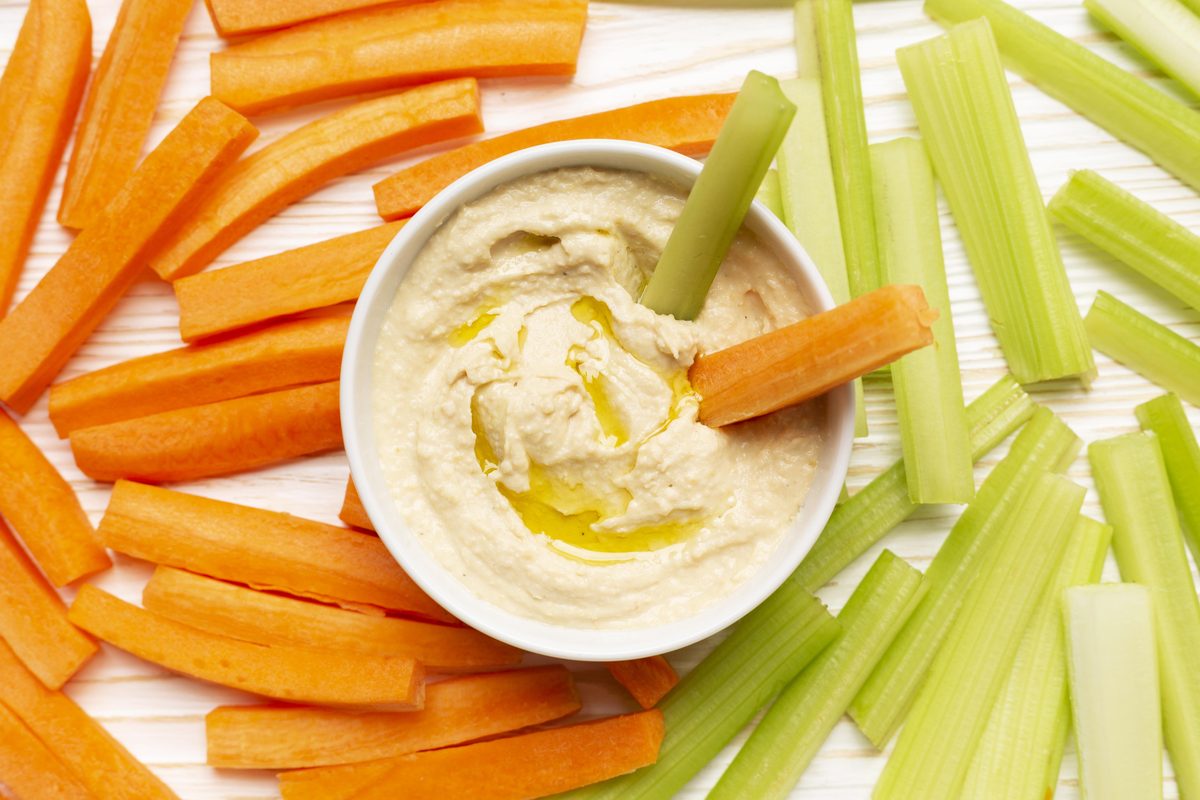
| 100 g of carrot sticks + 50 g of shop-bought hummus | 159 kcal | 4.8 g | 5.5 g |
| 1 hard-boiled egg (50 g) + 150 g of cucumber | 92 kcal | 7.8 g | 0.8 g |
If you exercise, the International Society of Sports Nutrition (ISSN) puts the effective protein intake for muscle synthesis at 20 to 40 g per serving. None of these snacks gets there on its own: they complement meals, they do not replace them. Richer options are in our guides highest-protein foods and nutrition for muscle gain.
Watch the salt in savoury snacks
The “unsalted” choice recommended by Manger Bouger makes a big difference. According to Ciqual, roasted salted pistachios contain 664 mg of sodium per 100 g, against 7.7 mg with no added salt; roasted salted almonds 380 mg, against less than 5 mg for plain almonds with skin. Shop-bought hummus contains 472 mg per 100 g. Homemade hummus lets you control the salt yourself.
Preparing snacks in advance
Manger Bouger advises planning your menus for the week: it is also the best way to avoid the bar bought from a vending machine. A few simple habits: keep seasonal fruit visible on the table, a bag of unsalted nuts in your bag, plain yoghurts in the fridge, and make a batch of homemade bars or crackers on Sunday. Our batch cooking guide gives the method for organising the week.
Ideas for every occasion
Before exercise
A banana, a few dates or date, almond and cocoa energy balls provide easy-to-carry carbohydrate. Timing guidelines are in our guide what to eat before and after exercise.
After exercise
The NATA, the US athletic trainers’ association, advises eating and drinking within 2 hours of the activity to replace water, electrolytes, carbohydrate and protein. A yoghurt, granola and fruit parfait, a banana and cocoa recovery shake or a chocolate protein mug cake will do the job. More ideas in our guide to protein snacks.
At snack time
Banana and oat cookies, oat and banana bars with no added sugar or homemade cereal bars. For children, homemade apple compote or fresh fruit skewers with a glass of milk.
At the office
A skyr, fruit and nut bowl prepared the night before, a fromage frais and banana toast, or simply a piece of fruit and a handful of almonds kept in your drawer.
With drinks
A homemade hummus with carrot and cucumber sticks, chickpea crackers, spiced roasted chickpeas, a yoghurt, cucumber and herb dip or steamed edamame. Chickpeas are pulses, which Manger Bouger advises eating at least twice a week.
For more ideas, browse our healthy recipes and our protein recipes, or the fruit family to mix things up.
Homemade or shop-bought: read the label
Homemade lets you control sugar, salt and fat, and avoid ultra-processed products with lots of additives, Manger Bouger reminds us. When you buy a ready-made snack, three habits help:
- The Nutri-Score: Manger Bouger recommends limiting products rated D and E, and using it to compare products from the same aisle. See Nutri-Score in our glossary.
- The ingredients list: Manger Bouger advises limiting additives, recognisable by their code starting with E. Our guide to decoding food labels helps you read it.
- Sugars per 100 g: according to Ciqual, a fruit cereal bar contains 29.6 g of sugars per 100 g, a chocolate biscuit bar 43.3 g. A “balance” bar is not necessarily low in sugar.
On protein bars, our comparison of protein bars put 82 products under the microscope. And if you love chocolate, dark chocolate is best eaten in small amounts: our guide how much dark chocolate a day gives the guidelines.
Children’s afternoon snack
For Manger Bouger, the afternoon snack helps children and teenagers tide themselves over until dinner. A few official guidelines apply directly:
- 3 dairy products a day during childhood and adolescence: the afternoon snack is a good time for one of them.
- No more than half a glass of fruit juice or sugary drink a day before the age of 11.
- Whole nuts should not be given before the age of 6, because of the choking risk: offer them ground in preparations.
- Introduce sugary products as late as possible and in limited amounts.
An example of a snack that ticks these boxes: a glass of milk, a slice of wholemeal bread and a piece of fruit. Our guide to children’s nutrition adds to these guidelines.
Myths about snacks
“Eating between meals necessarily makes you put on weight”
The data do not allow us to say so: the 2024 review draws no conclusion on the link between snacking and energy intake in adults. It all depends on what you eat and what it replaces.
“You need to eat every three hours to kick-start your metabolism”
None of the sources consulted shows this. Manger Bouger recommends three meals a day, and the 2024 review cannot conclude on the number of eating occasions. If you are not hungry between meals, there is no need to eat.
“A fruit juice is as good as a piece of fruit”
No. Manger Bouger specifies that a fruit juice, whatever it is, does not count as a portion of fruit: it is very sugary and low in fibre. A 200 ml glass of orange juice contains 19.2 g of sugars according to Ciqual, and almost no fibre.
“Dried fruit is the same as fresh fruit”
They keep the fibre but concentrate the sugars: 64.7 g per 100 g of dried dates and 70.3 g per 100 g of raisins, against 10.6 g for apples according to Ciqual. As a guide, 30 g of dates provide 86 kcal and 19.4 g of sugars according to Ciqual.
“Diet drinks are a good alternative”
They provide very few calories, but Manger Bouger notes that they keep up the taste for sweetness and also advises limiting them. Water remains the reference drink between meals.
Frequently asked questions
What is the best snack to stop you feeling hungry?
When you are hungry, Manger Bouger advises a piece of fresh fruit or a handful of unsalted nuts. Combining a piece of fruit with almonds, or a yoghurt with wholemeal bread, provides fibre, protein and good fats. If hunger keeps coming back, look at your meals first: meals that are not filling enough are a cause of nibbling.
How many calories should a snack have?
There is no official guideline. In our table, simple snacks range from 30 kcal (carrots) to 184 kcal (30 g of almonds). What matters is that it fits within your intake for the day.
Is an evening snack a bad idea?
None of the sources consulted sets a forbidden time. The problem is nibbling when you are not hungry in front of a screen, which Manger Bouger cites as a classic trigger. A plain yoghurt or a piece of fruit remain good choices if you are hungry.
Are cereal bars healthy?
It depends: according to Ciqual, a fruit cereal bar contains around 30 g of sugars per 100 g. Compare Nutri-Scores, read the ingredients list, or make them yourself, like our oat and banana bars with no added sugar.
What snack for a child?
A dairy product, a piece of fruit and a starchy food, for example a glass of milk, a slice of bread and an apple. No whole nuts before the age of 6, and no more than half a glass of juice or sugary drink a day before the age of 11.
This article is for information only and does not replace the advice of your doctor or a dietitian.
Our sources
- Santé publique France, Manger Bouger. How to avoid snacking between meals? (in French)
- Santé publique France, Manger Bouger. PNNS 2019 recommendations: eat more fruit and vegetables; eat more unsalted nuts; eat more pulses; aim for a sufficient but limited consumption of dairy products; cut down on sugary drinks and on fatty, sugary, salty and ultra-processed foods (in French).
- Andres A, Giovannucci E, Fisher JO et al. Frequency of Meals and/or Snacking and Energy Intake: A Systematic Review. USDA Nutrition Evidence Systematic Review, 2025 Dietary Guidelines Advisory Committee, 2024. PMID 39812565.
- Nikodijevic CJ, Probst YC, Tan SY, Neale EP. The Effects of Tree Nut and Peanut Consumption on Energy Compensation and Energy Expenditure: A Systematic Review and Meta-Analysis. Advances in Nutrition, 2023. PMID 36811596.
- Anses. Sugars in the diet: recommendation not to exceed 100 g of total sugars a day for adults, 2016 opinion (in French).
- McDermott BP, Anderson SA, Armstrong LE et al. National Athletic Trainers’ Association Position Statement: Fluid Replacement for the Physically Active. Journal of Athletic Training, 2017. PMID 28985128.
- Anses. Ciqual food composition table (in French), 2025.
Further reading
Food pages: Banana, Chickpea, Hummus, Oats, Almond
Recipes to try: Banana and almond porridge, Oat and raisin cookies, Chocolate and banana overnight oats


